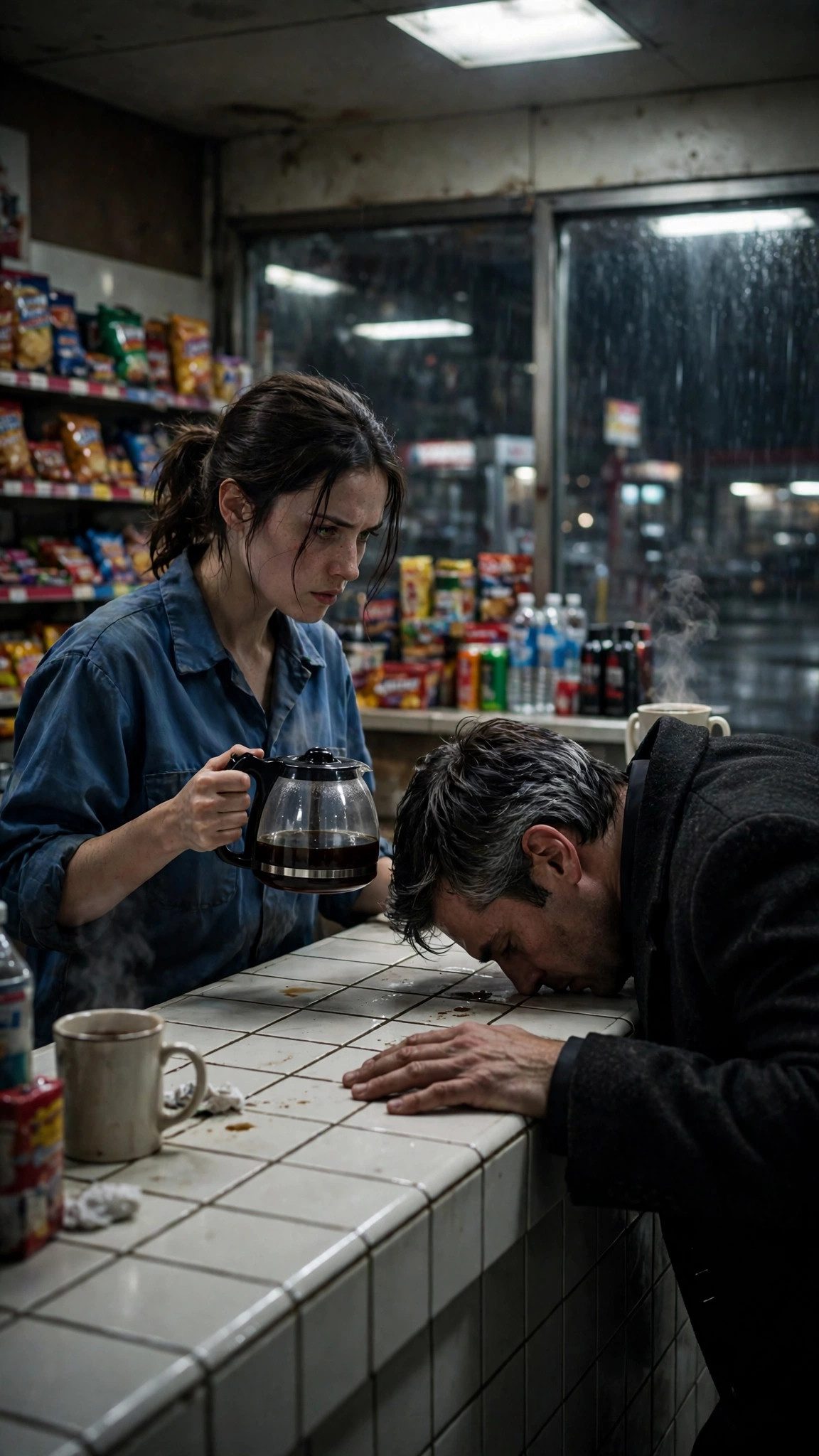
The pot was still in my hand when I moved.
I didn't think. Thinking would have taken too long, and the moment my father had told me about doesn't wait for thought. It waits for the hand that is already moving.
I swung the glass pot in a short, hard arc and threw the scalding coffee straight into the leader's face.
He screamed. The sound tore out of him, raw and animal, and his pistol went off as his hand clenched — but the barrel was pointed at the ceiling, and the shot punched a hole through the acoustic tile and sent white dust raining down over the cigarette rack. The two truckers shouted. Earl rolled behind the table. Marcus pressed himself flat against the coolers.
The leader staggered back, both hands clawing at his face, the coffee dripping from his chin, his eyes squeezed shut against the burn. His pistol clattered to the floor and skidded under the shelf of motor oil.
And then my other hand was already moving, because my father's voice was in my ear again — don't rush the shot, wait for the moment — and my hand found the grip of the pistol in Carmine Zito's holster, and I pulled it free.
It was heavier than I expected. Heavier than the practice pistol my father had let me hold at the range when I was seventeen. The metal was cold, and my palm was sweating, and for one terrible second I thought it would slip out of my hand and everything would be over.
Then Carmine moved.
He moved like a man who had been waiting for exactly this second. His arms came free as the two men holding him turned toward the screaming leader, and he drove his elbow back into the ribs of the one on his left, hard enough that the man folded with a sound like air leaving a tire. He turned, caught the second man's wrist, and twisted until the pistol in that man's hand dropped onto the counter and slid across the tile to stop against the register.
"Carmine!" I shouted, and I didn't know why I shouted his name, except that it was the only name in the room that meant safety.
He turned toward me, and his eyes found the pistol in my shaking hands, and he did something I did not expect. He smiled. Not a cruel smile. A small, sharp smile, the smile of a man who has just discovered that the person standing next to him is not who he thought she was.
"Give it to me," he said, calm as still water. "Slowly. Finger off the trigger. Just like that."
I held it out, grip first, the way my father had taught me to hand a loaded weapon to another person — never by the barrel, never carelessly, always with respect for what it could do. Carmine took it, checked it with one practiced glance, and turned back toward the room.
The leader was still clawing at his face, blind and screaming. The man with the hurt ribs was on his knees, gasping. The fourth man — the one who had locked the door — was frozen halfway between the door and the counter, his own pistol half out of his jacket, his eyes wide, trying to decide whether to run or fight.
"Don't," Carmine said to him, and the word landed like a door closing. "You have three seconds to put that back. One."
The man's hand stopped.
"Two."
The pistol slid back into his jacket. His hands came up, empty, palms out.
"Good choice," Carmine said. "Now sit down. All of you. On the floor. Hands where I can see them."
They sat. Even the leader, still weeping coffee from his burned eyes, sank to the floor with his back against the shelves, his hands in his lap. The man with the hurt ribs sat beside him, breathing in short, shallow gasps. The fourth man sat by the door, his hands on his knees, staring at nothing.
Carmine looked at me. "Are you hurt?"
I shook my head. I couldn't speak. My whole body was shaking now, the way a body shakes after the danger has passed and it finally has permission to be afraid. My knees felt like water. I put one hand on the counter to hold myself up, and the counter was solid, and that helped.
"You're shaking," he said.
"I know."
"That's normal," he said, and he said it the way my father used to say it, like a fact and not a judgment. "It means you're still here."
Outside, through the front window, headlights swept across the lot. Two black cars pulled in fast, and men got out — four of them, moving quickly, and at the front of them was Carmine's driver, Tony, a short, broad man with graying hair and a face like a closed fist. He had a phone in one hand and a pistol in the other, and he went straight for the door.
"It's locked," I called out, and my voice sounded far away. "The lock. One of them locked it."
Tony tried the handle, swore, and then one of the other men produced a key — or a tool, I couldn't see which — and a moment later the door swung open and Tony was inside, his pistol sweeping the room, his eyes finding Carmine first, then me, then the four men on the floor.
"Boss," Tony said, and the relief in his voice was so plain it was almost embarrassing. "Boss, are you—"
"I'm fine," Carmine said. "Thanks to her."
Tony looked at me. He looked at the broken coffee pot on the floor. He looked at the leader, whose face was red and blistering, and at the cup of coffee still sitting on the counter, steam curling up from it, untouched.
"She did that?" Tony said.
"She did that," Carmine said.
One of Tony's men was already on the phone, calling the police, his voice low and professional. Another was gathering the fallen pistols, handling them with a cloth, careful, practiced. Tony himself went to the truckers, crouching beside Earl, asking if they were hurt, telling them to stay down, that it was over.
It wasn't over. I knew that even then, shaking behind the counter, because I could hear the sirens in the distance, growing louder, and I knew that sirens meant questions, and questions meant police, and police meant that this night was going to last a very long time.
But for one moment, standing there with the smell of coffee and gunpowder in the air, I let myself breathe.
Carmine walked back to the counter and picked up the cup I had poured for him. He lifted it to his lips and took a slow sip. Black coffee. Just the way he liked it.
"Good coffee," he said. "Strong. You make good coffee, Gemma."
He knew my name. I didn't know how he knew my name. Maybe he had read it on the stitched patch on my uniform. Maybe Tony had told him. It didn't matter. Hearing him say it — my name, in that low, even voice, in this room full of broken glass and spilled coffee — felt like someone had finally noticed me after six years of being invisible.
"Thank you," I said, and my voice came back, small but steady.
"No," Carmine said. "Thank you."
Tony came back inside then, and he went straight to Carmine, and the two of them spoke in low voices, too low for me to hear, but I saw Tony's face, and I saw the way his shoulders dropped when Carmine nodded, and I understood that whatever Tony had been afraid of — that he had been too late, that he had failed — was over now.
Then Tony came to me. He was a short, broad man, with graying hair and hands like slabs of stone, and he looked at me the way a man looks at someone he owes something to.
"I was behind the hood," he said. "When they walked in, I was checking the oil, and I saw them through the window, and I knew. I slipped around the back of the car and I called the boys, and I moved the sedan to block their car in the lot. I was never going to leave him. I've driven for Carmine Zito for twelve years, and I have never once left him."
"I know," I said. "I saw you disappear. I didn't know where you went."
"Now you know," Tony said, and he nodded toward the men on the floor. "And those men — they won't be a problem anymore. Not tonight. Not ever."
One of Tony's men was gathering the fallen pistols, handling them with a cloth, careful and practiced, the way a man handles something that could hurt him if he is careless. Another was standing by the door, watching the lot. A third was crouching beside Earl, asking if he was hurt, telling him to stay down, that it was over.
Earl got up slowly, holding onto the table, and Marcus got up beside him, and they looked at each other, and then they looked at me, and Earl said, "Girl, are you all right?"
"I think so," I said, but my voice shook, and my knees shook, and I had to put both hands on the counter to hold myself up. The shaking had started in my hands, and now it was everywhere — in my arms, in my legs, in my chest — the way a body shakes after the danger has passed and it finally has permission to be afraid.
"That's the adrenaline," Marcus said. "It'll pass. It always passes. You just have to breathe through it."
I breathed. In, out. In, out. The way my father had taught me. And slowly, the shaking eased, until it was only in my fingertips, and then it was gone.
Carmine was watching me. He had finished his coffee, and he set the cup down, and he looked at the broken glass on the floor, and the spilled coffee, and the men on the floor, and the hole in the ceiling where the leader's pistol had gone off, and he shook his head, once, like a man adding up a bill he hadn't expected.
"Your manager," he said. "The one in the office. He locked himself in."
"Yes," I said.
"Did he call for help?"
"No," I said. "He just locked the door."
Carmine was quiet for a moment, and then he said, "Some men run toward trouble. Some men run away from it. And some men lock the door and pretend the trouble isn't there. I've met all three kinds. The third kind is the worst, because they always come back and say they were helping."
I thought about Dale, sitting in his office, listening to the gunshot and the screaming through the steel door, and I thought about the way he had looked at me when he told me to stop acting like I was worth more than the job, and I felt something cold and hard settle in my chest. It wasn't fear. It was something else. Something that would keep.
Outside, through the window, I could see the first police car turning into the lot, its lights washing across the pumps, and behind it another, and behind that an ambulance, and I thought of my father, who had spent twenty-three years driving toward lights like that, and I thought of the night he had told me that fear was normal but it couldn't make every decision for you.
I had made my decision. I had taken the moment. And whatever came next, I would face it the same way.
One cup at a time.
I looked at the four men on the floor, and I thought about what my father would have written in his notebook about this night. He had a way of writing about bad nights — not the fear, but the facts. The time. The place. The people. The choices. He used to say that a crime scene is a story, and if you write down the facts carefully enough, the story tells itself. I looked at the leader, his face red and blistering, and at the man with the hurt ribs, and at the one by the door, and I thought: 3:14 A.M. A gas station outside the city. Four men. One cup of coffee. And a girl who decided not to be afraid.
The sirens were close now. Red and blue light washed across the front windows, painting the shelves and the floor in alternating colors. Through the glass I could see two police cars pulling into the lot, and behind them an ambulance, its lights turning, and I thought of my father, who had spent twenty-three years driving toward lights like that, and I thought of the night he had told me that fear was normal but it couldn't make every decision for you.
I had made my decision. I had taken the moment. And whatever came next — the police, the questions, the men on the floor, the man in the office who had locked himself away — I would face it the same way.
One cup at a time.
The front door opened, and the night air came in, cold and clean, and a police officer stepped inside with his hand on his holster and his eyes moving across the room, taking in the broken glass, the men on the floor, the blood on the leader's cheek where the hot coffee had split the skin, and me, standing behind the counter in my oversized blue uniform, shaking and holding onto the counter like it was the only solid thing in the world.
"Who's in charge here?" the officer asked.
Carmine set the coffee cup down, gently, like it mattered. "She is," he said, and he nodded toward me. "Ask her. She saw everything."
And for the first time in six years, in a gas station on a highway outside the city at three-fourteen in the morning, with four hitmen sitting on my floor and a mafia boss drinking my coffee, somebody looked at me — really looked at me — and waited for what I had to say.