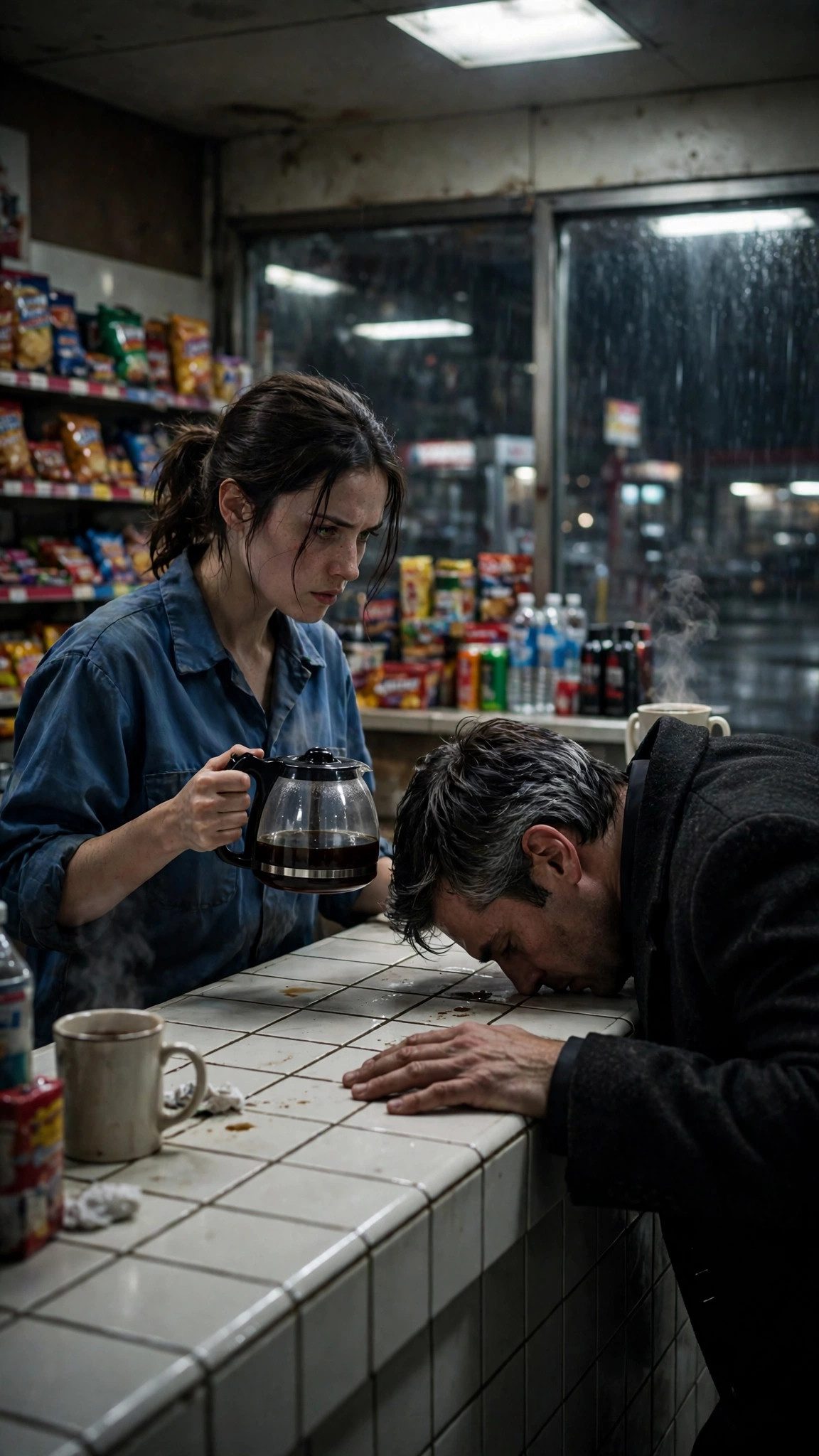
I went back to work the next night.
People asked me later why I did that — why I went back to the same gas station, to the same counter, to the same manager who had locked himself in his office and left me to die. The truth is simpler than anyone wants it to be. I needed the paycheck. My father's medicine cost more every month, and the house payment didn't care that I had thrown a coffee pot at a hitman. The world doesn't stop because you had a bad night. It just keeps turning, and you either turn with it or you get left behind.
Dale was already there when I arrived, sitting in his office with the door open, watching me the way he always watched me — except now there was something different in his eyes. Fear. He kept glancing at the door. He kept checking his phone. He jumped when the bell over the entrance rang.
"Gemma," he said, when I walked past his office. "Can I see you for a minute?"
I stopped. I didn't go in. I stood in the doorway, where I could still see the counter and the door, and I waited.
"I just want you to know," Dale said, "that what happened last night — I was calling for help. I was on the phone with the police the whole time. You have to believe me."
"The police arrived eleven minutes after the first shot," I said. "Somebody called them. It wasn't you."
His face went pale. "How do you know that?"
"Because I was the one standing behind the counter," I said. "I heard everything. And I saw you step backward and turn the deadbolt with your own hand."
Dale's mouth opened and closed. He looked like a fish on a dock. "Gemma, listen. You don't understand. There are things about this job you don't know. Things I can't explain."
"Then explain them," I said.
He didn't. He looked down at his desk, at his phone lying face-up beside his coffee mug, and his hand twitched toward it, like he wanted to pick it up and hide it.
That was when I knew. I didn't know what, exactly — but I knew his phone mattered. A guilty man always reaches for the thing that can hurt him.
I went back to the counter and started my shift, and for the next two hours I watched Dale out of the corner of my eye. He checked his phone constantly. He deleted things. He typed with both thumbs, fast and nervous, and every time the bell over the door rang, he flinched.
At eleven o'clock, Dale went to the bathroom. He left his phone on his desk, face-down, and the office door open, and I thought about my father, who had taught me that evidence doesn't walk up to you and introduce itself. Sometimes you have to go and get it.
I walked into the office, picked up Dale's phone, and turned it over.
The screen lit up. No lock. Dale was the kind of man who thought a locked office door was enough security.
I opened his messages. The most recent one was from a number with no name, just digits, and it had been sent at 3:11 A.M. — three minutes before the hitmen walked through my door.
The message said: "Black sedan here."
And below it, Dale's reply, sent at 3:11 A.M.: "He's inside. Alone at the counter. Go now."
My hands went cold. I scrolled up. There were more messages, going back weeks. Every Thursday night, the same pattern. A message from the number: "Is he here?" And Dale's reply: "Not yet." Or: "Here now." Or: "Leaving in ten."
The last message before tonight's was from the number, sent at 2:58 A.M.: "Tonight. Make sure the girl is on shift. The one with the ponytail. She'll be useful."
Useful. That's what I was to them. Not a person. A tool. A piece of the plan.
I heard the bathroom door open down the hall. I put the phone back on the desk, face-down, exactly where I had found it, and I walked out of the office and back to my counter, and I stood there with my hands flat on the tile, breathing slowly, the way my father had taught me to breathe when the adrenaline was too much.
Dale came back, sat down, picked up his phone, and went back to typing. He didn't notice anything. Men like Dale never notice anything until it's too late.
I finished my shift at six in the morning, and I drove home, and I sat in my car in the driveway for a long time, staring at the white card Carmine had given me. The phone number was written in black ink, in a neat, careful hand. No name. Just the number.
I called it.
A man answered on the second ring. "Yes?"
"My name is Gemma Boon," I said. "I work at the gas station. Mr. Zito gave me this number. I need to speak with him."
"Hold on," the man said. There was a pause, and then a different voice, low and even, the voice from the counter.
"Miss Boon," Carmine said. "Is something wrong?"
"I found something," I said. "On my manager's phone. He was texting someone. Every Thursday night. He told them when you were here."
There was a silence on the other end of the line. Not a surprised silence. A considering silence, the silence of a man who has just had a suspicion confirmed.
"Can you bring me the phone?" Carmine asked.
"I didn't take it," I said. "I put it back. But I remember the number. And I remember what the messages said."
"Tell me," he said.
I told him. I told him about the messages, about the pattern, about the last one — "Make sure the girl is on shift. The one with the ponytail. She'll be useful."
"Useful," Carmine repeated, and his voice had gone cold in a way that made me glad I was on the phone and not in the room with him. "Thank you, Miss Boon. You've done more than you know. I'm going to send someone to get that phone. Don't go back to the station tonight. Do you understand? Don't go back."
"But my shift—"
"Your shift is over," he said. "For now. I'll take care of your manager. And I'll take care of the rest."
He hung up, and I sat in my car, and the sun was coming up over the roof of my father's house, and I thought about Dale sitting in his office, typing with both thumbs, and I thought about the men on my floor, and I thought about the word useful, and I felt something in my chest that I hadn't felt in a long time.
It wasn't fear. It was anger.
I thought about my father's case notebooks while I sat in the car. He had kept them for twenty-three years, one for every year on the job, stacked on a shelf in his study, the covers worn and the pages full of his careful handwriting. When I was a girl, I used to read them when he wasn't looking — not the sad parts, but the parts where he wrote about how he had figured something out. "The suspect always returns to the scene," he had written once, in the margin of a notebook from 1998. "Not because he's stupid. Because he can't help himself. A crime is a story, and the criminal always wants to know how the story ends."
I had never understood that note until now. Sitting in my car, staring at the white card, I understood it perfectly. Dale would come back to his office. Falco would come back to the station. They always came back. And when they did, I would be waiting.
That afternoon, while my father slept in his chair, I drove back to the station. Not to work. To watch. I parked across the highway, where the trees gave me cover, and I waited.
At three o'clock, a black car pulled into the lot. Not Carmine's sedan. A different car, darker, with tinted windows. Two men got out — Tony, Carmine's driver, and another man I didn't recognize, tall and broad with a scar on his jaw. They walked into the station, and a few minutes later they walked out again, and between them was Dale, his face white, his hands empty, his tie gone. They put him in the back of the car, gently, the way you put a man in a car when you don't want to hurt him yet, and the car pulled out of the lot and onto the highway, and it was gone.
I drove home, and I sat with my father, and I waited for the phone to ring.
It rang at nine o'clock that night. Carmine's voice, low and even.
"Miss Boon. The phone is in my hands. Your manager has told us everything. The number belongs to a man who works for Vincent Falco."
"Who is Vincent Falco?" I asked.
"My capo," Carmine said. "My right hand. For fifteen years. He hired the men who came to your station. He paid your manager five hundred dollars a week to report my movements. He wanted my seat, Miss Boon. He wanted what I have. And he was willing to kill me in a gas station at three-fourteen in the morning to get it."
"And the leader?" I asked. "Rook?"
"Rook is talking now," Carmine said. "He wasn't so brave when he realized nobody was coming to save him. He told us everything. Falco hired him. Falco gave him the address. Falco told him about the girl on shift, the one with the ponytail, and said she would be useful."
"Useful for what?"
There was a pause. "As a witness," Carmine said. "Falco wanted a witness. He wanted someone to see me die and tell the world that Carmine Zito died on his knees in a gas station, begging for his life. He wanted my death to be a story. He didn't count on the witness being you."
I didn't know what to say to that. I sat in the dark kitchen with the phone against my ear, listening to my father's breathing from the next room, and I thought about the man who had looked at me across the counter and decided I would be useful, and I thought about the man who had looked at me across the same counter and decided I was worth saving.
"Miss Boon," Carmine said. "I need you to listen to me now, very carefully. Falco knows the plan failed. He knows Rook is talking. He knows your manager is gone. That makes you dangerous to him, because you are the one person who saw everything and told the truth about it. So I am going to put a man outside your house tonight. His name is Sal. He's been with me for twenty years, and he doesn't sleep on the job. You won't see him. That's the point. But he'll be there."
"I don't need a guard," I said.
"Yes," Carmine said, quietly. "You do. And so does your father."
I wanted to argue. I wanted to tell him that I could take care of myself, that my father had taught me how, that I had already proven it. But I thought about the house, and my father asleep in his chair, and the highway outside, dark and empty, and I swallowed the argument.
"All right," I said. "All right. But Carmine — be careful. If Falco was your right hand for fifteen years, he knows how you think. He knows where you'll look."
There was a pause, and then Carmine said something I didn't expect.
"That's why I'm not the one looking for him anymore," he said. "You are."
"What do you mean?"
"I mean," he said, "that Falco knows me. But he doesn't know you. And you saw his plan from the inside. You saw the messages. You saw the pattern. I need you to think, Miss Boon. Think like your father would think. Where would a man like Falco go, when his plan has failed and his men are talking and the walls are closing in?"
I thought about it. I thought about the gas station, and the highway, and the city, and the men who had come through my door, and the manager who had sold me for five hundred dollars a week.
And then I remembered something. Something small. Something I hadn't thought about since the night it happened.
"The leader," I said. "Rook. When he walked in, he looked at the coffee brewer. He looked at it like he already knew it would be there. Like he'd been in the station before."
"Go on," Carmine said.
"And the man who locked the door," I said. "He didn't hesitate. He went straight for the lock. He knew where it was. They'd been there before, Carmine. All of them. They'd cased the station. They'd walked through it when it was empty, when I was on my break, and they'd planned where everyone would stand."
"That's good," Carmine said. "That's very good. What else?"
"What else," I said, and I closed my eyes, and I saw the night again, frame by frame, the way my father had taught me to see a crime scene — not as a story, but as a room full of facts.
"The sedan," I said. "Your sedan was parked outside, and the driver was behind the hood. But the hitmen didn't look at the sedan. Not once. They walked past it like it wasn't there. Because they already knew Tony would be out there. They already knew he wouldn't be a problem."
"They knew Tony's routine too," Carmine said.
"They knew everything," I said. "Because someone showed them. Someone who'd been in that station a hundred times. Someone who knew where the lock was and where the brewer was and where I stood behind the counter."
"Falco," Carmine said.
"Falco," I agreed. "But Falco didn't case the station himself. He's too important for that. He sent someone. Someone the men trusted. Someone who could walk through a gas station at noon and nobody would remember his face."
I opened my eyes. "Ask Rook who showed them the station. Ask him who walked them through it."
There was a long silence on the other end of the line. Then Carmine said, very quietly, "Miss Boon, your father taught you well."
"Thank you," I said.
"Get some sleep," he said. "Sal is outside. You're safe tonight. Tomorrow, we find out who walked those men through your station."
He hung up, and I sat in the dark, and outside the window the night was quiet, and somewhere in the city a traitor was running out of places to hide.