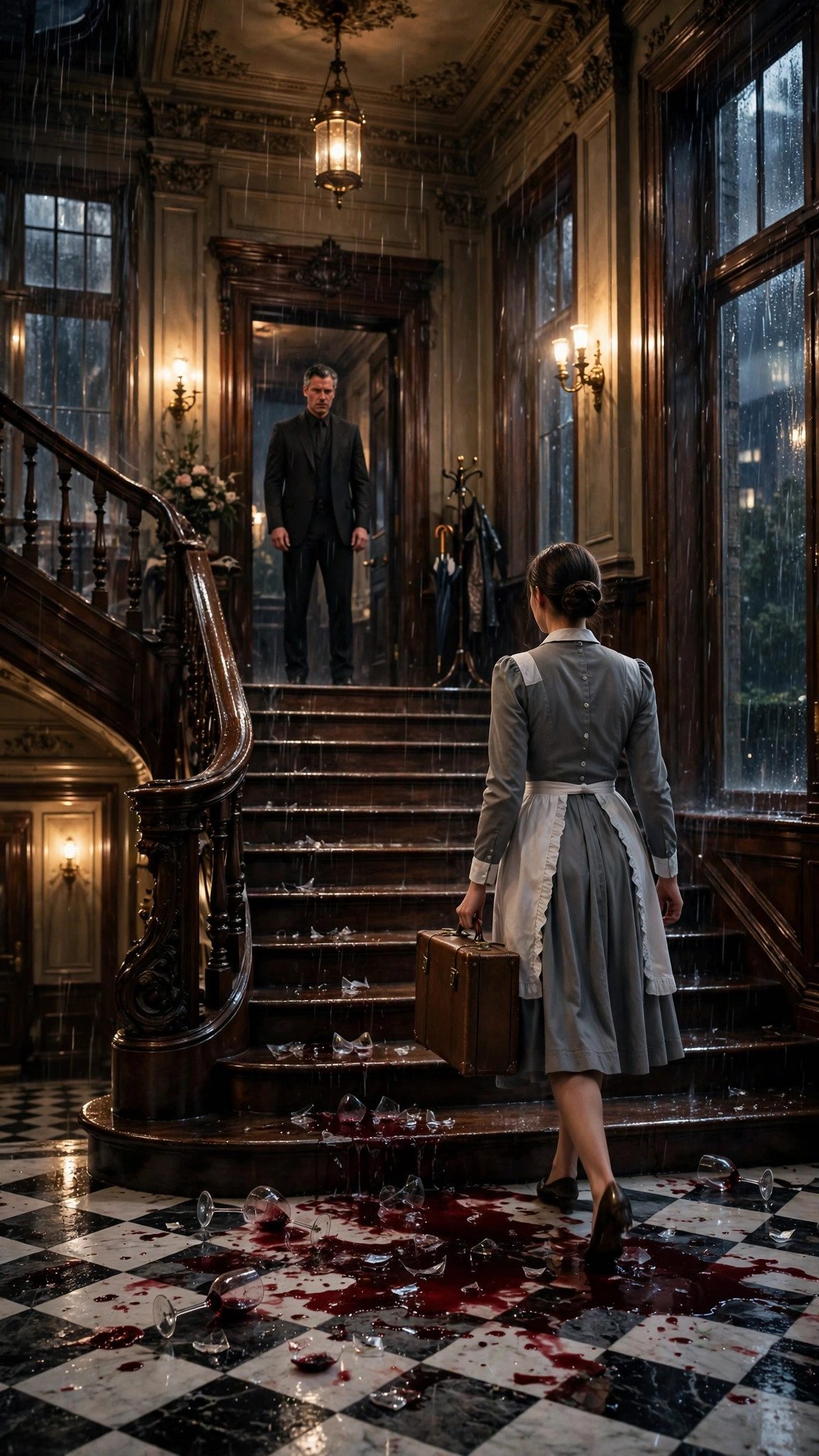
Hazel Marino had been twenty-four years old the first time she walked into the Rossi house, and she had been afraid of almost everything in it: the high ceilings, the marble floors, the portraits of dead men on the walls, and most of all the man who owned it all, who had looked at her across the front hall with eyes the color of a winter sea and said, "You are Rosa's daughter. Your mother spoke of you. The house is yours to keep. Do your work well and no one will trouble you."
Her mother, Rosa Marino, had been a maid in the Rossi house for twenty years. She had ironed the shirts of three generations of Rossi men, she had polished the silver until it shone like water, and she had died quietly in her sleep one winter night, two months before Hazel came to take her place. The agency had sent three other girls first. Gabriel had sent all three of them away. They had been too loud, or too curious, or too eager to be noticed. Hazel was none of those things. Hazel had learned from her mother that the safest way to survive in a house like this was to be useful and invisible at the same time.
She was good at it. She was so good at it that within a year, the house ran on her silence the way a clock runs on its gears. She knew that Gabriel took his coffee black and his eggs soft. She knew that Sebastian liked his toast cut into triangles and his milk warm. She knew which floorboard creaked on the second floor and which window stuck in the rain. She knew that the roses in the garden needed water on Thursdays, and that the old bell by the front door rang a half-second late, and that the housekeeper's keys hung on the third hook by the kitchen door.
What no one knew was that she also knew how Angela Rossi had died.
Angela had been Gabriel's wife, and she had been beautiful in the way that summer light is beautiful, all warmth and laughter, and she had been the only person in the house who had ever spoken to Hazel as if she were a person and not a piece of furniture. She had asked Hazel about her mother. She had taught her to make the lemon cake that Gabriel loved. She had held Sebastian on her hip and danced with him in the kitchen while Hazel washed the dishes, and she had laughed, and the whole house had laughed with her.
Hazel had loved her. Everyone in the house had loved her. And then, on a Tuesday night in November, five years ago, Angela had died on the old wooden stairs.
The police had called it an accident. She had been coming down the stairs in the dark, they said, and she had slipped, and she had fallen, and she had broken her neck. There had been a funeral. There had been flowers. Gabriel had stood at the grave in the rain and said nothing at all, and he had not smiled since, not once, not in five years.
But Hazel had been there that night. She had been in the hall below the stairs, carrying a tray of clean glasses, and she had heard the voices above her, and she had looked up, and she had seen it.
She had seen Angela at the top of the stairs, holding a folder of papers against her chest, her face white with anger and fear. And she had seen Vittorio Rossi standing behind her, his hand on the small of her back, his mouth close to her ear, saying something Hazel could not hear. And then she had seen Angela turn, and pull away from him, and say, very clearly, "I will tell Gabriel. I will tell him tonight. You have been stealing from the docks for years, Vittorio, and I have the proof, and I will not let you destroy this family."
And then Vittorio had pushed her.
It was not a shove. It was not a blow. It was one smooth, deliberate movement, the heel of his hand between her shoulder blades, and Angela had gone down the stairs the way a doll goes down the stairs when a child drops it, tumbling, weightless, terrible, and she had landed at the bottom in a silence so complete that Hazel could hear her own heart beating.
Hazel had stood frozen in the hall with the tray in her hands, and Vittorio had come down the stairs slowly, and he had looked at Angela's body, and then he had looked at Hazel, and his eyes had been calm and cold and entirely without surprise, as if he had expected her to be there.
"You saw nothing," he had said, very quietly, and he had taken one step toward her, and then another, until he was close enough that she could smell the whiskey on his breath. "Do you understand me, girl? You saw nothing. Your mother worked in this house for twenty years, and she understood the rules. If you speak one word of what you think you saw, I will make sure that you are the next accident in this house. And your mother is dead, and you have no one, and no one will ever believe a maid."
Then he had picked up Angela's folder of papers, and he had walked away, and Hazel had stood in the hall alone with the body of the only woman who had ever been kind to her, and she had not screamed, and she had not run, and she had not told anyone. She had set the tray down. She had knelt beside Angela and closed her eyes. And she had gone to the kitchen and washed the glasses, because that was what she did, and because she did not know what else to do.
She had kept the secret for five years.
She had kept it because she was afraid, and she was not ashamed of being afraid, because fear had kept her alive. But she had also kept it because of something else, something she had not admitted to herself until much later: she had kept it because of Gabriel.
Gabriel had been twenty-six when his father was murdered, and thirty-three when his wife died, and Hazel had watched him turn to stone, year by year, and she had watched him raise his son alone, and run the family alone, and carry the grief alone, and she had thought, every day, that if she told him the truth, it would destroy him. His own uncle had killed his wife. His own blood. The man who sat at his table and advised him and smiled at his son. If Gabriel learned that, he would kill Vittorio with his own hands, and then the family would tear itself apart, and the police would come, and Sebastian would lose his father the way he had lost his mother.
So she had said nothing. She had made his coffee. She had kept his food warm. She had taught his son to read. She had watered the roses on Thursdays. And she had loved him, quietly, from a distance, the way you love a fire through a window, knowing you can never touch it without burning.
She had not planned to love him. Love had come the way the rain comes in Chicago, slowly at first and then all at once, in the small things: the way he said "Your food is good" every morning, as if it were the only sentence he knew how to say to her, and the way his voice went soft when he said it, as if he were trying to say something else entirely. The way he had once, without a word, left a new coat on the hook by the kitchen door when the winter turned cold, and pretended he had not noticed her shivering. The way he had sat with Sebastian on the nights when the boy was afraid of thunderstorms, and read to him in a low voice until he fell asleep, and the way Hazel had stood in the doorway and watched, and thought that a man who could be that gentle with his son could not be the monster the city said he was.
She had told herself a hundred times that it was foolish. He was a mafia boss. She was a maid. He was going to marry a woman from a prominent family, a woman who matched his status, a woman the family had chosen for him. Hazel was nobody. Hazel was the woman who kept his food warm.
But love does not listen to reason. Love sits in the kitchen at midnight and watches a man eat his dinner alone, and thinks about how lonely he must be, and wishes, just once, that he would look up and see her.
The first time she had met him, really met him, had been in the rose garden. It was her third day in the house, and she had been sent out to cut roses for the dining room table, and she had been kneeling in the dirt with her sleeves rolled up, and she had looked up and seen him standing at the end of the path, watching her.
"You are Rosa's daughter," he had said.
"Yes, Mr. Rossi," she had said, and she had stood up too quickly, and a thorn had caught her finger, and a bead of blood had welled up, and he had taken her hand before she could pull away, and he had looked at the cut, and he had said, "Be careful. The roses here have thorns."
And then he had let go of her hand, and he had walked away, and Hazel had stood in the rose garden with a bleeding finger and a racing heart, and she had thought that she would remember that moment for the rest of her life.
She had remembered it for five years.
And she had kept something else for five years, too, something she had never told anyone about, something hidden in the bottom of her drawer under her mother's prayer card, wrapped in a piece of white cloth.
It was a gold earring. A small gold earring shaped like a rose, one of a pair Angela had worn the night she died. Hazel had found it on the top step of the old wooden staircase the morning after, when she had gone up early to clean before anyone else woke, and she had picked it up with shaking hands and understood, at once, exactly what it meant. Angela had lost it in the struggle at the top of the stairs. It was proof that she had not slipped. It was proof that someone had been up there with her, holding her, pushing her.
Hazel had wrapped it in the cloth and hidden it, and she had never shown it to anyone, because showing it would mean accusing Vittorio Rossi, the underboss of the family, the man who had threatened her life, and because she had no one to show it to who would believe a maid over a Rossi.
But she had kept it, all the same. She had kept it because her mother had taught her that the truth does not die just because you bury it, and because some part of her, the part that had loved Angela, had refused to let the only proof of what had happened disappear.
Vittorio had watched her, in the months after Angela's death. She had felt his eyes on her in the hallways, at the dinner table, in the garden, and she had understood that he was waiting for her to make a mistake, waiting for her to tell someone, waiting for an excuse. Once, when she had been carrying a tray past his study, he had stopped her and said, very softly, "You are a good girl, Hazel. Your mother was a good woman. Good girls do not make trouble for themselves. Remember that."
She had nodded. She had gone back to the kitchen. And she had kept the earring hidden, and she had kept her mouth shut, and she had waited, year after year, for a day when the truth would matter more than her fear.
That day had never come. And now she was dying, and the earring was still in her drawer, and the truth was still buried, and she thought, lying in the hospital bed, that perhaps it would stay buried forever, and that perhaps that was the saddest thing of all.
The doctors had told her six weeks ago. She had gone to the clinic because she had been tired, so tired, and because there had been a pain in her side that would not go away, and the doctor had run the tests, and then he had run them again, and then he had sat her down and told her that the cancer had already spread, and that there were treatments, and that they could try, but that she should prepare herself, and that she should tell her family.
She had no family. Her mother was dead. She had no brothers or sisters. The only people in the world who knew her name were the people in the Rossi house, and she could not tell them, because telling them would mean explaining why she was leaving, and explaining why she was leaving would mean explaining everything, and she could not explain everything, because everything included the secret she had kept for five years, and the love she had kept for five years, and the truth that she was dying.
So she had decided to leave quietly. She would go to the little house her mother had left her on the south side, the house with the creaking wooden stairs and the small garden, and she would die there quietly, the way she had lived quietly, without asking anyone for anything.
She had not counted on the phone call. She had not counted on Gabriel finding out. She had not counted on the nurse calling the number on her emergency card, the number she had written down three years ago, in a moment of weakness, when the clinic had asked her who to call if anything happened to her, and she had written Gabriel Rossi's number, because there was no one else in the world to write.
She lay in the hospital bed and listened to the machines beeping, and she thought about the rose garden, and about the man who had once held her bleeding hand, and she thought about how she had spent five years loving him from a distance, and how she was going to die without ever having told him.
And then the door of her hospital room burst open, and Gabriel Rossi stood there, soaking wet from the rain, his suit ruined, his hair plastered to his forehead, and his eyes were wild, and his voice was shaking, and he said her name like a prayer.
"Hazel."