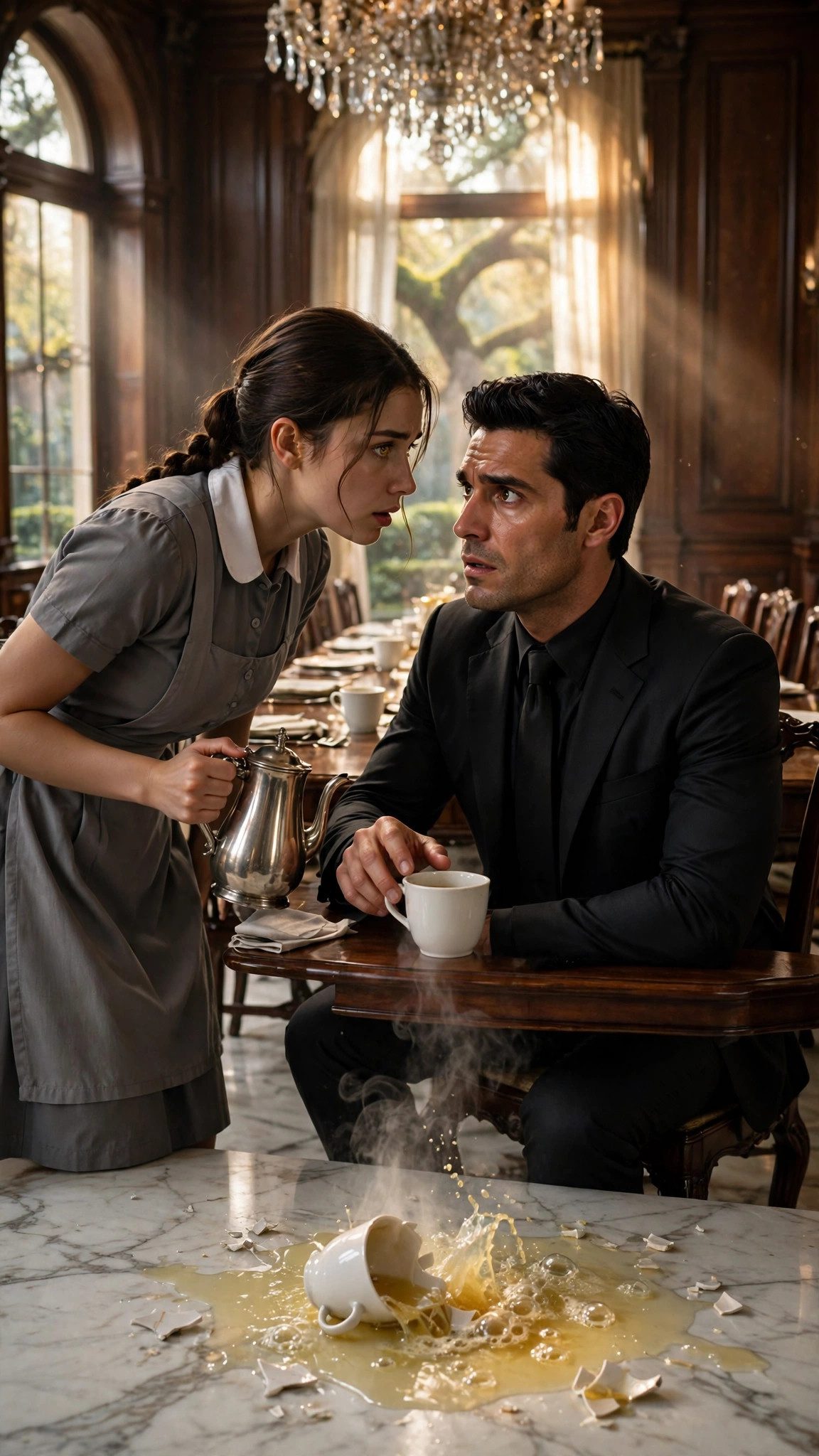
Benny's men searched the house all night, top to bottom, every room, every closet, every wall, and they found him at four in the morning, in the place where he had been hiding for twenty-five years, in plain sight.
His name was Henri Laurent, and he was the butler. He had served dinner in my house for twenty-five years. He had poured my father's wine and my wine. He had stood behind my chair at a thousand meals, silent and correct, with white gloves and a straight back, and he had been Castellano's man for almost all of it.
They found him in the pantry, sitting on the floor with his back against the wall, the same way Clara had sat, except Henri was not smiling, and he was not holding a gun or a knife. He was holding a photograph, old and creased, of a woman with dark hair and a tired smile, and when Benny's men came in with their flashlights, he did not run, and he did not fight. He held out his hands for the handcuffs, and he said, "I am ready. I have been ready for a long time."
I went down to the pantry myself, because I needed to hear it from him, and I sat down on the floor across from him, the way I had sat across from Clara, and I looked at the man who had served my family for twenty-five years and betrayed us for almost as long.
"Why, Henri?" I said.
He looked at the photograph in his hands, and his voice was quiet, and his hands were shaking, the way the hands of an old man shake when he is holding something precious.
"My wife," he said. "Her name was Colette. She got sick, twenty-six years ago, a cancer in her blood, and the doctors said the treatment would cost more money than I would earn in ten lifetimes. I went to Castellano because he was the only man in this city who had that kind of money to lend, and he lent it to me, and Colette lived for six more years, and I paid him back by doing what he asked. A door left unlocked. A letter moved from one room to another. A name whispered in the right ear at the right time. Small things, Mr. Orsini. Small things that added up to a life."
"Did you know about my father?" I said.
Henri closed his eyes. "I knew the night it happened. Castellano's men came to the house that evening, and they told me to leave the side door unlocked, and to make sure the driver left on time, and I did it, because Colette was still alive then, and I was still paying for her life with my soul. I have carried that night for fourteen years, Mr. Orsini. I have served your dinners and poured your wine for fourteen years, and every night I have gone home to an empty house and asked God to forgive me, and every morning God has said nothing, and I have come back to work."
"And the bangle?" I said. "My mother's bangle? The letters?"
"I moved them," Henri said. "Castellano told me to take one letter at a time from the library, and to give them to Marcel, and Marcel would take them away, so that when you finally went looking for the truth, there would be nothing left to find. I took your mother's bangle from her dressing table the week she died, because Castellano wanted something of hers, something to prove he could reach into this house and take whatever he wanted. I kept it in the hidden room because I could not bring myself to give it to him. It was the one thing I did not give him. Everything else, I gave."
I sat on the pantry floor with the butler who had betrayed my family for twenty-five years, and I thought about my mother's letter, and about what she had written: If you ever have to choose between revenge and mercy, remember that every choice in this story was made out of love, even the ones that hurt.
"Henri," I said, "my father would have had you killed. My uncles would have had you killed. Twelve years ago, I would have had you killed. But my mother wrote me a letter, and in it she told me to be better than the men who killed my father. So I am not going to kill you. I am going to turn you over to Agent Reyes, and I am going to tell him that you cooperated, and that you told the truth, and that you did what you did for your wife, and I am going to ask him to remember that when he writes his report."
Henri stared at me. Tears ran down his face, into the lines around his mouth, and he held the photograph of his wife against his chest like a child holding a blanket.
"Why?" he whispered.
"Because your wife lived for six more years," I said. "And because my mother protected the family of the man who betrayed my father, and I have inherited that protection, and it is mine to give now. And because killing you will not bring my father back, and it will not bring your wife back, and it will not make this house any safer. The only thing that will make this house safe is the truth, and you have just given it to me."
They took Henri away, gently, the way you take away an old man who has already punished himself more than any court ever could, and I stood in the pantry alone, and I listened to the quiet of my house, and I understood that Castellano's last man was gone, and that my house was finally, after fourteen years, clean.
The next afternoon, Violet and I drove to the cemetery where my parents were buried, in the old part of the city where the tombs stand above the ground like small white houses, and the oak trees make a green roof over the paths, and the air smells like rain even when it is not raining.
I had not been to their graves in three years. I told myself it was because I was busy, and because a man like me does not have time for cemeteries, but the truth was that I had not gone because I was afraid of what I would feel when I stood in front of my father's name carved in stone and remembered the argument on the telephone.
Violet brought white jasmine, because Maureen had told her that Elena loved jasmine, and she laid the flowers on my mother's grave with the care of a woman laying flowers on her own mother's grave, and she stood back, and she did not speak, and she let me have the silence.
I took my father's letter out of my pocket, the one from the safe-deposit box, and I read it aloud, standing in front of his tomb, my voice shaking in the quiet of the cemetery.
"My son, if you are reading this, then the night I feared has come, and I am gone. Do not blame Thomas. Do not blame your mother. Do not blame yourself for the argument on the telephone. I made you angry on purpose, my son. I needed you to stay home. I needed you to live. Be better than me, Carmine. Be better than all of us."
When I finished, I folded the letter again, and I put it back in my pocket, and I stood there for a long time with my hand on the warm stone of my father's tomb, and I felt fourteen years of guilt lift off my shoulders like a coat I had been wearing in the summer, and I understood, finally, that my father had not died believing I had failed him. He had died believing I would live, and that was enough for him.
"He would be proud of you," Violet said quietly, beside me. "Your mother would be proud of you too. You chose mercy over revenge, and you chose the truth over a comfortable lie, and you did it in one week, after fourteen years of carrying a story that wasn't true."
"I had help," I said. "I had a maid in a gray uniform who was paying attention."
"And now you have something else," she said, and she took my hand, right there in the cemetery, in front of my parents' tombs, and her hand was steady, the way it had been steady on the morning of July 25th, when she poured my coffee and saved my life. "Now you have a woman who sees you. All of you. Not the boss. Not the name. You."
I held her hand, and we stood together in the quiet of the cemetery, with the jasmine on my mother's grave and the oak trees overhead, and I thought about the passport in my pocket, and the letter folded seven times, and the bangle on the table beneath my mother's portrait, and I thought about how a family is not made of blood or names or houses, but of the people who choose to stand guard over each other, even when it costs them everything.
Agent Reyes called me that evening, while Violet and I were walking back to the car, and he told me that Clara had pleaded guilty, and that she was cooperating fully, and that her testimony, along with the ledger and my father's letter, was enough to put Castellano away for the rest of his life. He told me that Marcel had been found hiding in a motel outside Baton Rouge, and that he was in custody, and that Henri's testimony had filled in the last gaps. He told me that the case was closed, and that my father's murder, fourteen years old, was finally solved, and that I would never have to wonder again.
I thanked him, and I hung up, and I looked at Violet, and I said, "It is over. All of it. Fourteen years, over."
"No," she said, smiling. "It is not over. It is just beginning."
The next morning, I did something I had never done before. I went down to the kitchen at seven o'clock, and I sat down at the staff table with the maids and the cooks and the drivers, and I ate breakfast with them, and I learned their names, all of them, one by one, and I wrote them down in a notebook, the way Violet had written down the habits of my house.
Violet watched me from the doorway, and when I caught her eye, she smiled, the first real smile I had ever seen from her, and it changed her whole face, the way the sun changes a room when it comes through the window.
After breakfast, I took her up to the library, and I uncovered my mother's portrait, and I took Elena's gold bangle out of the evidence bag Benny had given me, and I laid it on the table beneath the portrait, where it belonged, and I put the box of my mother's letters back on the shelf where they had been stolen from, one bundle at a time, until the shelf was full again.
And then I took the passport out of my pocket, the dark blue passport in Maureen Delacroix's name, with the young woman's photograph inside, holding a baby in her arms, and I held it out to Violet.
"This is yours," I said. "My mother arranged it for your aunt, in case she ever needed to run. It was her way of protecting your family. But Maureen never used it, because she chose to stay and watch over mine. Now I am giving it to you. It is a passport, Violet. It means you can go anywhere in the world. You can start a new life, anywhere, as anyone, and no one in this house will ever ask you for anything again. You have paid your family's debt, and mine, a hundred times over."
Violet looked at the passport in my hand. She looked at my mother's portrait. She looked at me. And then she did something I did not expect. She took the passport, and she walked over to the fireplace, and she held it over the flames for a moment, and then she put it back in my hand, unburned.
"I don't need to run," she said. "I never did. Maureen raised me to stand guard, not to run away. And I am not a maid anymore, Mr. Orsini. Not in my own mind. I am the woman who saved your life, and the woman who stood in Castellano's dining room and told the truth, and the woman who is going to keep standing here until you tell me to go. So I am asking you, as an equal, for the first time in three years: will you have dinner with me tonight? Not as a master and a maid. As a man and a woman. In your dining room, at your long table, with candles, and no guards, and no folders, and no talk of territory. Just dinner."
I stared at her. I thought about the morning of July 25th, and the cup of coffee, and the girl with the steady hand, and the three years I had walked past her without seeing her, and the letter folded seven times, and my mother's handwriting, and my father's letter, and all the ways my life had changed in the space of a week because a maid in a gray uniform had decided to pay attention.
"Yes," I said. "Yes, I will have dinner with you tonight."
That night, we ate in the dining room, at the long table, with candles, and no guards, and no folders, and no talk of territory. She wore a blue dress that was not a uniform, and I wore a suit that was not armor, and we talked about her aunt, and my mother, and the little house in the Ninth Ward, and the soup Maureen used to make, and for the first time in fourteen years, I sat in the house my father had built and felt like I was home.
It was the best dinner of my life. It was not the last.