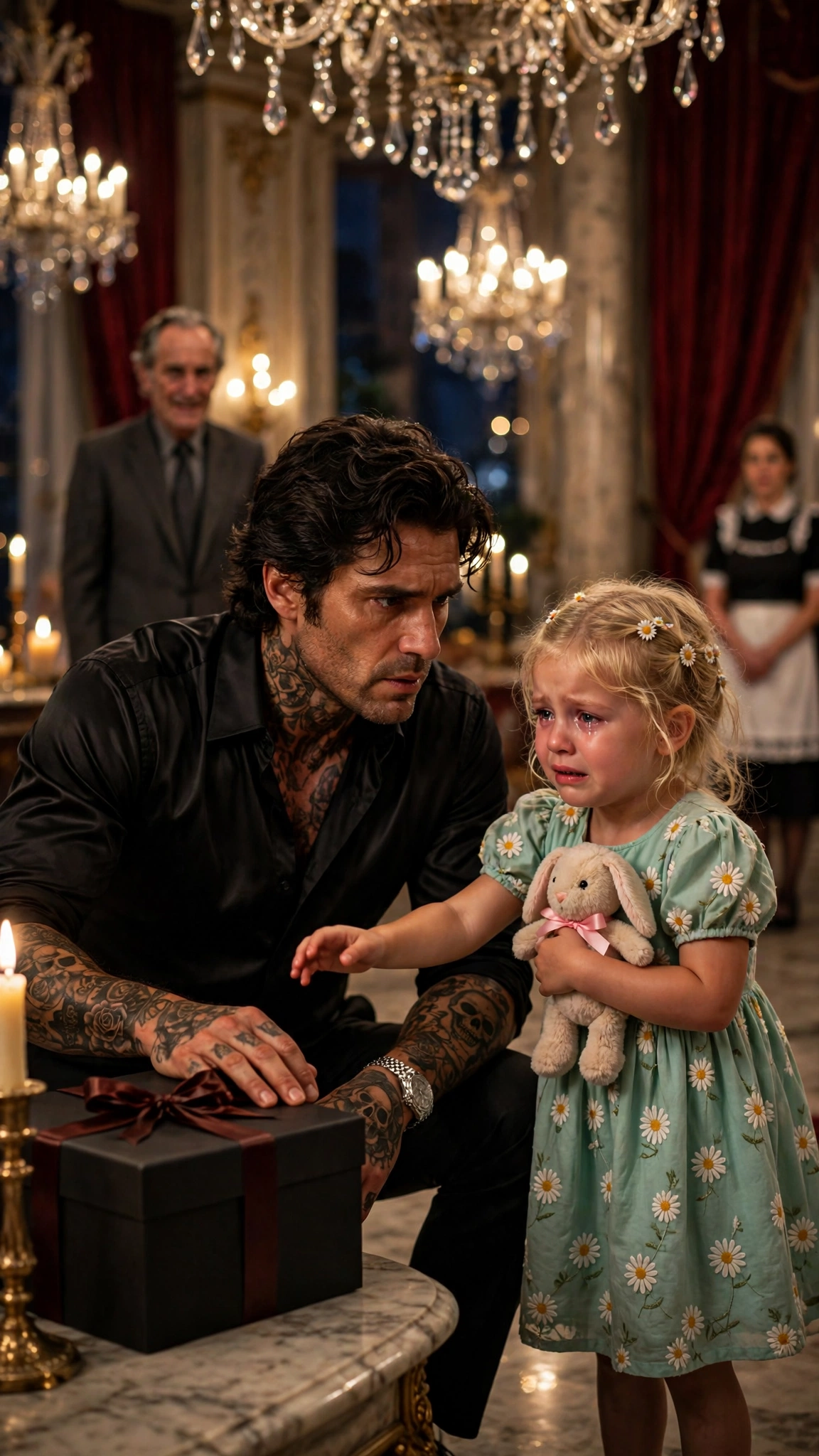
One week later, on a clear October evening, Lorenzo Moretti had a second birthday dinner.
It was nothing like the first one. There were no hundred guests in evening dress. There was no roast lamb, no cigar smoke, no crystal chandeliers blazing over the marble tables. There was no black gift box with a dark red ribbon sitting in the center of the table like a heart.
There were three people, and a small table by the window, and a pot of Rosa's soup, and a cake that Rosa had baked herself — a small cake, with five candles on it, because Mia had insisted that five was a better number than thirty-six, and Lorenzo had agreed, because his daughter was right about most things.
Mia sat in her chair, swinging her legs, wearing her mint-green daisy dress with the lace at the collar, the daisy clip in her hair, her small white shoes barely reaching the floor. Rosa sat across from her, in her dark uniform with her white apron, her silver cross catching the light of the candles, her hair in its neat bun, smiling the way she smiled when she was truly happy, which was not often, but which was worth waiting for.
And Lorenzo sat at the head of the small table, in his shirtsleeves, his watch on his wrist, his hair still damp from the shower, looking at the two people he loved most in the world, and feeling something he had not felt in a very long time.
He felt at peace.
The house on the hill was quiet that evening. The rain had stopped. The trees outside the window were gold and red, and the water beyond the lawn was calm, and the stone wall stood solid around the garden, and the windows glowed warm against the dark sky. It was the kind of evening that made you believe, for a little while, that the world was a safe place, and that the people you loved would always be there, and that nothing bad could ever touch them.
Lorenzo knew better. He had spent seventeen years learning that the world was not safe, and that the people you loved could be taken from you in a single night, and that a house was only as safe as the people inside it. He knew that Vincent De Luca was still out there, somewhere, licking his wounds and waiting for another chance. He knew that the business would always have enemies, and that the docks would always need protecting, and that there would always be another trap, another voice in a box, another long night.
But tonight, none of that mattered. Tonight, there was soup, and cake, and candles, and his daughter, and Rosa, and the small warm light of the dining room, and that was enough.
"Daddy," Mia said, and she was holding something behind her back, something flat and white, and she was trying very hard not to giggle. "I have a present for you. A real one this time."
Lorenzo raised his eyebrows. "A real one?"
"A real one," Mia said solemnly. "Not a box with a ribbon. Not a secret. A real present. I made it myself."
She brought it out from behind her back and held it up with both hands, proud as a queen. It was a drawing. The same drawing she had been working on since Tuesday — the picture of the three of them, himself and Mia and Rosa, standing in front of the house, all of them smiling, the sun yellow and enormous in the corner. But she had added to it. Now there were four people in the picture. Herself, and her father, and Rosa — and a fourth figure, standing a little apart, with graying hair and a charcoal suit, smiling, waving.
"Who is that?" Lorenzo asked, very quietly.
"That's Uncle Marcus," Mia said. "I put him in the picture because I miss him. Rosa says he went away on a long trip. I hope he comes back someday."
Lorenzo looked at the drawing for a long moment. He looked at the four figures, standing in front of the house, all of them smiling, the sun yellow and enormous in the corner. He thought about Marcus, on a plane to somewhere warm, with his son beside him, starting over, far away from the city, far away from the life that had nearly destroyed him. He thought about the promise he had made — exile, not death — and about the money he had given him, and about the letter he had written, the one he had not shown to anyone, telling Marcus that he was forgiven, in the only way Lorenzo knew how to forgive: by letting him go, and by letting him live.
"He will come back someday, Mia," Lorenzo said, and it was not quite a promise, and it was not quite a lie. "Someday, when the time is right, he will come back. And when he does, we will have a party, and you can show him this picture."
Mia beamed. She folded the drawing carefully, and she handed it to him, and he took it with both hands, the way you take something precious, and he looked at it for a moment longer, and then he set it down on the table beside his plate, where he could see it.
"Thank you, Mia," he said. "It is the best present I have ever received."
"It is the best drawing I have ever drawn," Mia said, with great satisfaction. "Rosa says so."
"Rosa is right," Lorenzo said. "Rosa is always right."
Rosa snorted. It was the sound she had perfected over twenty years. "I am right about most things," she said. "And I am right about this: it is time for cake."
She cut the cake, and she gave the biggest piece to Mia, and the second biggest piece to Lorenzo, and she took the smallest piece for herself, the way she always did, and they ate it in the warm light of the dining room, and Mia told them about her day — about the rabbit in the garden, and the book Rosa had read to her, and the cloud that had looked like a dragon — and Lorenzo listened to every word, the way a father listens when he has finally learned to be present, and Rosa watched them both, and she thought about Elena, who had told her husband to take care of their girl, and she thought that Elena would have been proud of him tonight.
After dinner, Lorenzo carried Mia upstairs to bed. He tucked her in, and he put Mr. Buttons under her arm, and he sat on the edge of the bed, and he told her a story — not a true story, but a good one, about a brave little girl who saved a castle from a dragon, because she was the only one who saw the dragon coming, and because she was brave enough to say so.
Mia listened with her eyes half closed, and when the story was over, she said, in a sleepy voice, "Daddy?"
"Yes, sweetheart?"
"Are we safe now?"
Lorenzo looked at her — at her blonde hair spread on the pillow, at her wide blue eyes, at the daisy clip that had come loose and was lying on the blanket beside her — and he thought about everything that had happened in the last week: the box, and the recorder, and the warehouse, and the boy who had come home, and the man who had gone away. He thought about the trap, and about the choice he had made, and about the fact that his five-year-old daughter had saved his life, and that he would never forget it, not for as long as he lived.
"Yes, Mia," he said, and he kissed her forehead, and he meant it. "We are safe now. I promise."
"Good," Mia said, and she closed her eyes, and she was asleep within moments, her breathing slow and even, Mr. Buttons tucked tight under her arm.
Lorenzo sat there for a while, watching her sleep. Then he went downstairs, and he found Rosa in the kitchen, washing the dishes, humming an old song under her breath.
"Rosa," he said.
She looked up. "Mr. Moretti?"
"Thank you," he said. "For believing her. For believing Mia. If you hadn't — if you had told her she was imagining things, if you had told her to be quiet — I don't know what would have happened. I think — I think I might not be standing here."
Rosa put down the dish she was holding. She dried her hands on her apron. Her silver cross caught the light.
"She is her mother's daughter," Rosa said quietly. "Elena saw straight through people. Mia does too. I just listened. That is all I did. I listened."
"I know," Lorenzo said. "And I will never forget it."
They stood in the kitchen for a moment, in the warm light, in the quiet house, and then Rosa went back to the dishes, and Lorenzo went to the study, and he took the drawing Mia had given him, and he put it in the top drawer of his desk, next to the small black recorder he had kept — the recorder that had started everything, and that had ended everything, all at once.
He kept them both. The drawing, and the recorder. The best present he had ever received, and the worst. He kept them side by side, in the dark, in the drawer, as a reminder: that the world could be cruel, and that it could be kind, and that the difference between the two was often a single person, in a single moment, choosing to listen.
Outside, the moon rose over the water. The house on the hill stood quiet and warm against the dark sky. And inside, a five-year-old girl slept safely in her bed, dreaming of dragons and castles and a father who had finally learned to come home.
The birthday was over. The danger was past. And the family — the small, stubborn, unbreakable family of three, plus one who had gone away and might someday come back — was together, and safe, and happy, at last.
The next morning, Mia woke up early, before the sun was fully up, and she went to the window in her room and looked out at the garden, where the rain had washed everything clean, and the trees were gold and red, and the grass was wet and shining. She stood there for a while, in her nightdress, holding Mr. Buttons, and she thought about the last week — about the box, and the ribbon, and the party, and her godfather, and her father — and she felt the small cold feeling in her chest, the one she had carried for two days before the party, finally, completely, go away.
She went downstairs, and Rosa was in the kitchen, and her father was at the table, reading the newspaper, and the house smelled of coffee and toast, and it was an ordinary morning, and that was the most wonderful thing in the world.
"Daddy," she said, climbing onto his lap. "Can we have another party? A small one. Just us. And Rosa. And maybe Mr. Buttons."
Lorenzo laughed, and he kissed the top of her head, and he said, "We can have a party every week, if you want. We can have a party every day."
"Every day is too many," Mia said seriously. "Every week is just right."
"Every week it is," Lorenzo said.
And so it was. Every Sunday after that, the three of them had dinner together at the small table by the window — just Lorenzo, and Mia, and Rosa — and they talked, and they laughed, and Mia told them about her week, and Lorenzo told her about his, and Rosa told them both that they were ridiculous, and that she loved them anyway.
It was not a grand life. It was not the life of a mafia boss, with a hundred guests at the marble tables and chandeliers blazing overhead. It was a small life, a quiet life, a life of soup and cake and candles and a little girl in a mint-green dress, swinging her legs under the table.
But it was a happy life. And Lorenzo, who had spent seventeen years building a fortress on a hill, finally understood what his grandmother had tried to teach him when he was a boy: a house is not made safe by stone walls, or by locked doors, or by men with guns. A house is made safe by the people inside it — by a little girl who is brave enough to tell the truth, and by a housekeeper who is wise enough to listen, and by a father who is strong enough to choose mercy over vengeance, even when vengeance would have been easier.
A month later, a letter arrived at the house. It had no return address. It was postmarked from Florida. Inside was a single photograph: Marcus and Marco, standing on a beach, smiling, the sun behind them, the ocean blue and endless. On the back, in Marcus's handwriting, were the words: "Thank you. We are safe. We are happy. Tell Mia I love her, and that I will always be her Uncle Marcus."
Lorenzo showed the photograph to Mia, and she held it carefully, with both hands, and she said, "He looks happy, Daddy."
"He is happy," Lorenzo said. "And so are we."
She put the photograph on the table beside her drawing — the drawing of the four of them, standing in front of the house, all of them smiling, the sun yellow and enormous in the corner — and she looked at them both for a long moment, and then she went back to her toast, and her father went back to his newspaper, and Rosa went back to the dishes, humming an old song under her breath.
The house on the hill stood quiet and warm against the morning sky. The rain had stopped. The sun was shining. And inside, a family that had nearly been broken was whole again — not because they were strong, or rich, or feared, but because a five-year-old girl had stood up at her father's birthday table, and put her small hand on his wrist, and told him the truth.
And her father had listened.