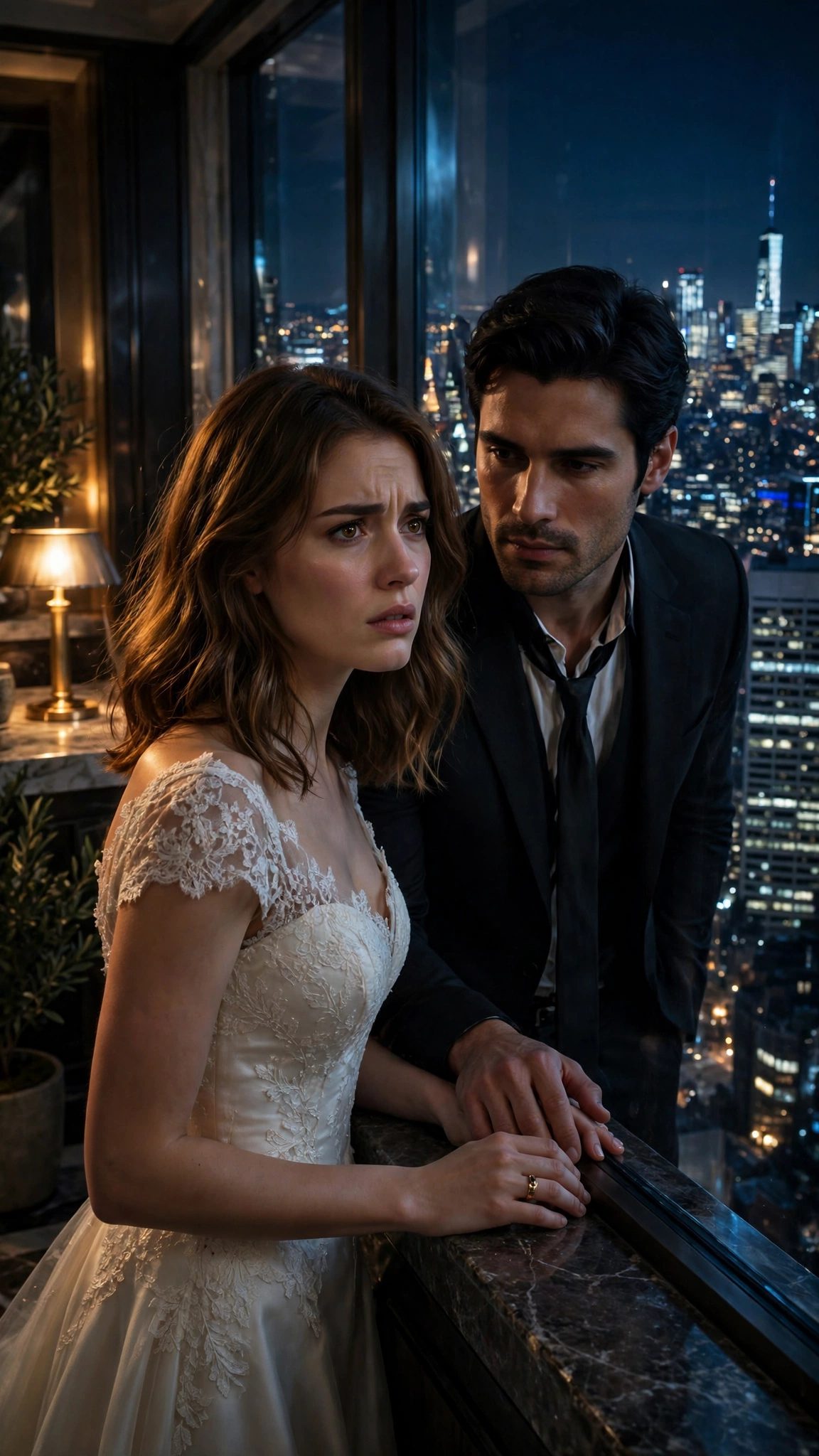
The first morning I woke up as Mrs. Moretti, I did not know where I was.
The bedroom was too quiet. My apartment had always woken me with the radiator's clanking and the garbage truck on the street below and the neighbor's dog. Here there was only a soft hum of air conditioning and a pale wash of light coming through linen curtains, and for one confused second I thought I was still dreaming about a wedding that had never happened.
Then I saw the ivory dress hanging on the wardrobe door, and the gold ring on my finger, and the man asleep in the armchair across the room with his jacket folded over his knees, and I remembered everything.
Dominic had slept in the chair. He had not touched the bed. He had kept his word in the strangest way possible: the marriage meant nothing, so he had treated the wedding night like a guard shift.
I sat up slowly, careful not to wake him, and studied him in the morning light. Asleep, he looked younger. The hard lines around his mouth softened. There was a thin white scar along his left jaw that I had not noticed before, and his dark hair had fallen across his forehead in a way that made him look almost ordinary, like any tired man who had stayed up too late. Then his eyes opened, and the ordinary vanished, and he was Dominic Moretti again, calm and watchful and already three steps ahead of me.
"Good morning," he said. His voice was rough with sleep. "Did you sleep?"
"No," I said honestly. "Did you?"
"Enough." He stood and put on his jacket in one smooth motion, like a man putting on armor. "Breakfast is at seven. Rosa will be here at nine. Jack will drive you anywhere you need to go, but you do not go anywhere without Jack. Those are the rules. There are only three. Learn them."
"What are the rules for you?" I asked.
He paused at the door. "I don't have rules, Emily. I have enemies. That's worse."
Then he was gone, and I was alone in a penthouse the size of a small hotel, married to a man who slept in chairs and spoke in warnings.
Breakfast was waiting in the dining room: coffee, fruit, bread still warm from the oven, eggs I had not asked for. A housekeeper I had not met moved silently through the rooms, and I ate alone at a table built for twelve, feeling like an intruder in someone else's life. Every surface gleamed. Every flower was fresh. There were no photographs on the walls, no books left open, no shoes by the door. The penthouse looked like a place where no one actually lived, and I understood, suddenly, that it was true. Dominic did not live here. He stayed here. There was a difference, and it was written in every empty room.
At nine o'clock exactly, Rosa Moretti arrived. She wore black, as she had at the wedding, and her silver hair was pulled back so tightly it looked painful. She carried a leather folder and a small paper bag, and she looked at me the way a headmistress looks at a new student: measuring, unimpressed, and not unkind.
"Dominic tells me you are an art teacher," she said, without sitting down.
"Yes," I said.
"Then you know how to look at things," she said. "Good. You will need that here. Sit down, Emily. We are going to talk about how to stay alive in this family, because my son is very good at many things, but explaining himself is not one of them."
She opened the leather folder and laid out three photographs on the dining table. The first showed the warehouse on the docks at night, trucks lined up in the rain. The second showed a manifest, columns of numbers and codes, with three lines circled in red ink. The third showed a young woman with dark hair and Dominic's eyes, laughing on a beach, her arms around a man I did not know.
"Isabella," Rosa said, touching the photograph with one finger. "My daughter. Dominic's sister. Two years ago, she found something in the shipping records, the same kind of thing that is on that flash drive Dominic showed you. Someone had changed the routes. Trucks that should have gone to one warehouse went to another. Cargo that should have been counted was never counted. She told Dominic, and three weeks later her car went off a road in the rain, and the police called it an accident."
Her voice did not break. That was the most terrible part. She said it the way you say something you have said a thousand times to yourself in the dark.
"The police report in the folder says the brakes failed," she continued. "The brakes on a car that had been serviced the week before, by a mechanic who has since left the country. Do you understand what I am telling you, Emily?"
"Someone in the family killed her," I said quietly.
"Someone in the family had her killed," Rosa corrected. "And Dominic has spent two years looking for the proof. The flash drive is part of it. The folder is part of it. You are now part of it, because you heard the routes, and because you are his wife, and because in this world a wife is either protected or she is a target. There is no third thing."
She pushed the paper bag across the table toward me. Inside was a phone, black and plain, with one number already saved in it.
"Dominic's number," she said. "Your old phone stays in a drawer. From now on, you call no one from your old life. Not your friend. Not your school. Not yet. When this is over, you can have all of it back. But not yet."
"When will it be over?" I asked.
Rosa looked at me for a long moment, and for the first time I saw something behind the measurement in her eyes. It might have been pity. It might have been respect. "When the man who changed those routes is found," she said. "Or when he finds you first."
She stood to leave, and then she stopped at the door and turned back. "One more thing, Emily. My son told you this marriage means nothing. He has told himself that every day since he decided to marry you. Do not believe him. A man who means nothing does not sleep in a chair to keep his word. Remember that."
After she left, I sat at the table for a long time, looking at the photograph of Isabella laughing on a beach. She had Dominic's eyes and an easy smile, and she was dead because she had noticed numbers that did not add up.
I was an art teacher. I noticed things for a living. A line that did not belong. A color that was wrong. A shape that had been painted over. I had spent years teaching teenagers to see what was actually in front of them instead of what they expected to see.
That afternoon, when Dominic came home, I was waiting in his office with the flash drive plugged into his laptop and a notepad covered in my own handwriting.
"You said I could do whatever I want with the folder," I said. "Does that include the flash drive?"
He looked at the screen, then at my notes, then at me. "What did you find?"
"Three routes," I said, and I pointed at the columns on the screen. "The manifests say the trucks go to Warehouse Four. But the delivery schedules say they go to Warehouse Nine. And Warehouse Nine doesn't exist on any of the company records. It's a ghost. Someone built a ghost warehouse into the routes, and the trucks have been going there for two years."
Dominic went very still. "Show me."
I showed him. I walked him through it the way I would walk a student through a painting: here is the line that doesn't belong, here is the color that is wrong, here is the shape that was painted over. He listened without interrupting, his hands flat on the desk, his face giving away nothing, and when I finished, he was quiet for so long that I thought I had done something wrong.
"Isabella found the same thing," he said at last. "She found it in the paper records. She didn't have the flash drive. She had half of it, and it still got her killed."
"Then we have more than she did," I said. "We have the flash drive, and the folder, and the police report. And we have me."
"We have you," he repeated, and something moved in his face, something I could not name. "That is the part that frightens me, Emily. The rest of it is numbers. You are not numbers."
That night, for the first time, we ate dinner together, just the two of us, in the dining room built for twelve. Jack served the food and then disappeared, silent as smoke. Dominic asked me about my students, and I told him about a boy who could draw hands better than anyone I had ever taught and a girl who painted everything in shades of blue because blue was the only color that felt honest to her. He listened like a man who had forgotten that people could talk about ordinary things.
"Why did you become a teacher?" he asked.
"Because my mother was one," I said. "She taught history. She used to say that people never really listen until something is at stake. I think she was right."
"What happened to her?" he asked.
"She died when I was sixteen," I said. "A stroke. One morning she was making breakfast, and the next morning she was gone. I still hear her sometimes, when I'm about to do something stupid. She has a very particular voice for that."
Dominic was quiet. Then he said, "My father died when I was nineteen. Heart attack, in this very building. I took over the family the next day. I have not had an ordinary day since."
It was the most honest thing he had said to me. I wanted to ask him a hundred questions, but I could see the tiredness in his face, the kind of tiredness that comes from carrying something heavy for a very long time, so I said only, "Thank you for telling me."
He looked at me across the table, and for a moment the distance between us felt smaller, like a door that had opened a crack.
"Get some sleep, Emily," he said, but his voice was softer than it had been the night before. "Tomorrow we start again."
I went to bed that night thinking about Isabella on a beach, and ghost warehouses, and a mother who spoke to me from eleven years away. I thought about the fact that I had married a stranger to stay alive, and that the stranger had slept in a chair to keep his word, and that his mother had told me not to believe him when he said the marriage meant nothing.
And I thought about the three routes on the flash drive, and the red circles on the manifest, and the simple, terrible fact that someone inside this family had already killed once to protect a secret.
They would kill again. I knew that now. The only question was whether we would find them first, or whether they would find me.
That night, I could not sleep. The penthouse was too quiet, too big, too full of rooms I had not yet entered. At two in the morning I gave up on the bed and went wandering in my bare feet, through the living room with its cold marble floor, past the dining room built for twelve, to a door at the end of the hallway I had not opened yet.
It was a study. Dark wood, leather chairs, a desk smaller than the one in his office, and shelves full of books that looked as if they had actually been read. On the desk there was a photograph in a silver frame: a young Dominic, maybe nineteen, standing beside a girl with his dark eyes and an easy smile, both of them laughing on a beach. Isabella. On the back, in faded ink, someone had written, "Maine, 2009. Bella's first summer."
I picked up the photograph and held it for a long time. She looked so alive. She looked like someone who had never been afraid of anything, and I wondered what she had felt in those last three weeks, after she found the numbers and before her car went off the road in the rain. Had she been afraid? Had she told anyone? Had she sat in a room like this one, at two in the morning, holding a photograph and trying to decide what to do?
I set the photograph down and found a sketchbook on the shelf, blank pages, and a pencil, and I sat by the window and began to draw the city. I drew the lights, and the river, and the dark shape of the bridge, and as I drew, my hands stopped shaking. Drawing had always done that for me. It took the fear and turned it into lines, and lines I could control, even when nothing else could be controlled.
I was so lost in the drawing that I did not hear Dominic come in. He stood in the doorway in his shirtsleeves, watching me, and when I finally looked up, he said, "You draw the city like you love it."
"I do love it," I said. "Even now. Especially now. It's the only home I've ever had."
He came and sat beside me, and looked at the sketch, and said nothing for a while. Then he said, "Isabella used to sit in this exact spot and paint the sea. She said the city was too loud to paint. But you paint it like it's singing."
"Maybe I'm just stubborn," I said.
"Maybe," he said, and for the first time, I saw him almost smile. Not the cold, careful expression he wore for the world. A real smile, small and tired and human. "Get some sleep, Emily. Tomorrow we start again."
I went back to bed that night with the sketchbook on the nightstand and the photograph of Isabella still bright in my mind, and I thought about how strange it was that a dead girl I had never met was already the person I felt closest to in this house, because she was the only one who had ever looked at the numbers and refused to look away.