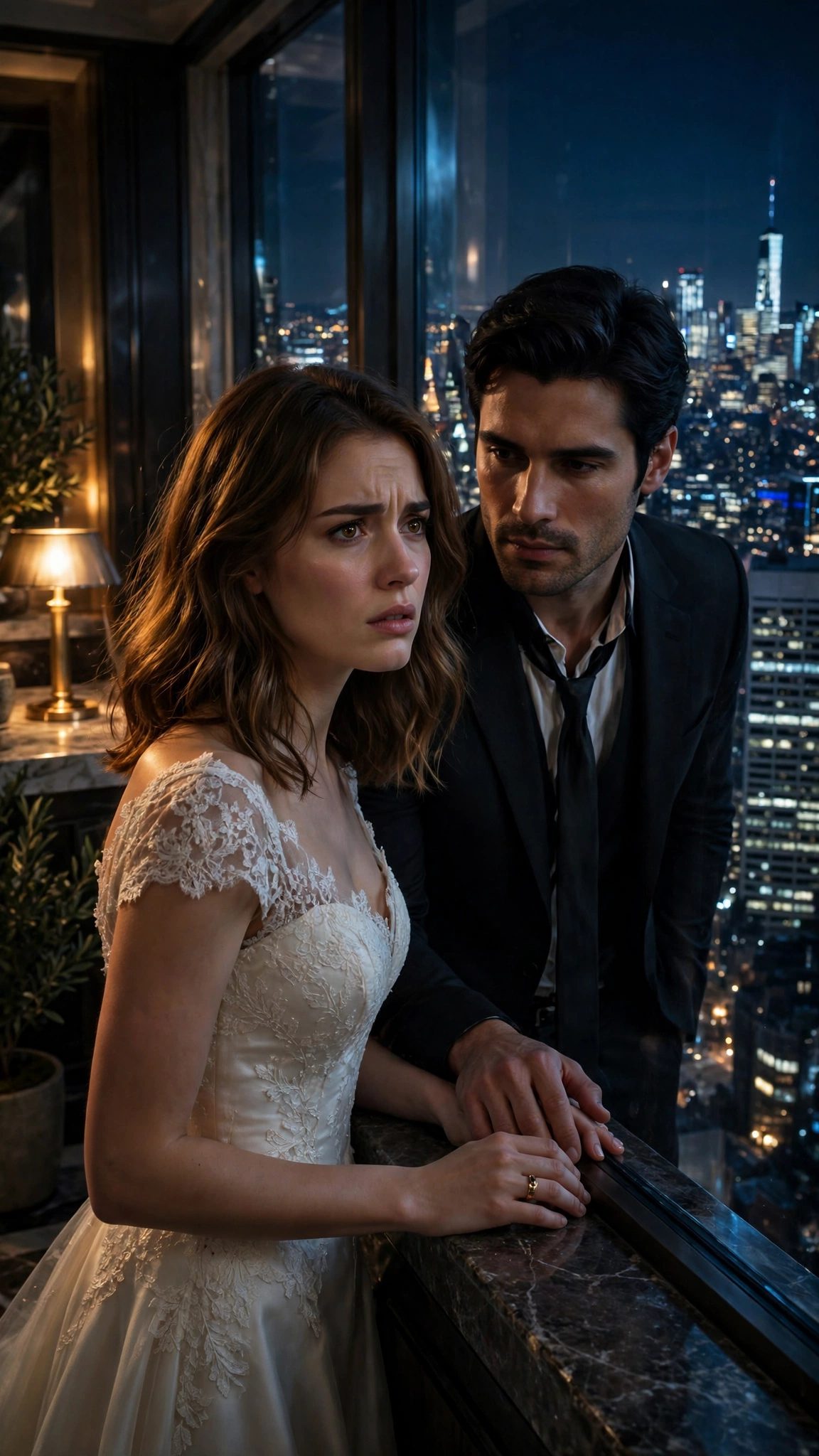
Dominic slept for fourteen hours after the surgery, and I did not leave his room once.
The nurses brought me coffee I did not drink and a blanket I did not use. Jack stood outside the door the whole night, silent as smoke, and every time the door opened he looked up with his hand already moving toward his jacket, until he saw it was only a nurse, and then he would settle again. Rosa came and went, making calls in the hallway in a low voice, her black dress unchanged, her silver hair still perfect. She looked like a woman who had done this before, and I realized with a sick feeling that she probably had.
When Dominic finally woke, the first thing he said was, "Is the gunman talking?"
"Hello to you too," I said, and I poured him water from the plastic jug, holding the cup steady while he drank. "The police have him. Jack says he's nineteen and he's terrified and he won't say who paid him, but he doesn't have to. You already know."
"I know," Dominic said. He shifted against the pillows and winced. "Anthony has been skimming the shipping for two years. The ghost warehouse is his. The altered routes are his. He needed Isabella gone because she found the manifests, and he needs you gone because you heard the codes."
"Then why did he send a nineteen-year-old boy to a gallery full of people?" I asked. "That's not a professional. That's a panic move."
"Because he's panicking," Dominic said. "Because you found the ghost warehouse in two days, Emily. Isabella took weeks. You walked into my office with a notepad and found in one afternoon what my own men couldn't find in two years. Anthony knows that. And a panicking man makes mistakes."
He looked at me then, really looked at me, and said, "You have blood on your dress."
I looked down. The green dress was stiff with it, dark in the folds. "It's yours," I said. "I haven't changed."
"Go home and change," he said. "Jack will take you. Shower. Sleep in a real bed. I'll still be here when you come back."
"I'm not leaving," I said.
"Emily—"
"I'm not leaving," I said again, and I meant it so completely that he didn't argue. He just closed his eyes and nodded, and for the first time since I had met him, he looked like a man who was letting someone else carry part of the weight.
Rosa came in that afternoon with a bag of clean clothes for me and a look that said she had already decided something about me. She set the bag on the chair and said, "Walk with me, Emily. My son needs to rest, and you need to understand what comes next."
We walked down the hospital hallway, past rooms full of strangers' lives, to a small waiting room with a window that looked out over the river. Rosa sat down and folded her hands in her lap, and for a moment she looked older than her years, like a woman who had buried a daughter and was now watching her son bleed for a stranger.
"You opened the folder," she said. It wasn't a question.
"Yes," I said.
"Then you saw the photographs," she said. "Tell me what you saw."
I thought back to the folder, to the photographs I had looked at in Dominic's office with shaking hands. "Men getting into trucks at a warehouse. The police report about the dockworker in the river. And Isabella, on a beach, laughing."
"There is more in the folder than that," Rosa said. "Dominic showed you the beginning of it. The rest of it is in the safe in his office. Photographs of Anthony meeting the gunman's handler at a restaurant on the docks. A copy of the mechanic's statement about Isabella's brakes, the one the police never filed. A letter Isabella wrote to Dominic the week she died, saying she had found something and she was afraid."
She looked out the window at the river, grey and steady. "Isabella was the brave one. Dominic was the careful one. She found the altered routes because she was helping with the books while Dominic was in Chicago, and she told him, and he told her to be quiet and let him handle it. She waited three weeks. Then her car went off the road in the rain."
"And Dominic blames himself," I said quietly.
"He has blamed himself for two years," Rosa said. "He thinks if he had acted faster, she would be alive. He thinks the marriage, the flash drive, all of it is his penance. That is why he told you it meant nothing. If it means nothing, he cannot lose it. Do you understand?"
I understood. I understood it the way you understand a painting when you finally step back far enough to see the whole thing. Dominic had built a wall around himself out of the words "it means nothing," and he had been living behind it for two years, alone, because the last time something had meant something to him, it had died in the rain.
"He's wrong," I said. "About the marriage. And about Isabella. She didn't die because he was slow. She died because Anthony is a murderer. There's a difference, and Dominic needs to hear it from someone who isn't his mother."
Rosa almost smiled. It was a small, tired thing, but it was real. "Then tell him," she said. "He listens to you. I have watched it. He listens to you the way he used to listen to her."
That night, back in Dominic's room, I told him. I told him about Isabella's letter, and the mechanic's statement, and the photographs in the safe, and I told him that his sister had not died because he was slow, but because a man who steals will kill to keep stealing, and that the only way to honor her was to finish what she started.
He listened without interrupting, his hands flat on the white blanket, his face giving away nothing, and when I finished, he was quiet for a long time.
"She wrote me a letter," he said at last. "I never read it. It's in the safe. I've never opened it."
"Then we'll open it together," I said. "When you're out of here. We'll read it, and we'll use it, and Anthony will answer for all of it. Not just Isabella. The dockworker. The routes. The gallery. All of it."
Dominic looked at me, and something moved in his face, the same something I had seen in his office when I showed him the ghost warehouse. "You are not afraid," he said.
"I am terrified," I said honestly. "I was terrified in the parking lot, and I was terrified in the gallery, and I am terrified now. But I am also furious, Dominic. I am furious because I didn't know how to explain that no one had ever simply removed a burden that large from my shoulders. You did. You stepped in front of a bullet. You don't get to tell me this marriage means nothing after that."
He reached for my hand, slowly, careful of the IV line, and held it. His hand was warm. It did not tremble.
"When I get out of here," he said, "we are going to Maine."
"Maine?" I said.
"The house by the sea," he said. "The family house. Isabella loved it. There are photographs of her bedroom there. I want you to see it. I want you to see the place where she was happy, before all of this. And I want Anthony to think we have run away, so he stops watching the penthouse and starts making mistakes."
It was a plan, and it was also something else: an invitation. He was inviting me into the part of his life that had nothing to do with trucks and routes and blood. He was inviting me to see the place where his sister had been happy.
"Then we'll go to Maine," I said. "But first, we're going to open that safe."
He nodded, and his eyes closed, and for the first time since the gallery, he slept without the tight lines of pain around his mouth. I sat beside his bed and watched him breathe, and I thought about the folder, and the safe, and the letter I had never read, and the man who had changed the routes and killed a young woman for noticing.
I thought about my mother's voice, which had gone quiet in the gallery and had not come back yet, as if even she was waiting to see what I would do next.
What I would do next was simple. I would stay. I would fight. I would finish what Isabella started, and I would bring Dominic home alive, and I would not let Anthony Moretti take one more thing from this family.
The blood on my dress had dried by then, stiff and dark. I did not change it. I wore it like a promise: I had been there. I had held his hand. I was not going anywhere.
Late that night, when Dominic finally slept without the tight lines of pain around his mouth, Jack came into the room with two cups of coffee and sat down in the chair by the door, the way a man sits when he has something to say and has been waiting a long time to say it.
"You remind me of her," he said quietly, so as not to wake Dominic. "Not your face. Your eyes. Isabella looked at things the same way. Like she was really seeing them."
"Tell me about her," I said. "Please. Everyone tells me she was brave, and she found the numbers, and she died. But no one tells me who she was."
Jack was quiet for a moment, staring into his coffee. Then he said, "I drove her to school when she was a girl. Every morning, six years. She used to sit in the back seat and paint in a little notebook, watercolors, mostly the sea. She said the sea was the only thing that never lied to her. She wanted to be an artist, you know. Not a great one. Just an artist. She said she didn't need to be famous. She just needed to make something true."
He smiled, a sad, tired smile. "She was sixteen when she told me that. Sixteen, and she already knew more about what mattered than most grown people I know. When she got older, she started helping with the books, because Dominic was in Chicago, and someone had to watch the numbers. She found the ghost warehouse because she was the only one who actually looked. Everyone else just signed the papers. She read them."
"And then she told Dominic," I said.
"And then she told Dominic," Jack agreed. "And he told her to be quiet and let him handle it. And she waited three weeks. And then her car went off the road in the rain. I was supposed to drive her that night. She told me not to come. She said she wanted to drive herself, just once, like a normal person. I should have gone anyway. I have thought about that every day for two years."
"You couldn't have known," I said.
"I know," Jack said. "That's what Rosa tells me. That's what Dominic tells me. But knowing doesn't help. The only thing that helps is finishing it. And that's what we're going to do, you and me and him. We're going to finish what she started."
He stood up then, and put his hand on my shoulder, briefly, the way a father would, and said, "Get some rest, Mrs. Moretti. I'll watch the door."
After he left, I sat beside Dominic's bed and took out the sketchbook the nurse had given me, the small one from the hospital gift shop, and I began to draw his sleeping face. I drew the scar along his jaw, and the dark hair falling across his forehead, and the bandage under the blanket, and the way his hand lay open on the white sheet, as if he were reaching for something even in his sleep.
Drawing him felt different from drawing the city. The city was lines and light. Dominic was weight and shadow, a man who carried things no one could see. I drew the lines around his mouth, the ones that came from two years of blaming himself, and I thought about how strange it was that I had known this man for only a week, and yet I could already read his face the way I read a painting: here is the line that doesn't belong, here is the color that is wrong, here is the shape that was painted over, and here, underneath it all, is the truth.
The next morning, I went back to the penthouse with Jack to get clean clothes, and I walked through the empty rooms in the early light, and for the first time, the place did not feel like a hotel. It felt like a house that was waiting for someone to come home. In Dominic's office, I stood in front of the painting of the sea at dusk, grey and gold, and I looked at it the way Isabella must have looked at it, and I understood something I had not understood before.
The sea in the painting was not calm. It was not peaceful. It was the moment before a storm, when the water goes dark and the light goes gold, and everything is beautiful and dangerous at the same time. That was Dominic. That was this family. That was the whole story: beauty and danger, held together in the same frame, and the only thing that mattered was who was standing beside you when the wave came.
I took a clean dress from the wardrobe, and a sweater, and the sketchbook from the study, and I went back to the hospital, and when Dominic woke up, I showed him the drawing of his sleeping face.
He looked at it for a long time. Then he said, "You made me look peaceful."
"You were peaceful," I said. "For the first time since I met you. I wanted to remember it."
He held the sketchbook carefully, like it was something breakable, and said, "Keep drawing, Emily. Draw all of it. The city. The sea. Me. All of it. When this is over, I want to see what you saw, because I think you see things the rest of us miss."
"I will," I said. "I promise."
And I meant it. I would draw all of it: the penthouse, and the hospital, and the gallery, and the sea in Maine, and the man who had stepped in front of a bullet for me, and the woman I was becoming, the one who had walked into a parking lot as a schoolteacher and was walking out of a hospital as something else entirely, something braver, something I had not known I could be.