Tuesday morning came gray and cold, with rain on the windows and a wind coming off the river that cut straight through coats.
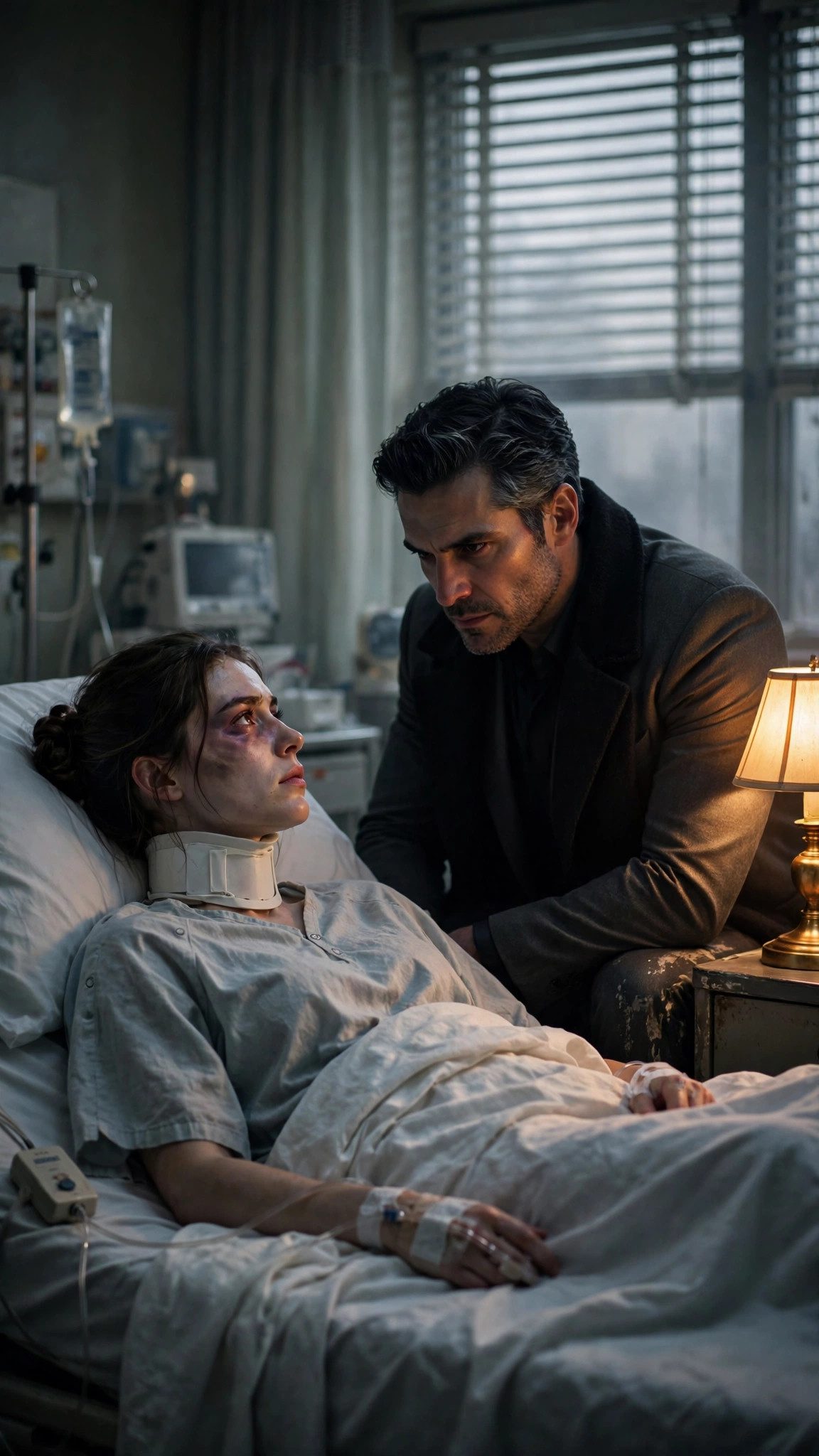
Harper stood in front of the mirror in her hospital room and looked at herself. The bruise around her left eye had faded from black to a deep purple. The cervical collar was gone, replaced by a soft brace Dr. Alvarez had fitted that morning. Her ribs were taped tight under her blouse. She was wearing a navy suit, the same one she had worn to a hundred meetings, and her dark brown hair was pulled back in a low bun, and her hands were shaking.
"You don't have to do this," Dante said from the doorway. He was in a charcoal suit and black overcoat, and he looked, as always, like a man carved out of stone.
"Yes, I do," she said.
They drove to City Hall in silence. Tony drove. Harper sat in the back seat with Dante, holding the folder with the corrected traffic study against her chest like a shield, and she watched the city slide past the windows, and she thought about the alley, and the black Lincoln, and the man who had whispered in her ear, and she felt her hands stop shaking.
By the time they reached City Hall, her hands were perfectly still.
The zoning boardroom was full. Chairwoman Voss sat at the head of the table, sharp-eyed and calm. The board members sat in a row behind their nameplates. The lawyers sat in the front row with their briefcases. And in the back row, near the door, sat Vincent Castellano.
He was sixty-one years old, with silver hair and a tailored gray suit and a face that had once been handsome and was now only hard. He was watching Harper with the calm, curious expression of a man watching a play he had already seen.
Harper walked to the podium. Her ribs screamed with every step. Her head throbbed. Her left eye ached. But she did not limp. She did not hesitate. She set the folder down, and she opened it, and she looked out at the room, and she began to speak.
Before she had reached the podium, there had been a moment in the hallway outside the boardroom that she would remember for the rest of her life. Castellano's lawyer, a sleek man in a gray suit named Whitaker, had stepped into her path and said, "Miss Bennett, my client objects to your presenting today. You are not a board member. You are not a licensed engineer. You are a secretary, and you have been in the hospital, and you are clearly unfit to speak."
Harper had looked at him, and she had felt her ribs ache, and she had felt her head throb, and she had said, in a voice so calm it surprised even her, "Mr. Whitaker, I wrote the traffic study. I checked every number. I am the person who caught the error in it. And I am going to walk into that room and present it, because the board asked me to, and because no lawyer is going to tell me I am unfit to speak about my own work."
Chairwoman Voss, who had been standing nearby, had stepped forward then, and she had said, "Mr. Whitaker, Miss Bennett will present. The board has voted on it. You may sit down now."
Whitaker had sat down. And Harper had walked into the boardroom, and the rest was history.
"Chairwoman Voss. Members of the board. My name is Harper Bennett. I am the executive assistant to Mr. Dante Moretti, and I am here to present the corrected traffic study for the waterfront parcel."
Her voice was steady. It did not shake. It did not waver. She spoke for twenty minutes, and she gave them every number: four hundred and twenty-one trucks a day on the north route, not four hundred and twelve. Two thousand longshoremen employed. Forty-seven acres. Three warehouses. Two deep-water berths. A rail spur that connected directly to the interstate.
She did not look at Castellano. Not once. But she could feel him watching her, and she could feel the weight of his gaze, and she kept speaking, and when she finished, the room was silent.
Chairwoman Voss looked at her for a long moment. Then she said, "Thank you, Miss Bennett. The board will now vote."
The vote took four minutes. When it was over, the clerk read the result in a flat, official voice.
"Seven in favor of the Moretti bid. Two opposed. The motion carries."
The room erupted. The longshoremen's union representative stood up and cheered. The lawyers began shaking hands. Chairwoman Voss banged her gavel. And in the back row, Vincent Castellano stood up slowly, and buttoned his jacket, and walked out of the room without looking at anyone.
In the hallway afterward, the union representative caught Harper's arm. He was a broad man in his fifties named Frank DeLuca, with gray hair and a voice like gravel, and there were tears in his eyes.
"Miss Bennett," he said, "my father worked those docks. My grandfather worked those docks. My son works those docks. You just saved two thousand jobs. I want you to know that. I want you to remember it."
Harper shook his hand, and her ribs ached, and she did not care, because Frank DeLuca's gratitude was worth more than any paycheck.
A reporter pushed forward then, holding out a recorder. "Miss Bennett, how does it feel to present with two cracked ribs?"
Harper looked at the recorder, and then she looked at the reporter, and she said, "It feels like Tuesday."
Before she reached him, Chairwoman Voss stopped her in the hallway, and she took Harper's hand in both of hers, and she said, "Miss Bennett, I have run this board for eleven years, and I have never seen anyone present a study the way you did today. You were hurt, and you were afraid, and you came anyway. Remember that about yourself."
Dante was waiting for Harper in the hallway. He did not say anything. He simply looked at her, and she looked at him, and then, very carefully, because of her ribs, he put his arms around her.
"You did it," he said quietly.
"We did it," she said.
But the day was not over. The vote had been the first half of Dante's plan. The second half was the trap.
That afternoon, Dante called Marcus Hale into his office.
"Marcus," he said, "I need you to do something for me. Harper is being discharged from the hospital tomorrow morning at nine. I want you to pick her up. Take her to her apartment. Stay with her until I call you. Do you understand?"
"Of course," Marcus said. He did not hesitate. He did not blink. He looked, in every way, like a loyal man.
"Good," Dante said. "And Marcus. One more thing. Harper's laptop was stolen. The drive is encrypted. But there is a backup. A second copy of the zoning packet, on a drive in my safe. I want you to know that, because I want you to understand that Castellano gained nothing. Nothing at all."
Marcus nodded. "I understand, Mr. Moretti."
He left the office, and Dante sat very still for a long moment, and then he picked up his phone and called Daniel Reyes.
"He took the bait," Dante said. "He will call Castellano within the hour. He will tell him that Harper is being discharged tomorrow at nine, and that she will be alone in her apartment, and that the backup drive is in my safe. And Castellano will send Krol."
"And we will be waiting," Reyes said.
"We will be waiting," Dante agreed.
That night, Harper lay in her hospital bed and tried to sleep, and she could not, because she knew what tomorrow was. Dante had told her everything that morning, before the vote, because he refused to use her as bait without her permission.
"Marcus sold your schedule," he had said. "He sold the number in the traffic study. He left the rose outside your door. And tomorrow, I am going to let him sell one more thing: the time of your discharge. Krol will come for you. But this time, we will be ready. The FBI will be in the apartment across the hall. Tony will be in the stairwell. I will be in the apartment with you."
"And if something goes wrong?" she had asked.
"Nothing will go wrong," he had said. "I will be there."
Now, lying in the dark, Harper thought about the man who had whispered in her ear in the rain. She thought about the smell of cigarettes and cheap cologne. She thought about the fist connecting with her face. And she thought about Dante, sitting beside her bed at six in the morning, and she knew that she was not afraid.
She was ready.
At eight forty-five the next morning, Harper walked out of West End General Hospital on her own two feet, holding her bag in her right hand, with Marcus Hale walking beside her like a loyal friend. He opened the car door for her. He helped her into the back seat. He drove her to her apartment on Maple Street, and he walked her up the stairs, and he unlocked her door with the spare key she had given him three years ago, when she had still believed he was a man she could trust.
"Thank you, Marcus," she said, standing in her doorway. "You can go now."
"I'll stay," he said. "Mr. Moretti asked me to stay until he calls."
Harper nodded, and she walked into her apartment, and Marcus followed her in, and the door closed behind them.
Inside, the apartment was quiet. The secondhand couch. The bookshelf full of paperbacks. The framed photograph of her father on the mantel. Harper set her bag down on the kitchen counter, and she turned on the kettle, and she said, "Would you like some tea, Marcus?"
He did not answer. He was standing by the window, looking down at the street, and his phone was in his hand, and Harper saw his thumb move across the screen.
She knew, in that moment, that he was sending the message. She is here. She is alone. Come now.
"Marcus," she said quietly.
He turned around. And for the first time in three years, she saw his real face. Not the polite face. Not the loyal face. The face of a man who had sold her for money, and who knew that she knew, and who did not care.
"I am sorry, Harper," he said. "It was never personal. Castellano pays very well. And you were just a secretary."
"That is what Krol said," Harper said. "He said I was 'just a secretary.'"
"Then you understand," Marcus said.
"No," Harper said. "I understand that you are wrong. I was never just a secretary. I was the woman who memorized the numbers you could not steal. I was the woman who walked into the zoning boardroom with two cracked ribs and took the docks from Castellano. And you are the man who sold me for money and called it business."
Marcus took a step toward her. His hand moved toward his jacket, toward the place where a man like him would keep a gun.
And then the apartment door opened, and Dante Moretti walked in.
He did not raise his voice. He did not move quickly. He walked across the room, and he stood between Harper and Marcus, and he looked at the man who had been his head of security for nine years, and his voice was low and quiet and absolutely final.
"Nine years, Marcus," he said. "Nine years I trusted you with my life. And you sold my secretary for money."
Marcus's hand was still moving toward his jacket. Dante's hand moved faster. He caught Marcus's wrist, and he twisted it, and the gun clattered to the floor, and Tony came through the door behind him, and two FBI agents came through the door behind Tony, and the hallway filled with the sound of boots and radios and handcuffs clicking shut.
"Marcus Hale," Agent Daniel Reyes said, "you are under arrest for conspiracy, assault, and attempted murder."
Marcus did not resist. He looked at Harper, and his face was gray, and he said, "You were never supposed to be hurt that badly. Krol was only supposed to scare you."
"Tell that to my ribs," Harper said.
They took Marcus away. And then, from the street below, came the sound of car doors slamming, and shouting, and more handcuffs, and Tony leaned out the window and called up, "Krol is here! He came with Cole and Falco! The FBI has all three!"
Harper walked to the window and looked down. In the street below, Eddie Krol was being pressed against the hood of a black sedan, his hands behind his back, his cheap suit wrinkled, his face red with rage. Danny Cole and Tommy Falco were already in handcuffs. And standing on the sidewalk, watching it all with his arms crossed, was Agent Daniel Reyes.
Harper turned around. Dante was standing behind her, and his eyes were on her face, and for the first time since the night of the attack, she saw something in them that she had never seen before.
Relief.
"It is over," he said.
"No," she said. "It is not over. Castellano is still out there."
"Not for long," Dante said. "Reyes has Krol. Krol will talk. Hale will talk. And when they talk, Castellano will fall. I promise you that."
Harper nodded. Then she did something she had been wanting to do since the morning she woke up in the hospital and saw him sitting beside her bed.
She stepped forward, carefully, because of her ribs, and she put her arms around him, and she held on, and Dante Moretti, the most feared man in Chicago, stood very still in the middle of her small apartment, and then, slowly, he put his arms around her, and he held her back.
Outside, the rain had stopped. The sun was coming through the clouds. And Harper Bennett, who had been an envelope for someone else's message, was finally, at last, just herself again.