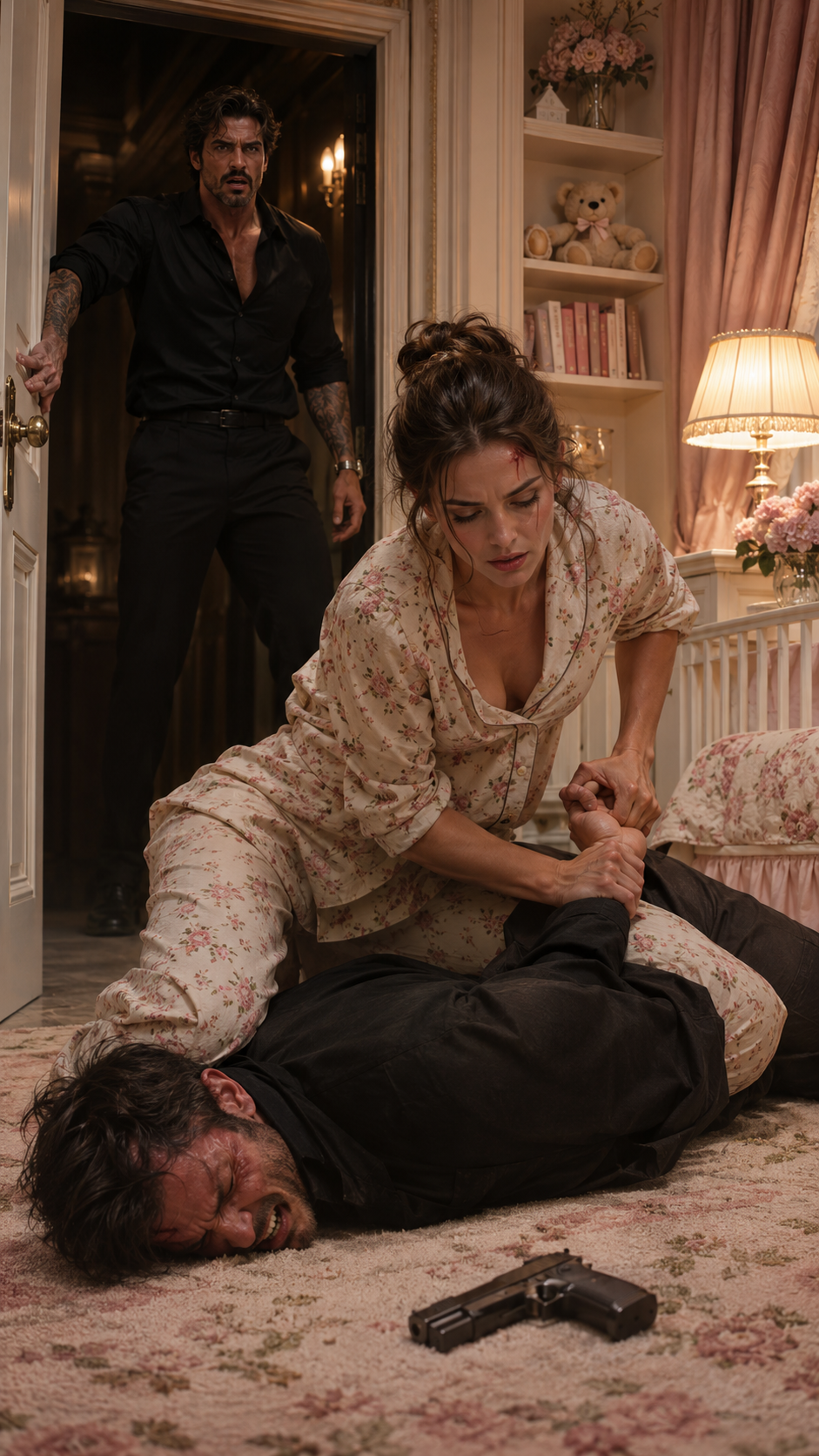
Harbor House had been closed for six years.
Vincent discovered that much before breakfast.
It had once been a private residential facility used during high-risk protective assignments. The building stood outside the city, surrounded by woodland and an old security perimeter.
There were no public records connecting Hannah Mercer to it.
There were, however, several references to a federal operation that had been sealed.
Vincent read the information twice.
Then he called Hannah into his study.
She entered wearing a simple cream sweater and dark trousers.
Her hair was tied back.
The small cut on her forehead had almost healed.
Vincent placed a printed report on the desk.
"Harbor House."
Hannah looked at it.
"Where did you get that?"
"Does it matter?"
"Not really."
"Then explain."
She sat.
For the first time, she seemed uncertain where to begin.
"I wasn't always a nanny."
Vincent gave her a dry look.
"I had gathered that."
She almost smiled.
Then her expression became serious.
"I worked in protective services for the federal government. My assignments involved people whose lives were at risk because of information they possessed."
"Deputy marshal?"
She looked at him.
"Yes."
Vincent leaned back.
"How long?"
"Seven years."
"What happened at Harbor House?"
"A family was being moved to a secure location. Their identities had been compromised."
"Did someone attack them?"
"Not successfully."
"Then what happened?"
Hannah looked down at her hands.
"The security plan was changed without authorization. The family was redirected to a location that wasn't secure."
"By whom?"
"I never received a complete answer."
"But you knew?"
"I suspected an internal breach."
Vincent studied her.
"Did you disobey an order?"
"Yes."
"Why?"
"Because the original evacuation route had been compromised, and I refused to send the family through it."
"What did you do instead?"
"I moved them to a safe location."
"And that ended your career?"
"Not immediately."
She looked toward the window.
"The investigation became complicated. Some people believed I had exceeded my authority. Others believed I had prevented something terrible."
"Which was true?"
"Both."
Vincent remained silent.
Hannah continued.
"I left the service after the investigation was closed. I had spent years watching people mistake authority for competence. I needed a life where I could make decisions without wondering whether the person above me was selling the information I was protecting."
"And then you became a nanny."
"I began working privately with families."
"Why mine?"
She looked at him.
"Because someone sent me a warning."
"What warning?"
"Your children's names appeared in a threat profile connected to the same network."
Vincent's eyes narrowed.
"Who sent it?"
"I don't know."
"Why didn't you bring it to me?"
"Because the warning included details that could only have come from inside your household."
Vincent stared at her.
"And you thought I was involved?"
"I thought your security system had been compromised. I didn't know whether you were aware."
"Did you?"
She hesitated.
"I didn't know."
The honesty unsettled him more than an accusation would have.
***
Later that afternoon, Vincent found Hannah in the nursery.
She was repairing a small wooden toy.
A piece had come loose from Noah's train.
He watched her work.
"Do you miss it?"
She looked up.
"What?"
"Your old job."
Hannah considered the question.
"Sometimes."
"Why?"
"Because I knew exactly what I was doing."
"And now?"
"Now I read stories about rabbits and negotiate with five-year-olds over vegetables."
Vincent almost smiled.
"Sounds difficult."
"Much more difficult than my old assignments."
She returned to the toy.
He sat on the edge of a small chair.
"Why didn't you tell me the truth from the beginning?"
"Because I wanted to know whether the danger was real before bringing it into your children's lives."
"It was already in their lives."
"Yes."
"That should have been my decision."
"I know."
She looked at him.
"But if I had told you everything on the first day, you might have dismissed me or removed me from the house. I needed time to understand the threat."
Vincent didn't answer.
She continued.
"I wasn't trying to control you. I was trying to make sure the people responsible didn't know I had found them."
He looked at her hands.
"You're very good at this."
"At what?"
"Protecting people."
Hannah's expression softened.
"Children make it easier."
"Why?"
"Because they don't care how powerful someone is. They just want to know whether you'll be there when they wake up."
Vincent looked toward Emma's bed.
He knew exactly what she meant.
***
That evening, Emma insisted that the family eat dinner together.
She had drawn a picture for each person.
Vincent received a drawing of a very tall man with black hair.
Hannah received one of a woman wearing a pink dress.
Noah had drawn a blue train with four wheels and a smiling sun.
"Why does my picture have a crown?" Vincent asked.
Emma shrugged.
"Because you're the king."
"Of what?"
"Our house."
Noah corrected her.
"You're not the king. You're Daddy."
Emma considered that.
"That's better."
Hannah laughed softly.
Vincent looked at her.
For a moment, the room felt ordinary.
No security reports.
No intruders.
No hidden files.
Just dinner with two children who believed the world could be made safe with enough love and a little imagination.
After dinner, Emma asked Hannah to read the rabbit story.
Noah brought the blanket.
Vincent sat beside them.
When the story ended, Emma looked at him.
"Daddy, can Hannah stay with us forever?"
Vincent glanced toward Hannah.
She had gone very still.
He looked back at his daughter.
"That's a very big question, sweetheart."
"Why?"
"Because grown-ups have to talk about things."
Emma frowned.
"Then talk."
Noah nodded.
"Please."
Vincent smiled faintly.
"We'll talk."
***
At midnight, Hannah returned to her room.
She locked the door.
Then she opened a small notebook hidden inside her travel bag.
Its pages contained handwritten observations.
Dates.
Camera interruptions.
Vehicle descriptions.
Security access changes.
And a list of initials.
One set appeared more often than the others.
The initials belonged to the administrator of the mansion's central security network.
Hannah had suspected him for weeks.
Now she had proof.
She removed a small memory card from the notebook.
It contained a copy of the access records.
She had not told Vincent about it.
Not yet.
Her telephone vibrated.
A message appeared from an unknown number.
YOU HAVE UNTIL TOMORROW NIGHT.
Hannah stared.
Another message arrived.
THE CHILDREN ARE NOT THE ONLY ONES WE CAN REACH.
She immediately deleted the notifications.
Then she looked toward the nursery.
Her expression hardened.
***
She reached back into her travel bag and found the document she had carried through every move since leaving federal service.
The paper had softened along its folds.
She opened it carefully.
It was the final report from the Harbor House investigation.
The memory came back with the smell of burnt coffee and copier toner.
Six years earlier, she had stood in a government office across from a supervisor whose face she could still remember more clearly than she wanted to.
He had placed a report on the desk.
"Sign the closure page, Mercer. The review is finished."
Hannah read the final paragraph again.
"It says every transfer was completed and every protected identity was accounted for."
"That's the official finding."
"It isn't what I verified."
The supervisor sighed and removed his glasses.
"You completed the assignment. The family was moved. No one was harmed. The file is being closed."
"The access breach wasn't resolved."
"The technical review found no continuing exposure."
"The technical review didn't include the original authorization log."
He leaned back.
"That log is restricted."
"I know. I requested it three times."
"And you were told the request was denied."
"I was told it was unavailable. That's not the same thing."
The supervisor tapped the signature line.
"Your job is to protect the people assigned to you, not to challenge every administrative decision."
Hannah looked at the report.
"My job was to protect them. I did that. But I won't sign a statement saying the breach is contained when I haven't seen the evidence."
"You're making this personal."
"It became personal when someone used a protected family's information to put them in danger."
He lowered his voice.
"If you refuse to sign, your assignment will be closed without your certification. It will affect your standing. You may not be offered another protective detail."
Hannah felt the weight of the choice. Seven years of work sat behind that desk: long nights, careful plans, difficult transfers, and people who had trusted her when they had nowhere else to turn.
She picked up the pen.
For a moment, the supervisor seemed relieved.
Then she placed the pen beside the report without signing.
"Write that I refused."
He stared at her.
"You're throwing away your career over a missing document."
"No," she said. "I'm refusing to pretend a missing document is proof."
The memory ended there, as it always did.
She remembered the corridor outside the office. A former teammate had been waiting near the elevator with two paper cups of coffee. He had offered her one without asking whether she wanted it.
"You could appeal," he said.
Hannah accepted the cup. "I could."
"You were right to question the report."
"Being right doesn't put the missing records back."
He studied her for a moment. "What will you do now?"
"I don't know. I want a place where I can hear a door close and not wonder who authorized it."
"You won't stop noticing things."
"Probably not." She looked down at the coffee. "But maybe I can use that instinct for something ordinary. Help a family. Make sure a child gets to school on time. Read a story without checking the corridor every two minutes."
Her teammate gave a tired smile. "You think you'll be able to do that?"
"I have to find out."
He didn't try to persuade her again. He simply walked with her to the elevator, carrying the second cup she had forgotten to drink. That small kindness stayed with her longer than the arguments in the office.
She had never regretted refusing to sign. What she regretted was how long she had believed that leaving the service would make the past stop following her.
She folded the report and returned it to the bag. The message on her telephone remained deleted, but its meaning did not disappear with it. Someone knew about Harbor House. Someone knew she had refused to certify the investigation as complete. And someone believed that old decision could still be used to frighten her.
Hannah sat on the edge of the bed, listening to the quiet house. She had spent years learning to separate a warning from a threat, evidence from assumption, and fear from instinct. The distinction mattered now more than ever. She would not let an anonymous message make her careless. She would not let it push her away from the children.
She closed the travel bag and placed it beneath the chair. In the morning, she would review the authorization records again. If the person behind the breach wanted her to make a mistake, she would give them no such advantage.
***
The next morning, Vincent found the security administrator's authorization records.
Someone had accessed the system from a remote terminal.
The access was legitimate.
The authorization was not.
Vincent called Hannah.
"I need you to look at something."
She entered the study.
He showed her the records.
She recognized the pattern immediately.
"That's the same sequence."
"From Harbor House?"
"Yes."
Vincent looked at her.
"Then the person responsible is connected to your old investigation."
"Possibly."
"Can you identify them?"
"Not from this."
He placed another document beside it.
A list of internal access approvals.
Hannah examined the names.
Then she stopped.
"That's impossible."
"What?"
She pointed to one entry.
"This authorization was made after the administrator's account was supposedly disabled."
Vincent leaned forward.
"Meaning?"
"Someone has duplicated the credentials."
"Can they be traced?"
"Yes. But only if we access the original server."
Vincent reached for his telephone.
"Then we'll access it."
Hannah placed a hand over the document.
"Wait."
He looked at her.
"Why?"
"Because if the person responsible knows we're investigating, they'll destroy the records."
Vincent's eyes narrowed.
"How would they know?"
Hannah didn't answer.
His gaze shifted toward her hand.
Then toward her bag.
"What's in there?"
"Nothing important."
"Show me."
She withdrew her hand.
Vincent stood.
"Hannah."
For the first time, she looked genuinely frightened.
Not of him.
Of what would happen if he discovered the truth before she was ready to explain it.
"Vincent, please."
He stared at her.
"What are you hiding?"
Before she could answer, the security alarm sounded.
The nursery door had been opened.
And someone had entered the room.