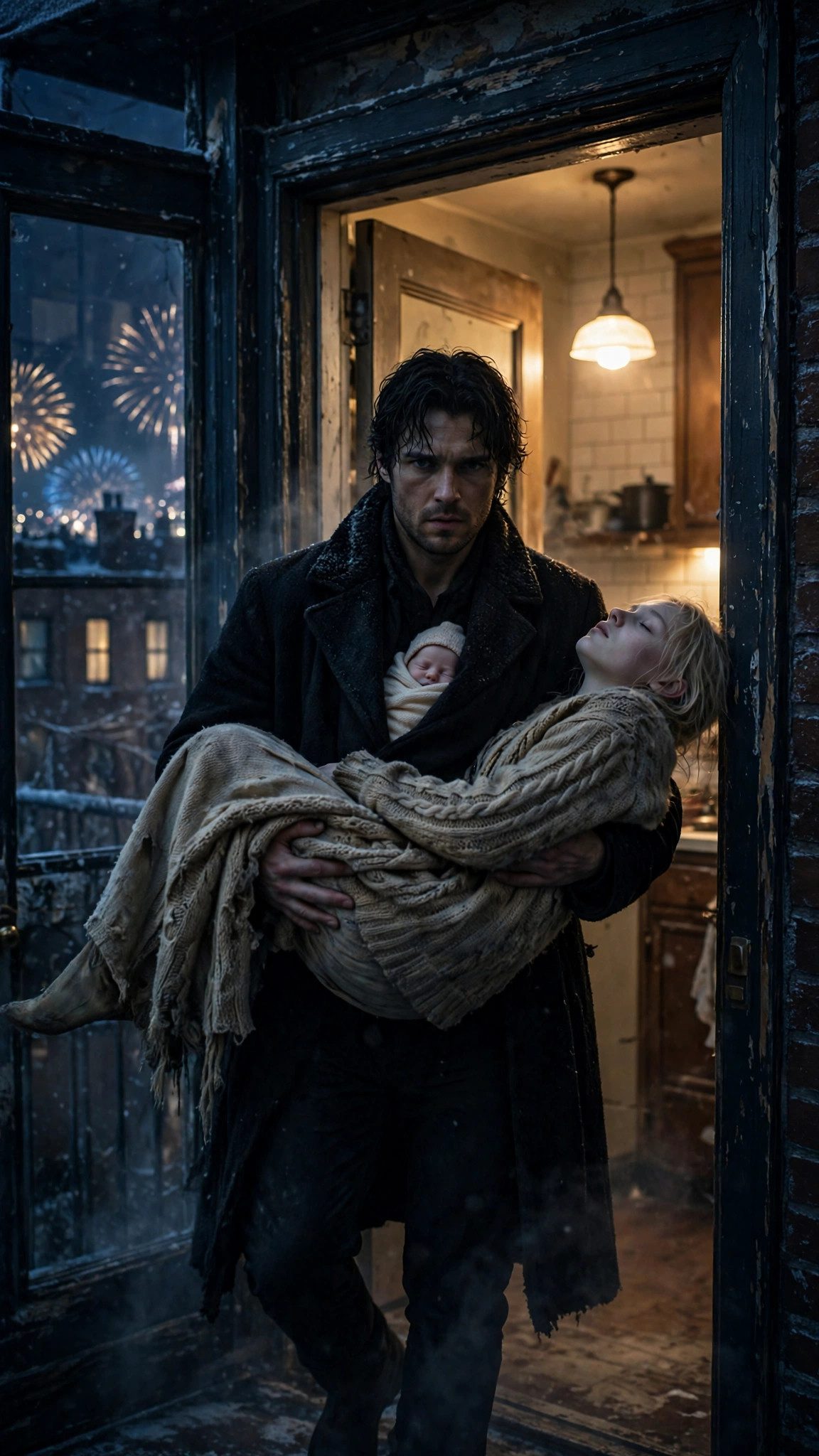
Three weeks before that night, I was sitting in a hotel room in Stuttgart, staring at a spreadsheet that did not make sense, and thinking about my wife.
The business problem was simple on paper and ugly underneath. Money was disappearing from one of our shipping accounts. Not a lot at first — a few thousand here, a few thousand there, the kind of amounts that could be explained away as fees or exchange rates or bad timing. But over six months it had added up to nearly four hundred thousand dollars, and the pattern was too careful to be an accident. Someone inside the family was taking it. Someone who knew the accounts well enough to hide the gaps, and someone who knew I was too distracted to look closely.
I knew who it had to be. There were only four people with access to those accounts: me, my head of operations, my accountant, and Mark. My head of operations had been with us for twenty years and had never taken a cent. My accountant was a nervous man who filed his own taxes three months early. That left Mark, my sister's husband, the man my mother had brought into the family five years earlier and treated like a second son.
I did not want it to be Mark. Chloe loved him. My mother adored him. He was charming in the way that men who have never been tested are charming — quick with a joke, generous with other people's money, always ready to tell you what you wanted to hear. I had never trusted him completely, but I had never had a reason not to trust him either, and in my family, that had always been enough.
I flew to Stuttgart because the money had passed through a German shell company, and because I needed to see the records with my own eyes before I accused anyone. If I was wrong about Mark, an accusation would tear my family apart. If I was right, I needed proof that would hold up in front of my sister and my mother, because they would not believe me without it.
What I did not know, sitting in that hotel room, was that while I was chasing a thief across an ocean, my wife was fighting for her life in a hospital in Brooklyn.
Maya went into labor two weeks early, while I was still in Stuttgart. The doctors called me at three in the morning, German time. Her blood pressure had spiked. The baby was in distress. They were taking her in for an emergency C-section, and they needed my consent over the phone because I was not there. I gave it. I remember the exact words I said to the surgeon — "Do whatever you have to do to save them both" — and I remember the silence on the other end of the line before she said, "We will do our best, Mr. Romano."
Her name is Maya Romano now. She was Maya Chen when I met her, five years earlier, in a restaurant in Manhattan where she was working as a pastry chef. I had gone there for a business dinner, the kind of dinner where everyone talks about money and no one eats anything. She came to our table to apologize because the dessert I had ordered was going to take ten more minutes, and she was so direct about it — no groveling, no excuses, just "I'm sorry, it's going to be ten minutes, and it's worth the wait" — that I laughed for the first time in weeks. I asked her out before the dessert even arrived. She said no. She said she didn't date customers. I went back the next week and ordered the same dessert, and she said no again. I went back a third time, and she laughed at me, and she said, "You're persistent. I like persistent. But I still don't date customers." So I stopped being a customer. I waited outside the restaurant on a Tuesday night when her shift ended, and I asked her if she would have coffee with me, not as a customer, just as a man who thought she was the most interesting person he had met in a long time.
She said yes to coffee. Six months later, she said yes to dinner. A year after that, she said yes to everything else.
Maya was not impressed by money. That was the first thing I loved about her, and it was the thing my mother never forgave her for. My mother had grown up poor and had married into money, and she believed that money was the only thing that kept a woman safe. She believed a wife should be grateful, quiet, and useful. Maya was none of those things in the way my mother meant them. She was grateful for what mattered and unimpressed by what didn't. She was quiet when she had nothing to say and very loud when she did. And she was useful in the way that actually counts — she was kind, she was honest, and she could make a room full of strangers feel like they belonged there.
My mother decided within a month of meeting Maya that she was wrong for me. She said it to my face, in my own kitchen, over a cup of coffee she had made too strong on purpose. "She's not one of us, David," she said. "She doesn't understand this family. She'll never understand what it takes." What she meant was that Maya would not bow to her. What she meant was that Maya had her own mind, her own career, her own opinions, and my mother had spent her entire life making sure that no woman in her house had any of those things.
I married Maya anyway. We had a small wedding — forty people, a garden, a string quartet, a cake Maya made herself because she refused to let anyone else bake her wedding cake. My mother cried through the entire ceremony, and not in a good way. Chloe tried to smooth things over. Mark made a toast that was too long and too much about himself. But Maya and I danced under the lights, and for one evening, everything felt simple.
The pregnancy was hard from the beginning. Maya was sick for the first four months, then tired for the next three, then in the last month she swelled up like a balloon and her blood pressure started climbing. The doctors watched her closely. They used words like "preeclampsia" and "careful monitoring" and "we may need to deliver early," and I nodded like I understood what any of it meant. I didn't. I just knew that my wife was in danger and my son was in danger, and there was nothing I could do except be there, which I was, until the business problem in Stuttgart pulled me away.
I should not have gone. I know that now. I knew it then, too, if I'm honest. The morning I left, Maya was thirty-six weeks pregnant and her ankles were so swollen she could barely fit into her shoes. She stood in the doorway of our apartment and smiled at me, and she said, "Go. Fix it. Come home." And I believed her, because she always made it sound easy, and because I had spent my whole life believing that providing for my family meant leaving them to do it.
Before I left, I did everything I thought a responsible husband would do. I stocked the apartment with food — smoked salmon, fresh fruit, medical broth, vitamins, milk, prescription formula, bottled water, everything the doctors had recommended. I left fourteen thousand dollars in the account my mother shared with me, with clear instructions: this is for Maya and Liam, food and medicine and anything they need, do not spend it on anything else. I asked my mother and Chloe to move into the apartment while I was gone, to help Maya, to make sure she was never alone. My mother put her hand on my cheek and said, "Of course, darling. She's family now. We'll take care of her."
I believed her. God help me, I believed her.
The call from the hospital came two days after I landed in Stuttgart. Maya's blood pressure had spiked during a routine checkup. The baby's heart rate was dropping. They were taking her in for an emergency C-section, and they needed my consent. I gave it over the phone, and then I sat in a hotel room in Germany while my wife was cut open on an operating table in Brooklyn, and I listened to a surgeon tell me that Maya had lost a dangerous amount of blood, that they had almost lost her twice, that Liam was small but stable, and that both of them would need weeks of careful recovery.
I wanted to fly home that night. The doctors told me Maya was stable and that there was nothing I could do from her bedside that the nurses couldn't do better. My head of operations told me the Stuttgart records would be gone if I left — that whoever was stealing the money would cover their tracks the moment I stopped looking. So I stayed. I stayed for eleven more days, and every night I called Maya, and every night someone else answered the phone.
It was always my mother. "She's sleeping, David. She's resting. Don't worry." Or Chloe. "She's fine. She's eating. The baby is beautiful." Short calls. Tight voices. No detail. I asked to speak to Maya and was told she was asleep, or in the shower, or feeding the baby. I asked about the money and was told everything was taken care of. I asked about the food and was told the refrigerator was full.
I should have known. I should have heard it in their voices. But I was three thousand miles away, chasing a thief through bank records, and I wanted so badly to believe that my family was taking care of my wife that I let myself believe it.
On the tenth day, I found what I was looking for in Stuttgart. The shell company. The forged signatures. The transfers, routed through three accounts and ending in a private account that belonged to Mark. Four hundred thousand dollars, taken over six months, a few thousand at a time, always just small enough to miss. I had the proof. I had the records, the dates, the account numbers. I was going to fly home on the third of January, walk into my apartment, and put the evidence on the table in front of my entire family.
But on the eleventh day, something changed. I was sitting in my hotel room, and I realized I could not wait three more days to see my wife and hold my son. I did not know why. There was no phone call, no message, no sign. Just a feeling, low in my gut, that something was wrong at home. I changed my flight. I paid nearly triple for the last available seat. I packed my suitcase with winter clothes for the baby and recovery creams for Maya and chocolates for my mother and perfume for Chloe and a watch for Mark, and I flew home on New Year's Eve, thinking I was coming home to surprise the people I loved.
I was coming home to find out what they had really done.
The flight home was the longest of my life. I sat in a window seat in the last row, wedged between a businessman who snored and a woman with a crying toddler, and I could not sleep. Every time I closed my eyes, I saw Maya's face on the day I left — standing in the doorway, smiling, telling me to go. I kept thinking about the phone calls from the last eleven days. My mother's voice, too smooth. Chloe's voice, too quick. The way neither of them had ever let me speak to Maya for more than a few seconds. The way they had always answered for her, as if she were a child who could not speak for herself.
I told myself I was being paranoid. I told myself that new mothers were tired, that babies were exhausting, that my family was doing their best and I was inventing problems because I felt guilty for being away. I told myself all of that, and I did not believe a word of it.
Somewhere over the Atlantic, the woman with the toddler turned to me and said, "First baby?" I nodded. She smiled. "You're going to love it," she said. "There's nothing like holding your own child for the first time. Nothing in the world prepares you for it." I thanked her. I did not tell her that I had already missed the first eleven days of my son's life, or that I was flying home to a wife I had not seen since the day she nearly died, or that the only reason I was on this plane at all was a feeling in my gut that I could not explain to anyone, including myself.
When we landed at JFK, it was already evening on New Year's Eve. The airport was full of people in party clothes, carrying bottles of champagne and bags of gifts, laughing and kissing under the holiday lights. I walked through them with my suitcase and my coat and my gifts, and I felt like I was walking through someone else's celebration. I took a cab to Brooklyn. I asked the driver to go slowly past the building first, because I wanted to see the windows. Our windows were dark. Every window in the apartment was dark, on New Year's Eve, with a newborn baby inside. I told the driver to stop. I paid him. I stood on the sidewalk and looked up at those dark windows for a long moment, and the feeling in my gut got worse.
I did not knock. I did not ring the bell. I took out my key and I unlocked the door without making a sound, because some part of me already knew that whatever was waiting for me inside that apartment, I needed to see it exactly as it was, before anyone had a chance to explain it away.