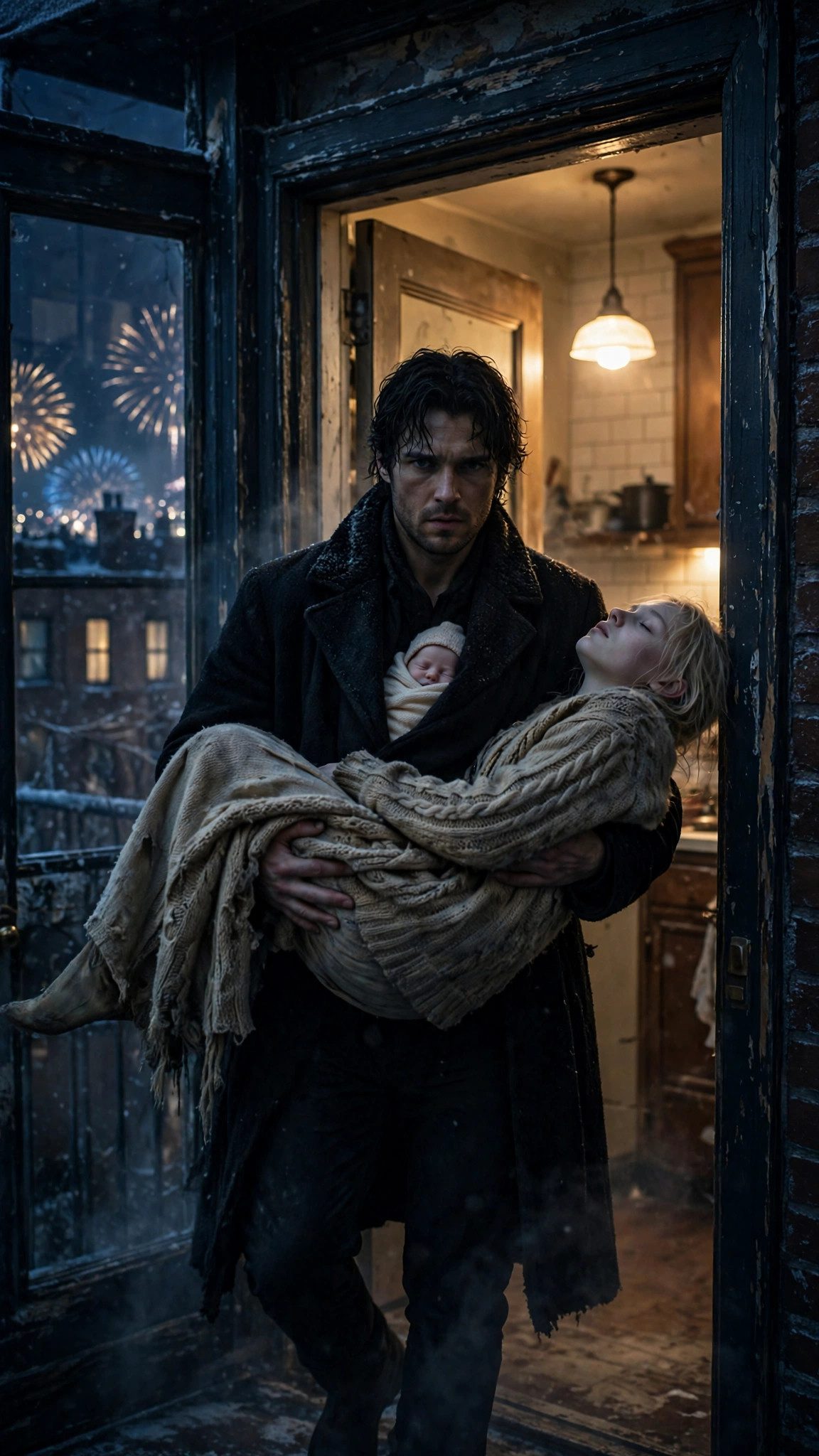
Maya came home from the hospital nine days later, on a cold, bright morning in the middle of January. The apartment was different. I had hired a cleaning crew to scrub every room, and I had thrown away the thin blanket and the hard plastic chair and the cup of instant noodles, and I had restocked the refrigerator myself — salmon, fruit, broth, vitamins, milk, formula, bottled water, everything the doctors had recommended, twice over. I had hired a nurse to come every day for the first month, a kind woman named Rosa who had raised four children of her own and who looked at Maya the way a mother is supposed to look at a daughter. I had changed the locks. I had installed new cameras, in every room, with the feed going directly to my phone and to no one else's.
Maya walked through the door slowly, holding Liam in her arms, and she looked around at the apartment like she was seeing it for the first time. She went to the kitchen. She opened the refrigerator. She stood there for a long moment, just looking at the food, and then she closed the door and she turned to me and she said, "It feels different. It feels like ours again."
"It is ours," I said. "Just ours. No one else gets a key. No one else gets to decide what happens in this home."
The first week at home was hard. Maya was still weak. Her incision was healing, but it hurt when she moved too fast, and she tired easily, and she woke up in the night with nightmares. In the nightmares, she was back in the cold kitchen, sitting on the plastic chair, and the phone was on top of the refrigerator where she couldn't reach it, and her mother-in-law was standing in the doorway, telling her that if she called David, she would lose her baby. She would wake up shaking, and I would hold her, and I would tell her the same thing every time: "You're safe. You're home. No one can hurt you here."
Liam grew stronger every day. He gained weight. His cry got louder. He started to smile — not at first, but by the third week, he smiled at Maya, and then he smiled at me, and the first time he smiled at me I sat down on the floor of the nursery and cried like a child. I had missed the first eleven days of his life. I would never get those days back. But I was here now, and I was going to be here for every day after that.
Chloe came to visit every other day. She brought food. She brought books. She sat with Maya and talked about normal things — movies, recipes, the weather — and slowly, carefully, the two of them built something new. It was not the relationship they had before. It was something more honest. Chloe did not pretend that nothing had happened. She apologized, more than once, and she meant it, and Maya forgave her, because Maya understood what it was like to trust the wrong person and to pay for it.
Mark was gone. He had left the house in Queens the day after I confronted him, and he had not come back. Tony told me he had gone to stay with a cousin in New Jersey, and that he was working in a warehouse, paying off his debts a little at a time. I had given him a choice: pay back every cent he stole, or face the consequences through other channels. He had chosen to pay it back. It would take him years. That was his problem now, not mine. Chloe's divorce was moving forward. She cried about it sometimes, when she thought no one was looking. But she never once asked me to take him back, and she never once defended what he had done.
My mother came back from Miami after two weeks, when the money ran out. She called me from the airport. Her voice was different now — smaller, thinner, the voice of a woman who had discovered that the world was not as soft as she had thought it was.
"David," she said, "I'm home. Can I come see the baby?"
"No," I said.
"David, please. I'm your mother."
"You were my mother," I said. "And then you went to Miami and left my wife to die. You don't get to come see the baby. You don't get to come to this apartment. You don't get to call yourself his grandmother until you understand what you did."
"I didn't mean for it to go that far," she said. Her voice was shaking. "I didn't mean for her to get sick. I just wanted — I just wanted you to see that she wasn't right for you. I wanted you to come home to me. I wanted things to go back to the way they were before you married her."
"Before I married her, you had a son who trusted you," I said. "Now you have a son who knows exactly who you are. That's what you wanted, isn't it? For things to go back to the way they were? Well, this is the way they are now."
I hung up. I did not feel triumphant. I did not feel vindicated. I felt tired, and sad, and strangely empty, the way you feel after you have cut something out of your life that was poisoning you, and you know you did the right thing, and it still hurts.
My mother called again the next day. And the next. And the next. Each time, her voice got a little smaller. Each time, she said a little more. She said she was sorry. She said she had made a mistake. She said she missed me. She said she missed Liam, even though she had never held him. I listened, and I did not answer, because I was not ready. I was not ready to forgive her, and I was not ready to let her back into our lives, and I was not going to pretend otherwise just because she was my mother.
It was Maya who finally said the words I could not say to myself. We were sitting in the living room one evening, in late February, and Liam was asleep in his bassinet, and the apartment was warm, and Rosa had just left for the night, and Maya looked at me and said, "David, your mother called me today."
I sat up straight. "What did she say?"
"She said she was sorry," Maya said. "She cried. She said she had been wrong about me. She said she was afraid of losing you, and that fear made her cruel, and that she was sorry. And David — I believe her. Not all of it. Not yet. But I believe she is sorry."
"Do you want me to let her back in?" I asked.
"I want you to decide," Maya said. "She is your mother. But I want you to know something. I forgive her. Not because what she did was all right. It wasn't. It will never be all right. But I forgive her because I don't want to carry her around with me for the rest of my life. I don't want her to live in my head. I want to be free of her. And the only way I know how to be free is to forgive her and let her go."
I thought about that for a long time. I thought about my father, and what he used to say about family. I thought about Maya, and Liam, and the life we were building. And I realized that forgiveness was not the same as forgetting, and it was not the same as letting someone back in. Forgiveness was something you did for yourself. Letting someone back in was something else entirely, and it had to be earned.
I called my mother the next day. I told her that Maya had forgiven her, and that I was working on it, and that if she wanted to be part of our lives again, there were conditions. She would pay back the fourteen thousand dollars, every cent, on a schedule we agreed on. She would apologize to Maya in person, face to face, and she would mean it. She would never again speak to Maya the way she had spoken to her in that kitchen. She would never again threaten her, or manipulate her, or try to come between us. And her visits with Liam would be supervised, by me or by Maya, until we were sure — really sure — that she could be trusted.
My mother agreed to all of it. She cried. She said she would do anything. She said she would pay back the money. She said she would apologize. And for the first time in my life, I believed that she meant it, because for the first time in my life, she had something to lose that she actually valued: us.
I did not let her come to the apartment that day. I told her we would start slowly. A phone call. Then a visit, in a public place, with me there. Then, maybe, someday, she could hold her grandson. But slowly. On our terms. Not hers.
That night, Maya and I sat together on the couch, and Liam slept in his bassinet beside us, and the apartment was warm, and the refrigerator was full, and the heat was on, and I thought about what a family really was. It was not blood. It was not obligation. It was not the people who shared your last name. A family was the people who showed up. The people who told the truth. The people who stayed. And the people who, when they failed you, did the hard work of earning their way back.
I had lost a mother that winter. I had lost a brother-in-law. I had almost lost my wife and my son. But I had gained something too. I had gained a family of my own choosing — a wife who had survived eleven days of cruelty and come out stronger, a son who smiled at me like I was the whole world, and a sister who had chosen the truth over comfort. It was a small family. But it was real. And it was mine.
The first visit happened in March, in a small café near the park, on a Sunday afternoon. I chose the place. I chose the time. I sat next to Maya, and Liam was in his stroller beside us, and my mother walked in alone, wearing a plain coat and no makeup, carrying a small wrapped package in her hands.
She looked older than I remembered. The trip to Miami had not been kind to her. She had lost weight. Her hair was grayer. She sat down across from us, and she put the package on the table, and she looked at Maya, and she did not look away.
"Maya," she said, "I owe you an apology. A real one. Not a phone call. Not a message. Face to face, the way it should have been from the beginning."
Maya nodded. She did not speak. She waited.
"I was cruel to you," my mother said. Her voice shook, but she kept going. "I took your food. I hid your medicine. I turned off the heat. I threatened you with losing your son. I did all of that, and I told myself I was doing it for the family, but I wasn't. I was doing it because I was afraid. I was afraid that David loved you more than he loved me. I was afraid that you would take him away from me. And instead of saying that out loud, like an adult, I tried to break you so that he would have no choice but to come back to me. It was wrong. It was evil. And I am sorry. I am so sorry, Maya. I don't expect you to forgive me. I don't deserve it. But I needed you to hear me say it."
Maya was quiet for a long moment. Then she reached across the table and took my mother's hand. "Thank you," she said. "Thank you for saying it. Thank you for meaning it."
My mother started crying. She cried the way a person cries when they have been holding something inside for a very long time and it finally breaks open. She cried, and Maya held her hand, and Liam made a small sound in his stroller, and the waitress brought us coffee, and for a moment, in that small café, it felt like something was beginning to heal.
My mother opened the package on the table. Inside was a small silver rattle, old and tarnished, with a tiny bell inside it. "This was David's," she said. "When he was a baby. My mother gave it to me, and I gave it to David, and I have kept it all these years. I want Liam to have it now."
I took the rattle. I held it in my hand. It was heavier than I expected. I shook it gently, and the bell made a soft, clear sound, and Liam turned his head toward it, and he smiled.
"Thank you, Mom," I said. And I meant it. Not because everything was fixed. It wasn't. But because she had come, and she had told the truth, and she had brought the rattle, and that was a beginning.
That spring, I made another change. I restructured the business. I closed the shipping accounts that Mark had used to steal from us. I brought in an outside auditor, a man with no connection to my family, and I told him to look at everything, every account, every transfer, every dollar, going back ten years. I hired a new head of operations, a woman named Elena who had run a logistics company in Chicago and who had no patience for secrets. And I started the long, slow process of moving the family business toward legitimacy — real contracts, real taxes, real books that anyone could look at. It would take years. It would cost money. But I was done with the old ways. I was done with ledgers hidden in safes and money moving through shell companies in the dark. I had a wife and a son, and I wanted to build something they could be proud of, something that would not require them to lie, or to hide, or to be afraid.
Maya went back to work in the summer, part-time at first, baking in the mornings while Rosa watched Liam. She made a cake for Liam's first birthday that was so beautiful people took photographs of it before they ate it. Chloe got her divorce finalized in June, and she started a new job, and she laughed more than she had in years. And my mother — my mother paid back the fourteen thousand dollars, a little every month, on time, without being asked. She sent a check, and a note, and the note always said the same thing: "I am sorry. I am trying."
It was not a perfect family. It would never be a perfect family. But it was an honest one. And that was enough.