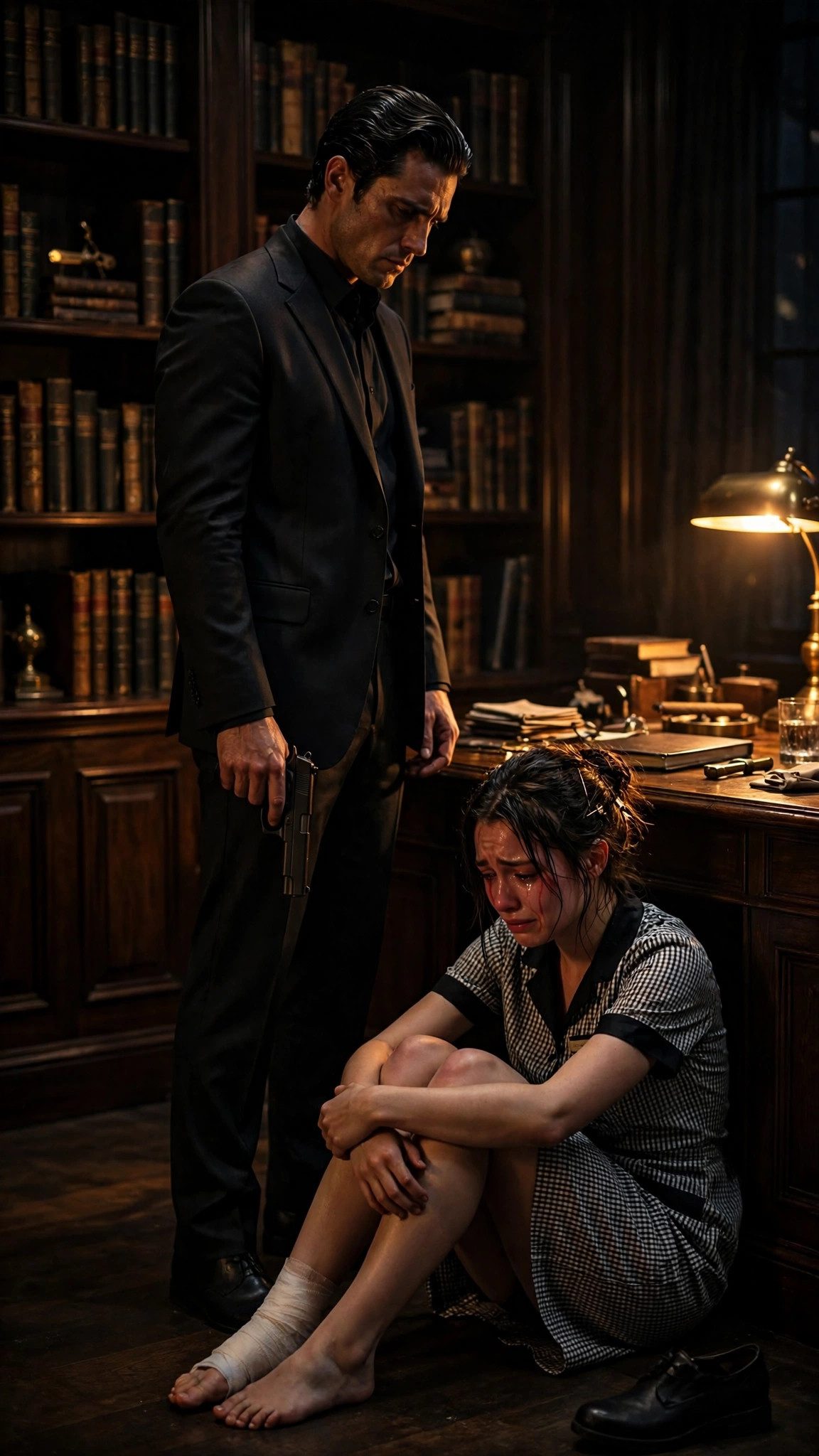
Thomas arrived at the study door less than two minutes after Gabriel called him. He was a massive man, six foot five, with shoulders like a doorway and hands that had broken bones for a living, and he filled the doorframe the way a wall fills a room. He took one look at Clare, sitting in the leather armchair with a bandaged heel and mascara down her face, and one look at Gabriel, standing behind his desk with his gun lying on the wood, and his face did not change at all. Thomas had worked for Gabriel Hayes for nine years, and in nine years he had learned that the only safe response to something he did not understand was to wait for orders.
"Thomas," Gabriel said. "This is Clare Dawson. She works for the catering company. Her sister is at St. Jude's. I need you to do three things. First, take her to the hospital. Not in my car. In the grey sedan, the one nobody knows. Drive her yourself. Second, pay the hospital bill. All of it. Thirty thousand dollars, before six in the morning. Use the Meridian account. Third, do not let anyone see her. Do not let anyone talk to her. Do you understand?"
Thomas nodded once. "Understood."
"Wait," Clare said. She stood up too fast, and her heel screamed, and she caught herself on the arm of the chair. "I can't just leave. I have a shift. Higgins will fire me. I need this job. I need—"
"Higgins will not fire you," Gabriel said. "Higgins will not say a word to you again unless I tell him to. Thomas will bring you back here before dawn. Your sister will be in a private room by the time you return. Go with him. Now."
Clare looked at Gabriel. She looked at Thomas. She looked at the door. Then she picked up her shoe, held it in her hand because her heel hurt too much to put it back on, and followed the massive head of security out of the study in her stocking feet.
Gabriel stood alone in the amber light. He picked up his gun, checked it, and slid it back into his shoulder holster. Then he walked to the window again and looked down at the ballroom.
The party was reaching its peak. The jazz band had moved into a fast number. Couples were dancing. Waiters moved through the crowd with silver trays. At the far end of the room, near the fireplace, Sullivan stood with two of his men, a glass of Scotch in his hand, watching the staircase. Waiting for Gabriel to come back down.
Gabriel did not go back down. He went to the small safe behind the painting of the river, opened it, and took out a thin folder he had kept there for three months. Inside were photographs, bank records, and a single sheet of paper with a list of names. At the top of the list, in Gabriel's own handwriting, was a name: Sullivan.
For three months, Gabriel had known that Sullivan was testing him. The veiled threats. The men who had started showing up at Hayes docks asking questions. The shipment that had gone missing in March, and the driver who had sworn he had never seen the men who took it. Sullivan wanted the South Side docks, and he wanted the river routes, and he wanted Gabriel's chair. He was an aging brute, and he was running out of time, and aging brutes with no time left are the most dangerous men in the world.
Gabriel had been planning to deal with Sullivan after the birthday party. He had been planning a quiet conversation, a warning, a line drawn in the sand. He had not planned for a crying girl in his study, or a hospital bill, or the strange, unfamiliar feeling in his chest that had started the moment he lowered his gun.
He put the folder back in the safe and closed the painting. Then he went downstairs by the private stairs, through the library, and into the ballroom from the side door, where nobody would notice him entering. He needed to see the room. He needed to see Sullivan's face when he realized Gabriel was not coming down for the toast.
He found a place near the bar, in the shadow of a pillar, and he watched.
The clock above the fireplace read eleven forty. Twenty minutes to midnight. The toast was scheduled for midnight exactly, a tradition Gabriel's father had started and Gabriel had never bothered to stop. At midnight, the head of the house would raise a glass, and every man in the room would drink to his health, and his long life, and his continued good fortune.
Gabriel never drank at the toast. He raised a glass of water, and everyone pretended not to notice.
He watched the waiters moving through the crowd. He watched Higgins, the perpetually sweating floor manager, standing near the kitchen doors with a clipboard, his eyes flicking around the room. Higgins looked nervous. More nervous than a floor manager should look at a party that was going well. Gabriel filed the observation away. Gabriel filed everything away. That was how he had survived twelve years in the chair.
At eleven fifty, a waiter carrying a silver tray loaded with crystal champagne flutes moved toward the fireplace. Gabriel watched him. The waiter was young, new, his hands shaking slightly under the weight of the tray. Gabriel had seen him earlier that evening, carrying trays to the west wing. He did not know the boy's name.
At eleven fifty-five, Higgins crossed the ballroom to the bar. He spoke to the bartender. The bartender nodded and set a single crystal glass of water on the bar, separate from the champagne. Gabriel's glass. The glass he raised every year at midnight, the glass everyone watched him drink from.
Higgins picked up the glass himself. He did not hand it to a waiter. He carried it across the room, toward the fireplace, toward the place where Gabriel was supposed to stand.
Gabriel stepped out of the shadow of the pillar.
"Stop," he said.
Higgins froze. The glass trembled in his hand. Water sloshed against the rim.
"Mr. Hayes," Higgins said, his voice cracking. "I didn't see you there. I was just bringing your glass. For the toast. It's almost midnight."
"I know what time it is," Gabriel said. He held out his hand. "Give me the glass."
Higgins hesitated. His eyes darted toward Sullivan, standing by the fireplace. Sullivan was watching them. His face was very still.
"Give me the glass, Higgins," Gabriel said, very quietly.
Higgins handed it over. His hand was shaking so badly that water spilled over the rim and onto Gabriel's fingers. Gabriel took the glass, held it up to the light, and looked at it. It looked like water. Clear, still, ordinary. But Gabriel had spent twelve years learning to see the things that were not there, and there was something about the way Higgins was breathing, and the way his eyes would not meet Gabriel's, and the way Sullivan had gone very still by the fireplace, that told him everything he needed to know.
"Thomas," Gabriel said into his phone, without taking his eyes off Higgins. "The tray. The one Clare left in the kitchen. The silver tray with the champagne flutes. I need it tested. Now. And I need the doctor. The one on call tonight. Bring him to the library."
He ended the call. He looked at Higgins.
"Who paid you?" Gabriel asked.
Higgins's face went white. "I don't know what you mean, Mr. Hayes. I swear. I just brought the glass. It's water. It's only water."
"Then drink it," Gabriel said, and held the glass out to him.
Higgins stared at the glass. He did not take it. His hands hung at his sides, shaking. Sweat ran down his face in thin lines. Around them, the ballroom had gone quiet. The band had stopped playing. The dancers had stopped dancing. Every man in the room was watching.
"Drink it, Higgins," Gabriel said again, his voice flat and cold. "If it is only water, you have nothing to fear."
Higgins took a step backward. His foot caught on the edge of the carpet, and he stumbled. A waiter caught his arm. Higgins pulled free.
"I can't," he whispered. "I can't. He said it was only to make you sick. He said it would only make you sick for a few days, so he could take the docks while you were weak. He said nobody would die. He swore nobody would die."
"Who said that, Higgins?" Gabriel asked.
Higgins's eyes flicked toward the fireplace. Toward Sullivan. And Sullivan, standing with a glass of Scotch in his hand, smiled a thin, cold smile, and raised his glass in a small, mocking toast.
Gabriel did not move. He did not raise his voice. He did not reach for his gun. He stood in the middle of his own ballroom, holding a glass of poisoned water, and he looked at the man who had tried to kill him on his birthday, and he thought about a girl crying on the floor of his study.
If Clare had not abandoned that tray in the kitchen, the poisoned glass would have reached him an hour ago. If Clare had not walked into his study, crying for her sister, Gabriel would have come downstairs at midnight, raised the glass, and drunk.
A crying girl in a catering uniform had saved his life, and she did not even know it.
"Thomas," Gabriel said into his phone, his voice calm and even. "Take Mr. Higgins to the library. Keep him there. Do not let him speak to anyone. I will be there in five minutes."
He set the poisoned glass down on the bar, carefully, as if it were made of thin ice. Then he turned to the room full of watching men, and he smiled, a slow, cold smile that did not reach his eyes.
"The toast is cancelled," he said. "Enjoy the party."
Then Gabriel Hayes walked out of his own ballroom, through the library door, and went to find out exactly how much Sullivan had paid to have him killed on his thirty-sixth birthday.
He did not know it yet, but the night was only beginning.
His phone buzzed as he crossed the ballroom. A text from Thomas, sent from the hospital parking lot.
"Bill paid. Thirty thousand. Private room, fourth floor. Sophie is stable. Fever down to 100.4. Clare is holding her hand. The nurse says she will make it through the night."
Gabriel stopped walking. He stood in the middle of his own ballroom, surrounded by music and laughter and expensive perfume, and he read the text a second time. Fever down. She will make it through the night. He thought about the deposit, and the crowded ward, and the nurse pulling a sheet over a fifteen-year-old girl's face, and he felt something loosen in his chest, something that had been tight for eighteen years.
He texted back. "Thank you. Stay with them. If the fever spikes again, call me first, then the doctor."
He put the phone away. He looked around the ballroom, at the men drinking Scotch and the women in glittering dresses, and he felt very far away from all of it, as if he were watching the party through a thick pane of glass. None of these people knew what had just happened upstairs. None of them knew that a girl had cried on his study floor, or that a hospital bill had been paid, or that a nineteen-year-old nursing student was going to live to see the morning. None of them knew that the man they feared, the coldest man in the room, had knelt on the floor and bandaged a stranger's heel.
Gabriel walked to the kitchen. He needed to see the tray. The silver tray Clare had abandoned on the stainless steel counter, loaded with crystal champagne flutes. He found it where she had left it, untouched, the flutes still standing in their neat rows. He lifted one. He held it up to the light. It looked like champagne. Pale gold, still, ordinary.
Dr. Patel arrived ten minutes later, carrying his black bag, his face tired but his hands steady. Gabriel handed him the flute. The doctor took a small kit from his bag, drew a thin strip of paper from a vial, and dipped it into the glass. He waited. He watched. The paper turned a faint, unmistakable blue.
"Same poison," Dr. Patel said quietly. "In the champagne. Whoever prepared this tray meant for it to reach the toast. If you had drunk from this glass at midnight, Mr. Hayes, you would not have woken up this morning."
Gabriel nodded slowly. He looked at the tray, at the neat rows of flutes, at the kitchen around him, all stainless steel and steam and shouting chefs who had no idea what had almost happened in their own room.
"Test them all," Gabriel said. "Every glass on that tray. Every bottle it came from. I want to know how many were poisoned, and which ones, and who poured them."
Dr. Patel nodded. He set to work, methodical and silent, while Gabriel stood in the doorway of the kitchen and watched the party through the swinging doors, and thought about Higgins, and Sullivan, and the man in the alley with the scar on his left hand, and the girl crying on his study floor who had saved his life without knowing it.
The toast was scheduled for midnight. It was eleven forty-five. In fifteen minutes, the head of the house was supposed to stand by the fireplace, raise a glass, and drink to his own health, while every man in the room watched him swallow.
Gabriel Hayes was not going to drink anything that night. Not from that tray. Not from any tray. He was going to find the man who had tried to kill him, and he was going to make him understand, very clearly, what happened to men who poisoned a Hayes in his own house.
But first, he was going to make sure that a nineteen-year-old girl named Sophie Dawson lived to see the morning. Because that, he was beginning to understand, was the only thing that mattered.