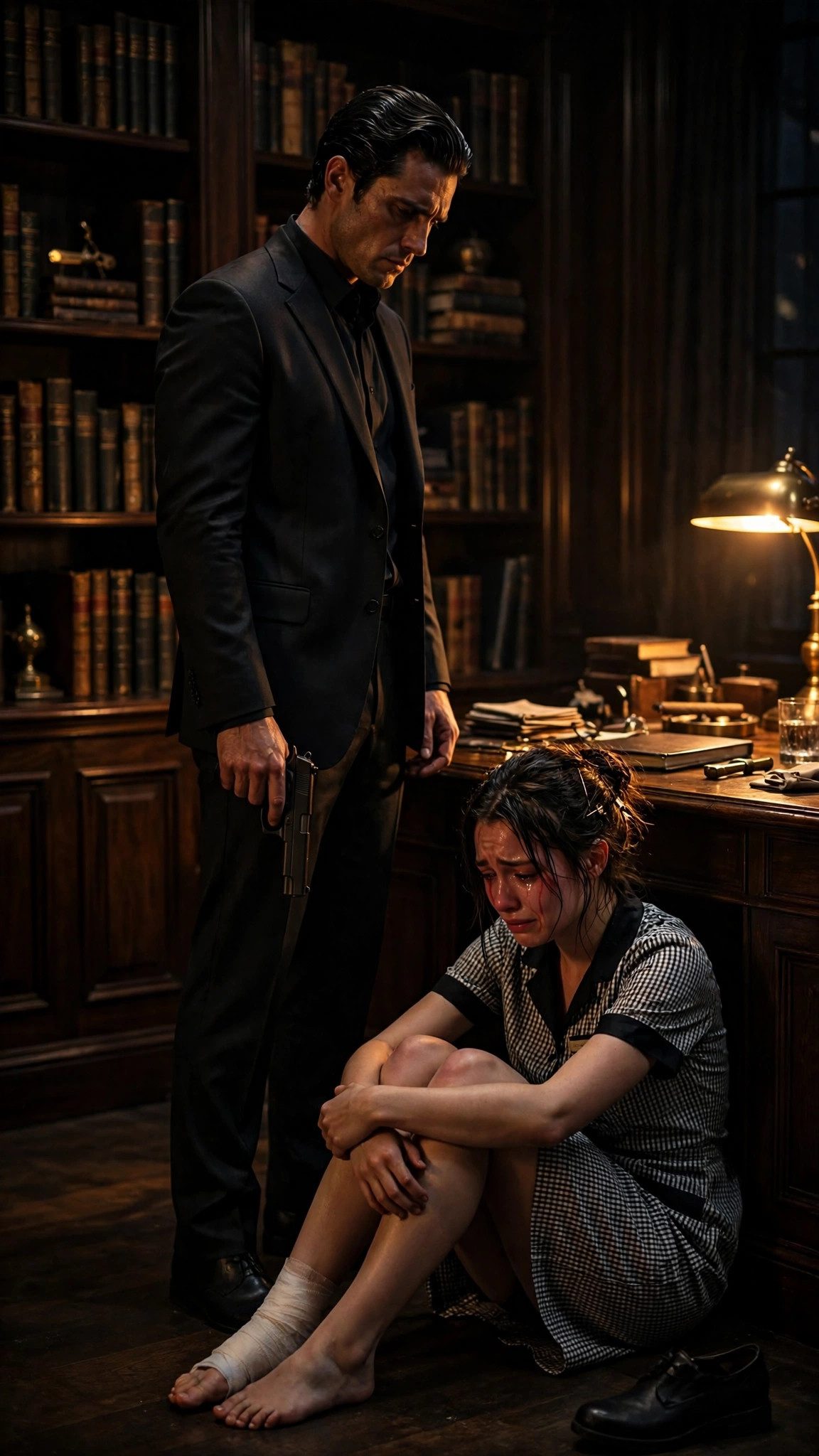
Mercy, Gabriel Hayes learned, was more expensive than revenge.
Revenge was simple. Revenge was a bullet, a body, a message. Revenge took an afternoon and a shovel. Mercy took weeks. Mercy took lawyers, and phone calls, and meetings, and men sitting in rooms arguing about what was fair, and what was just, and what would keep the peace. Mercy took patience, and Gabriel Hayes had never been a patient man.
But mercy, he was learning, was also the only thing that left you able to look at yourself in the mirror the morning after.
Sullivan left the city before dawn, as the council had ordered. He took one suitcase and his two men, and he drove south in a black car with the headlights off, and by the time the sun came up over the river, he was gone. Gabriel did not watch him go. He did not need to. He had Thomas confirm the departure, and then he put Sullivan out of his mind, the way a man puts a closed book back on a shelf.
Higgins was harder.
Higgins had tried to kill him. Higgins had taken twenty thousand dollars and poured poison into a glass and carried it across a ballroom, and if a crying girl had not walked into the wrong room on the wrong night, Gabriel Hayes would be dead. By every rule Gabriel had ever lived by, Higgins should have been dead too. That was the rule. That was the world. A man who sells out his boss does not get to walk away.
But Higgins had a twelve-year-old daughter. And Higgins had told the truth when it mattered. And Higgins had cried in the library, not for himself, but for his daughter, and Gabriel had seen his own face in that fear, the face of a seventeen-year-old boy sitting beside his sister's bed in a crowded ward, promising her that someone would come and fix everything.
So Gabriel did something he had never done before. He called a lawyer. A real lawyer, not a family lawyer, a man with a clean suit and a quiet office downtown, and he asked the lawyer what would happen to a man who confessed to attempted murder, cooperated fully, and testified against the man who had paid him.
"Eight years," the lawyer said. "Maybe less, with good behavior. He would be out in five."
Gabriel thought about five years. He thought about a twelve-year-old girl growing up without her father for five years. He thought about Sophie Dawson, nineteen years old, lying in a hospital bed, and Clare Dawson, twenty-four years old, working three jobs and sleeping four hours a night, and he thought about how many ways a family could be broken by a bill, or a bullet, or a bad decision made in a moment of fear.
"Make it happen," Gabriel said. "He testifies. He cooperates. He goes to prison, and when he comes out, he has a job. Not in my house. Not near me. A job at the docks, under Thomas's eye, where I can see him. And his daughter's school fees are paid. All of them. Until she graduates."
The lawyer stared at him. "Mr. Hayes, are you sure? This is not how these things are usually done."
"I am sure," Gabriel said. "This is how I am doing it now."
He hung up. He looked out the window of his study, at the garden below, where the first leaves of autumn were beginning to fall. He had spent twelve years in the chair, and in twelve years he had never once shown mercy to a man who tried to kill him. He had never once wondered whether that made him strong or simply afraid.
Now he was wondering.
Clare came to the house three days after the sit-down. She came in the grey sedan, with Thomas driving, and she walked up the front steps in a simple dark coat, her hair loose, her bandaged heel in a soft shoe, and she knocked on the front door like a guest, not like a woman who had saved a man's life.
Gabriel met her in the library. He did not sit behind his desk. He sat in the armchair across from her, the way two people sit when they are trying to be honest with each other.
"Sophie is home," Clare said. "She came home yesterday. The doctors say the infection is gone. She is weak, but she is going to be all right. She is going to be a nurse. She told me this morning. She said she wants to work in the children's ward, so sick kids don't have to be scared alone."
Gabriel nodded. "I am glad."
"I came to thank you," Clare said. "For the hospital. For the money. For everything. I don't know how to thank you. I don't know how anyone thanks a man for saving her sister's life."
"You already thanked me," Gabriel said. "You cried in my study. That was enough."
Clare laughed, a small, surprised sound. "That is the strangest thank-you anyone has ever given me credit for."
"It was the truest thing I have seen in eighteen years," Gabriel said.
They sat in silence for a moment. The library was quiet. The old paper and leather smell wrapped around them like a blanket. Outside, the leaves fell in the garden, gold and red, drifting down through the afternoon light.
"I have to ask you something," Clare said. "And I need you to tell me the truth."
"Ask me," Gabriel said.
"Why did you do it? Why did you pay the bill? Why did you protect us? You didn't know me. You didn't know Sophie. You are a man who points guns at strangers in his study. Why did you help us?"
Gabriel looked at her. He thought about Anna, fifteen years old, dying in a crowded ward because a hospital wanted a deposit first. He thought about the promise he had made at her funeral, standing in a black suit that was too big for him. He thought about eighteen years of being the coldest man in the room, and how tired he was of being cold.
"Because once," he said, "there was a girl in a hospital bed, and nobody came. And I have spent eighteen years making sure I would never be the man who did not come."
Clare's eyes filled with tears. She did not cry. She blinked them back, hard, the way a woman does when she has cried enough for one lifetime and refuses to cry anymore.
"I have to tell you something too," she said. "I am not going to be your kept woman. I am not going to live in your house and wear your clothes and be grateful. I work. I have always worked. If I stay, I stay because I choose to stay, not because I owe you thirty thousand dollars."
Gabriel nodded. "I would not want you any other way."
"I mean it," Clare said. "I will work in your kitchen. I will run your household. I will earn my place here, the way I have earned everything in my life. And if one day I decide to leave, I will leave. And you will let me go."
"I will let you go," Gabriel said. "But I hope you do not leave."
Clare stood up. She walked to the door. Then she stopped, and she turned around, and she looked at him, and she smiled, a real smile, the first real smile Gabriel had seen from her, and it changed her whole face.
"My sister is going to be a nurse," she said. "And I am going to be the woman who stood in a warehouse on Pier Nine and held your hand in front of forty dangerous men. I think we are both going to be all right."
She left. Gabriel sat in the library, alone, in the amber light, and he thought about mercy, and what it cost, and what it was worth.
Mercy had cost him a poisoned glass, a sit-down, a council vote, a lawyer's fee, and eighteen years of being the coldest man in the room.
Mercy had given him a girl who cried in his study, and her sister who lived, and a hand in his in front of forty dangerous men, and a reason to wake up in the morning that had nothing to do with survival.
Gabriel Hayes had spent eighteen years believing that being strong meant never needing anyone.
He was beginning to understand that being strong meant something else entirely.
It meant refusing to leave someone behind.
Sophie came home on a Tuesday, in the grey sedan, with Thomas driving and Clare sitting beside her in the back seat, holding her hand the whole way. The apartment was small, two rooms above a bakery, with a window that looked out over the street and a radiator that made terrifying noises every winter. Clare had cleaned it the night before, scrubbed the floors, changed the sheets, put fresh flowers on the table. Sophie walked in slowly, leaning on Clare's arm, and she stopped in the doorway, and she looked around, and she started to cry.
"It is so good to be home," she whispered. "I thought I would never see this place again."
Clare helped her to the couch. She made tea. She put a blanket over Sophie's legs. She sat beside her, and they did not talk for a long time. They did not need to. They simply sat together, in their small apartment above the bakery, listening to the sounds of the street below, alive, both of them alive, and that was enough.
The next morning, Clare went to the house for the first time as an employee, not as a stranger crying on a study floor. Thomas met her at the door. He showed her the kitchen, a vast room with copper pots hanging from the ceiling and a stove big enough to cook for fifty people. He introduced her to the cook, an older woman named Mrs. Alvarez, who had worked in the house for twenty years and who looked Clare up and down with sharp eyes and then nodded, once, as if to say that she would do.
"You will run this household," Gabriel had told her. "The kitchen, the staff, the accounts. Mrs. Alvarez will teach you. You will earn your place here, the way you have earned everything in your life. And you will be paid fairly, and on time, and no one will ever shout at you in this house again."
Clare took the job seriously. She learned the household the way she had learned everything in her life: by watching, by asking, by working harder than anyone else. Within a month, the kitchen ran like a clock. Within two months, the staff came to her with their problems, because she listened, and because she fixed things, and because she never once used her position to make anyone feel small.
Gabriel watched all of this from a distance, the way he watched everything, quietly, carefully, filing it away. He watched Clare teach Mrs. Alvarez how to make Sophie's favorite soup. He watched her stay late to help a young maid study for her driving test. He watched her stand in the garden one evening, her face turned up to the sky, breathing in the autumn air, and he thought about how strange it was that a house that had been a fortress for twelve years was slowly, quietly, becoming a home.
The Anna Hayes Foundation paid its first bill in October. A mother at St. Jude's, a woman named Rosa, whose son needed surgery and whose insurance had run out. Gabriel did not meet her. He did not need to. He signed the check, and Thomas delivered it, and the boy had his surgery, and he lived. Gabriel kept the letter Rosa wrote him in his desk drawer, next to the list of the other bills, and on bad nights, he read it, and he remembered why he was doing this.
One cold morning in November, Gabriel drove to the small cemetery on the edge of the city, alone, before the sun was fully up. He parked the black car at the gate, and he walked between the rows of stones, and he stopped at the small white marker half-hidden under the old oak tree. He laid white roses on the stone. He stood there for twenty minutes.
"I met someone, Anna," he said quietly, to the stone, to the oak tree, to the cold morning air. "Her name is Clare. Her sister is Sophie. She reminds me of you. She is brave the way you were brave. I think you would have liked her. I think you would have liked her very much."
He stood there a moment longer. Then he turned, and he walked back to the car, and he drove home, to a house that was no longer a fortress, and to a woman who had chosen to stay, and to a life he had never thought he would have.
That winter, Clare started a small tradition of her own. Every Sunday morning, she cooked breakfast in the big kitchen, pancakes and bacon and fresh coffee, and she invited the staff to sit down at the long table and eat together, all of them, no one standing, no one serving, everyone equal for one hour. Mrs. Alvarez grumbled at first, said it was not proper, said the staff ate in the kitchen and the family ate in the dining room, and that was how it had always been. But by the third Sunday, Mrs. Alvarez was the one flipping the pancakes, and by the fifth, she was the one telling the young maid stories about the house in the old days, laughing so hard she had to sit down. Gabriel would come downstairs on Sunday mornings and stand in the doorway, unnoticed, watching them eat and talk and laugh, and he would think about how strange it was that the thing he had feared most in his life, letting people in, had turned out to be the thing that saved him.