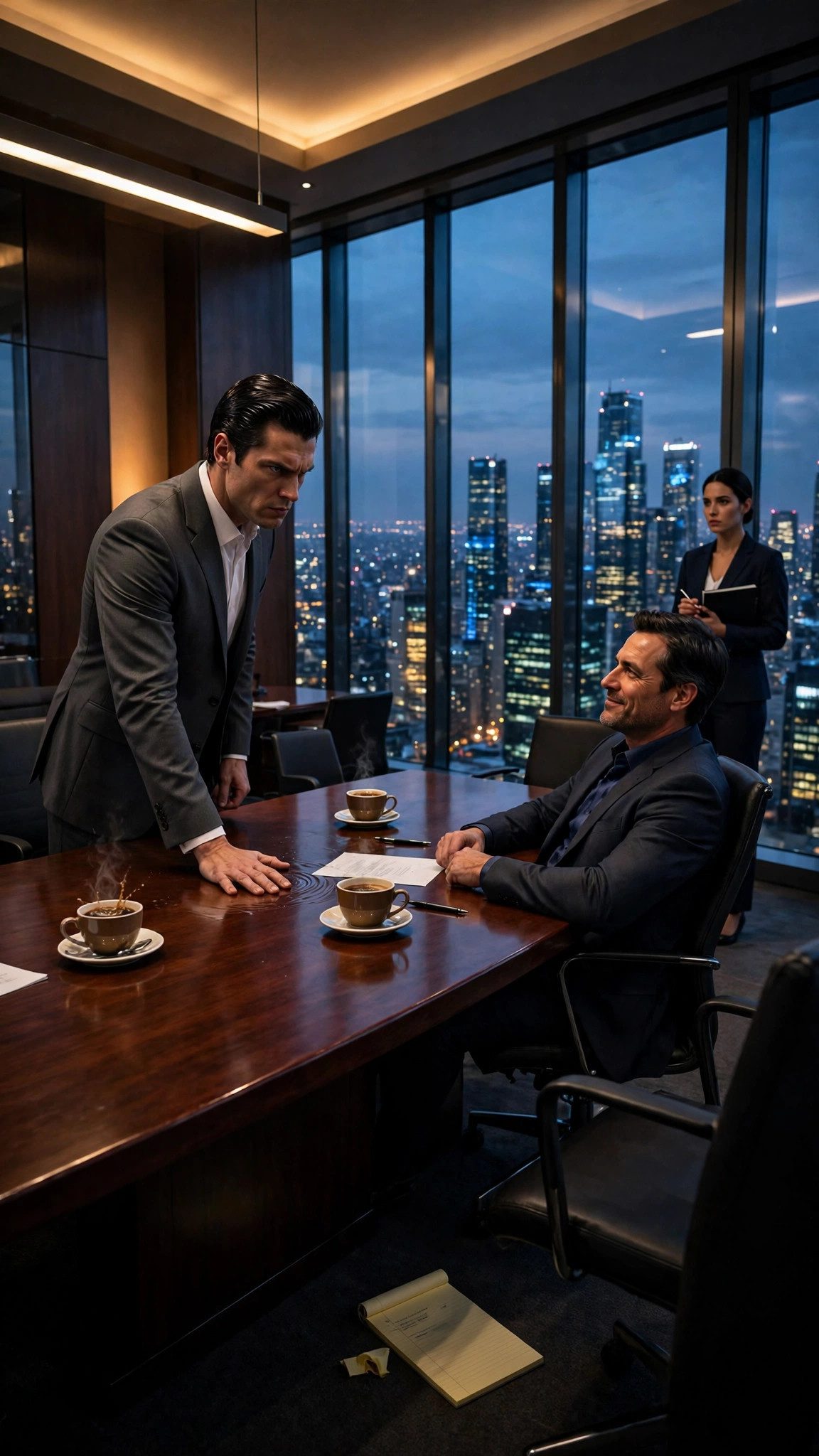
At 5:47 in the evening, thirteen minutes before I was supposed to meet Adrian in the empty conference room, my desk phone rang.
It was a number I did not recognize. I almost did not answer it. Ruth had warned me that morning: don't answer calls from numbers you don't recognize. But the phone kept ringing, and the office was nearly empty, and I thought — foolishly, I know now — that it might be a client, or a courier, or someone from the building about a delivery.
"Vescari Holdings, Tessa Morgan speaking."
"Miss Morgan." The voice was smooth, and confident, and I knew it at once. "This is Vincent Calder. I hope I'm not interrupting."
My hand tightened around the phone. "Mr. Calder. What do you want?"
"Only to talk," he said. "I think we have a great deal to discuss, you and I. For instance, I think we should discuss what you are worth."
"I don't know what you mean."
"Oh, I think you do." There was a smile in his voice, the same smile he had worn in the conference room that morning. "This morning, in front of sixteen men, Adrian Vescari ended a forty-million-dollar deal because of you. Do you know what that means, Miss Morgan? It means you are worth forty million dollars. At least. Possibly more. And a woman who is worth that much should be very careful. Because there are men in this city who would pay a great deal of money to own something worth forty million dollars."
"I am not something to be owned," I said. My voice was steady. I was proud of that. "And if you threaten me again, I will tell Mr. Vescari."
"Threaten you?" Vincent laughed softly. "My dear, I am not threatening you. I am warning you. There is a difference. A threat is something a man says. A warning is something a man says because he knows what is coming, and he would rather you were prepared. Adrian Vescari has enemies, Miss Morgan. Powerful enemies. And now that they know about you, they will come for you. Not because they hate you. Because you are the easiest way to hurt him."
"Then why are you calling me?" I asked. "If you're warning me, why not warn him?"
"Because," Vincent said, and his voice went very quiet, "I am one of those enemies. And I wanted you to hear it from me first."
The line went dead.
I sat at my desk with the phone in my hand for a long time. The office was empty now. The sun was going down over the river, and the light in the room had turned the color of old gold. At six o'clock, Adrian would be waiting for me in the conference room. I should have gone to him. I should have told him about the call immediately. But I was frozen. I was thinking about Sofia, and about the car bomb, and about the fourteenth of March, and about the fact that Vincent Calder had just told me, in so many words, that I was going to die.
Then the elevator opened, and Adrian walked out, and he took one look at my face and knew.
"What happened?" he asked.
"Vincent called," I said. "He said — he said I was worth forty million dollars. He said his enemies would come for me. He said he was one of them."
Adrian's face went very still. It was the stillness I had seen a hundred times in meetings, the stillness that meant he was calculating, the stillness that came before a decision. Then he did something I had never seen him do before. He picked up my desk phone, dialed a number from memory, and spoke three words into it.
"Now. My office."
Five minutes later, a man I had never seen before walked into the office. He was in his forties, with short gray hair and a plain dark suit, and he carried himself the way policemen carry themselves — as if he had spent his whole life walking into rooms where people did not want him. Adrian introduced him as Daniel Reyes. Special Agent, Federal Bureau of Investigation.
"Agent Reyes has been investigating Vincent Calder for two years," Adrian said. "The distribution deal was never just a deal. It was a front. Calder moves stolen goods, weapons, and drugs through his warehouses, and he has been using the Vescari distribution routes to do it. The forty million dollars was the price of my silence. If I signed, I would have become his partner. If I refused, he would have found another way to get what he wanted."
"And now he has found another way," Reyes said. He looked at me. "Miss Morgan, I need you to listen to me very carefully. Vincent Calder is a dangerous man. He ordered the bombing that killed Sofia Marchetti two years ago. We have never been able to prove it. But we have been building a case against him for eighteen months, and we are very close. What happened this morning — what he did in that conference room — tells me he is getting desperate. Desperate men make mistakes. And I need you to help me make him make one."
"What do you want me to do?" I asked.
"Nothing," Adrian said, sharply. "She is not going to be bait. I will not use her that way."
"Adrian," Reyes said, patiently, "I am not asking her to be bait. I am asking her to be careful, and to be smart, and to do exactly what I tell her. Vincent is going to try to reach her. He is going to try to frighten her, or bribe her, or take her. When he does, I need her to survive it, and I need her to remember everything. Can you do that, Miss Morgan?"
I looked at Adrian. I looked at Reyes. And I thought about my mother, and about Sunday dinner, and about the man who had held my hand that morning and told me he loved me.
"Yes," I said. "I can do that."
Reyes nodded. He gave me a number to call, day or night. He told me to change my routine, to vary the time I left the office, to never walk to my car alone. He told me that two of his agents would be watching my building from tonight onward, and that if I saw anything strange — a car that followed me, a man who waited too long in the lobby, a phone call from a number I did not know — I was to call him immediately.
Then he left. And Adrian and I were alone in the office, and the sun had gone down, and the city lights were coming on below the glass.
"I should have told you sooner," Adrian said. "About Calder. About the deal. About all of it. I kept it from you because I wanted to protect you. But keeping secrets is what put Sofia in that car. I will not make the same mistake twice."
"You didn't put Sofia in that car," I said. "Vincent did."
"Then help me stop him," Adrian said. "Help me finish this. And then, Tessa — then we will have the rest of our lives to be ordinary."
We stayed in the office until midnight, going through files, reading contracts, tracing the money that Vincent Calder had moved through his warehouses for three years. Adrian showed me everything: the shipping manifests, the bank transfers, the names of the men who worked for Calder, the routes he used, the warehouses where he stored what he was not supposed to store. He showed me the photograph of the car after the bombing. He showed me the police report. He showed me the card Vincent had sent to the funeral — white lilies, "My deepest condolences" — and I understood, finally, why Adrian had kept it in his drawer for two years.
"It is the only proof I have that he did it," Adrian said. "He sent flowers to her funeral. He wanted me to know. He wanted me to know that he could reach anyone, at any time, and that there was nothing I could do about it."
"There is something you can do about it," I said. "You can give it to Reyes. You can give him everything. And you can let the law do what your family has never been willing to do."
Adrian looked at me for a long time. Then he opened the drawer, took out the card, and set it on the desk between us.
"Tomorrow morning," he said, "I will give Reyes everything. Every file. Every contract. Every name. And then, whatever happens, we will face it together."
At midnight, he walked me to my car himself. He did not let me go alone. He stood beside me in the parking garage, looking at every shadow, listening for every sound, until I was safely inside my car with the doors locked. And as I drove home through the empty streets, I saw, in my rearview mirror, a black car pull out from the curb three blocks behind me and follow me all the way home.
I called Reyes from my apartment, my hands shaking. "There's a black car," I said. "It followed me from the office."
"Stay inside," Reyes said. "Lock your door. My agents are outside your building. You are safe tonight. But Miss Morgan — from now on, you do not go anywhere alone. Do you understand?"
"Yes," I said.
I locked my door. I sat on my couch in the dark. And I thought about the morning, and the question, and the hand slamming against the table, and the forty-million-dollar deal that had died in a single second.
The next morning, I arrived at the office at seven o'clock, the way I always did, and found a package on my desk.
It was a small white box, tied with a black ribbon, with no return address and no note. Ruth was standing beside my desk, her face pale, and she said, "It came by courier ten minutes ago. The courier didn't leave a name. I didn't open it. I didn't think I should."
I opened it. Inside the box, on a bed of white tissue paper, was a single white lily. And under the lily, folded in half, was a card. I knew what it would say before I read it. I had seen the card before — in Adrian's drawer, under a stack of contracts, kept for two years like a wound that would not heal.
"My deepest condolences."
My hands started to shake. Ruth took the box from me and set it down on the desk, very gently, the way you set down something that might explode.
"Call him," she said. "Call Adrian. Now."
Adrian came out of his office in less than a minute. He took one look at the box, one look at my face, and his own face went white — not with fear, but with a kind of cold, terrible anger I had never seen before, not even in the conference room when he slammed his hand against the table.
"Reyes," he said, and picked up my phone. "It's the lilies. He sent her the lilies."
Reyes arrived within the hour, with two agents and a forensics kit. They took the box. They took the card. They took fingerprints from the tissue paper. And while they worked, Adrian called a meeting of his council — the old men who had run the Vescari family for forty years, the men who had advised his father and his grandfather, the men who believed that problems in this city were solved with money, or with threats, or with silence.
They met in the conference room at noon. I was not invited. But I stood outside the glass wall with my notebook, the way I had stood for two years, and I heard every word, because the glass was not as thick as they thought it was.
"You should have signed the deal," said one of them — an old man named Carlo, who had been with the family since before Adrian was born. "Forty million dollars is forty million dollars. You do not throw away forty million dollars because of a secretary."
"She is not a secretary," Adrian said. His voice was very quiet. "She is the woman I love. And if any man in this room calls her a secretary again, he will leave this family."
There was a long silence. Then another voice — Salvatore, his uncle, old and shaking and unafraid. "He is right. I have watched this boy be alone for two years, and alone is no way for anyone to live. Not even him. Especially not him. If Calder wants a war, then let him have a war. But it will not be a war fought in the dark, the way our family has always fought. It will be a war fought in the light, with the law on our side, and the FBI at our backs. And if any man in this room disagrees, then he can leave now, and never come back."
No one left. No one spoke. And when the meeting ended, the old men filed out of the conference room one by one, and each of them, as he passed my desk, nodded at me — not the way men nod at a secretary, but the way men nod at a woman who belongs.
Adrian came out last. He stopped at my desk. He looked at the place where the white box had been. And he said, very quietly, "He sent you the lilies because he wanted me to know he could reach you. He wanted me to be afraid. But Tessa — I am not afraid anymore. I have been afraid for two years, and it did not save Sofia, and it did not save me. So from now on, I will not be afraid. I will be angry. And I will be patient. And I will let the law do what I could never do."
He picked up my notebook from my desk and handed it to me.
"Come with me," he said. "We are going to see Reyes. And we are going to end this."
Vincent Calder had been right about one thing. I was worth forty million dollars. Not because of what I was, but because of who loved me.
And that, I understood now, was the most dangerous thing in the world.