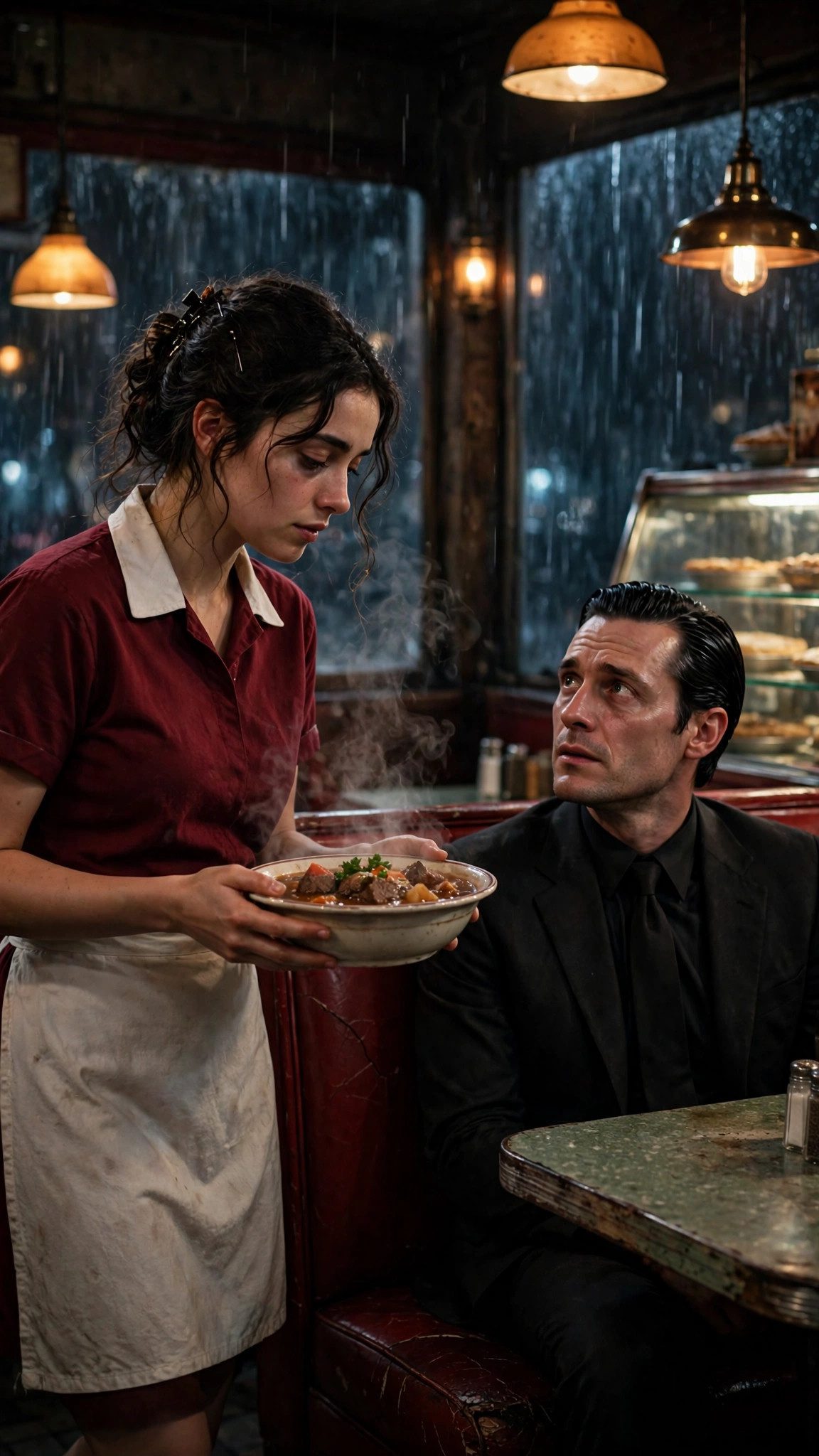
The most feared man in the city sat in a cracked red booth in my diner with five armed men watching my every step, and I was about to find out whether a bowl of stew could save his life or end mine.
His name was Gabriel Hayes, and I had never seen him before that night. I had only heard the name the way you hear about a storm coming — in lowered voices, in warnings, in the way grown men went quiet when it was mentioned. Gabriel Hayes had built his empire on loyalty, and now loyalty was the one thing he could no longer trust.
He sat with his back to the wall, the way dangerous men always do, his dark suit immaculate even in the rain, his slicked-back hair untouched by the storm outside. His face was pale. His shoulders were heavy, like a man carrying something too big for his frame. His eyes looked empty, the way a house looks empty when the lights have been off for a very long time.
And in front of him, on the chipped Formica table, sat a bowl of stew I had made with my own hands from ingredients I had opened myself, in front of witnesses, because that was the only way he would eat.
"Boss," Leo said quietly. Leo was Gabriel's oldest enforcer, a man who could break bones without hesitation, and that night his voice shook. "I watched her make it. Everything was opened fresh."
Gabriel's hand moved toward the spoon. It trembled. The most feared man in the city, a man who had survived bullets and federal investigations and brutal battles over territory, could not hold a spoon steady.
He lifted it to his mouth. He tasted it.
And his whole face changed.
It was not the face of a mafia boss anymore. It was the face of a little boy who had just walked into a kitchen he thought he would never see again. His eyes went wide, then wet, and his shoulders — those heavy, guarded shoulders — dropped like something inside him had finally let go.
The aroma rose from the bowl. Thyme. Roasted garlic. A faint hint of cinnamon.
He lowered the spoon. His lips parted. And he whispered a name I never expected to hear.
"Rosa."
My blood went cold. Rosa was the name of the woman who had raised me in Apartment 4B, the woman who had taught me that one recipe when I was nine years old, the woman who had been dead for six years. Nobody in that diner should have known her name. Least of all him.
"How do you know that name?" I asked, and my voice sounded far away, like it belonged to someone else.
He looked up at me, and for the first time that night his eyes were not empty. They were full of something I could not name — grief, wonder, hunger, all of it at once.
"Where did you learn to make that?" he asked.
And just like that, one dinner shift at a forgotten diner in the South End put me face-to-face with the most dangerous man in the city, and with a secret that had been buried for twenty years.
My name is Norah Bennett. I was twenty-four years old, exhausted, working nights while studying for my nursing exams, and all I wanted that night was to finish my shift and go home. I had no idea that the man in the cracked red booth had not eaten a real meal in eight days. I had no idea that his underboss had died face-first in a plate of lobster risotto two weeks earlier, poisoned by the very food he trusted. I had no idea that the bowl of stew in front of him was about to bring back a memory he thought he had buried forever.
I only knew what I saw through the kitchen window: a man who looked broken. A man who reminded me of the stray dogs I used to feed behind my old apartment building — terrified, starving, and dangerous only because they were desperate.
But to understand how a bowl of cheap diner stew ended up on the table of the most feared man in the city, I have to start eight days earlier, in a penthouse where a plate of Wagyu steak sat untouched, and a man who owned half the city was slowly starving to death because he trusted nobody.
Gabriel Hayes had built himself from nothing.
That was the story everyone told about him, and it was mostly true. He had grown up in a house with a kitchen that smelled of thyme and cinnamon, with a mother who sang while she cooked, and then that house had burned down — not in fire, but in the slow, ordinary way that childhoods end. His mother died when he was twelve. His father drank himself into an early grave two years later. Gabriel went into the streets with nothing but his name and his anger, and he climbed. He climbed over men who underestimated him and men who tried to kill him, and by thirty-eight he controlled the city's criminal underworld through intelligence and fear.
He had survived bullets. He had survived federal investigations. He had survived brutal battles over territory that left other men in the ground.
But he had never survived being poisoned. And now he was certain someone was trying.
It started with Paulie.
Paulie Romano had been Gabriel's underboss for eleven years, the man who had stood beside him since the early days, the man who had taken a knife for him once outside a warehouse in the rain. Paulie was not a man who died easily. But two weeks before the night at my diner, Paulie sat down to dinner in his own house, in his own dining room, with his own chef, and he took three bites of lobster risotto and collapsed face-first into the plate.
The chef tasted everything first. That was the rule. The chef tasted the risotto, and he died in the ambulance on the way to the hospital. Paulie died on the floor, with his face in the food he had trusted.
Gabriel stood over the body and said nothing for a long time. Then he went home to his penthouse and looked at his own kitchen — the gleaming steel, the white marble, the chef he had employed for six years — and he saw a weapon in every corner.
"Boss, you have to eat," Leo said that first night. Leo had been with Gabriel longer than anyone, a broad-shouldered man with scarred knuckles and a voice like gravel. He could break bones without hesitation. But that night, standing near the dining room entrance with a plate in his hands, his voice shook.
Gabriel stared at the untouched plate. The Wagyu steak on the porcelain had cost more than most people's monthly rent, but Gabriel didn't see an expensive meal. He saw poison. Arsenic. Cyanide. He saw Paulie's face in the risotto.
His hand reached forward, trembling slightly, before he pushed the meal away. The scrape of china against the mahogany table echoed through the silent room.
"Get it out of here."
"Gabriel, please." Leo stepped closer. "The chef tasted everything. I watched him. It's clean."
Gabriel's eyes hardened. "Paulie's chef tasted the risotto. He died in the ambulance. Paulie died on the floor."
He did not eat that night. He did not eat the next night, or the night after that. His mind had turned every bottle of water into a possible weapon and every plate of food into a death sentence. He drank sealed bottles of water that he opened himself, and even then he watched the seal like it might betray him. He ate nothing. For eight days, nothing.
Meanwhile, the rumors spread. A boss too weak to stand without holding onto furniture was a boss waiting to be replaced. Gabriel knew the vultures were circling. He could feel it in the way his lieutenants looked at him, in the way phone calls went unanswered, in the way the city's other families suddenly had opinions about his territory.
His oldest enemy, Vincent Castellano, had been waiting twenty years for Gabriel Hayes to show weakness. And now Gabriel was showing it in the worst possible way — he was starving in his own fortress, surrounded by men he no longer trusted, unable to eat the food his own kitchen prepared.
On the eighth night, Gabriel stood up from his chair. His legs shook. He had to hold onto the back of the chair to stay upright, and he hated himself for it.
"Get the cars," he said.
Leo looked confused. "The cars? Where are we going?"
"I don't know." Gabriel forced himself to stand. "Just drive. Away from my kitchens. Away from my people."
Twenty minutes later, three black SUVs moved through the pouring rain. Gabriel sat in the back seat, staring through the window as the city changed around him. The luxury buildings disappeared. The clean streets faded. Soon they entered the South End, a neighborhood Gabriel hadn't cared about in years, a neighborhood of cracked sidewalks and tired neon and people who had stopped expecting anything good to happen to them.
"Pull over." The driver glanced back. "Here?" "Here."
Across the street, a broken neon sign flickered above an old diner. Benny's. Half the letters were burned out. It looked like the kind of place people visited only when they had no other option.
Gabriel's men entered first, clearing the diner before he stepped into the rain. Inside, the smell was completely different from his sterile penthouse. Stale coffee. Burnt grease. Cheap bleach. The few customers were escorted away, and the owner, Benny, stood frozen beside the pie display, a dish towel clutched in his hands like a shield.
Gabriel sat in a cracked red booth. "Lock the doors." Leo turned the sign and lowered the blinds.
Gabriel looked at Benny. "Cook something."
Benny swallowed. "We have burgers, meatloaf—"
"Fresh ingredients. Unopened packages." Gabriel's voice dropped. "If I see you using anything already prepared, you won't be using your hands afterward."
Benny's face went pale. His hands shook as he struggled with a sealed package of meat, and I could see from behind the kitchen doors that he was going to drop it, or cut himself, or do something that would make this terrible night even worse.
So I stepped forward.
"Move," I said.
Benny turned to me, his eyes wide. "Norah, don't."
"He's going to hurt you if you keep shaking."
I was scared. But fear had never helped anyone survive, and I had learned that a long time ago, in Apartment 4B, when my mother worked double shifts and the radiator was broken and the only warm thing in the world was Rosa's kitchen.
I searched the kitchen and found unopened ingredients. A chuck roast. Potatoes. Carrots. Fresh broth. A bottle of cheap red wine.
And then the smell of the roast brought back a memory. Apartment 4B. Old wallpaper. A broken radiator. And Rosa. The woman who watched me when my mother worked double shifts. She taught me one recipe. Stracotto. She always said the secret wasn't expensive meat.
"The secret," Rosa told me when I was nine, "is the dirt and the spice." Thyme for the earth. Cinnamon for the soul.
I started cooking. The beef sizzled as it hit the pan. I added garlic, vegetables, wine, broth, thyme, cinnamon, and black pepper. The diner went silent as the smell filled the room — not the smell of stale coffee and burnt grease, but something warm and old and alive, something that did not belong in a tired diner in the South End.
Thirty-five minutes later, I carried the bowl myself. Five armed men watched every step. I placed the steaming stew in front of Gabriel. The aroma reached him. Thyme. Roasted garlic. A faint hint of cinnamon.
His eyes moved from the bowl to my face.
"I watched her make it," Leo said quietly. "Everything was opened fresh."
Gabriel slowly picked up the spoon. His hand still trembled. Then he tasted it.
And the expression on the most feared man in the city changed.
Because somehow, a bowl of cheap diner stew had brought him back to a place nobody in that room knew existed. His mother's kitchen. His childhood. A memory he thought was gone forever.
Gabriel lowered the spoon. And whispered a name I never expected to hear.
"Rosa."
I stood frozen, the empty tray still in my hands, staring at the most dangerous man in the city as tears ran down his face and he whispered my dead guardian's name like a prayer.
And in that moment, I understood something that would change both our lives: the recipe that had fed a lonely little girl in Apartment 4B had once fed a lonely little boy in a house on the other side of the city. And whatever had happened to Rosa, whatever had happened to Gabriel's mother, whatever had happened twenty years ago — it was not finished. It had been waiting, all this time, in a bowl of stew.
Gabriel looked up at me. "Where did you learn to make that?" he asked, and his voice was not the voice of a boss giving an order. It was the voice of a man who had just found something he thought he had lost forever.
I took a breath. I did not know yet that the answer would put my life in danger. I did not know yet that the man who had poisoned Paulie was still out there, and that he would soon come for both of us. I only knew that I had to tell the truth.
"My guardian taught me," I said. "Her name was Rosa. Rosa Marchetti."
Gabriel went very still. The spoon fell from his hand and clattered against the table.
"Rosa Marchetti," he repeated, and his voice broke on the name. "She cooked in my mother's kitchen. She was the only person in that house who was ever kind to me."
And that was the moment everything changed.
Gabriel stood then, and the room stood with him. Leo held the door open, and the rain was still falling outside, and the three black SUVs were still waiting at the curb with their headlights on, cutting two pale tunnels through the wet dark. Gabriel stopped at the threshold and looked back at me one last time, and I saw something in his face that I had never seen in a stranger's face before — not hunger, not anger, but something quieter, something like hope. Then he was gone, and the door closed, and the diner was quiet again, and Benny stood beside the pie display staring at me like I had just performed a miracle. I picked up the empty bowl with hands that would not stop shaking, and I carried it back to the kitchen, and I stood there for a long time with the warm ceramic in my hands, listening to the rain and thinking about Rosa, and about a little boy in a house that was gone now, and about how a recipe could travel twenty years and two lives and still arrive exactly where it was needed.