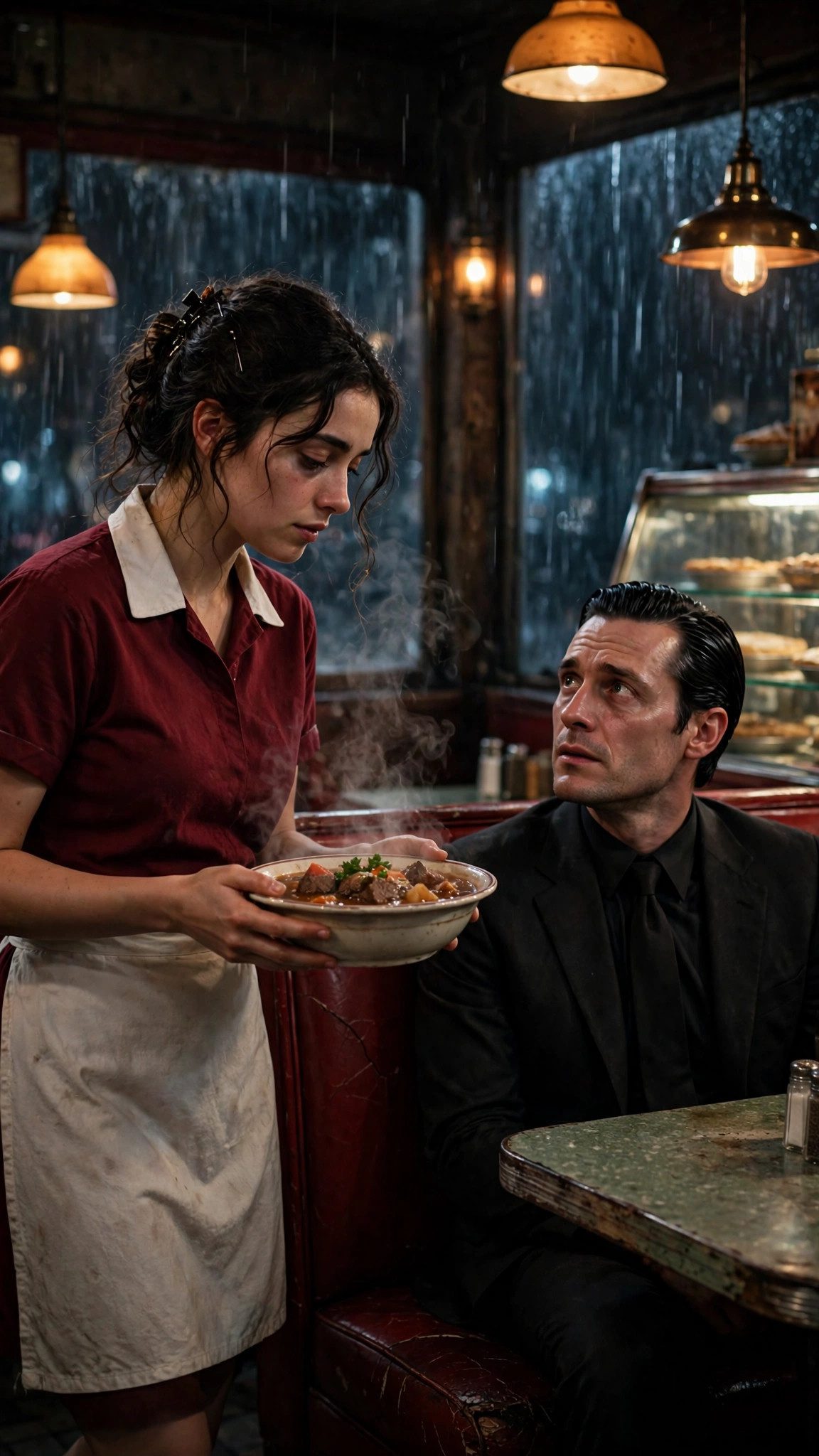
The diner went silent after Gabriel whispered Rosa's name.
It was not the ordinary silence of a room full of people holding their breath. It was the silence of a room that had just watched something impossible happen — the most feared man in the city, a man who had not eaten in eight days, a man who had not cried in front of anyone in twenty-six years, sitting in a cracked red booth with tears on his face, staring at a waitress in a burgundy uniform like she was a ghost.
Leo moved first. He stepped closer to the booth, his hand near his jacket, his eyes moving between Gabriel and me. "Boss? Are you all right?"
Gabriel did not answer. He was looking at me, and his eyes were doing something I had never seen eyes do before. They were looking at me and through me at the same time, the way you look at a person and see someone else standing behind them.
"Rosa Marchetti," he said again, slowly, like he was tasting the name the way he had tasted the stew. "She cooked in my mother's kitchen. She was there when I was a boy. She was the only person in that house who was ever kind to me."
My hands were shaking. I put the tray down on the counter so nobody would see it. "Rosa was my guardian," I said. "She watched me when my mother worked double shifts. She lived in Apartment 4B, two floors below us. She taught me that recipe when I was nine."
"When did she die?" Gabriel asked.
"Six years ago. She was seventy-nine."
Gabriel closed his eyes. "She left our house when I was twelve. The week after my mother died. Nobody told me why. Nobody told me where she went. I looked for her, later, when I had money and men. I could never find her."
"She never talked about your family," I said. "She only said she cooked in a house that is gone now, for a family that is gone too."
"My mother is gone," Gabriel said. "My father is gone. The house is gone. I sold it ten years ago because I couldn't stand to walk past it." He opened his eyes. "But Rosa is not gone. She's here. In this bowl. In you."
Benny stood frozen beside the pie display, a dish towel still clutched in his hands. The five armed men stood around the room like statues. Nobody moved. Nobody spoke. The rain hit the windows, and the broken neon sign buzzed outside, and the smell of the stew filled the whole diner like something warm had come back to life.
Gabriel picked up the spoon again. This time his hand did not tremble. He took another bite, and then another, and he ate slowly, the way a man eats when he is afraid the food will disappear. He ate half the bowl before he stopped, and when he looked up at me again, some of the emptiness was gone from his eyes.
"Sit down," he said.
I looked at Leo. Leo nodded, very slightly. I sat down across from Gabriel in the cracked red booth, and I felt like I was sitting across from a loaded gun that had just decided not to go off.
"Tell me about her," Gabriel said. "Tell me about Rosa. Everything you remember."
So I told him. I told him about Apartment 4B, and the old wallpaper, and the broken radiator that clanged all night in the winter. I told him about the yellow curtains and the pot that was always on the stove. I told him about the way Rosa taught me to read, and the way she taught me to sew a button, and the way she stood me on a chair when I was nine years old so I could reach the stove, and put a wooden spoon in my hand, and told me the secret was the dirt and the spice.
"Thyme for the earth," Gabriel said, quietly, finishing the sentence with me. "Cinnamon for the soul."
I stared at him. "She said that to you too?"
"Every time she made it," Gabriel said. "My mother used to laugh and say Rosa was the only person in the house who knew how to cook, and Rosa would say, 'Your mother knows how to love, Mrs. Hayes. That's harder.'"
I felt tears in my eyes, and I did not know why. I had not cried about Rosa in years. But sitting across from this stranger — this dangerous, broken stranger — I felt like Rosa was in the room with us, standing behind me with her hand on my shoulder, the way she used to when I was small and afraid of the dark.
"Your mother," I said. "What was her name?"
"Elena," Gabriel said. "Elena Hayes. She sang while she cooked. She had a terrible voice, and she knew it, and she sang anyway. Rosa used to say that was the bravest thing about her."
I smiled, even though I was crying. "Rosa used to sing too. Off-key. She said a kitchen without singing was just a room with a stove."
Gabriel laughed then — a short, surprised sound, like a man who had forgotten he knew how to do it. And then he stopped laughing, and his face changed, and the boss came back into his eyes.
"Leo," he said, "I want this diner watched. I want Miss Bennett watched. If anyone comes near her, anyone at all, I want to know about it before they get within a block."
Leo nodded. "Yes, boss."
Gabriel turned back to me. "Miss Bennett, I am going to be honest with you, because you have just done something no one in this city has been able to do in eight days. You fed me. And you did it without knowing who I was, and without being afraid enough to run, and that tells me something about you."
"I'm not brave," I said. "I was terrified."
"Bravery isn't the absence of fear," Gabriel said. "It's cooking anyway."
He stood up, and the men in the room stood up with him, the way a tide rises. He reached into his jacket and took out a card — a plain white card with a phone number written on it in black ink, nothing else.
"If you need anything," he said, "you call this number. Day or night. And if anyone threatens you, or follows you, or makes you feel unsafe in any way, you call this number."
"I don't need anything," I said. "I just need to finish my shift."
"Then finish your shift," Gabriel said. "But Miss Bennett — Norah — I am coming back tomorrow. And I am going to ask you to cook for me again. And I am going to pay you more for one bowl of stew than this diner makes in a month."
"I can't take your money," I said.
"You can," Gabriel said, "and you will. Because that recipe is the only thing in this city that I trust. And trust, Miss Bennett, is something I do not give away lightly."
He walked to the door, and his men fell in behind him, and Leo turned the sign back around and lifted the blinds. The rain was still falling outside. The three black SUVs were still waiting at the curb. Gabriel stopped at the door and looked back at me, one last time.
"Rosa Marchetti," he said. "Tell me one more thing. Did she ever talk about a boy? A boy in that house?"
I thought about it. I thought about all the stories Rosa had told me over the years, about the house that was gone and the family that was gone too. And I remembered one thing, one small thing, that I had never understood until that moment.
"She used to say," I said slowly, "'There was a boy in that house who never got enough to eat. Not food — love. He was always hungry for it, and nobody fed him except me.'"
Gabriel stood in the doorway for a long moment, the rain falling behind him, and I saw his jaw tighten, and I saw him swallow hard, the way a man does when he is trying not to cry in front of his men.
"That was me," he said. "That boy was me."
And then he walked out into the rain, and the door closed behind him, and the diner was quiet again, and Benny stood beside the pie display staring at me like I had just performed a miracle.
"Norah," Benny said, his voice shaking, "do you have any idea what just happened?"
I looked down at the empty bowl on the table. I looked at the spoon Gabriel had used. I thought about Rosa, and Apartment 4B, and a little boy in a house that was gone now, who had never gotten enough to eat.
"I think," I said slowly, "that I just cooked dinner for a ghost."
But I was wrong. I had not cooked dinner for a ghost. I had cooked dinner for a man who was very much alive, and very much in danger, and who had just decided that I was the only person in the city he could trust.
I did not know it yet. But the man who had poisoned Paulie was still out there. And he had just learned that Gabriel Hayes had found someone who could feed him. And that made me the most dangerous person in the city to know — and the most valuable.
That night, after my shift ended, I walked home through the rain with Rosa's recipe card in my apron pocket, and I thought about the boy in the house that was gone, and I thought about the man in the cracked red booth, and I wondered how it was possible that the two of them were the same person.
And I wondered, for the first time in my life, whether Rosa had been keeping a secret from me all along — and whether that secret was the reason she had left the Hayes house the week Elena Hayes died.
I would find out soon enough. And when I did, it would change everything I thought I knew about Rosa, about Gabriel, and about the night his mother died.
The next morning, I arrived at the diner an hour early, because I could not sleep. A black SUV was parked across the street, and when I walked in, Leo was sitting at the counter drinking coffee out of a chipped white mug, looking completely at home in a place that was nothing like his world.
"Morning, Miss Bennett," he said. "Boss wanted someone here before you arrived. Just in case."
"In case of what?" I asked.
"In case anyone got any ideas," Leo said, and he did not elaborate, and I did not ask him to. He slid a small black phone across the counter toward me. "Boss's number is already in it. First one on speed dial. You press one button, and I answer, day or night. Boss's orders."
"I don't need a phone," I said. "I have a phone."
"Not like this one," Leo said. "This one can't be tracked the usual way. Boss had it made special." He took a sip of his coffee. "You know, Miss Bennett, I've been with Gabriel Hayes for nineteen years. I've seen him walk into rooms full of men with guns and not blink. I've seen him sit through meetings with federal agents and not break a sweat. But I have never — not once — seen him cry. Not when Paulie died. Not when his father died. Not ever. Until last night."
I wiped down the counter, because I did not know what else to do with my hands. "He was thinking about his mother."
"He was thinking about Rosa," Leo said. "And about you. Boss told me on the drive home that you reminded him of her. Not your face. Your hands. The way you moved in the kitchen. He said Rosa moved the same way — like the kitchen was the only place in the world that made sense."
Benny came out of the back then, carrying a box of napkins, and he stopped when he saw Leo. "You're still here?"
"Boss's orders," Leo said. "I'm on diner duty until further notice."
Benny put the box down and looked at me, and his face was serious in a way I had never seen before. "Norah, I've owned this diner for twenty-two years. I've seen all kinds. But I have never seen Gabriel Hayes eat in a place like this. And I have never seen him come back three nights in a row. Whatever you did, girl — whatever that stew is — you hold onto it. That's the most valuable thing in this city right now."
After Leo left that morning, I stood in the kitchen alone, and I took Rosa's recipe card out of my apron pocket, and I read it again — the neat, slanted handwriting, the ingredients, the note at the bottom about the dirt and the spice. And I thought about Rosa's last days in the hospital, six years ago. She had been so small in that bed, so thin, and she had held my hand, and she had said, "Be a nurse, Norah. You have gentle hands and a steady heart. And remember the recipe. Recipes don't die as long as someone remembers them."
I had promised her I would remember. I had kept that promise for six years without knowing why it mattered so much.
Now I knew. The recipe had been waiting — waiting for the night a starving man walked into a tired diner in the South End and sat in a cracked red booth and asked for something he could trust. The recipe had been waiting for Gabriel Hayes. And Rosa, wherever she was, had known all along that one day, the boy from the house that was gone would come looking for the taste of home.
I put the card back in my pocket. I tied my apron. I turned on the grill. And I got ready for another night, not knowing that by the end of the week, everything I thought I knew about Rosa — and about Gabriel's mother, and about the house on the other side of the city — was going to change forever.