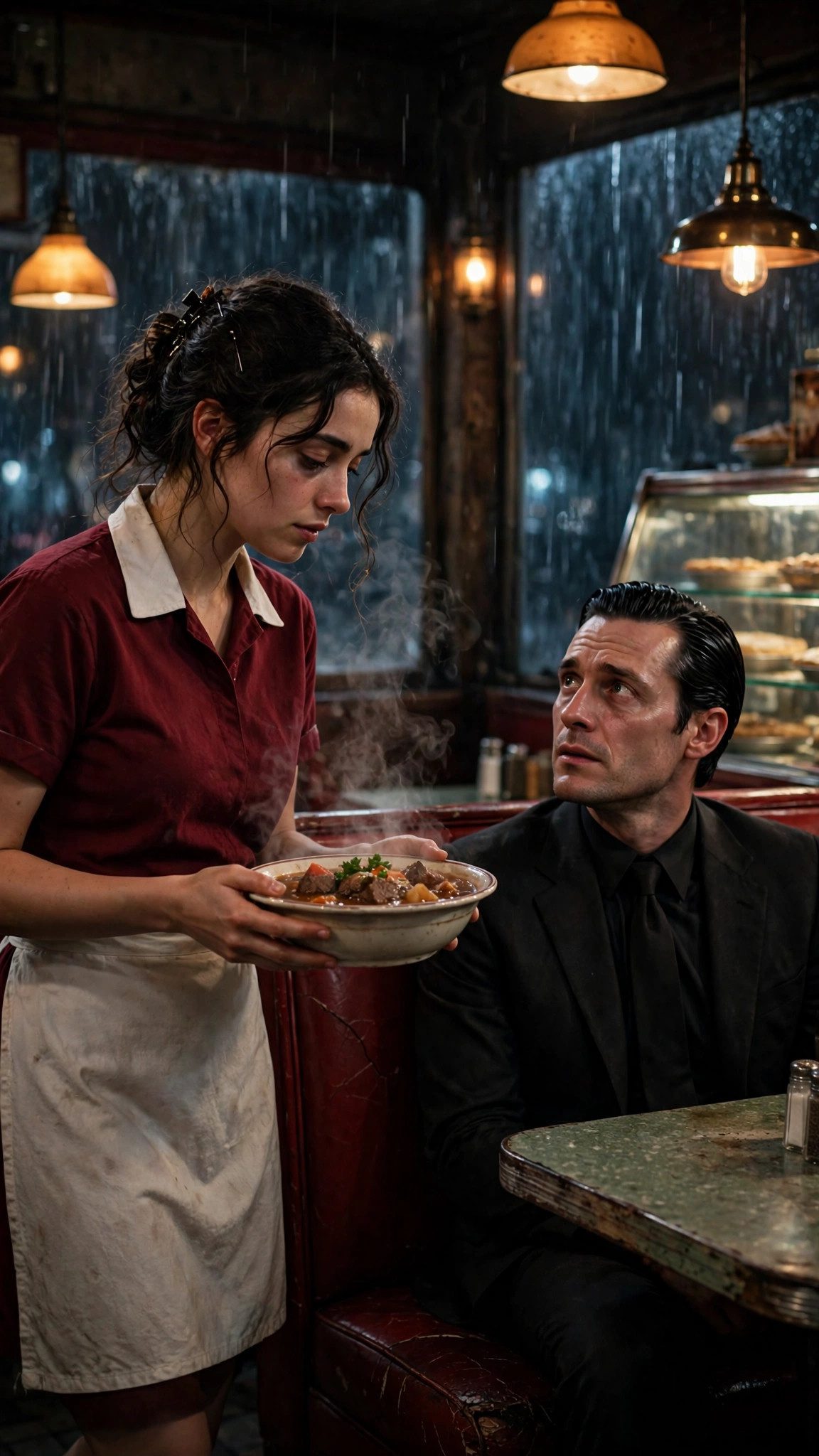
The wedding was small, and it was held in the diner.
That was Norah's idea. She said she did not want a cathedral, or a ballroom, or a hotel with chandeliers. She wanted to get married in the place where it had all started — in Benny's Diner, in the South End, in the cracked red booth where a starving man had tasted a bowl of stew and whispered a dead woman's name.
Gabriel agreed immediately. He said he had spent twenty-six years in rooms that were too big and too empty, and he was done with that. He wanted a small room, and a warm kitchen, and people he loved.
So on a Saturday in October, when the leaves were turning gold outside and the air smelled like rain and woodsmoke, Benny closed the diner to the public, and he put white tablecloths on the tables, and he hung fairy lights from the ceiling, and he moved the pie display to make room for a small altar made out of a wooden crate and a vase of white lilies.
My mother was there, wearing a blue dress she had bought for the occasion, crying before the ceremony even started. Leo was there, in a suit that did not quite fit him, standing as Gabriel's best man, looking deeply uncomfortable and deeply happy at the same time. Benny was there, of course — he insisted on cooking the wedding dinner himself, and he cried into the mashed potatoes twice.
And Rosa was there too. Not in person — she had been gone for six years — but in the photograph on the altar, the one Gabriel had shown me that night in the diner: the kitchen with the yellow curtains, the woman singing at the stove, the little boy half hidden behind her skirt, and Rosa at the edge of the frame, with flour on her hands, watching over all of them.
I wore a simple white dress. I did not want anything fancy. I wanted to look like myself — a waitress in a burgundy uniform who had become a nurse, who had become a wife, who had never stopped being the girl from Apartment 4B.
Gabriel wore a dark suit, the way he always did. But this time, his shoulders were not heavy. This time, his eyes were not empty. This time, when he looked at me, he looked like a man who had finally found what he had been looking for.
"Norah Bennett," he said, when it was his turn to speak, "I have owned buildings and businesses and half this city, and none of it ever felt like home. Home is not a place. Home is a person who feeds you when you are starving. Home is a person who stays beside you in a hospital room. Home is a person who brings you a notebook that tells you the truth, even when the truth hurts. You are my home, Norah. You have been my home since the night you carried a bowl of stew across a diner and put it in front of a man who did not deserve it."
I cried. My mother cried. Leo cried, and then pretended he had something in his eye. Even Benny cried, and he was supposed to be cooking.
When the ceremony was over, we ate stracotto. Of course we ate stracotto. I cooked it myself, in the diner kitchen, with the door open so everyone could watch, the way I had cooked it the first night. And when I carried the bowl out, Gabriel stood up, and he took the bowl from my hands, and he carried it to the table himself, and he sat down, and he ate it slowly, the way a man eats when he knows the food will always be there.
After the wedding, Gabriel did something that surprised everyone in the city — including me.
He gave it all up. Not all at once, and not recklessly, but carefully, the way a man dismantles a house he no longer wants to live in. He sold the penthouse. He closed the businesses that could not be made legal, and he turned the ones that could into real companies, with real employees and real taxes. He went to the police, and he told them everything he knew — not just about Castellano and Marcus, but about his own organization, about the routes and the money and the men. He cooperated fully. He accepted the consequences.
Some people said he was crazy. Some people said he was weak. Some people said the city would eat him alive without his empire.
But Gabriel did not care what they said. He had spent twenty-six years being the most feared man in the city, and he had been starving the whole time. He was done being feared. He wanted to be something else. He wanted to be a husband. He wanted to be a father, one day. He wanted to be a man who could sit down to dinner without wondering if the food would kill him.
He bought Benny's Diner. He bought the whole building. He renovated it — not into something fancy, but into something warm. He fixed the broken neon sign. He replaced the cracked red booths with new ones, but he kept one booth exactly the way it was — the booth where he had sat that first night — and he put a small brass plaque on the table that said: THIS IS WHERE I CAME HOME.
He renamed the diner. It was no longer Benny's. It was Rosa's. Rosa's Kitchen. And on the menu, in the place of honor, at the very top, was the stracotto — Rosa's stracotto, the recipe that had brought the mafia boss home.
Benny stayed on as the manager, and he cried when Gabriel told him, and he said he had never been so happy in his life. Leo stayed on too, as the head of security, although there was not much left to secure — just a diner, and a kitchen, and a family.
My mother retired from the laundry. Gabriel bought her a small house with a garden, two streets away from us, and she planted tomatoes and roses, and she came to the diner every day for lunch, and she told everyone who would listen that her daughter had married a good man.
And me? I finished my nursing exams. I passed them on the first try. I became a nurse at the hospital downtown, the same hospital where Gabriel had been treated for cyanide poisoning. I worked three days a week, and I spent the other days at the diner, in the kitchen, cooking beside Benny, teaching the young cooks Rosa's recipe, telling them the secret was the dirt and the spice.
One year after the wedding, on a quiet Tuesday morning, I was in the diner kitchen when Gabriel came in through the back door, carrying a bag of groceries. He set the bag on the counter, and he came up behind me, and he put his arms around my waist, and he rested his chin on my shoulder, and he watched me stir the pot.
"Thyme for the earth," he said. "Cinnamon for the soul."
"And love," I said, "is the reason you cook at all."
He smiled. "Rosa would be proud of you."
"Rosa would be proud of you too," I said. "You came home, Gabriel. That's all she ever wanted."
He turned me around, and he kissed me, and the pot simmered on the stove, and the smell of thyme and garlic and cinnamon filled the kitchen, and for a moment, it felt like Rosa was there with us, standing at the edge of the room with flour on her hands, watching over all of us.
That night, after the diner closed, Gabriel and I sat in the cracked red booth — the one with the brass plaque — and we ate stracotto together, the way we did every night. And when we were finished, Gabriel took my hand, and he looked at me, and he said something I will never forget.
"Norah," he said, "everyone who tried to make me eat failed. The chefs failed. The doctors failed. Leo failed. They all failed because they were trying to feed a boss. But you — you didn't feed a boss. You fed a little boy who missed his mother. And that boy grew up, and he married you, and now he is home."
I squeezed his hand. "You're home, Gabriel. You're home."
And he was. He was home.
The recipe that had fed a lonely little girl in Apartment 4B had fed a lonely little boy in a house on the other side of the city. And now, that recipe fed a family — a husband and a wife, a mother and a best man and a diner full of people who had once been strangers and were now something else.
Rosa used to say that recipes don't die as long as someone remembers them. She was right. The recipe lived. And because the recipe lived, Gabriel lived. And because Gabriel lived, I lived. And because we lived, the story did not end in a penthouse with an untouched plate of Wagyu steak, or in a hospital bed with poison in the blood, or in a cemetery under an old oak tree.
It ended in a diner, in the South End, on a Tuesday morning, with a bowl of stew, and a man who was no longer afraid of his food, and a woman who had never been afraid to cook it.
It ended at home.
One year later, on the first anniversary of the day we renamed the diner Rosa's Kitchen, we held a party. Benny cooked all afternoon. Leo brought his new girlfriend, a schoolteacher named Ana, who laughed at all of Leo's jokes and made him blush. My mother brought a cake she had baked herself, with white frosting and fresh strawberries, and she told everyone who would listen that her daughter had married the best man in the city.
That night, Gabriel did something no one had ever seen him do before. He put on an apron — a plain white apron, the same kind Benny wore — and he stood at the stove in the diner kitchen, with me beside him, guiding his hands, and he cooked the stracotto himself for the first time in his life.
He burned the garlic slightly. We both laughed. He added too much cinnamon, and I told him so, and he said, "Rosa would have said the same thing," and he fixed it, and the second batch was perfect. He carried the bowl out himself, the way I had carried it that first night, and he placed it on the table in the cracked red booth, and he sat down, and he ate it slowly, the way a man eats when he knows the food will always be there.
After dinner, I stood up, and I took Rosa's notebook from the shelf where we kept it now — not hidden in a box, but out in the open, where anyone could see it — and I read aloud the line Rosa had written at the end, in her neat, slanted handwriting: "Recipes don't die as long as someone remembers them."
Then Gabriel stood up, and he cleared his throat, and he said, "I have an announcement. Starting next month, Rosa's Kitchen is going to fund a scholarship — the Rosa Marchetti Scholarship — for nursing students who work night shifts to pay for their classes. Because I married a woman who did exactly that, and she saved my life, and I want to make sure the next Norah Bennett doesn't have to choose between her dreams and her dinner."
Everyone cheered. My mother cried. Benny cried. Even Leo cried, and then pretended he had something in his eye, the way he always did.
Later that night, after the party was over and the diner was quiet, Gabriel and I sat in the cracked red booth — the one with the brass plaque that said THIS IS WHERE I CAME HOME — and we ate the last of the stracotto together, the way we did every night. The rain was falling outside, soft and steady, and the neon sign glowed in the window, and the kitchen smelled like thyme and garlic and cinnamon.
Gabriel took my hand across the table, and he looked at me, and he said, "Norah, do you remember the first night? Do you remember what I whispered after I tasted your stew?"
"Rosa," I said.
"That's right," Gabriel said. "I whispered Rosa's name, because for the first time in twenty-six years, I could taste home. And now, every night, I taste it again. And I will taste it for the rest of my life."
I squeezed his hand. "And I'll keep cooking it," I said. "For as long as you want. For the rest of our lives."
And Gabriel Hayes — the most feared man in the city, the man who had once been afraid of his own kitchen, the man who had starved for eight days because he trusted nobody — smiled, and he leaned across the table, and he kissed me, and the pot simmered on the stove, and the smell of thyme and cinnamon filled the room, and for a moment, it felt like Rosa was there with us, standing at the edge of the room with flour on her hands, watching over all of us, and smiling.
Because the recipe had lived. And because the recipe lived, Gabriel lived. And because Gabriel lived, I lived. And because we lived, the story did not end in a penthouse with an untouched plate of Wagyu steak, or in a hospital bed with poison in the blood, or in a cemetery under an old oak tree.
It ended in a diner, in the South End, on a rainy night, with a bowl of stew, and a man who was no longer afraid of his food, and a woman who had never been afraid to cook it.
It ended at home.
The End.
THE END