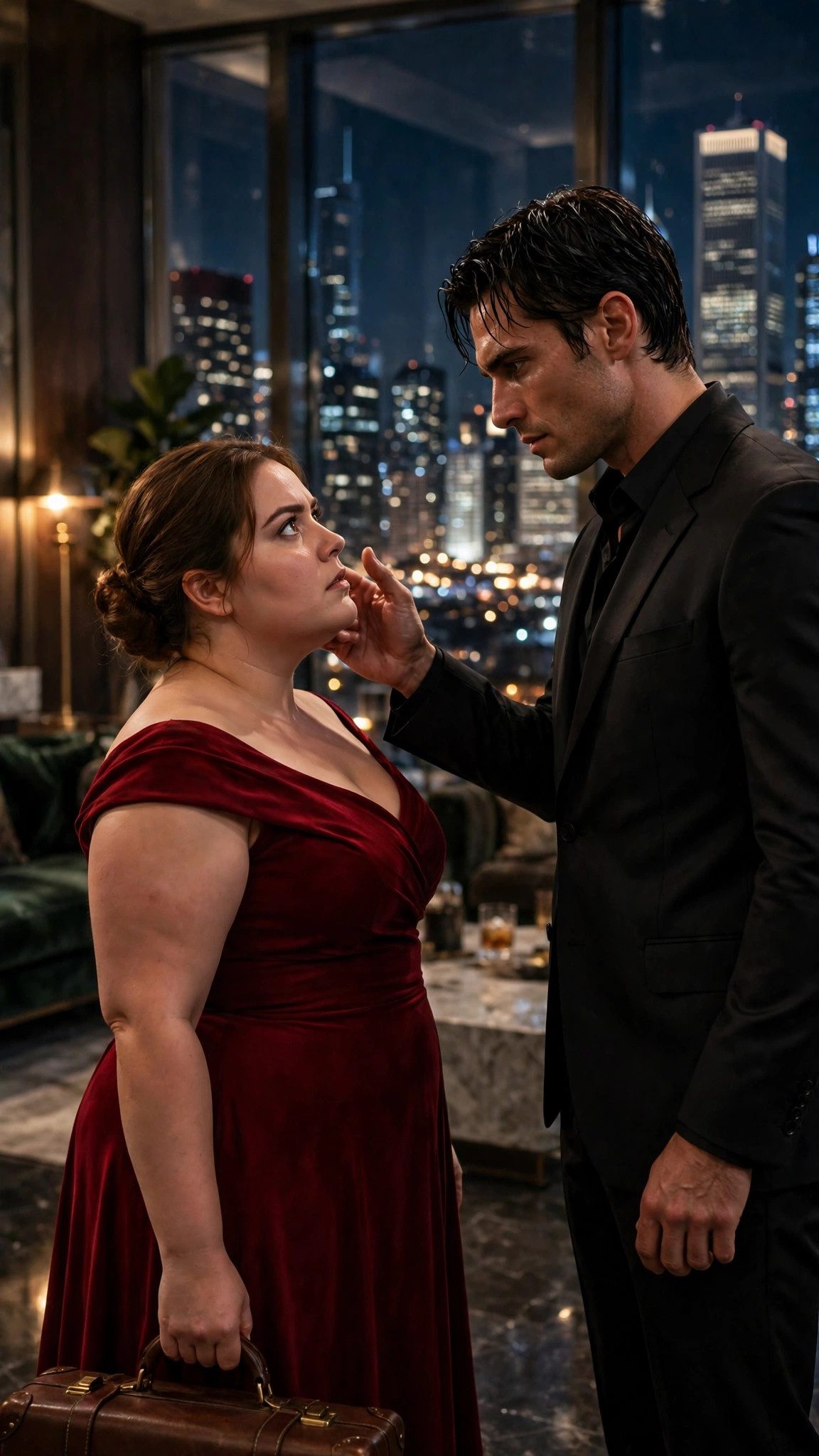
March 17, 2025. Nine o'clock at night. The Rossi penthouse, fifty-two floors above Chicago, glittered like a held breath, and Charlotte was standing in the middle of the living room with a suitcase in her hand, a lie on her tongue, and nowhere left to hide.
She had been so careful. She had waited until the penthouse went quiet, until the dinner dishes were cleared and the staff had gone down to their quarters and the only sound was the low hum of the city through the glass. She had packed in the dark, folding her good blouse and her mother's birthday card into the small brown suitcase she had owned since she was nineteen, and she had told herself that if she moved quietly enough, no one would ever know she had been here at all.
Then the elevator dinged.
"Roman!" she called, turning toward the sound, her heart already hammering, because she knew that voice in the elevator could only belong to one person, and that person was not supposed to be home until midnight.
But when she saw him, her breath caught in her throat. He had changed into a black suit, his dark hair still damp from the shower, his gaze sharp as he stepped into the living room, a small frown creasing his forehead. Roman Rossi did not walk into rooms. He arrived in them, the way weather arrives, and everything in the room rearranged itself around him.
"You are still here at this hour?" he asked, his eyes flicking from her face to the suitcase in her hand. "I did not think you were scheduled tonight."
Charlotte swallowed. "I was… just finishing up."
"Finishing up?" He raised one brow. "With a suitcase?"
She panicked. "Oh, this? It is… mine. I was just heading out."
Roman stepped closer, and the scent of his cologne wrapped around her, something dark and expensive and clean. "Charlotte, we both know you live in the staff quarters downstairs. You do not have a suitcase like that."
She clutched the handle tighter. "I was borrowing it."
"From who?"
Her brain scrambled. "From… my friend. I am going to visit my mother tomorrow, and she wanted to—"
He did not buy it. Not for a second.
"Charlotte." His voice was low, measured, the kind of voice that made people all over the city straighten up. "You are lying to me."
She opened her mouth, but nothing came out.
Roman tilted his head, studying her like she was a puzzle he had not solved yet, and he kept looking at her that way even as he waited, thinking about whether to push her or let it go.
"Fine," he said finally, his voice quieter now. "Keep your secrets."
He turned to leave, but then he paused at the doorway.
"Oh, and Charlotte?" He looked back, his gaze cutting straight through her. "Tomorrow night, you will be at the Moretti family sit-down."
Her stomach dropped.
"The… what?"
"The family dinner." His eyes held hers. "All the heads will be there. I want you present."
"But I am just the maid—"
"Not tomorrow night." His tone was final. "Tomorrow, you will be my date."
She froze.
"Your… date?"
He nodded once, his expression unreadable. "There is a problem in the family. My uncle thinks I have gone soft since I took over."
"But I am not—" she started.
"You will be," he said. "And you will be convincing."
She opened her mouth to argue, but he silenced her with a look.
"Charlotte," he said quietly. "You cannot refuse me. Not when the whole family will be watching."
Her heart was pounding so hard she could barely breathe. Roman Rossi, the mob boss of Chicago, was asking her — a plus-size maid who mopped his floors — to pretend to be his date at the most dangerous family dinner in the city.
"I cannot do that," she whispered. "I am not—"
"You will," he said. His voice was calm, certain. "Because I am not asking. And Charlotte…"
He stepped closer, his eyes locking with hers until she felt her breath hitch.
"You are going to wear the red dress."
She frowned. "What red dress?"
"The one I had delivered this morning," he said. "It is hanging in your closet right now."
She swallowed hard. "You bought me a dress?"
"Charlotte," he said, his voice dropping lower. "You are going to need to look the part."
He turned toward the door, but before he left, he paused once more, his gaze sweeping over her from head to toe. It was not the look of a boss inspecting his employee. It was the look of a man seeing a woman for the first time.
"And Charlotte?" he added, his voice softer now, almost gentle. "My uncle will test you. He will try to find a weakness. So whatever happens tomorrow night, do not flinch. Do not look away."
He leaned in close enough that she could feel his breath against her ear.
"Understand?"
She nodded slowly, her throat too dry to speak.
"Good," he said. "Because I need you to pretend to be mine for one night."
He did not smile when she approached. He simply looked at her. And then he was gone, and Charlotte was alone in the glittering living room with a suitcase in her hand and a red dress hanging in a closet downstairs that she had not even known existed, and a tomorrow that had just become the most dangerous night of her life.
She stood there for a long time after the elevator doors closed, listening to the city hum through the glass, and then she did the only thing she could think of to do. She set the suitcase down, very carefully, the way you set down something that might explode, and she went downstairs to look at the dress.
It was there. Of course it was there. A long garment bag hung on the front of her closet door, and inside it was the most beautiful thing Charlotte had ever owned, or ever would own: a deep red dress, the color of wine held up to candlelight, with a bodice that would fit her the way a glove fits a hand and a skirt that moved like water when she touched it. There was no note. There was no price tag. There was only the dress, and the faint smell of his cologne on the garment bag, as if he had carried it here himself.
Charlotte sat down on the edge of her narrow bed and stared at it, and for the first time since she had come to work in the Rossi penthouse, she allowed herself to ask the question she had been refusing to ask for almost a year.
How did Roman Rossi know her size?
She had never told him. She had never tried on a dress in front of him. She had never even spoken to him for more than thirty seconds at a time, and yet the dress hanging in her closet was cut for her body, for her shoulders and her waist and her hips, as if someone had measured her in her sleep.
Someone had. She knew who. Mrs. Alvarez, the housekeeper, ran the penthouse staff the way a general runs an army, and Mrs. Alvarez knew everything: who was sick, who was stealing sugar, who cried in the laundry room on Sunday nights. Mrs. Alvarez could have taken Charlotte's measurements from her uniform in ten minutes, and she would have done it without a word, because when Roman Rossi asked for something, Mrs. Alvarez did not ask why.
But that only moved the question one step further back. Why had Roman Rossi asked for her measurements at all? Why had he ordered a dress for his maid? Why had he been watching her closely enough to know that she needed a boyfriend by tomorrow?
Because he had heard her. That was the part that made her face burn when she thought about it, there on the edge of her bed with the red dress glowing in the dark like a coal. He had heard her whisper it.
It had happened three nights ago, in the kitchen, late, when she thought the penthouse was empty. Her best friend Lauren had called, and Charlotte had been standing at the sink with the phone pressed to her ear, scrubbing a pan that did not need scrubbing, and she had said it out loud, the thing she had been carrying around for weeks like a stone in her pocket.
"I need a boyfriend by tomorrow," she had whispered, and she had almost laughed at herself, because it sounded so ridiculous, so small and so ordinary, and yet it had felt like the most urgent thing in the world. "My mother is coming, and she keeps asking, and I told her I was seeing someone, and now she wants to meet him, and I do not have anyone, Lauren, I do not have anyone at all."
She had not known he was standing in the doorway. She had not known he had heard every word. She had only known, when she turned around with the pan still in her hands, that the kitchen was empty and the hallway was dark and she was alone, and she had told herself she was being paranoid.
She had not been paranoid. Roman Rossi had heard everything. And he had not laughed. He had not told anyone. He had gone out the next morning and ordered a red dress for his maid, and he had waited until tonight, until she was standing in his living room with a suitcase in her hand, to tell her what he wanted.
She did not understand him. That was the truth of it, sitting there on her bed in the staff quarters, fifty-two floors below the glittering city. She had worked in this penthouse for eleven months, and she did not understand Roman Rossi at all.
She understood the job. The job was simple. She arrived at six in the morning, in her black uniform with the white apron, her warm brown hair pulled back in a low bun, and she made the penthouse shine. She polished the marble and the glass. She changed the sheets. She folded his shirts the way Mrs. Alvarez had taught her, with the collars exactly straight. She was invisible, and she was good at being invisible, because invisibility was the whole skill of the job: you moved through a rich man's house like weather moves through a room, present and unnoticed, and you never, ever spoke unless spoken to.
She understood the house. The penthouse was beautiful and cold, all glass and marble and black leather, and it was the loneliest place Charlotte had ever worked. Roman Rossi lived there alone. No wife. No girlfriend that anyone had ever seen. No photographs on the tables. No children's drawings on the refrigerator. Just a man, thirty-six years old, tall and dark and sharp-eyed, who came home late and left early and ate standing up at the kitchen counter like a man who had forgotten how to sit down at a table with another person.
She understood her own life, too, or she thought she did. She was thirty years old. She was a plus-size woman with a soft round face and warm brown hair and hands that were always a little red from hot water, and she had spent most of her adult life being told, in a hundred small ways, that women who looked like her did not get chosen. Not for the good tables at restaurants. Not for the front row at weddings. Not for the kind of love that made a man cross a room. She had learned to be useful instead of beautiful, and she was very good at being useful. She could stretch a dollar until it screamed. She could make a room shine. She could take care of everyone around her and ask for nothing in return, and she had told herself for years that this was enough.
It was not enough. That was the other thing she had been refusing to admit, there on the edge of her bed, looking at a red dress she had not asked for and did not deserve and wanted so badly it hurt.
Her mother was the reason. Angela, fifty-eight years old, living alone in Cicero in the little house where Charlotte had grown up, calling every Sunday night at seven o'clock sharp, asking the same questions in the same order: Are you eating enough? Are you sleeping? Are you happy? And then, always, the last one, the one that made Charlotte's chest go tight: Have you met anyone yet, mija?
For years Charlotte had said no, and her mother had sighed, and they had both pretended it did not matter. But three months ago her mother had been in the hospital for four days with her heart, and the doctors had used words like "stress" and "watch her closely," and Charlotte had gone to see her in that white room with the machines beeping, and her mother had taken her hand and said, very quietly, "I just want to know you will not be alone when I am gone."
And Charlotte, who had never been able to lie to her mother, had lied. She had said, "Mama, I am seeing someone. He is kind. Do not worry." And her mother had cried with relief, and the machines had beeped a little more steadily, and Charlotte had walked out of that hospital room knowing she had just promised her sick mother a man who did not exist.
Now her mother was coming to visit. Tomorrow. She had called that morning, bright and excited, to say she had bought a train ticket, and she could not wait to meet him, and she was bringing Charlotte's favorite pan dulce from the bakery on Cermak, and Charlotte had stood in the kitchen with the phone to her ear and said, "That is wonderful, Mama," while her whole life quietly fell apart.
That was why she had packed the suitcase. Not to run away. To go to her mother first, to get there before her mother got on the train, to tell her the truth in person, in her own kitchen, where she could hold her mother's hand while she said it. I made it up, Mama. There is no one. I am sorry.
But Roman Rossi had heard her whisper, and Roman Rossi had other plans, and now there was a red dress in her closet and a family dinner tomorrow night and a man who needed her to pretend to be his for one night, and Charlotte did not know whether to laugh or cry or run.
She reached out and touched the dress again, very gently, the way you touch something that might be a dream. The fabric was soft and heavy and cool under her fingers, and it smelled faintly of cedar and new cloth, and it was the color of the wine her father used to drink on Sundays, back when her father was alive and the world made sense.
Her father had died when she was sixteen. A heart attack, sudden, in the middle of making coffee, and after that it had just been Charlotte and her mother in the little house in Cicero, and Charlotte had learned early that the world did not give you what you deserved. It gave you what you could carry. And she had carried a lot.
She stood up, slowly, and took the dress out of the garment bag, and held it up against herself in the narrow mirror on the back of her door. The woman in the mirror was not a maid. The woman in the mirror was not invisible. The woman in the mirror was tall and soft and strong, with warm brown hair and a soft round face and a red dress the color of wine, and for one dizzying second Charlotte saw what Roman Rossi must have seen when he looked at her, and her breath caught, because the woman in the mirror looked like someone who could walk into a room full of dangerous men and not flinch.
Then the second passed, and she was Charlotte again, a maid in a staff-quarters bedroom with a suitcase half-packed on the floor, and she hung the dress back up with shaking hands and went to bed without sleeping, listening to the building breathe around her, waiting for morning.
Tomorrow she would wear the red dress. Tomorrow she would sit at a table with the heads of the Rossi family and pretend to belong to a man she barely knew. Tomorrow her mother would arrive in Chicago expecting to meet a boyfriend who did not exist.
Charlotte closed her eyes and thought about her mother's voice on the phone that morning, bright and excited, and she thought about Roman's voice in the living room, low and certain, and she thought about the dress hanging in her closet like a promise she had not made, and she understood, finally, that tomorrow was going to change everything, whether she was ready or not.
She was not ready. But she had never been ready for anything that mattered, and she had survived all of it anyway. She would survive this, too. She would put on the red dress. She would not flinch. She would not look away.
And if Roman Rossi thought he had chosen a maid to play a part for one night, then Roman Rossi was about to learn something about Charlotte that no one in his world had ever bothered to learn.
She was not playing. She never played. And when Charlotte made a promise, even a pretend one, she kept it.