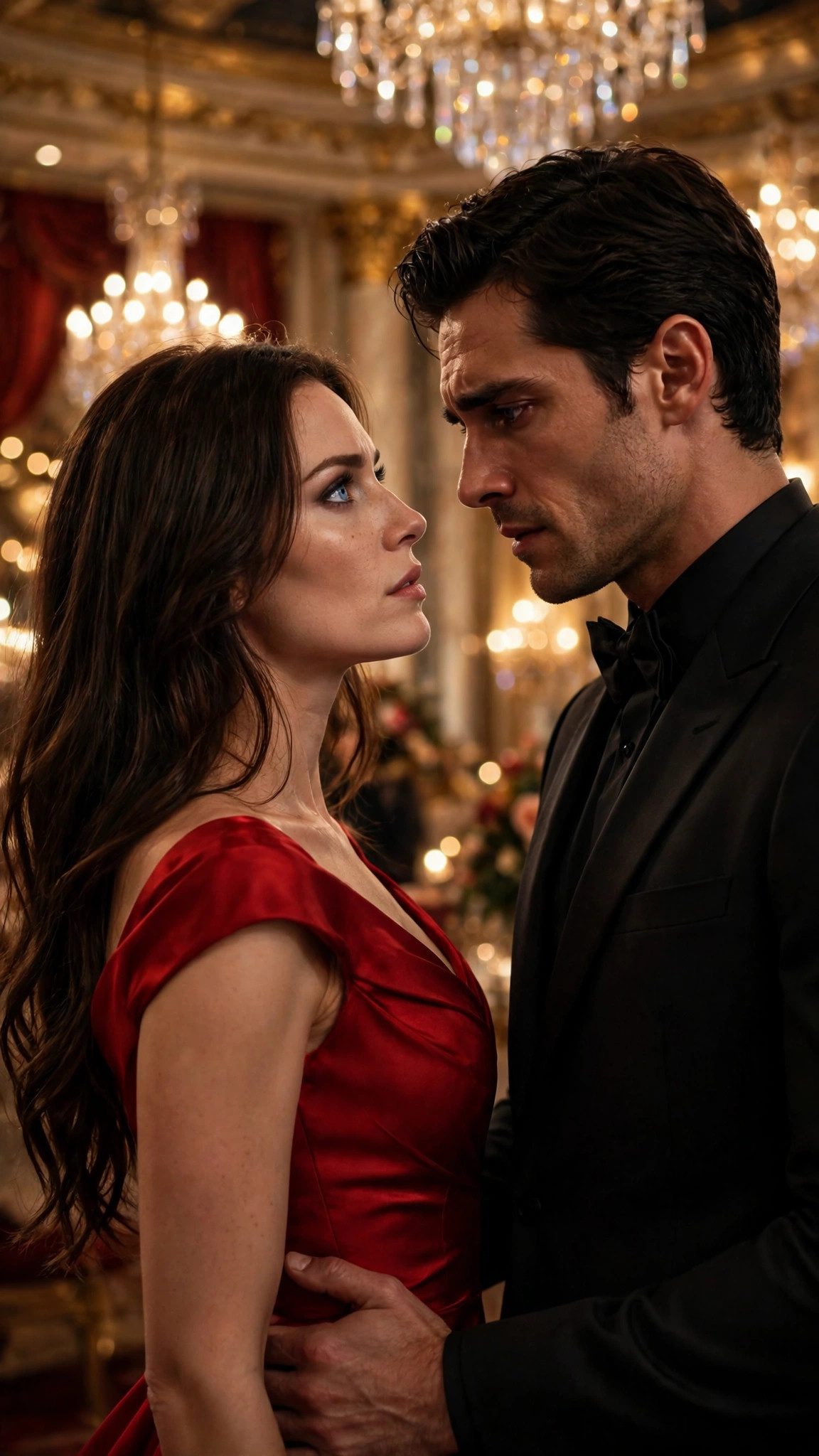
By eight the next morning, the photograph was everywhere.
Maya sent it to me first, at 7:42, with seventeen exclamation points. There we were, Luca and I, on the dance floor at the Bellagio, his hand at my waist, my head tilted back, laughing at something he had said. I looked radiant. I looked like a woman who had never once been betrayed in her life.
*You are on three gossip sites,* Maya wrote. *THREE. People are saying Luca Moretti has a new girlfriend and she is GORGEOUS. Ryan's sister just called me asking if it's true. I told her to ask Ryan.*
Then the texts started coming in from numbers I did not recognize, and from numbers I did, and by nine o'clock my phone was a nonstop buzz of congratulations and questions and thinly disguised shock. I turned it off and went to work, where my boss pulled me aside and told me, with the careful expression of a man who does not want to pry, that the client from Tuesday had called to say how much they admired my "grace under pressure."
I did not correct him. Let him think the grace was about the campaign.
At lunch, my phone buzzed with a message from an unknown number. A photo. Vanessa, sitting alone at a café table, staring at her phone. The caption underneath, from a gossip account: *Vanessa Moretti, spotted alone after her husband was photographed dancing with a mystery brunette at the Bellagio gala.*
I deleted it. I did not feel as good as I thought I would. I felt something closer to pity, and that frightened me, because pity meant I was already moving on, and moving on meant the revenge was working, and the revenge working meant the six weeks were ticking down.
That afternoon, Luca called.
"Have you seen the photo?" he asked.
"Everyone has seen the photo."
"Good," he said. "That is the point. But I called for another reason. My aunt is having Sunday dinner at her house, and she has asked to meet you."
"Your aunt," I repeated. "You want me to meet your family."
"I want you to see my world," he said. "The real one. Not the ballroom. If we are going to do this for six weeks, you should know what you are walking into."
Sunday dinner was at a house in Summerlin, a sprawling ranch-style place with a garden full of roses and a kitchen that smelled like Sunday sauce. Luca's aunt Rosa was seventy-two years old, four foot eleven, with iron-gray hair and hands that had been making pasta since before I was born. She took one look at me, put both hands on my face, and said, "So. You are the one who made my nephew smile in a photograph. I have not seen him smile like that since his mother died."
"Aunt Rosa," Luca said, warning in his voice.
"What? I am old. I say what I want." She turned back to me. "Come. You will help me with the salad. Luca, go away. Men are useless in a kitchen."
I spent the next hour in Rosa's kitchen, tearing lettuce and listening to her talk about Luca as a boy — how he had been serious even then, how he had taken over the family at twenty-six when his father died, how he had never once complained, how Vanessa had never understood that the family was not a business to him, it was a promise he had made to his dying father.
"He works too much," Rosa said, chopping tomatoes with a speed that made me nervous. "He carries too much. His mother used to say: Luca, you cannot save everyone. And he would say: I can try, Mama. That is the boy. That is the man. Vanessa wanted a husband who would take her to Paris. Luca gave her a house and a name and protection, and she called it a prison."
"Did she ever love him?" I asked quietly.
Rosa stopped chopping. "I think she loved the idea of him. The power. The money. The name. But love?" She shook her head. "Love is staying when it is hard. Vanessa never stayed for anything hard."
Dinner was loud and warm and nothing like the ballroom. Cousins argued about football. Someone's toddler ran through the house with sauce on his face. Enzo told a story about Luca at sixteen, trying to fix a car and making it worse, and Luca laughed — a real laugh, deep and unguarded, the kind of laugh I had never heard from him.
I watched him across the table, surrounded by people who loved him, and I understood something I had not understood before. Luca Moretti was not a monster. He was a man carrying a weight so heavy it had bent his whole life around it, and no one had ever once offered to help him carry it.
After dinner, he drove me home himself. No driver. Just the two of us, in the dark car, the city lights sliding past.
"Thank you for coming," he said.
"Thank you for asking me."
"Claire." He stopped at a red light and looked at me. "I need to tell you something. About Vanessa. About why she left."
"You don't have to."
"I want to. Rule one. No lies between us."
He told me then, in the quiet car, that Vanessa had been unhappy for years, and that he had known it and had done nothing, because he did not know what to do. He told me that the night she left, she had said to him: "You love your family more than you love me." And he had said: "My family is my life." And she had said: "Then live it alone."
"I should have fought for her," he said. "I should have tried harder. I was too proud. I thought providing was enough."
"It isn't," I said softly. "But it's not nothing, either. Ryan provided nothing, and he still left."
Luca laughed, a short, surprised sound. "You are very direct, Claire Bennett."
"I have learned that being indirect gets you betrayed in an airport."
He pulled up in front of my building and turned off the engine. We sat there for a moment, neither of us moving.
"Can I ask you something?" I said.
"Anything."
"Why me? You could have chosen anyone for this. A model. An actress. Someone who does this kind of thing for a living."
"Because you are the only person in this city who looked at me and saw a man, not a name," he said. "At the restaurant, that first morning, you looked at me like I was just a man whose wife had left him. Nobody has looked at me like that in years."
I did not know what to say to that. So I said goodnight, and I went upstairs, and I stood in my kitchen for a long time, thinking about Rosa's kitchen and the toddler with sauce on his face and the way Luca had laughed at Enzo's story.
The next morning, my office phone rang. I almost didn't answer it — I was in the middle of a budget review, and the number was blocked. But something made me pick up.
"Claire." Ryan's voice. Low. Furious. "I saw the photo. You and Luca Moretti. Dancing. Are you out of your mind?"
"Good morning to you too, Ryan."
"Don't do that. Don't be clever. Do you have any idea who that man is? Do you have any idea what he does?"
"I have a better idea than you do," I said, keeping my voice level, because my assistant was at the next desk and I did not want a scene. "You ran away with his wife, Ryan. You don't get to have opinions about who I dance with."
"I'm worried about you," he said, and the lie was so obvious it was almost funny. "Vanessa says he's dangerous. She says he ruins people."
"Vanessa says a lot of things," I said. "She said she was my best friend for ten years. She said you loved me. Forgive me if I don't take her word for much anymore."
"Claire, please. I'm serious. Whatever this is, whatever game you're playing, stop. Come back. We can fix this. We can go to counseling. I'll end it with Vanessa. I already told her—"
"Stop," I said. "You don't get to call me from a blocked number and rewrite the last five days. You left me, Ryan. You left a letter on my nightstand and you went to the airport with my best friend in my coat. You don't get to be worried about me now. You gave up that right at Harry Reid International."
There was a long silence. Then, quietly: "I miss you."
"I know," I said. "I miss the man I thought you were, too. Goodbye, Ryan."
I hung up, and my hands were shaking, and Maya appeared at my desk with a coffee and a look that said she had heard every word.
"That was him, wasn't it?" she said.
"Yes."
"And?"
"And I told him goodbye," I said, and I took the coffee, and I realized my hands had stopped shaking. "It felt good, Maya. It felt like closing a door I should have closed a long time ago."
That afternoon, my father was discharged from the hospital. I picked him up with my mother, and we drove him home slowly, and he complained the whole way about the hospital food and the nurses and the fact that nobody would let him carry his own bag.
At the house, over my mother's soup, my father looked at me across the table and said, "You look different."
"Different how?"
"Like you did when you were seventeen and you got into college," he said. "Like someone just told you the world is bigger than you thought."
I smiled, and I did not tell him about the kiss that had not happened yet, or the man who had cooked me terrible pasta in a warm kitchen. I just said, "I'm happy, Dad. For the first time in a long time, I'm happy."
"Good," he said, and he went back to his soup. "Hold on to that. Whatever it is. Hold on to it."
The next evening, Luca cooked for me. At his house. In the warm kitchen with the bookshelves and the photograph of his mother on the mantel.
He made pasta the way Rosa had taught him, he said, and he was terrible at it in the specific way of a man who had been taught properly once and had never practiced since. The sauce was too salty. The pasta was slightly overcooked. I ate two helpings anyway, because he had made it with his own hands, and because he looked so proud of it that I could not bear to tell him the truth.
"You are a terrible cook," I said, taking a third helping.
"I know," he said. "My mother used to say the same thing. She said I was good at everything except the things that mattered."
"She was wrong," I said. "You are good at the things that matter. You are just bad at pasta."
He laughed, and then he poured more wine, and then we were sitting on the terrace, and the desert was going dark, and he was telling me about his mother — about the garden she had kept, about the roses, about how she had made him promise, on her deathbed, that he would not let the family eat him alive the way it had eaten his father.
"I promised her," he said quietly. "And then I spent fourteen years breaking that promise, one day at a time."
"You can stop," I said. "Promises can be remade. My father says the only promise that matters is the one you keep tomorrow."
Luca looked at me for a long moment, and the terrace was quiet, and the city was far away, and there was nothing between us except the wine glasses and the desert dark.
"Claire," he said, "I need you to know something. This arrangement. The six weeks. The revenge. I agreed to it because I wanted Vanessa to hurt. But somewhere between the gala and Rosa's kitchen, it stopped feeling like revenge to me."
My heart was beating so hard I was sure he could hear it.
"It stopped feeling like revenge to me too," I whispered.
He leaned across the table, slowly, giving me time to pull away, and I did not pull away. His hand came up to my face, his thumb brushing my cheekbone, and then he kissed me.
It was not the kiss of a man pretending. It was not the kiss of a man performing for an audience. It was slow and careful and real, and it tasted like red wine and salt and fourteen years of loneliness finally ending.
When he pulled back, his forehead rested against mine.
"Tell me to stop," he said. "Rule two. One word."
"Don't stop," I said.
And he didn't.
The next morning, I woke up in my own bed, alone, and for a moment I thought I had dreamed the whole evening — the pasta, the terrace, the kiss. Then I saw my phone on the nightstand, and the message waiting on it.
*Good morning, Claire. Last night was real. In case you were wondering.*
I smiled at the phone like an idiot, and then I got up and went to work, and the whole day felt different, like the world had tilted two degrees and everything was suddenly in sharper focus. Maya took one look at me and said, "Oh no. You have that look."
"What look?"
"The look of a woman who is in trouble," she said, grinning. "The good kind of trouble. Tell me everything."
So I told her. Not everything — some things were mine alone. But enough. And Maya, who had known me for six years, who had seen me through every bad day and every good one, put her hand over mine and said, "It's about time, Claire. It's about time someone looked at you the way you deserve to be looked at."