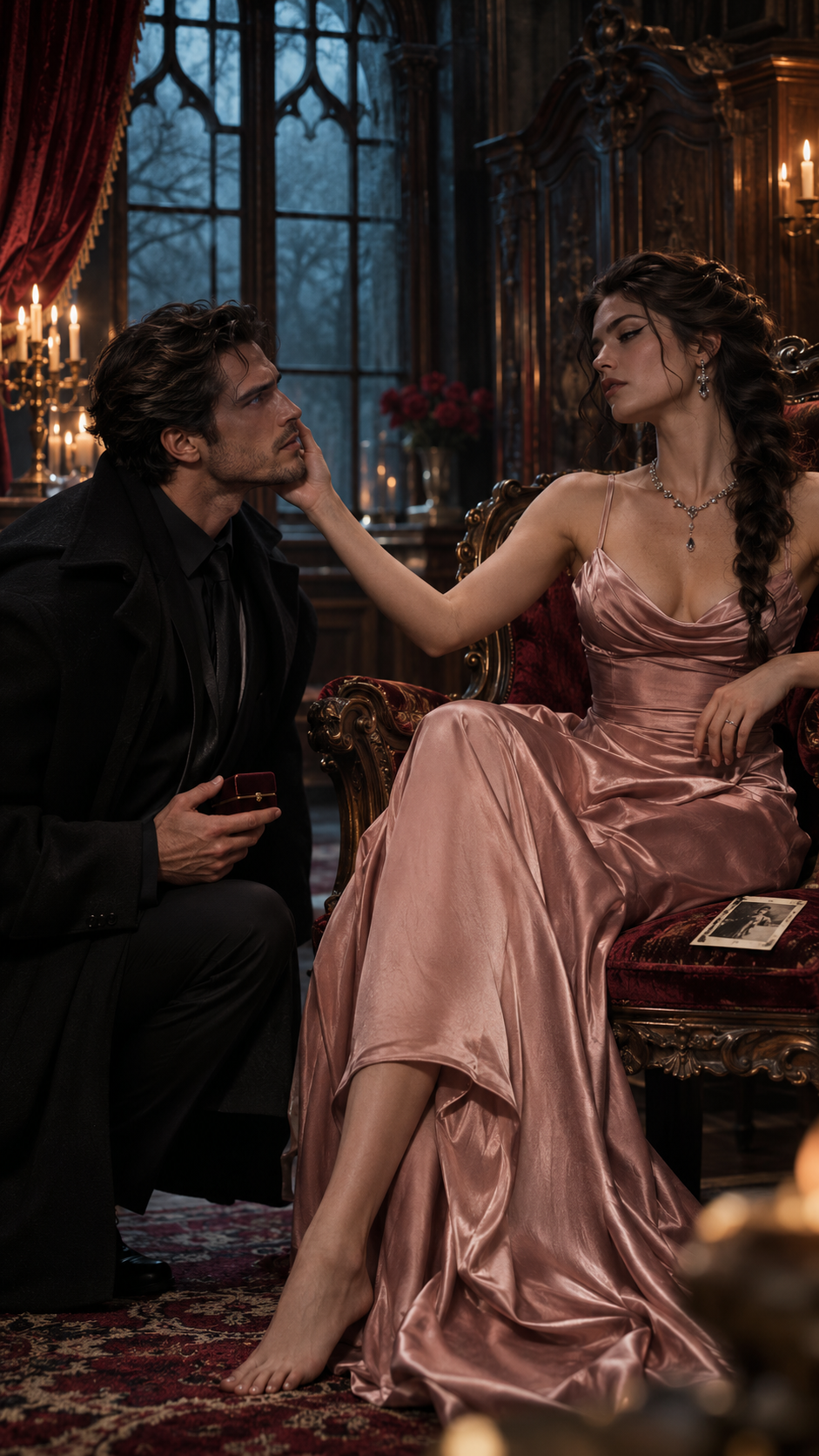
The photograph had been on Adeline's chair for months.
It showed Nico at twenty-five, standing beside her on the stone steps of the conservatory. He wore a dark jacket, his hair fell across his forehead, and his smile was slightly crooked. Adeline stood beside him in a cream coat, one hand resting on his shoulder.
The photograph had been taken after the scholarship recital, the last public event Nico attended before his death.
But there was another picture beneath it.
A smaller photograph, faded at the edges, showed Nico at seventeen. He was taller than the boy Adeline remembered from the first year of their life together, but his expression was still cautious. He stood beside a piano with a sheet of music in his hand.
On the back, in Adeline's handwriting, were the words: *The first time he called this home.*
Elias studied the two images.
“I've never seen this one.”
“You were in Chicago that week.”
“I remember.”
“You said you would come the following weekend.”
“I didn't.”
“No.”
Adeline placed the photographs side by side.
“People think a family begins when someone signs a paper. It doesn't. It begins when someone stays.”
Elias looked at the younger Nico.
“You stayed.”
“I did.”
“I'm sorry I wasn't there.”
She looked at him.
“You were there sometimes. You were not there enough.”
He accepted the distinction.
***
The photographs had been kept in a small album inside Nico's desk. Adeline had found it after the funeral but had not been able to turn every page. Now she opened it slowly.
The first photograph showed Nico at twelve, small beside the piano, holding a sheet of music while Adeline stood behind him. It was the only picture in the album from the first year he lived at Ashcombe. The next showed Nico at seventeen, sitting at the piano while Adeline corrected his posture. The second showed him at nineteen, standing outside a university library with a folder under his arm. The third showed him at twenty-one, laughing with Elena in the garden after a rainstorm.
Elias recognized the garden.
“He said Elena had beaten him at chess.”
“She did.”
“He claimed she cheated.”
“She did not.”
“He was very certain.”
“He was very wrong.”
A faint smile crossed her face.
The next photograph showed Nico at twenty-three, standing beside Elias at a charity dinner. Elias wore a black suit; Nico wore a dark blue one. They were not looking at the camera. They were looking at each other, mid-conversation.
“What were we talking about?” Elias asked.
“Whether a foundation should publish its full accounts.”
“I remember that argument.”
“He said transparency was not a threat to a good organization.”
“And I told him some records could endanger people.”
“You were both right about part of it.”
Elias studied the picture.
“He looks comfortable with me.”
“He trusted you.”
“I don't deserve that photograph.”
“It isn't a reward, Elias. It is a memory.”
He looked at her.
She turned another page.
A photograph showed Adeline at a concert hall, younger and dressed in black, standing beside a grand piano. Nico stood near the stage entrance, holding a bouquet of white flowers.
“You never told me he kept this.”
“He was proud of me.”
“You stopped playing after the injury.”
“I stopped performing. I never stopped being a pianist.”
Elias nodded.
“I know.”
“Do you?”
He did not answer.
Adeline closed the album halfway.
“When my hand was injured, the doctors said I might recover enough to play privately. I could not accept that. I thought if I couldn't perform at the level I had before, there was no point.”
“Nico helped you return.”
“He sat with me every afternoon. He never asked me to play well. He asked me to play something.”
Elias looked at the photograph.
“What did you play?”
“Whatever I could.”
“Did he like it?”
“He said the imperfect notes were the ones that sounded most honest.”
Elias lowered his eyes.
“I wish I had known him better.”
“You had time.”
The words were not cruel.
That made them harder.
***
Mara arrived with a document sleeve.
“I found something in the ledger's binding,” she said. “A photograph was used as a divider.”
She placed a thin image on the table.
It showed the west archive before the restoration. A young Elias stood beside Vittorio, both of them looking toward a carved cabinet. Father Anselm was visible in the background, holding a folder.
Adeline examined it.
“How old were you?”
“Twenty,” Elias said.
“And Father Anselm?”
“Probably forty-five.”
Mara turned the photograph over.
There was a handwritten note: *The original authority file remains with the family. No copies outside the house.*
Elias studied his younger face.
“I remember this day.”
“What happened?” Adeline asked.
“My father was showing me the archive system. He said the emergency authority records were the most important documents in the family.”
“Why?”
“Because they established who could act when he was unavailable.”
“Who had access?”
“Vittorio, me, Silas, and Father Anselm.”
Mara looked at the picture.
“Then the signature sample could have been copied at this meeting.”
Elias nodded.
“Or later.”
Adeline turned the photograph toward the light.
There was a faint mark near Father Anselm's hand.
A second document.
“Can you enlarge that?” she asked.
Mara took a close photograph with her phone.
The image showed a narrow page with the heading *Laurent Beneficiary Record.*
Adeline went still.
“What does that mean?”
Elias looked at the page.
“Your original trust file.”
“I never gave Father Anselm permission to handle it.”
“He managed the charitable accounts.”
“He did not manage my personal records.”
Mara studied the image.
“Someone had access to your beneficiary information.”
Adeline looked at Elias.
“Could that be how Nico was connected to the M-17 order?”
“Possibly.”
“Why would my name appear?”
“To make the order look like it had a legitimate family request.”
Adeline took the photograph and placed it beside the two images of Nico.
The three pictures now formed a line: Nico at seventeen, Nico at twenty-five, and the old archive with Elias, Vittorio, and Father Anselm.
She looked at the first photograph again.
“There's something I never told you.”
Elias waited.
“When I adopted Nico, I was still working as a pianist. I had just returned from a tour in Europe. I met him through a music program for young adults leaving care.”
“You told me that.”
“I told you how we met. I didn't tell you why I chose him.”
She opened the album to a page with a photograph of Nico holding a sheet of music.
“He was sitting outside the practice room one afternoon. He had been asked to audition for a scholarship, but he refused to go in. He said he didn't want to be judged by people who had already decided what he was.”
Elias listened.
“I told him that I understood.”
“Because of your injury?”
“Because I had spent years being judged by how well I could play. When I couldn't do it anymore, people stopped asking what I wanted.”
She touched the photograph.
“He asked me whether I regretted choosing music. I told him no. I regretted allowing other people to decide when I was finished.”
Elias looked at the image.
“And he came to the audition?”
“He did. He played badly.”
A small smile appeared.
“Terribly. He missed half the notes.”
“What happened?”
“He got the scholarship.”
“Why?”
“Because the panel saw that he had kept practicing even when he was frightened.”
She turned another page.
A later photograph showed Nico receiving his university certificate. Adeline stood beside him, smiling. Elias was not in the picture.
“I wasn't there,” he said.
“No.”
“I was negotiating the sale of the Atlantic division.”
“I know.”
“I should have come.”
“Yes.”
He looked at the photograph for a long time.
“Did he ask for me?”
“Not that day.”
“Did he ever?”
Adeline hesitated.
“Sometimes.”
Elias looked at her.
“What did you tell him?”
“That you were busy.”
He closed his eyes.
“I was.”
“I know.”
***
The next photograph was different.
It showed Nico standing in front of the Moretti family library. Behind him was a framed painting of Elias's mother, Lucia. Nico wore a gray sweater and held a document folder.
Adeline had not seen the image before.
“Where did this come from?”
Mara examined the back.
“It was tucked behind the first photograph.”
Elias took it.
“Nico was in the library?”
“He must have been.”
“When?”
“The date is written here.”
Adeline read it aloud.
“October seventeenth, 2019.”
Elias went still.
“That was the day my mother died.”
Adeline looked at him.
“Nico went to the library that day?”
“I don't know.”
Mara studied the picture.
“Could he have been looking for something?”
Elias examined the folder in Nico's hand.
There was a small label.
*L.M. correspondence.*
Lucia Moretti's letters.
Elias looked toward the window.
“My mother kept private correspondence in the library. My father moved it after she died.”
“Did Nico know her?” Adeline asked.
“He met her when he was younger. She liked him.”
“What did she say about him?”
Elias looked at the photograph.
“She said he asked questions like someone who expected the world to answer.”
Adeline's expression softened.
“That's exactly how he was.”
Elias turned the photograph over.
A note had been written in Nico's hand.
*The old story is not the whole story. Ask Elias about the winter room.*
Adeline looked at him.
“What is the winter room?”
Elias stared at the note.
“It was my mother's music room.”
“Why would Nico ask about it?”
“Because he found something there.”
***
The winter room was on the north side of the Moretti estate, a private residence outside Philadelphia that Vittorio had rarely used after Lucia died. It contained a small piano, a writing desk, and a locked cabinet.
Elias had not visited it in years.
He called the estate manager and requested access.
Adeline insisted on going with him.
They arrived the next morning. The grounds were quiet, the old trees bare against a gray sky. Elias opened the front door himself.
The winter room smelled faintly of wood polish and old paper.
Adeline approached the piano.
“Your mother played?”
“Every morning.”
“What did she play?”
“Bach. Sometimes Chopin.”
Adeline rested her hand on the closed lid.
“Did she teach you?”
“She tried.”
“Were you good?”
“No.”
“Did she tell you?”
“She told me I had other talents.”
Adeline smiled faintly.
Elias opened the cabinet.
Inside were letters, music scores, and a narrow leather folder.
He removed it.
The first page contained Lucia's handwriting.
*Elias, if you ever find this, you must understand that the Moretti name is not a permission slip. It is a responsibility.*
He read the line silently.
Adeline looked at him.
“What is it?”
“My mother's letter.”
He continued.
The letter described a conversation Lucia had held with Father Anselm shortly before her death. She had discovered that emergency charitable funds were being used to finance private security movements. She had demanded an audit.
The final paragraph was brief.
*Anselm says the family must remain united. I fear he means silent.*
Elias looked up.
“My mother knew.”
Adeline took the letter.
“She was trying to stop it.”
“Yes.”
“Did she tell your father?”
“I don't know.”
Mara, who had accompanied them, examined the folder.
“There are references to a second letter.”
She found it in the back pocket.
The envelope was addressed to Elias.
He opened it.
Inside was a single photograph.
Lucia stood beside a young Adeline at a piano recital. Adeline looked to be in her early twenties. Beside them stood Father Anselm, smiling.
On the back, Lucia had written:
*The girl who played through the storm. Keep her safe if the family ever asks her to be quiet.*
Adeline looked at the photograph.
“I met your mother once.”
Elias turned to her.
“What?”
“At a recital in Philadelphia. I was twenty-one. She came backstage after the performance and told me that my playing had made the room feel warm.”
He stared at her.
“You never told me.”
“I didn't know she was your mother until you showed me her portrait.”
Adeline touched the photograph.
“She asked me whether I believed music could make people tell the truth.”
“What did you say?”
“I said music could make people feel something they had been trying not to feel.”
Elias looked at his mother's handwriting.
“Then she knew about you before I did.”
Adeline nodded.
Mara found a small card beneath the letters.
It contained an address and a time.
St. Bartholomew's.
Tonight, nine o'clock.
Beneath it was a final note.
*Ask Father Anselm what happened to the second signature.*
Elias folded the card.
Adeline looked at him.
“Your mother was investigating the same thing.”
“Yes.”
“And Nico found her papers.”
“Yes.”
“Then the photographs are not just memories.”
“They are evidence.”
***
They returned to Ashcombe before dusk.
Adeline placed the photographs on the chair in the vintage room. Nico at seventeen. Nico at twenty-five. Elias beside Vittorio. Lucia with the young Adeline.
She looked at the collection.
“Your mother tried to warn me.”
Elias stood behind her.
“She may have wanted to protect you.”
“From what?”
“From the family.”
Adeline turned.
“And you?”
He looked at the photographs.
“I should have protected you from what I became.”
She did not answer.
A knock sounded at the door.
Elena entered with a small package.
“This was delivered by hand. The messenger said it was for Mrs. Laurent.”
Adeline opened it.
Inside was a photograph of the winter room.
The piano lid was open.
The leather folder lay on the bench.
Someone had taken the picture after they left.
On the back, a message had been written.
*You have found the photographs. Now find the man who kept the negatives.*
Elias read it.
“Who had access to the winter room?”
“Vittorio,” he said. “Silas. Father Anselm. And me.”
Adeline looked toward the window.
“Then one of them knew we were coming.”
Elias took out his phone.
A message appeared from an unknown number.
*Do not go to St. Bartholomew's tonight. Father Anselm is waiting for you.*
A second message arrived.
*So is the man who sold Nico's silence.*