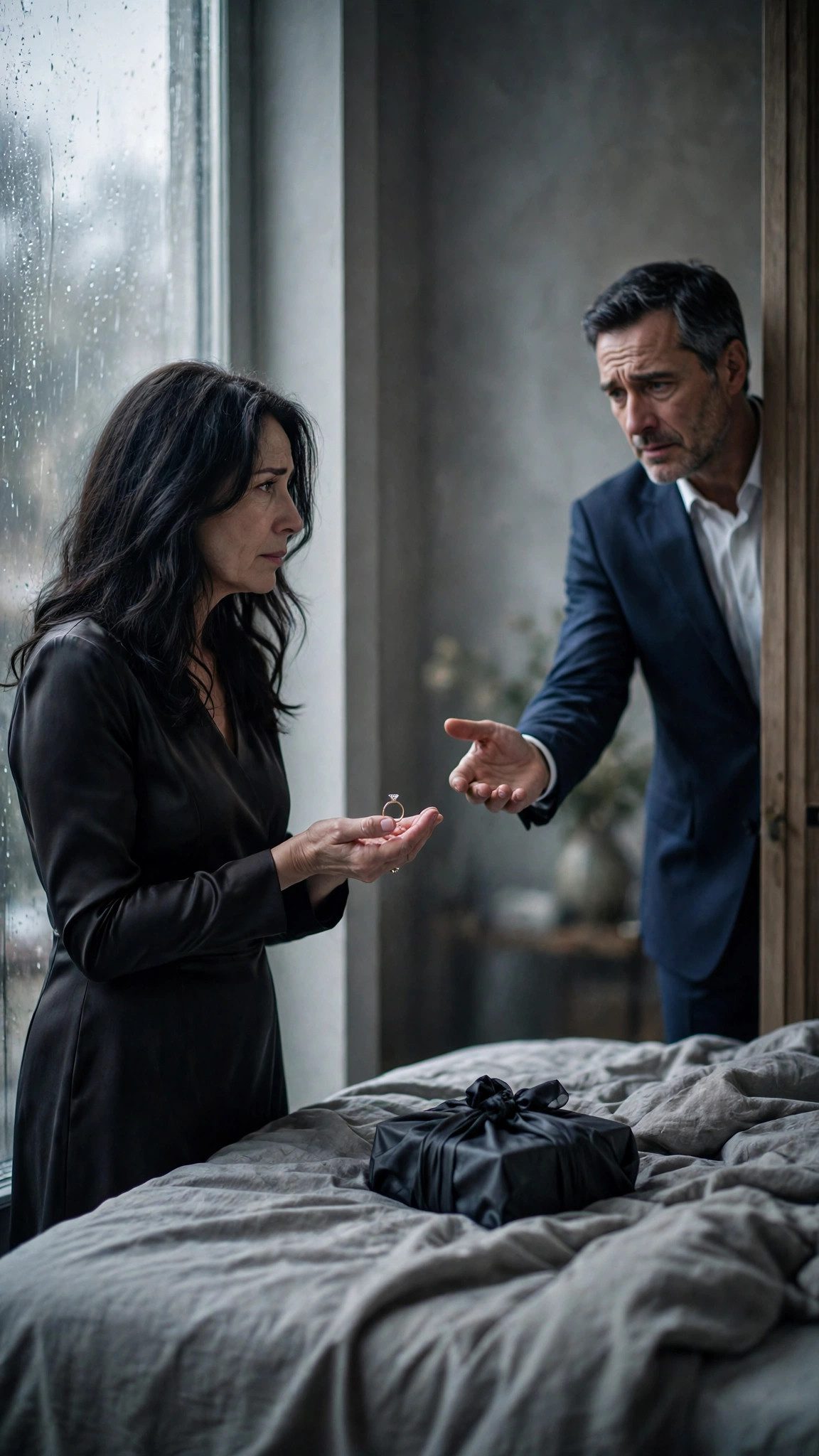
I was twenty-two years old, and I had been a doctor for exactly eleven months, and I believed, with the absolute certainty that only the very young can manage, that medicine was a clean profession. You studied. You learned. You saved people. The world rewarded competence. That was what I believed on the night I met Declan Mercer, and it took me twenty-six years to understand how wrong I was, and how right I was, both at the same time.
The fundraiser was for the children's ward at St. Catherine's Hospital, where I was a resident. It was held in the grand ballroom of the Whitmore Hotel, and the tickets cost more than I earned in a month, and I was only there because Dr. Helen Marsh, my attending and my best friend, had insisted that I come. Helen was forty then, sharp-tongued and warm-hearted in equal measure, and she had taken me under her wing the day I arrived at St. Catherine's, terrified and determined in equal measure.
"You need to meet people who are not dying, Sarah," she had said, pressing a borrowed black dress into my hands. "You need to remember that the world has music in it. Put on the dress. Smile. Talk to someone who is not a patient."
I did not own a dress suitable for a ballroom. The borrowed dress was simple and black and a little too long, and I kept stepping on the hem, and my dark hair would not stay in the twist I had attempted, and I felt like a fraud among the glittering people with their champagne and their diamonds. I spent the first hour near the buffet, eating small pastries and pretending to read the auction catalog, and I was just deciding that I had fulfilled my social duty and could go home when a man stopped beside me and asked me what I thought of the children's ward.
He was thirty-five. He was dressed in a pressed navy suit that fit him like it had been sewn onto him. He was tall, and broad-shouldered, and built like a man who had never known a single doubt, and his dark hair was swept back from a face that was handsome in a way that made you look twice, not because it was perfect, but because it was interesting. There was a scar through his left eyebrow, thin and white, and his eyes were a dark, deep brown, and when he looked at me, he actually looked at me, the way people rarely do.
"I think," I said, because he had asked me a real question and I was too tired to be polite, "that the children's ward needs new monitors more than it needs a ballroom full of people congratulating themselves for caring about children."
He laughed. It was a real laugh, low and surprised, and it changed his whole face.
"And you are?" he asked.
"Dr. Sarah Hamilton," I said. "Second-year resident. I work on the ward you are all here to save."
"Declan Mercer," he said, and he held out his hand, and when I shook it, his grip was firm and warm, and he did not let go right away. "I own some of the buildings your hospital rents. I suppose that makes me part of the problem."
"It makes you part of the solution, if you want to be," I said.
We talked for an hour. Or rather, I talked, and he listened, and that was the remarkable thing. Declan Mercer listened the way no one had ever listened to me before. He did not interrupt. He did not glance at his phone. He did not look over my shoulder for someone more important. He asked me about the ward, about the children, about the monitors, about what it felt like to tell a mother that her son was going to be all right, and what it felt like to tell a mother that he was not. And when I told him, he did not flinch. He did not offer empty comfort. He simply listened, and then he said, "That sounds like a hard way to live."
"It is," I said. "But it is the only way I know."
He asked me to dinner before the night was over. I said no. I said no because I was twenty-two and he was thirty-five and he was rich and I was a resident who ate hospital cafeteria food, and because Helen had warned me, with a look, that the man in the navy suit was not the kind of man you said yes to lightly. But he asked again the next week, at the hospital, of all places, appearing in the corridor outside the children's ward with two cups of coffee and no explanation for how he had gotten past security, and this time I said yes, because I was curious, and because he had listened, and because no one had ever looked at me the way he did, as if I were the only interesting thing in the room.
Dinner was at a small Italian restaurant with no sign on the door and candles on every table. He asked me about my grandmother. I do not remember why I told him about her. I had not planned to. But he asked, and I answered, and once I started, I could not stop.
My grandmother, Rose Hamilton, had raised me after my parents died in a car accident when I was nine. She had come to this country with nothing but a diamond ring sewn into the pocket of her coat, a ring that had survived the war, survived the invasion, survived the crossing of an ocean. She had sold everything else she owned to keep us fed, but she had never sold the ring. "This ring is our family," she used to tell me, holding it up to the light so it caught the sun. "As long as we have this ring, we have each other. It is protection. It is love. It is history. Never let anyone take it from you, Sarah. Never."
She gave it to me on my eighteenth birthday, pressing it into my palm the way I would one day press it into someone else's, and she made me promise to keep it safe. She died two years later, quietly, in her sleep, in the small apartment above the bakery where she had worked for thirty years. I wore the ring every day after that. It was the only piece of her I had left.
Declan listened to all of it without interrupting, and when I finished, he was quiet for a long moment, and then he said, "She sounds like a woman who understood what matters."
"She did," I said.
He proposed after five months. Five months of dinners, and walks, and long conversations in hospital corridors at two in the morning, when I came off shift and he was somehow always there, waiting, with coffee and no questions. Five months in which he never once used his power with me, never once raised his voice, never once made me feel small. He held my hand in bed. He whispered my name in the dark. He defended the people I loved — quietly, without telling me, paying off a colleague's gambling debt, finding a specialist for Helen's mother, making problems disappear before I even knew they existed.
I said yes. Of course I said yes. I was twenty-two, and I was in love, and I did not know yet that the man I was marrying was one of the most feared men in the city I called home. I did not know that his name made half the city tremble with a phone call. I did not know that his family had ruled the docks and the trucking routes and the quiet corners of the city for three generations. I learned those things later, piece by piece, the way you learn that the house you have moved into has rooms you have never seen.
What I did know, on the day he proposed, was that he had listened to me. And that was enough.
The wedding was small. Declan wanted it small, he said, because what mattered was us, not the city. I wore a simple ivory dress. Helen stood beside me. Marcus Mercer, Declan's younger brother, stood beside him, tall and laughing, with the same dark eyes and the same scar through his eyebrow — his from a childhood fall, he told me, grinning. I liked Marcus at once. He was warmer than Declan, quicker to laugh, and he treated me like a sister from the first hour.
It was after the ceremony, in the small garden behind the chapel, that Declan did the thing that captured my heart completely. He took my hand, and he gently slid my grandmother's diamond ring from my finger, and he replaced it with a bigger one — a flawless stone in a platinum band that must have cost more than my grandmother had earned in her entire life.
"You will never need this again," he promised, and his voice was soft, and his eyes were on mine, and I believed him completely. "What is mine is yours. You are safe now. You are mine now, and I will take care of you."
And then he did something that made me love him more than anything he had ever done. He wrapped the old ring in dark silk, and he locked it away in the safe in his study, and he said, "Let her memory guide us and watch over us. She will always be with us, Sarah. I promise you that."
I cried. I cried because it was beautiful, and because it was thoughtful, and because no one had ever treated my grandmother's memory with such reverence. I did not know then that the ring would stay locked in that safe for four years. I did not know that the promise he made that day — what is mine is yours — was a promise he would break, and break, and break again, in ways I could not yet imagine.
From that moment, he took care of me. For four years, our life felt almost perfect. But it was never quite that easy, because I learned, slowly, that Declan hid things from me. Small things, at first. Then larger ones. Then things that frightened me.
I should have seen it sooner. I was a doctor. I was trained to notice symptoms, to read the small signs before they became emergencies. But love, I have learned, is the one disease that makes even a doctor blind.
The first sign was Victoria.
Victoria Hale was twenty-nine, sharp, and beautiful in the cool, efficient way of a woman who has never needed anyone's approval. She was Declan's personal assistant, and she scheduled everything. She scheduled my visits with him. She scheduled his flights. She scheduled our dinners, our holidays, our anniversaries. At first I thought she was simply good at her job. Then I began to notice the small things. He had told me we had the same flight to Chicago, and then he emailed me the day before my trip to tell me it had been postponed. He would say he was listening, but I always knew he was not paying attention. If I found his phone, he would be messaging a name I had never heard before, and he deleted those messages before I could read them.
"Who is Victoria?" I asked him one night, and I tried to keep my voice light, and I failed.
"Victoria is very special to our family," he said, and he did not look at me when he said it. "She is not my mistress. She is a personal assistant, and she has access to my phone sometimes. Her life is complicated and secretive-shy. She is a valued person who really cares about us."
I believed him. I believed every word he said. I wanted to believe him, and that is the same thing, in the end.
But there was something else I did not know then, something I would not learn until much later, and it is the thing that explains everything that came after. Seven years before our wedding, before I ever met Declan Mercer at that fundraiser, I had saved his brother's life.
Marcus Mercer was carried into my emergency room on a rainy night in October, with a bullet in his chest and his blood on the hands of the men who carried him. The men who shot him had meant to shoot Declan. That was the truth, though no one told me so at the time. I was the attending on call. I was twenty-six years old, and I had been a doctor for four years, and I had never lost a patient on my table, and I was not going to lose this one.
I worked on him for six hours. I held his heart in my hands — literally, with my gloved hands inside his chest, massaging it back to life when it stopped — and I felt his cool skin under my fingers, and I watched his family cry in the waiting room while I told them there was nothing left to do, and then I went back in and did it anyway. When he opened his eyes the next morning, the first thing he said was, "Tell the doctor I owe her my life."
Declan Mercer was standing at the foot of the bed when Marcus said it. He had been there all night, silent, in his navy suit, watching the door of the operating room the way a man watches the door of a room where his whole world is being decided. He looked at me, and he said, "Thank you, Doctor," and there was something in his voice that I did not understand then.
I understand it now. That was the night Declan Mercer decided that Sarah Hamilton was the woman he would marry. Not because he loved me yet. He did not know me yet. But because I had held his brother's life in my hands and had not let go, and in Declan Mercer's world, that kind of debt was the only thing that mattered.
He came to the fundraiser three weeks later because he knew I would be there. He listened to me because he had already decided to spend his life listening to me. And when he proposed, five months later, it was not a beginning. It was the end of a plan he had already made.
I did not know any of this on my wedding day. I knew only that the man I loved had wrapped my grandmother's ring in dark silk and locked it away, and that he had promised me I would never need it again.
I believed him. I believed every word.
Until the day he proved me wrong.