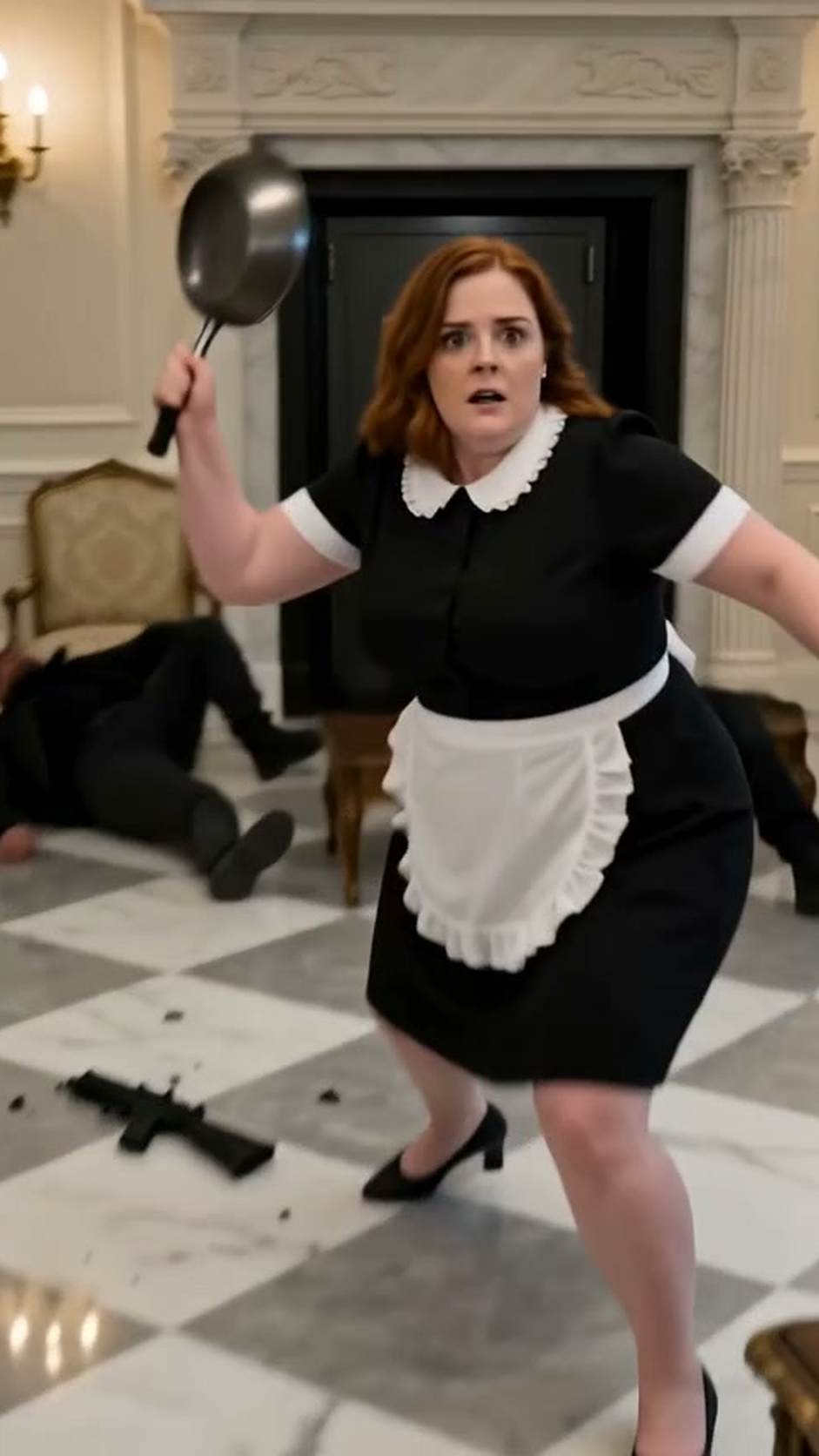
The first man came at her with a rifle, and Maggie Doyle hit him with a frying pan.
Not a frying pan. His frying pan — the big cast-iron skillet that lived on the third hook in the Caldwell kitchen, black as a coal and heavy as sin, the one Rosa the cook refused to let anyone else wash. It was in Maggie's hand because she had been putting away the night's dishes when the mansion's lights died in the wrong way, and a woman raised the way Maggie was raised does not walk toward a wrong silence empty-handed.
The intruder lunged across the study's marble floor, weapon up. Maggie stepped inside the swing of the rifle instead of away from it — close, where a long gun is useless — and brought the skillet down on his gun arm with everything fourteen months of invisibility had stored up in her.
CLANG.
The sound rang off the marble like a church bell dropped down a well. The rifle tore free of his hands and skidded across the polished floor, spinning, until it fetched up against the leg of Ethan Caldwell's desk. The man reeled backward with a shout, clutching his forearm, and crashed into the glass coffee table, which exploded under his weight in a bright burst of crystal and magazines.
Maggie's hair whipped across her face. Her eyes were wide, her breathing sharp and fast — but her feet were already moving, because there were two more of them, and the second one was coming around the desk with his weapon rising, and the third was already at the far wall, at the painting, at the safe hidden behind it, which was the whole reason they had come.
She did not remember deciding anything. Later, watching the footage, Ethan Caldwell would lean toward the monitor and try to find the moment where his quiet maid chose to fight, and he would not find it, because there was no choosing in it. There was only the training her father's voice had laid down in her bones before she was old enough to drive: Hands first. Feet always. Whatever is in your hand is a weapon; whatever is in theirs is a liability. Make the room yours.
The second man swung at her and she ducked under it and drove the skillet's edge up into his ribs and felt him fold, felt his breath leave him in a grunt, and she shoved him sideways into the bookshelves and he went down on one knee among the falling ledgers. The third man turned from the safe with his gun coming up and Maggie hurled the heavy crystal decanter from the desk — no. She would tell it honestly afterward, to exactly one person: she threw Ethan Caldwell's two-hundred-dollar whiskey glass, because it was closer, and it struck the man's wrist and spoiled his aim by six inches, which was the difference between the bullet taking her through the chest and the bullet taking her through the sleeve of her uniform, high on the left arm, in a hot bright line of pain.
Then she was on him before he could correct, and the skillet finished the conversation.
Afterward there was a silence so complete she could hear the ice melting in the overturned decanter.
Maggie sat down — carefully, like an old woman — in Ethan Caldwell's executive chair, behind Ethan Caldwell's desk, in the wreckage of Ethan Caldwell's study, with three unconscious armed men arranged around her like the world's worst furniture, a cast-iron skillet resting across her lap, and blood coming through the sleeve of her black-and-white uniform in a slow, dark flower. Her hand, still wrapped around the skillet's handle, would not stop trembling.
That was how the most dangerous man in New Jersey came home and found her: on his own security cameras, hours later, in cold blue light.
Ethan Caldwell sat in his surveillance office in the dark, in the cream polo shirt he had worn to a sit-down across town, his tattooed forearms bare on the desk, and watched the wall of monitors replay the destruction of his study. He watched a man drop to his knees. He watched another stagger and fall. He watched the woman he had passed in his own hallways for fourteen months without once truly seeing — the woman who laid out his shirts, who knew he took his coffee black and his calls in the study and his silence absolute — move through three professional killers like weather through a cornfield.
His hand, which had been at his mouth, lowered slowly to the desk.
"She did all that?" he said, quietly, to the empty room.
He got up and went down to the study, where the police his lawyer had already bribed into patience were not, where his own men stood in a useless ring saying nothing, where Maggie Doyle sat exactly where the cameras had left her.
He looked at the skillet across her lap. He looked at her bleeding arm. He looked at her face — really looked, perhaps for the first time in fourteen months — and something in his own face went through several locked doors in succession.
"And you had a skillet?" he said.
"It was closer," Maggie said, and her voice shook only a little.
She did not sleep that night, though the doctor Danny had summoned stitched her arm and told her to. She lay in her narrow room under the eaves and stared at the ceiling and listened to the house settle, and at four in the morning she heard, through two floors of oak and marble, the sound of a man rewinding a recording.
Upstairs, Ethan had found the frame. He had dragged the footage backward at speed — the fight unspooling in reverse, the men rising from the floor like puppets — and then he had stopped it dead, and the great monitor filled with a wrist.
A man's wrist, in close-up, as he reached for the painting over the safe.
Tattooed around it, small and black and precise: a compass, enclosed in a circle.
All the sound went out of the room. Ethan's breathing stopped with it. He leaned in until the cold light of the monitor reflected across his eyes, and he stared at a symbol he had not seen since he was a boy — a symbol that had been buried, by his father's order and with his father's body, twenty-six years ago — and from the recording, faint and muffled and unmistakable, came a voice from the middle of the fight, a man's voice, tight with a recognition that had arrived one second too late:
"Maggie Doyle."
They had known her name.
In the morning she stood in the doorway of the ruined study with her arm in a bandage and her face arranged back into its usual quiet, and Ethan Caldwell crossed the room to her with a slowness that was not gentleness but control, the way a man approaches something that might be a wire.
"They knew your name," he said, low and serious.
Her lips parted. Her breath caught. For the first time in fourteen months of service, Maggie Doyle looked directly into her employer's eyes — and he watched her understand that the floor of her life had just given way.
All that day, the house filled up with the machinery of Ethan Caldwell's anger. Men arrived who did not wear uniforms and did not give surnames. The three attackers were questioned in a place Maggie never saw, by methods she was never told, and what came back up the chain arrived in Danny's flat soldier's voice, in the study, with the door shut: professionals, freelancers, hired through two cut-outs and paid in full in advance, given the floor plan of a house they had never entered and the schedule of an alarm system they had never seen, and one instruction about the staff that had made all three of them laugh.
The maid, they had been told. Doyle. She's nobody. Don't waste a man on her.
Ethan listened to that report standing at the window of the surveillance office, with the frozen frame still up on the great monitor behind him — the wrist, the compass, the circle — and when Danny finished, Ethan said, "And the alarm?"
"Wasn't hacked, boss. It was switched off. From inside the house, with a staff code, at eleven-twelve that night."
"Whose code?"
Danny's pause was its own answer. "The codes rotate through Mr. Sorren's office. Half the senior staff could've—" He stopped. "We're working on it."
Ethan said nothing for a while. Then he did something he had not done in twenty years of being who he was: he went back to the beginning of the footage and watched all of it again, not for the symbol this time, not for the fight, but for the woman. He watched her come over the desk. He watched her kick a rifle away with a bare foot. And he watched the part he had missed the first time, the part after — his maid, bleeding through her sleeve, going from one unconscious man to the next in the wreckage of his study and putting two fingers against each man's throat, one by one, counting, the way a nurse counts. Making sure of them. Making sure they were alive.
"She checked their pulses," he said to the empty room, in a tone of complete bewilderment. "She put three men through my furniture and then she checked their pulses."
Two nights later there was a dinner, because men like Ethan Caldwell do not cancel dinners; a canceled dinner is a confession. Eight of his most trusted people sat at the long table under the chandeliers, and Maggie, arm bandaged, served, because she had refused — flatly, finally — to be sent away to rest.
Three times, at the far side of the table, a man she could not quite see past the candlelight did a small thing with his hands.
Once. Her eyes moved, the way eyes move at a sound too faint to name.
Twice. Her breathing changed.
Three times — and Maggie Doyle's whole body understood before her mind did, the way it had understood in the study, because her father had made a game of it at a kitchen table a lifetime ago: watch the hands, Margaret. The hands always tell you when the room is about to die.
"Ethan, get down!"
She was already moving. He was already turning toward her, his controlled face breaking open into alarm, and from somewhere outside the frame of that warm, golden room came a small, faint, mechanical click —
—and this is where the story, as the cameras tell it, goes black.
But it does not begin there. It begins fourteen months earlier, on a wet Tuesday in March, with a woman standing at a service entrance in a gray rain, holding a carpetbag and a forged reference she did not need, because the agency had already decided she was exactly what the Caldwell house required: quiet, competent, and forgettable.
FOURTEEN MONTHS EARLIER.
The house manager who interviewed her was named Mrs. Abernathy, and she had the exhausted kindness of a woman who had hired staff for three crime families and a senator. She looked at Maggie's plain face, her plain references, her plain sensible shoes, and she was satisfied in under four minutes.
"You'll find Mr. Caldwell is not a difficult employer," she said, leading Maggie up the back stairs. "He is a difficult man, which is different. He does not notice staff. Do not take it personally. He does not notice anyone he is not about to—" She stopped herself, with the air of a woman closing a door. "He keeps his own hours. The study is cleaned Tuesdays, with Mr. Sorren present. The east wing is—"
"Sorren?" Maggie asked.
"Mr. Victor Sorren. Mr. Caldwell's lieutenant." Mrs. Abernathy said the word the way other people said priest. "If Mr. Caldwell is the house, Mr. Sorren is the lock on its door. Anything you need, you will ask him."
Maggie said she understood, and she did, and it was not the understanding Mrs. Abernathy meant.
Ethan Caldwell passed her on the stairs that first evening, close enough that his sleeve brushed the banister she was polishing. He was taller than she had expected from the newspapers, and broader, and the tattoos climbed out of his collar like something alive under the skin. He was speaking into a phone in a low, pleasant voice that froze her where she stood, because pleasant, from that man, was so much worse than shouting.
"Then he shouldn't have signed it," Ethan Caldwell said, and went past her, and down, and was gone, and he had not seen her at all.
Maggie stood on the stairs with her polishing cloth in her hand and her heart going like a fist on a door.
Twenty-six years, she thought. Twenty-six years, and he doesn't know my face.
That night, in the narrow room under the eaves that was hers now, she opened the carpetbag and took out the things that were not in any inventory: a rosary, a folded photograph worn soft as cloth, and a black notebook with oilcloth covers, swollen with twenty years of a dead man's handwriting.
She turned the pages the way she always turned them — past the routes, past the names, past the careful columns of figures in pencil — to the last page, the one she had memorized before she was ten.
On it, drawn by her father's hand in his careful draftsman's lines, was a compass. A small black compass, enclosed in a circle.
And beneath it, in the handwriting that had taught her her own: If anything ever happens to me, Margaret — start with the compass. It points at the family. It always points at the family.