Ethan Caldwell had killed the headlights a quarter mile from his own gate, out of a habit older than his beard, and so he came up the drive in the rain-dark with his engine ticking and his instincts already standing at attention, and he knew before he reached the portico that the house was wrong.
A Caldwell house at midnight is never dark. There are lights the staff leave, lights the security leaves, lights that exist purely to announce that someone awake and paid is watching. That night there were none. There was only the emergency strip in the portico, burning on its battery, and Danny at the door with his weapon drawn and his face the color of paper, saying, "Boss. Boss, wait—" and Ethan was already past him, already inside, already moving through his blacked-out hall with the gun he kept in the car in his hand and his heart slamming, toward the study, where a single lamp had been righted and lit by someone with steady hands.
He stopped in the doorway.
He had seen rooms after violence all his life. He had made some of them. He knew the grammar of it — the furniture, the scatter, the way blood and paper and broken glass arrange themselves into a sentence. But the sentence in his study that night had a word in it he could not read.
Three men. His men, later, would tell him the particulars with the flat awe of altar boys describing a miracle: one through the coffee table, one folded over the bookshelf with two cracked ribs, one behind the desk with a skull like a struck bell. Three professionals, the kind you hire when you cannot afford a second attempt, taken apart in his study in under four minutes.
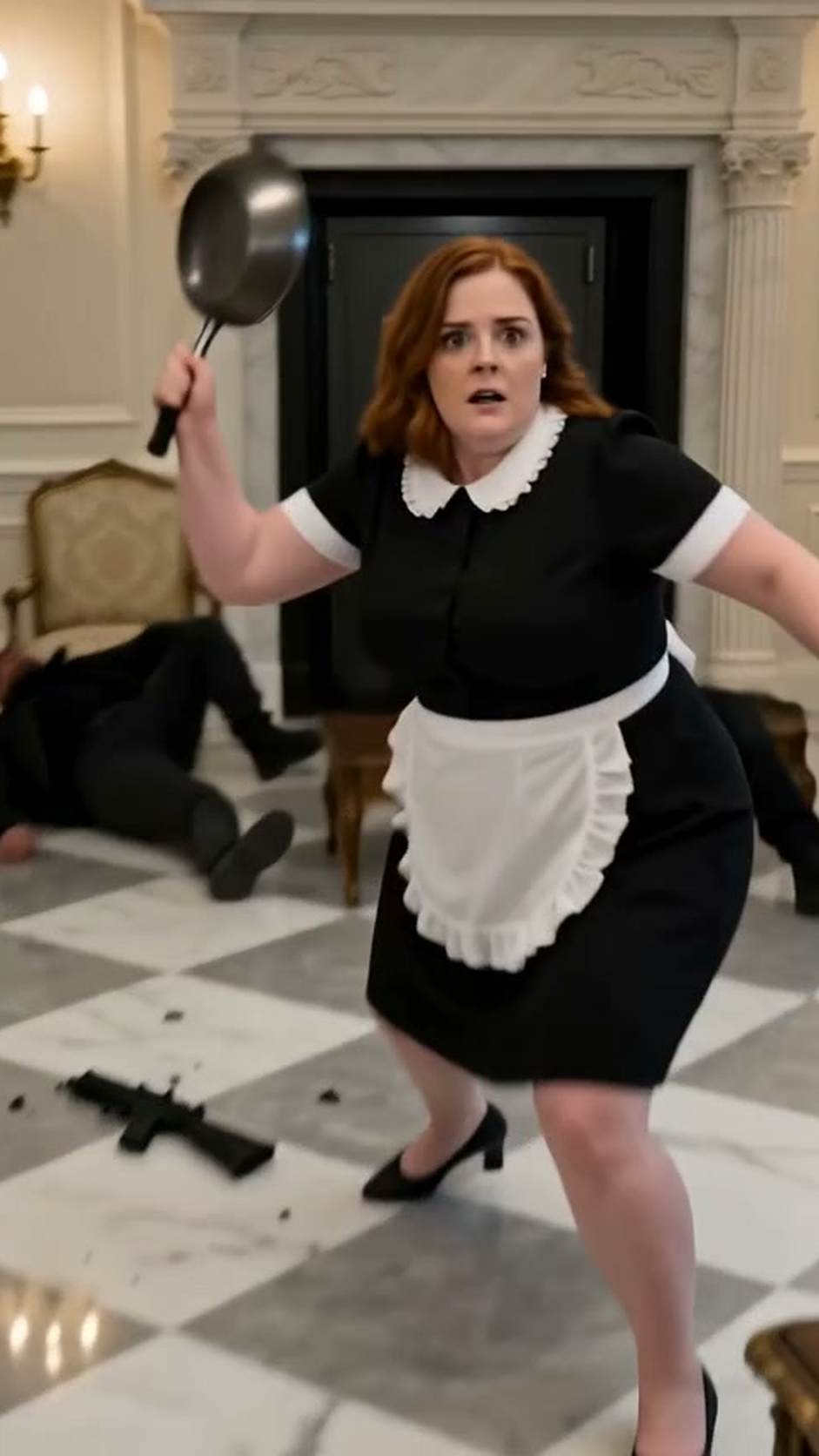
And in his chair, behind his desk, sat his maid.
She had the skillet across her lap like a woman in a painting of a saint no church would canonize. Her uniform sleeve was dark with blood. Her hair was down around her face, and her face — he would think about her face for a long time afterward, in the small hours — her face was not triumphant, and it was not hysterical, and it was not anything he had ever seen on it in fourteen months of passing her on stairs.
It was tired. That was all. She looked at the most feared man in New Jersey standing in his own doorway with a gun in his hand, and she looked tired, and faintly, obscurely, annoyed — the way a woman looks at one more mess she is going to have to clean.
"And you had a skillet?" he heard himself say, stupidly, because his brain, that famous instrument, had produced nothing else.
"It was closer," she said.
The doctor came, and Danny's men took the three attackers away to a place where questions could be asked at leisure, and the power came back in sections, and by three in the morning the house was lit and humming and full of men being quiet in doorways. Ethan sent them all away. He went up to the surveillance office, alone, and he pulled the night's footage, and he watched his maid dismantle three killers, and he said to the empty room, "She did all that?" — and then he kept watching, because the footage had more to tell him, and at the moment the third man reached for the painting, Ethan dragged the recording back and froze it, and the room went silent in a way that had nothing to do with sound.
The compass. On the man's wrist. In a circle.
He had been nine years old the last time he saw that mark on living skin. His grandfather had worn it — no. His grandfather had issued it, the way a king issues a seal: to the eleven men of the first crew, the smugglers and dock-runners who had built the Caldwell name out of other men's cargo. His father had abolished it before Ethan was born. Henry Caldwell had stood in a room in Elizabeth in 1974 and told the old guard that the family was done signing its work like pirates, and the compass had gone into the ground with the last of the eleven — all but one of whom were dead before Ethan could shave.
No living man should have been wearing it. No living man should have known what it was.
And then the recording, at its frozen frame, gave up its last gift: the audio track, a hiss of room tone, and through it, faint and muffled, in the middle of the fight — a man's voice, and the voice was not shouting a warning or a curse. It was saying a name, in the tone of a man who has just recognized something twenty-six years too late and knows it is going to cost him.
"Maggie Doyle."
Ethan sat in the blue light until the sky outside his windows went the color of wet ash.
Then he did the thing he should have done fourteen months before, or twenty-six years before, or at any point in a life spent being told who people were by men with reasons to lie to him.
He looked into Maggie Doyle himself.
The file Danny brought him by eight o'clock was four pages long and clean as a communion wafer. Born Columbus, Ohio. Mother deceased, a nurse. Father deceased, occupation listed as driver, died in a motor accident when the girl was a child. References impeccable. Employment history: two hotels, one private household in Princeton, each glowing, each brief.
Too clean. Ethan had read police files on himself that were dirtier than Maggie Doyle's life. A woman does not take apart three armed men with a kitchen implement and have a past that reads like a seed packet. Somewhere under the four clean pages was a fifth page, and Ethan Caldwell intended to stand in his ruined study in the morning light and ask her for it to her face.
She came when she was summoned, because she was still, in the paperwork of his life, his maid. She stood in the doorway with her arm bandaged and her hair pinned up and her face composed into its old quiet, and he saw — with the new eyes the night had given him — how much work that quiet was. How it was not emptiness at all. It was a held breath, fourteen months long.
"They knew your name," he said.
He watched it land. He had meant it as an accusation and it landed as something else — her lips parted, her breath caught, and for a second the composure simply left her, and what stood in its place was grief, old and organized, the kind a person builds shelves for.
"Say it again," she said.
"What?"
"My name. Say it the way he did." Her voice was not steady now. "Twenty-six years I've waited for somebody in this house to say my name like it was a thing that mattered. He knew it. Lying on your floor with my skillet mark on him, he knew it. Do you?"
Ethan Caldwell, who had faced down federal task forces and the assembled captains of three states without once raising his voice, found that he had nothing whatsoever to say.
"My father," Maggie Doyle said, "was Patrick Doyle. He drove your father's car for twenty years. He taught me to fight in a backyard in Columbus with a wooden spoon, because he said a girl in this family's weather should know how to stand in the rain. He died on Route 17 with your father's blood and his own all over the inside of that car, holding you—" and here her voice broke, cleanly, like a stick, "—holding you out of the fire with his hands. And you have had his daughter scrubbing your floors for fourteen months, Mr. Caldwell, and you never knew, because the story you were raised on says he froze."
"The story—" Ethan began.
"The story is a lie," she said. "It was always a lie. I came here to prove it. And last night three men came to steal the only proof there is, with my father's own mark tattooed on their skin — the mark your father buried. So whatever you're going to ask me, ask it knowing that."
"Why the floors?" Ethan said at last. His voice had lost its polish entirely; it sounded like something being dragged. "You had a name. You had a right to the door — the front door, Maggie, not the service stairs. You could have come to me at any time in fourteen months and said who you were."
"Could I?" She looked at him then with something that, in a less controlled face, would have been pity. "The boy who was raised on the story that my father froze — who has kept that story's author at his right hand and his uncle at his table for twenty-six years — what would he have done with the driver's daughter at his front door, Mr. Caldwell? Believed her? Or had Danny show her the road?" She shook her head, once. "I needed the truth to be standing in the room before I knocked. Floors were how I got it into the house. Floors were how my father got into every room in this family's life, if it comes to that. A Doyle comes in through the service entrance and stays until the fire. It's the family trade."
Before the confrontation, in the gray hour, Ethan had gone down to the study alone and stood in front of the painting.
The seascape hung straight — Danny's men had rehung it, over a door that was shut and locked and unbreached, which was itself a kind of testimony. Ethan stood where the third attacker had stood, and he put his hand flat against the frame, over the smudge in the gilt, and he thought about the tin box on the other side of that door: the photograph, the gloves, the letter he had never read, that he had been specifically and elaborately not reading for twenty years, because a man who inherits an empire at nineteen learns very quickly which doors in himself to keep locked, and Henry Caldwell's last letter had always been the darkest of them.
He took his hand off the frame. He did not open the safe. Not yet. He told himself it was because there were questions to ask first, in the proper order, and the first of them was standing upstairs in a doorway with her arm in a bandage.
But before that, he asked one other question, of one other person. He found Mrs. Abernathy in the pantry, supervising the inventory of the broken crystal with the grim air of a quartermaster after a battle, and he said, "Who hired her?"
"Maggie? I did, sir. Fourteen months ago. The agency sent six candidates and she was—" the old woman hesitated, and something in her face changed, the way a room changes when a candle is lit in it, "—she was the only one who asked about the house, sir. The others asked about the wages, and the hours, and whether they'd have to— the others asked about themselves. She asked which room the master used in the mornings, and whether the staff were long-serving, and whether the house was — her word, sir — settled. I thought it was conscientiousness."
"It wasn't conscientiousness," Ethan said.
"No, sir." Mrs. Abernathy folded her hands. "I believe it was reconnaissance. And I hired her anyway, God forgive me, because she had the saddest eyes of any candidate I've interviewed in thirty years, and this house—" She stopped, the way she had stopped herself on a staircase fourteen months before. "This house has not always been kind to sad-eyed people, sir. I thought perhaps that was about to be her problem. It never occurred to me it was about to be everyone else's."
Downstairs, an hour later, Danny put a photograph on Ethan's desk without a word. It came from the old files, from a box no one had opened since the funeral: a picnic, of all things, at the lake house, in the summer of 1991. Henry Caldwell laughing with a drink in his hand. A tall Irishman beside him with his arm around a boy — a serious, dark-haired boy of nine or ten, standing very straight, the way boys do when they are being photographed next to greatness.
The Irishman was Patrick Doyle. The boy was Ethan.
And on the back, in faded pencil, in a hand Ethan recognized as his father's, were four words that no one had ever read aloud to him in twenty-six years of being lied to:
Doyle kept us alive.