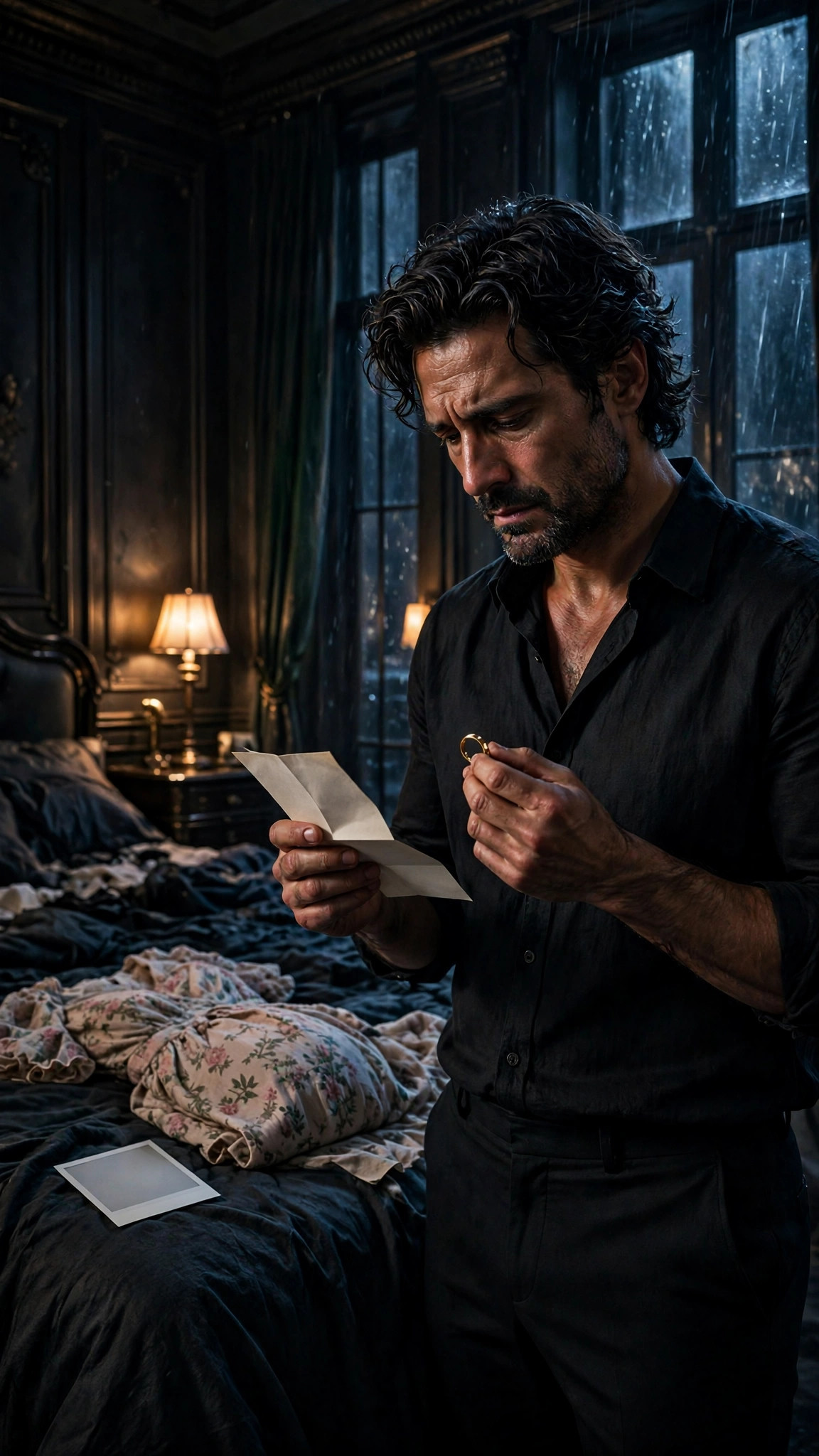
For a moment, I did not understand. I stood in Dr. Whitfield's office, staring at the report, and the words on the page swam in front of my eyes, and I said, "What are you talking about? What do you mean, I might never have seen my son again? My son is my son. Nobody can keep him from me."
Dr. Whitfield took off his glasses, and he cleaned them with a cloth, and his hands were shaking so badly that he dropped the cloth twice, and he said, "Mr. Carter, I am a doctor. I have delivered a thousand babies. I have seen a thousand families. And I have never — never — seen what I saw in your wife's blood."
He pointed at the report, at a line of numbers I could not read, and he said, "Seven months ago, your wife came to me in secret. She did not come to the hospital. She came to my private office, after hours, and she asked me to run a test — a toxicology screen. She told me she had been feeling ill. Dizzy. Tired in a way that sleep did not fix. Her hands shook. She fainted twice. She said she thought it was the pregnancy, but she wanted to be sure."
He turned the page, and he showed me the results, and he said, "There was a drug in her blood, Mr. Carter. A slow poison. A drug that crosses the placenta. In small doses, over time, it makes a woman weak, and dizzy, and tired. In larger doses, it causes a miscarriage. In still larger doses, it kills."
I stared at him. I could not speak. I could not breathe. I could feel my heart beating in my chest, hard and slow, like a drum.
"Someone was poisoning my wife," I said. It was not a question. It was the only sentence my mind could form.
"Yes," he said. "And your wife knew. She did not know who, but she knew. That is why she had the test done in secret. That is why she asked me to keep it between us. And that is why, after your son was born, she asked for the genetic test — not because she doubted you were the father, Mr. Carter. She never doubted that. She wrote 'That was never what I needed tested' because what she needed to know was whether the poison had reached her baby. Whether the drug had crossed the placenta in time to harm him. Whether her son would live."
"And?" I said. My voice sounded like it was coming from very far away. "Did it? Did the poison reach him?"
Dr. Whitfield looked at me, and for the first time since I had walked into his office, his hands stopped shaking, and he said, "No. Noah is healthy. The dose never reached him in enough quantity to harm him. Your wife — your wife protected him. She stopped drinking the tea two days before she gave birth. She stopped eating the food. She starved herself, Mr. Carter, for two days, to keep the poison away from her son. And it worked. He is alive, and he is healthy, and he is perfect."
I sat down. I do not remember sitting down. I remember the chair being under me, and the office being very quiet, and Dr. Whitfield's voice going on, telling me the rest of it, telling me the thing I had come to hear and the thing I had been afraid to hear, all at the same time.
"The poison was in her tea," he said. "The evening tea. The special tea, with honey and lemon. Your wife told me that Rosa — your housekeeper — made it for her every evening, and that Rosa had told her it was full of vitamins, good for the baby. But the powder Rosa stirred into it was not vitamins. It was the drug. And Rosa did not know. At first, she did not know. Someone told her it was medicine. Someone paid her to do it. Someone she trusted."
"Who?" I said. "Who paid her?"
Dr. Whitfield shook his head. "I don't know. Your wife didn't tell me. She said she needed to find out for herself, and that she needed to protect her son first. But she told me one more thing, Mr. Carter, and I think it is the most important thing she told me. She said — her exact words — 'If I stay one more week, Doctor, I will be dead. And if I die, they will take my son. They have papers. They have a plan. And my husband will never see him again.'"
"Papers," I said. "What papers? Who are 'they'?"
"I don't know," he said. "She wouldn't tell me. She said it wasn't safe to tell anyone. She said the only thing she could do was leave, and leave fast, and take her son with her, and trust that her brother would help her. And that is what she did."
I stood up. I thanked him — I don't know what I said, exactly, but I thanked him — and I walked out of his office, and I drove home, and I went into my house, and I called for Rosa.
She came to the study with a tray, the way she always did, with a cup of tea on it, and when she saw my face, she put the tray down, very slowly, and she folded her hands, and she said, "Mr. Carter."
"Rosa," I said. "Sit down."
She sat down. She was sixty-one years old, and she had kept my house for nine years, and she had watched my wife grow thinner and dizzier and more afraid, and she had made her tea every evening, and she had stirred a powder into it that she believed was medicine, and she had not slept for three nights after she learned what it really was.
I did not shout at her. I did not threaten her. I looked at her, and I said, "Tell me everything. Tell me who paid you. Tell me what they told you. Tell me what the powder was. Tell me everything, and tell me the truth, because my wife is gone, and my son is gone, and you are the only person in this house who knows why."
And she told me. She told me about the money — the money Vanessa had paid her, every month, in cash, in an envelope left in the mailbox. She told me about the tea. She told me about the clinic across town, and the powder, and the three nights she did not sleep, and the day she went to Emily's room and knelt beside her chair and told her everything.
And she told me about the phone call. She had been in the kitchen, two days before the birth, and she had heard Vanessa talking on the phone — not to me, but to her father — and Vanessa had said, "One more week. The doctor said one more week and it will be finished. And then the papers are ready. The custody papers. Michael will never see the baby again. He'll be ours."
Ours. The Bellinis'. Don Arturo Bellini had prepared papers — papers that said I was an unfit father, a criminal, a man who could not be trusted with a child — and the moment Emily was dead, Vanessa would step in as the mother of my heir, and Noah would be taken to be raised by the Bellini family, far away, where I would never be allowed to see him again.
That was the plan. That was the secret my wife had taken with our son. She had not run away from me. She had run to save us both — to save herself from the poison, and to save Noah from the family that wanted to steal him.
I looked at Rosa, and she was crying, and I said, "Rosa, did you know? When you stirred that powder into her tea, did you know what it was?"
She shook her head, and she said, "No, Mr. Carter. I swear on my mother's grave, I did not know. I thought it was medicine. Miss Vanessa told me it was medicine, and she paid me, and I believed her, because she is a beautiful woman from a good family, and I am just a housekeeper, and I did not think — I did not think a woman like that would ask me to kill another woman. When I learned the truth, I went to Mrs. Carter, and I told her everything, and I begged her to forgive me, and she did. She forgave me. She said, 'I already have.' And then she asked me to do one more thing for her. She asked me to drive her to the hospital, and to stay with her, and to never tell anyone what I had told her. And I did. I did all of it."
I believed her. I believed every word, because Rosa was crying, and because she had no reason to lie, and because the woman who had paid her was the same woman who had laughed at me in her penthouse and said, "She'll come back. Women always come back."
I sat in my car outside the clinic for twenty minutes after I left Dr. Whitfield's office, with my hands on the steering wheel, staring at nothing. My hands were shaking. I had not shaken like that since the night I was stabbed, twenty years ago, in an alley behind a bar, when I was twenty-five and stupid and lucky. I called Tony, and I told him what the doctor had said, and there was a long silence on the other end of the line, and then Tony said, "Boss, I'm sorry. I didn't know. None of us knew."
"None of us knew," I said, "because none of us were looking. Because I wasn't looking. Because I was in Chicago."
I drove home slowly, through streets I had driven a thousand times, and I looked at the city the way a man looks at a place he has just realized he does not know at all — the shops, the lights, the people walking on the sidewalks, all of them going about their lives, all of them unaware that a woman had almost died in a house three miles away, and that her husband had not even noticed.
I told Rosa to pack a bag. I told her to leave the house, and to go to her sister's, and to stay there until I called her, because the house was not safe for her anymore, and because I did not want her in the middle of what was about to happen. She went. She kissed my hand before she left, the way she used to when I was a young man with nothing, and she said, "Find her, Mr. Carter. Find your wife. Find your son. And be the man she married, not the man you became."
Then I called Tony, and I said, "Bring the men. All of them. We're going to see Vanessa."
We drove to the penthouse in Chicago that night — twenty men, in ten cars, in the dark — and I walked into the building, and I took the elevator to the fortieth floor, and I knocked on the door, and Vanessa opened it, wearing a silk robe, with her hair spread across her shoulders, and she smiled at me, and she said, "Michael. You're back."
I walked past her, into the penthouse, and I said, "Tell me about the tea, Vanessa."
Her smile did not move. It stayed on her face, perfectly still, like a painting, and she said, "What tea, darling?"
"The tea you paid Rosa to make," I said. "The tea with the poison in it. The tea that was supposed to kill my wife in one more week. The tea that was supposed to give you my son."
For a moment, she said nothing. And then she laughed — a short, sharp laugh, like a door slamming — and she said, "You can't prove anything, Michael. Rosa is a housekeeper. She's old. She's confused. Nobody will believe her."
"I believe her," I said. "And Dr. Whitfield believes her. And the toxicology report believes her. And my wife believed her, which is why she is gone, and my son is gone, and you are standing here in a silk robe, lying to my face."
Vanessa's face changed. The smile went away, and what was underneath it was cold, and hard, and very old — older than thirty, older than the penthouse, older than the Bellini family itself. It was the face of a woman who had never been told no, and who had just realized that the word no had finally arrived.
"My father will hear about this," she said.
"Your father already knows," I said. "He wrote the papers. The custody papers. The ones that say I'm an unfit father. The ones that were going to take my son away from me. Tell him I said this: if he comes near my wife, or my son, or anyone I love, ever again, I will burn his empire to the ground, and I will do it with my bare hands if I have to."
I left the penthouse. I did not hit her. I did not shout. I did not need to. I had said what I came to say, and I had seen her face when she realized that the game was over, and that was enough.
But as I rode the elevator down, with Tony beside me, I understood something that I had not understood before. Vanessa was not the plan. Vanessa was only a part of it. The plan belonged to her father, Don Arturo Bellini, and Don Arturo did not give up. He had wanted my ports for a decade. He had wanted my routes. He had wanted my casinos. And now he wanted my son.
I would have to go and see him. I would have to end this, the way it should have been ended a long time ago — face to face, man to man, with no one else in the room.
But first, I had to find my wife. I had to find Emily, and Noah, and I had to tell them the truth — that I knew, that I understood, that I was sorry, and that I would spend the rest of my life making it right.
I had the name of the man in the black car. I had the name of the cottage on the lake. And I had, for the first time in ten months, a reason to drive north, and not to stop until I found them.