I stayed at the cottage for three days.
Three days, in a small white house with blue shutters, on a lake I had never seen, with a woman I had almost lost and a son I had never met. Daniel slept on the couch, with the shotgun beside him, and he watched me the way a brother watches a man who has hurt his sister — not with hatred, but with a warning, clear and quiet: one wrong move, and you will never see either of them again.
I did not make a wrong move. I got up before dawn, and I made breakfast, and I washed the dishes, and I changed Noah's diapers, and I learned how to hold him — how to support his head, how to cradle him against my chest, how to feel his heartbeat against mine — and I sat in the rocking chair by the window, the same chair Emily had sat in when she talked to him before he was born, and I told him who I was.
"I'm your father," I said. "My name is Michael. I wasn't there when you were born, and I'm sorry. I will never miss another day of your life. I promise you that. I promise you on everything I have, and everything I am, and everything I will ever be."
He opened his eyes — dark eyes, my eyes — and he looked at me, and he yawned, and he fell asleep, and I sat there holding him, and I cried, very quietly, so as not to wake him, because I had not cried in twenty years, and I had forgotten how it felt, and it felt like something breaking open inside my chest, and something healing, both at the same time.
Emily watched me. She watched me from the doorway, and from the kitchen, and from the porch, and she did not say much, but she watched, and I knew she was deciding — deciding whether the man in front of her was real, or whether he was just another version of the man who had promised her things would change and then gone back to Vanessa's bed three days later.
On the third evening, she came and sat beside me on the porch, with Noah asleep in her arms, and she said, "Tell me what you've done. Not what you're going to do. What you've done."
So I told her. I told her about Dr. Whitfield, and the toxicology report, and Rosa's statement. I told her about Vanessa, and the penthouse, and the words I had said to her. I told her about Don Arturo, and the alliance, and the papers, and the promise I had made him. I told her that I had called my lawyer that morning, and that the sale of the three casinos was already underway, and that the money would be gone from my life within a month. I told her that I had called the port authority, and that every shipment, every route, every contract would be legal from that day forward, or it would not happen at all. I told her that I had told Tony to find every man who had ever worked for me in the shadows, and to offer them a choice: come into the light, or go.
"I don't know how to be a good man," I said. "I know how to be a powerful man. I know how to be a feared man. I know how to be a rich man. But I don't know how to be a good man, Emily. I never learned. The only good thing I ever did was marry you, and I spent fourteen years trying to ruin that, too. So if you come home with me, you will have to teach me. You will have to be patient with me. And I know — God, I know — that you have already been patient enough for a lifetime."
She was quiet for a long time. The lake was dark, and the stars were coming out, and Noah was asleep, and the only sound was the water against the dock, and the wind in the trees.
Then she said, "I don't need you to be a good man, Michael. I need you to be my husband. That's all I ever needed. Just my husband."
We went home the next morning. Not to the mansion — not at first. To the cottage, we would return every summer, for the rest of our lives, because it was the place where we had found each other again. But home, real home, was the house with the nursery, and the paper stars, and the crib I had not built, and the kitchen table where she had waited for dinner a thousand times.
Rosa was waiting for us on the porch. I had called her the night before, and I had told her to come back, and she had come, and she was standing there with tears in her eyes, and when Emily got out of the car, Rosa knelt down, and she took Emily's hands, and she said, "Mrs. Carter, forgive me."
Emily pulled her up, and she held her, and she said, "Rosa, you saved my life. You saved my son's life. There is nothing to forgive. You are family. You have always been family. And family does not leave."
We went inside, together, and the house was quiet, and the nursery was exactly as Emily had left it — the stars, the tiny clothes, the blanket with the blue anchors — and I stood in the doorway of that room, holding my son, and I understood, finally, what home was. Not a place. Not an empire. Not a mansion on a hill. A person who comes back. That was what Emily's mother had told her, all those years ago, and it was true. A home is a person who comes back. And I had come back.
The weeks that followed were not easy. There were lawyers, and police reports, and questions from men in suits who wanted to know about the poison, and the money, and the papers. Vanessa was arrested — not by me, but by the police, on charges that had nothing to do with me and everything to do with what she had done. Don Arturo's empire began to crumble, slowly, the way empires do when the men who built them grow old and afraid. I cooperated with every investigation. I told the truth, all of it, even the parts that made me look like a fool, even the parts that made me look like a criminal, because the truth was the only thing I had left that was worth anything, and I was not going to lose it the way I had lost everything else.
And slowly — very slowly, one day at a time — Emily began to trust me again. Not all at once. Not in a single moment. But in small ways, the way trust always comes back: she asked me to hold Noah while she cooked dinner, and I did. She asked me to come to his first checkup, and I did. She fell asleep on the couch one evening, and I covered her with a blanket, and when she woke up, she smiled at me — a real smile, the first one in months — and she said, "You stayed."
"I stayed," I said. "I'll always stay. That's the whole point."
Noah laughed for the first time when he was seven weeks old. I was making a face at him — a ridiculous face, the kind of face a forty-five-year-old mafia boss should never make — and he looked at me, and his whole face lit up, and he laughed, a small, bubbling sound, like water coming up from a spring, and Emily, who was standing in the doorway with a basket of laundry, put the basket down, and she came over, and she sat beside me, and she said, "Do it again."
I did it again. He laughed again. And Emily laughed, too — really laughed, the way she used to laugh before all of this, before Vanessa, before the tea, before the nights I did not come home — and for a moment, sitting on the floor of the nursery with my son in my lap and my wife beside me, I felt like the man I had been in the small apartment, twenty years ago, eating takeout on the floor, believing that the future was something you built together, one small moment at a time.
I learned to bathe him. Emily taught me — how to test the water with my elbow, how to support his head, how to wash his hair without getting soap in his eyes. The first time I did it alone, my hands were shaking, and Noah kicked, and water went everywhere, and Emily stood in the doorway, laughing, and she said, "You're doing fine, Michael. He likes you. Babies know."
Daniel came every Sunday. He would drive down from the lake, and he would stay for dinner, and he would hold Noah, and he would tell us stories about the army, and about the cottage, and about Emily when she was a girl — the time she fell off the dock and came up laughing, the time she tried to cook dinner for their mother and set fire to a dish towel, the time she told him she was going to marry a man who would never make her wait. He told that last story looking straight at me, and I understood that it was not a story. It was a warning, and a blessing, both at the same time.
The first family dinner was on a Friday night, six weeks after we came home. Rosa cooked — roast chicken, the way she always did — and we ate in the dining room, all four of us, with Noah asleep in his basket beside the table, and Emily looked at me across the candles, and she said, "This is what I wanted. Not the house. Not the money. Just this. Just us, at a table, together."
I reached across the table, and I took her hand, and I said, "Then this is what you'll have. Every night. For the rest of our lives."
And I meant it. This time, I meant it, and I knew I meant it, because I had finally learned the difference between saying a thing and doing it — and doing it was just showing up, every night, at the same table, with the same people, and staying.
Six months later, on a spring morning, we renewed our vows. Not in a church, and not in a ballroom, but in the garden behind our house, with Daniel standing beside Emily, and Rosa crying in the front row, and Noah — six months old, wearing a tiny white suit — sleeping in his grandmother's locket, which Emily wore around her neck, the way she had worn it on the night she left.
There was no priest. There was no music. There was just Emily, and me, and our son, and the people who had helped us survive, and the words I had wanted to say for fourteen years, said at last, in the open, where everyone could hear them.
"Emily Carter," I said, "I married you when I had nothing, and you made me everything. I forgot that. I forgot you. I forgot us. I will never forget again. I promise you — not tomorrow, not next time, not when the empire is finished, because the empire is finished — I promise you today, and every day after today, that I will be your husband. I will be Noah's father. I will be here. I will come home. I will stay."
She looked at me, and she smiled, and she said, "I know. I know you will. Because you came back. And a home is a person who comes back."
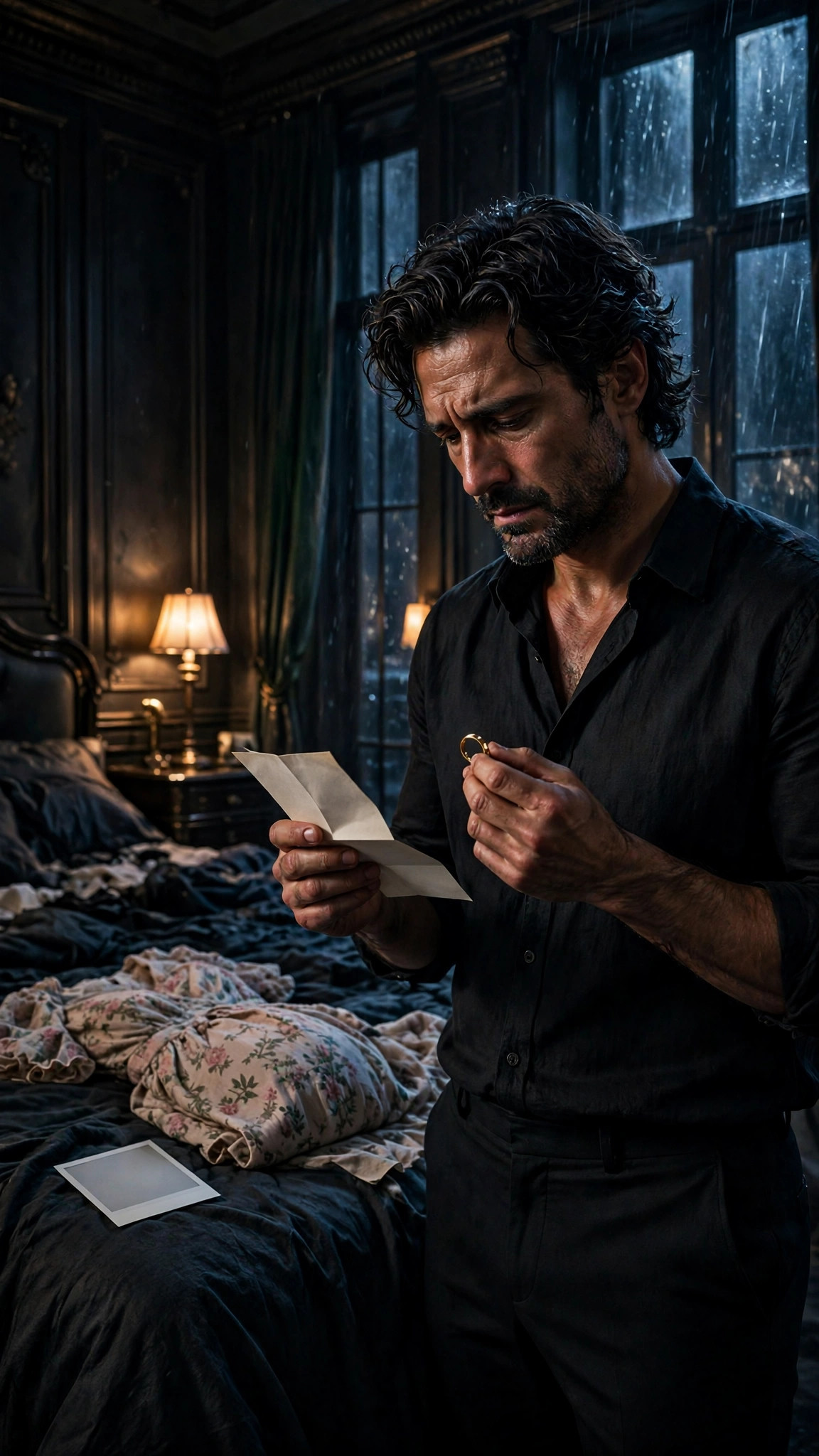
We kissed, in the garden, with the sun on our faces, and Noah woke up, and he cried, and Emily laughed, and she picked him up, and she held him out to me, and I took him, and I held him against my chest, and I felt his heartbeat against mine, and I thought about the night he was born — 1:17 in the morning, twelve days early, while his father was asleep in another woman's bed — and I thought about the morning I had found the ring, and the photograph, and the letter, and I thought about the seven words that had destroyed me.
"You were never there when we needed you."
She was right. She had been right about every word of it. But she had given me one chance — just one — to prove that the past did not have to be the future. And I had taken it. And I would spend the rest of my life proving that she had been right to give it to me.
That night, after the vows, after the dinner, after Rosa had gone home and Daniel had gone to his hotel, Emily and I sat in the nursery, in the rocking chair by the window, with Noah asleep in his crib, and she leaned her head on my shoulder, and she said, "Do you remember what I told you, the night you asked me to marry you? In the courthouse, after, when we were eating takeout on the floor?"
I remembered. I remembered everything about that night. "You said, 'I wait for dinner because I like feeling I still have a husband.'"
"No," she said, smiling. "I said that later. That night, I said, 'Don't make me regret this, Michael.' And you said, 'I won't.'"
"I won't," I said. "Not anymore. Not ever again."
She closed her eyes, and she fell asleep against my shoulder, and I sat there in the dark, holding her, listening to our son breathe, and I thought about the secret my wife had taken with our son — the secret of the poison, and the papers, and the plan to take him away from me — and I understood, finally, what the secret had really been.
It was not a secret about poison. It was not a secret about papers. It was a secret about love — the kind of love that leaves, not to punish, but to protect. The kind of love that runs, not away from a man, but toward the life her child deserves. The kind of love that gives a man one chance, and only one, to become the husband she asked for.
I had been given that chance. I had taken it. And I would never let it go.
The End.
THE END