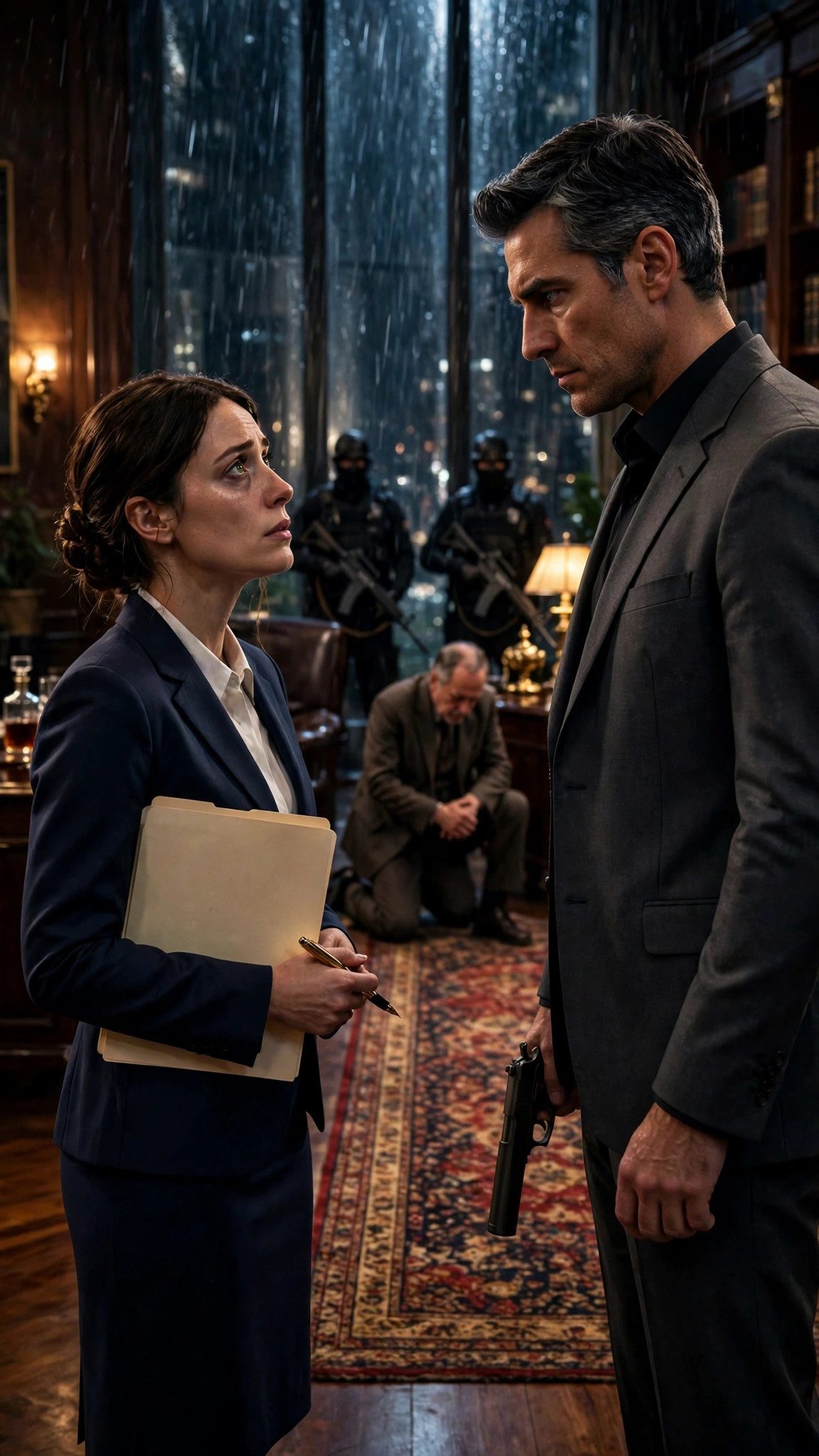
The laugh did not stop right away.
It rolled out of Dante Marino in waves, rough and broken, like a man coughing up nine years of silence, and for a moment nobody in the office knew what to do. The guards froze with their hands half on their weapons. Sal stayed on his knees, his face wet, his mouth open. Tommy, who had been summoned and then forgotten in the corner, pressed himself against the wall as if the wall might open up and take him somewhere safer.
I stood there holding the Montblanc pen like it was the only solid thing in the room.
Dante laughed until his shoulders shook. Then he stopped, abruptly, the way a man stops when he realizes he has done something he cannot take back. He wiped his mouth with the back of his hand. He looked at the gun in his hand as if he had forgotten it was there, and he set it down on his desk with a care I had never seen him use for anything.
"Get up, Sal," he said.
Sal got up slowly, like a man whose legs had forgotten how to work. His suit was creased at the knees. His tie was crooked. He looked at Dante the way a man looks at a judge who has just read a sentence he does not understand.
"Go home," Dante said. "Do not leave Chicago. Do not touch the money. Do not speak to anyone about this. We will discuss your future tomorrow."
Sal nodded. He could not speak. The guards escorted him out, and Tommy followed, and the door closed, and suddenly it was only Dante and me and the rain against the windows and the Persian rug that had survived the morning.
"Sign the folder," I said, because my mouth had apparently decided to keep working even though my brain had gone on strike.
Dante picked up the pen. He signed without reading, which was the first time I had ever seen him do that, and he set the pen down and looked at me for a long time.
"Emily Davis," he said.
"Yes, Mr. Marino."
"Do you have any idea what you just did?"
"I saved you a biohazard fee," I said.
He stared at me. Then his mouth twitched again, just once, like a muscle remembering an old habit, and he turned back to the window.
"Go back to work," he said.
I went back to work. My hands were shaking so badly I misfiled three letters before lunch, and Gloria kept looking at me over the top of her glasses like I had grown a second head. At noon, Tommy came to my desk with two coffees from the good place on the corner and set one down in front of me without a word.
"You're alive," he said finally.
"So far," I said.
"Sal's alive too," Tommy said. "Nobody's alive in that office by noon. Not usually."
"Maybe today is a special occasion."
Tommy leaned closer. "Emily. He laughed. I heard it from the hallway. Nine years, and he laughed at a joke about a rug."
"It wasn't a joke," I said. "The rug really was cleaned Tuesday."
That afternoon, the federal auditors arrived downstairs, and I spent four hours handing them folders and smiling politely while they asked questions I was not allowed to answer. Dante stayed in his office with the door closed. At five o'clock, he came out, put on his coat, and left without a word, the way he always did. But at the elevator, he paused. He looked back at my desk.
"Good work on the spreadsheets, Miss Davis," he said.
It was the first compliment he had ever given me. Gloria dropped a stapler.
That night, I drove to the facility to see Daniel. It was a Thursday, not a Sunday, and the evening nurse raised an eyebrow when I signed in, but she let me through. Daniel was in the common room, watching a game show with two other residents, and when he saw me, his whole face lit up.
"Em! You came on a Thursday!"
"I had a strange day," I said, sitting beside him. "I need to tell someone."
I told him about the rug. I told him about the laugh. I told him about Sal on his knees and the gun and the Montblanc pen and the ten seconds that felt like a year. Daniel listened with his mouth open, and when I finished, he laughed so hard one of the nurses came over to make sure he was all right.
"See?" he said, wiping his eyes. "I told you. Someone just needed to be funny at him."
"He's still a very dangerous man, Daniel."
"Yeah," Daniel said. "But now he's a dangerous man who laughs. That's better. Laughing people are harder to be scared of."
I drove home that night thinking about Clara Marino.
I had never met her, but I knew her story the way everyone in Chicago knew it. Clara Marino had been twenty-nine years old, a schoolteacher, funny by all accounts, the kind of woman who left notes in her husband's coat pockets. She had married Dante when he was twenty-nine and still trying to be two men at once: the legitimate shipping heir and the son of a Mafia boss. She had known what he was. She had married him anyway.
Nine years ago, on a Tuesday night in November, Dante had been fifteen minutes late to the parking garage because a meeting ran long. Clara had gone down to the car first. The bomb had been wired to the ignition, meant for Dante, and it killed her instantly. The police called it a professional hit. The men who planted it were never found. Some people in the building whispered that it was the Castellanos, the rival family that had been circling the Marino empire for years. Some people said it was an inside job. Nobody said it to Dante's face.
What everyone agreed on was this: the day they buried Clara, something in Dante Marino went quiet, and it never came back. He stopped smiling. He stopped joking. He stopped raising his voice, because shouting would have meant feeling something, and feeling something would have meant remembering. He ran his empire in silence, and silence, it turned out, was more terrifying than gunfire, because a man who shouts is a man you can predict, and a man who says nothing is a man who might do anything.
I thought about that as I drove home through the rain. I thought about the way his chest had moved when he laughed, once, like a door opening in a house that had been locked for nine years. And I thought about the fact that I had done it with a joke about a rug, which was either the bravest or the stupidest thing I had ever done, and I was too tired to decide which.
The following Monday, Gloria caught me at the coffee machine and dragged me into the break room with the air of a woman who had been waiting all weekend to say something.
"Tell me everything," she said. "Every word. I was in the bathroom when it happened and Tommy's version makes no sense."
I told her. She listened with her hands pressed to her cheeks, and when I got to the part about the rug, she actually gasped.
"The rug," she whispered. "Emily. Do you know what that rug is?"
"A rug," I said.
"It was Clara's," Gloria said. "She picked it out herself, from a shop in Istanbul, before they were married. Dante had it cleaned every month for nine years, even though nobody was allowed to walk on it. The cleaners come on Tuesdays. They have a special code for the biohazard fee because one of the guards bled on it in 2019 and Dante nearly fired the entire cleaning company."
I stared at her. "You're telling me I made a joke about his dead wife's rug."
"I'm telling you," Gloria said slowly, "that you are the first person in nine years who treated that rug like a rug, and he laughed. Do you understand what that means?"
"No," I said honestly. "And I don't want to."
Gloria lowered her voice. "I was here the day of the funeral. I watched him come back to this office the next morning and sit at that desk for fourteen hours without speaking to anyone. His mother came up in the elevator, crying, and he looked at her and said, 'Don't.' Just that one word. Don't. She left. She never came back to this floor again. For nine years, Emily, that man has been a locked room. And you just walked in with a folder and opened a window."
I didn't know what to say to that. I went back to my desk and stared at my spreadsheet until the numbers blurred, and I thought about Daniel, and about the facility, and about how my life was built on being invisible in a building full of dangerous men. Invisibility had kept me safe. Invisibility had kept Daniel safe. And now, because of a joke about a rug, I was visible.
That Sunday, I went to the facility early and took Daniel out to the garden. The morning sun was warm, and the nurses had put a blanket over his legs, and he was in a good mood, which meant he talked twice as fast as usual.
"Tell me about the laughing gangster again," he said.
"There's nothing more to tell."
"There is always more to tell. Does he have a dog? Gangsters in movies always have dogs."
"He doesn't have a dog, Daniel."
"Does he have a favorite food?"
"I don't know. He eats lunch at his desk. It's always the same thing. Grilled chicken, no sauce, sparkling water. Gloria says he hasn't ordered anything different in six years."
Daniel thought about this with great seriousness. "That's sad, Em. A man who eats the same lunch for six years is a man who forgot how to want things."
"Maybe," I said.
"You're going to fix him," Daniel said, with the absolute confidence of a twenty-four-year-old who has never been wrong about his sister in his life. "You're good at fixing things. You fixed my wheelchair when the wheel came off. You fixed the television when the remote broke. You're going to fix him."
"I'm not going to fix anyone," I said. "I'm going to balance his spreadsheets and pay your bills and mind my own business."
Daniel grinned. "That's what you said about the wheelchair."
I drove home that night thinking about Clara Marino, and about the rug, and about the fact that a locked room, once opened, does not close again just because you ask it to.
The next morning, Friday, I arrived at seven forty-five and found a white envelope on my desk. Inside was a handwritten note in a precise, slanted hand I recognized as Dante's, because I had seen it on a hundred signed documents.
"Miss Davis. The rug will be cleaned again on Tuesday. Please make sure the cleaners do not overcharge us. — D.M."
I stared at the note for a full minute. Gloria peered over my shoulder and read it twice.
"He wrote you a note," she whispered. "He has never written anyone a note. He doesn't even write birthday cards. His own mother gets a phone call."
"It's about the rug," I said.
"It's not about the rug," Gloria said.
She was right, and I knew she was right, and that frightened me more than the gun had.
Over the next two weeks, small things changed. Dante started taking his coffee from my hand instead of letting me set it on his desk. He started saying "good morning" when he passed, in a voice so quiet I almost missed it the first time. He asked me once, on a Wednesday, whether Daniel was doing well, and I nearly dropped the folder I was carrying, because I had never told him Daniel's name, which meant he had read my file, which meant he had been paying attention to me in a way I had not expected.
"Daniel is doing well," I said carefully. "His physiotherapist says he's making progress with the standing frame."
"Good," Dante said. And then, after a pause: "If the facility ever gives you trouble about the bills, tell me."
"I can handle the bills, Mr. Marino."
"I know you can," he said. "That wasn't what I asked."
I went back to my desk with my heart hammering, and I told myself to be careful. Men like Dante Marino did not notice secretaries. Men like Dante Marino did not write notes about rugs. And if he was noticing me, it was because I had made him laugh, and making a dangerous man laugh was not the same as being safe around him. It was, if anything, more dangerous, because now I mattered, and people who mattered to Dante Marino had a way of becoming targets.
I was right to be careful. I just didn't know how right yet.
On the third Friday after the laugh, my spreadsheet showed me the first sign of trouble. A payment from one of the South Side warehouses had been routed through three different accounts and arrived forty thousand dollars short. It was a small discrepancy, the kind of thing most people would miss, but I balanced spreadsheets for a living, and forty thousand dollars does not simply wander off.
I traced it. It took me an hour. The money had gone to a company called Bellini Holdings, and Bellini Holdings had no office, no employees, and no reason to exist except to receive money that did not belong to it.
Bellini. Sal Genovese's mother's maiden name.
I sat back in my chair and stared at the screen. Sal had been on his knees in Dante's office three weeks ago. Sal had been told to go home and wait. And Sal, or someone using Sal's name, was still moving money.
I printed the transfers. I put them in a folder. I wrote a note on the top sheet in my own neat handwriting: "For Mr. Marino. Three million dollars, South Side operation, routed through Bellini Holdings. Traced in twelve minutes. — E.D."
And then I sat at my desk with my hands folded, watching the rain against the windows, and waited for the door to Dante's office to open, because whatever happened next, I knew one thing for certain: the laugh had changed everything, and there was no going back to the way it was before.