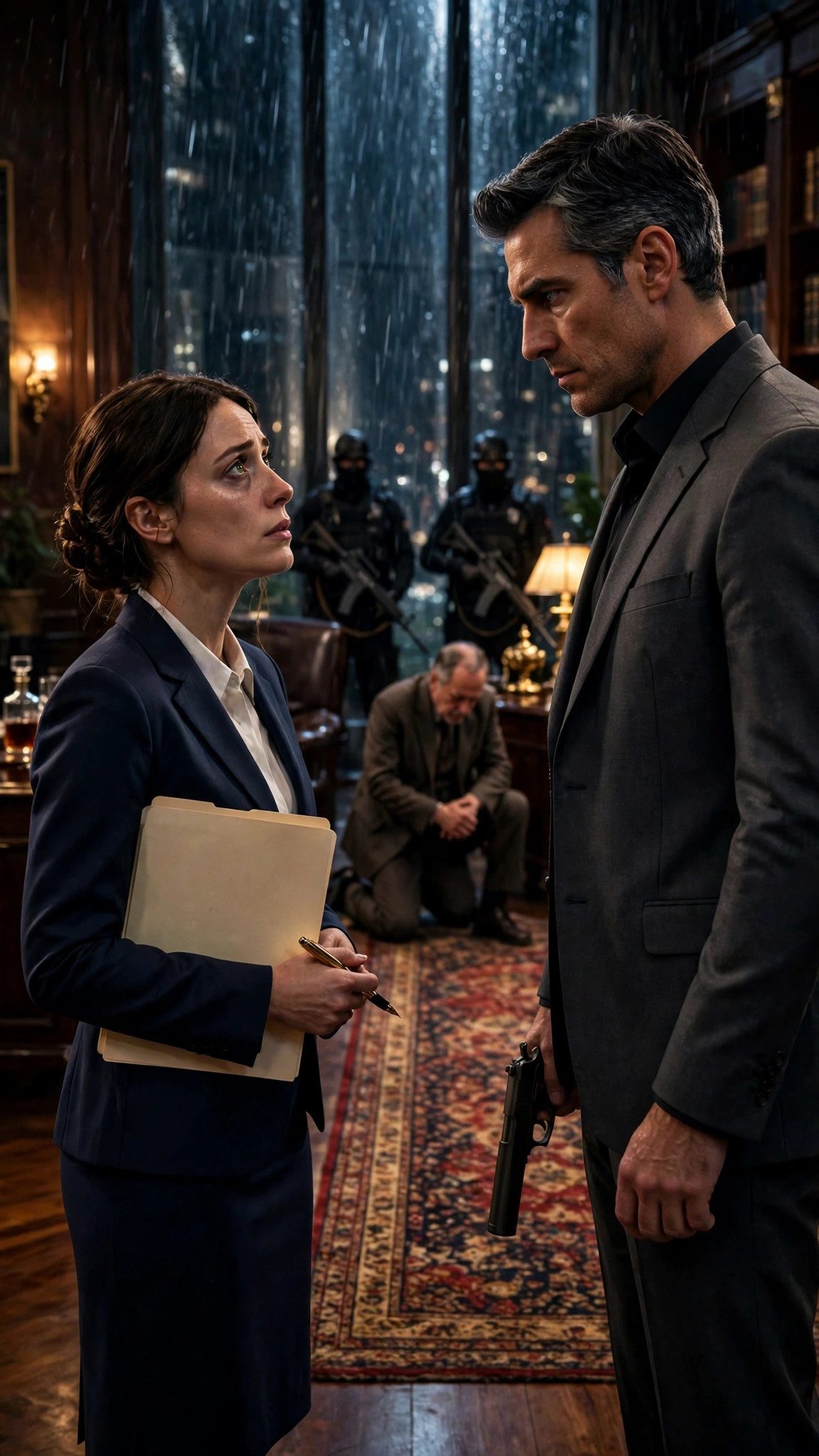
It happened on a Tuesday, because of course it did. Tuesdays were the day the rugs were cleaned, and Tuesdays, I was learning, were the day Castellano liked to remind people that he existed.
I was at my desk at nine in the morning when my phone rang. It was Mrs. Okafor from the facility, and her voice was shaking so hard I could barely understand her.
"Miss Davis. Two men came to the front desk this morning. They said they were from an insurance company, and they wanted to see your brother's file. I told them no. I told them what you said, that no one sees Daniel's file without your permission. They left, but one of them, he looked at me, Miss Davis, and he said, 'Tell the secretary her brother has a nice room. It would be a shame if something happened to the building.'"
My hands went cold. "Did you call the police, Mrs. Okafor?"
"I called you first. And then I called Mr. Ricci. He is on his way."
Enzo was already moving before I finished the call. He had heard enough from my side of the conversation, and he was on the phone to Dante before I had even put my own phone down.
Dante came out of his office like a storm breaking. His face was white. His hands were steady. That was the frightening part: his hands were completely steady.
"Tell me exactly what they said," he said.
I told him. Word for word. He listened, and then he picked up his phone and made three calls, and I watched the man who had chosen mercy over murder three weeks ago become someone else entirely, someone older and colder, someone who had survived nine years of silence by being the most dangerous man in any room he entered.
"Enzo will take you to the facility," he said. "You will stay with your brother until I call you. Do not argue."
"I don't need—"
"Emily." He said my name the way he had said it at the elevator, low and certain, and this time there was no smile in it. "They threatened your brother because of me. Because I laughed. Because I let them see that I care about you. That is my fault, and I will fix it. But right now, you will go to your brother, and you will stay with him, and you will let me do what I have to do."
I went. Enzo drove, fast and silent, through the morning traffic, and I sat in the back seat with my hands folded in my lap, and I thought about Daniel, and about the garden, and about the red truck, and about the fact that a man I had never met had stood in the lobby of my brother's home and threatened to burn it down because I had made a joke about a rug.
When we arrived, Mrs. Okafor met us at the door. She was still shaking. The front desk had a new crack in the glass, a thin white line running from one corner to the other, and she told me one of the men had leaned on it while he was talking to her, just leaned on it, and the glass had cracked under the weight of his hand.
Daniel was in his room, by the window, with his blanket over his legs. When he saw me, his face lit up, and then he saw my face, and his smile faded.
"Em? What's wrong?"
"Nothing," I said, sitting beside him. "I just wanted to see you on a Tuesday."
"You're lying," he said. "You only lie when you're scared. Are you scared, Em?"
I looked at my brother, twenty-four years old, in a wheelchair by a window, and I decided to tell him the truth, because he deserved the truth, and because I was tired of carrying fear alone.
"Yes," I said. "I'm scared. Some bad men threatened this place today because of my job. But Dante is fixing it. And Enzo is here. And nothing is going to happen to you. I promise."
Daniel was quiet for a moment. Then he said, "Is Dante the laughing gangster?"
"Yes."
"Then he'll fix it," Daniel said, with the same absolute confidence he had always had. "Laughing people don't let bad things happen. That's a rule."
I stayed with him until noon. We played cards. We watched a game show. The nurses brought lunch, and Daniel ate two sandwiches and told me about a new resident who played the harmonica badly, and for an hour, the world felt almost normal.
Then my phone rang. It was Dante.
Actually, before the phone rang, something else happened, and I want to remember it exactly, because it was the moment I understood what kind of man Dante Marino really was.
Mrs. Okafor came to Daniel's room with the facility director, a tall woman named Dr. Patel, who had run the facility for fifteen years and did not frighten easily. But that morning, her hands were shaking too.
"Miss Davis," Dr. Patel said, "I want you to know that we have already called our security company. We are replacing the front glass today. We are adding a second guard at the front desk, and a camera at every entrance. And I have spoken to Mr. Marino's office. He has offered to pay for all of it, and for a private security detail for the building, for as long as it is needed."
"That's very generous," I said.
"It's not generosity," Dr. Patel said. "It's responsibility. Mr. Marino told me on the phone that your brother was threatened because of him, and that a man who cannot protect the people he cares about does not deserve to be called a man at all. Those were his exact words, Miss Davis. I wrote them down."
She paused. "In fifteen years, no one has ever offered to pay for our security. Not the families of the residents. Not the city. No one. Your employer is a remarkable man, Miss Davis, whatever else he may be."
I thought about that as I sat beside Daniel, watching him eat his second sandwich, and I realized that Dr. Patel was right. Dante Marino was a remarkable man. He was also a dangerous man, and a grieving man, and a man who had done terrible things in his life. But he was the kind of man who paid for a stranger's security cameras because a threat had been made in his name, and that mattered. That mattered more than anything else I had learned about him.
Daniel, meanwhile, was entirely unbothered by the morning's excitement. He had spent the whole time telling Mrs. Okafor about the harmonica player, and when I asked him if he was frightened, he said, "A little. But Enzo is here, and Enzo is very big, and the man at the desk said he would call the police if the bad men came back. And you came, Em. You always come."
"Always," I said, and I meant it.
Then my phone rang. It was Dante.
"Come back to the office," he said. "Bring Enzo. It's done."
"What's done?"
"Come back," he said. "I'll explain."
The drive back was silent. Enzo kept checking the mirrors. When we reached the office, Dante was waiting in the conference room with Agent Reyes and a man I had never seen before, a thin man in a grey suit with a briefcase and the nervous air of someone who has made a terrible mistake and knows it.
"Miss Davis," Dante said. "This is Dominic Voss. Castellano's lieutenant. The man who has been watching this building for three weeks. The man who sent two men to your brother's facility this morning."
Voss did not look at me. He looked at the table.
"Mr. Voss has agreed to cooperate with the FBI," Reyes said. "In exchange for protection, he has given us everything. The shell companies. The gambling operation. The names of every man Castellano owns in this city. And the name of the man who planted the bomb that killed Clara Marino nine years ago."
The room went very quiet. Dante stood at the head of the table, his hands flat on the wood, and I saw his knuckles go white.
"Say it," Dante said to Voss.
Voss swallowed. "Castellano ordered it. Nine years ago. He wanted your shipping routes, and he wanted you dead, and when you were late, he…" Voss stopped. He could not finish the sentence.
"He killed my wife instead," Dante said, in a voice so quiet it was barely a sound.
"Yes," Voss whispered.
I watched Dante Marino stand there, a man who had carried nine years of silence and grief and rage in his chest, and I watched him do the hardest thing I had ever seen anyone do. He did not reach for a gun. He did not raise his voice. He looked at Reyes and said, "Arrest him. All of them. Tonight. I want Castellano in handcuffs before sunrise, and I want it done legally, so that no lawyer in Chicago can ever undo it."
Reyes nodded. "We're already moving. The warrants are signed."
Dante turned to me. "Emily. Are you all right?"
I thought about Daniel, by the window, with his blanket and his game shows. I thought about Mrs. Okafor, shaking at the front desk. I thought about Maria Genovese's biscotti, and about Sal in his garden pulling weeds, and about the rug that had been cleaned on Tuesday.
"No," I said honestly. "But I will be."
He nodded. "Then stay. Stay until it's over. Enzo will take you home when it's done."
That night, the FBI raided six locations across Chicago. I know because Reyes called Dante every hour, and Dante let me stay in the office and listen, and I sat at my desk with a cup of cold coffee and watched the city lights through the windows and thought about the fact that nine years of silence was finally ending, not with a gunshot, but with a spreadsheet, a forged signature, and a secretary who had made a joke about a rug.
At three in the morning, Reyes called with the news: Vincent Castellano had been arrested at his home in Lake Forest, in his pajamas, without a struggle. The gambling operation was seized. The shell companies were frozen. Dominic Voss was in protective custody. And the man who had planted the bomb nine years ago, a hired killer named Aldo Ferrante, had been arrested at O'Hare trying to board a flight to Naples.
Dante put the phone down. He looked at me across the desk, and his eyes were wet, and I realized, with a shock, that Dante Marino was crying. Not sobbing. Just tears, silent and steady, running down his face like rain on a window.
"Nine years," he said. "Nine years, and it's over."
I did not know what to do. So I did what I had always done. I got up, I walked around the desk, and I handed him a tissue from the box I kept in my drawer for days when the spreadsheets didn't balance.
"Here, Mr. Marino," I said. "The good ones. I hide them from Gloria."
He took the tissue. He laughed once, wet and broken, and then he said, "Thank you, Emily. For everything."
And I stood there in the quiet office at three in the morning, with the city asleep outside the windows, and I understood that the price of a laugh was not danger, or fear, or a cracked pane of glass at my brother's facility. The price of a laugh was this: once you let the light back in, you have to live in it. And living in it, after nine years of darkness, was the bravest thing Dante Marino had ever done.
The next morning, Dante asked me to take him to the facility.
He had never been there. He wore a charcoal suit, because he wore a charcoal suit everywhere, and he looked profoundly out of place in a lobby full of wheelchairs and potted plants and a receptionist who had never met a Mafia boss before.
Daniel was in the garden when we arrived. The morning sun was warm, and the nurses had put a blanket over his legs, and he was watching a red truck go by on the highway, the way he always did.
"Daniel," I said, "this is Mr. Marino. My boss."
Daniel looked up at Dante, tall and silent in his charcoal suit, and he grinned. "You're the laughing gangster."
Dante stared at him. Then, slowly, he crouched down beside the wheelchair, so that he was at Daniel's eye level, and he said, "I suppose I am. Your sister tells me you like trucks."
"I like red ones," Daniel said. "They're the fastest."
"They are," Dante agreed gravely. "I used to like red ones too, when I was your age."
They talked for twenty minutes. About trucks. About the garden. About the harmonica player who played badly. Dante asked Daniel about the standing frame, and about his physiotherapy, and about what he wanted for his birthday, and Daniel said he wanted a model truck, a red one, and Dante said he would see what he could do, and I stood there watching the most feared man in Chicago crouch in a garden talking about trucks with my brother, and I felt something in my chest crack open, the way a door opens in a house that has been locked for a long time.
When we left, Daniel waved from the garden, and Dante waved back, and in the car, Dante was quiet for a long time before he said, "He's a good boy, your brother."
"He is," I said.
"I'm glad I got to meet him," Dante said. "I've known about him for weeks, and I didn't even know his favorite color."
"What's his favorite color?" I asked.
"Red," Dante said. "Like the trucks."
I laughed. He laughed too, just once, short and surprised, and Enzo, driving the car, smiled at the road ahead, and for a moment, everything felt possible.
I just hoped I was brave enough to do it beside him.