Daniel Reyes was forty-two years old, with gray at his temples and a calm voice that reminded me, oddly, of the way I used to speak to frightened patients in the emergency room. He did not raise his voice. He did not threaten anyone. He sat down in the chair beside Colton's bed, opened a thin folder, and laid out the truth the way a surgeon lays out instruments: carefully, in order, without flinching.
"Vincent Castellano has been trying to take your husband's territory for three years," he said. "He tried money. He tried intimidation. He tried turning Colton's own men. None of it worked, because Colton's people are loyal, and because Colton is careful. So Castellano changed his approach. He stopped trying to defeat Colton. He started trying to remove him."
He looked at Colton. "The Lisbon flight was the removal. A one-way ticket, a beautiful woman, a shipping deal that didn't exist. In Lisbon, his men were waiting. Your husband would have disappeared, Mrs. Beckett. The world would have believed he ran away with his mistress. And Castellano would have walked into Atlanta and taken everything your husband built, while you were left alone with a newborn baby and a name that no longer meant anything."
"Why did they shoot him here, then?" I asked. "Why the parking garage?"
"Because someone in Castellano's organization got nervous," Reyes said. "The Lisbon plan was elegant, but it was slow. Someone decided it was easier to kill him at the airport and blame it on a robbery. They didn't count on Ms. Foresight calling 911. They didn't count on her calling you."
He turned a page in the folder. "Ms. Foresight has given us the payment records, the recordings of her conversations with Castellano's people, and the names of the two men in the garage. One of them is already in custody. The other is still out there. And Castellano himself is still free, because the recordings don't tie him to the shooting directly. They tie him to the Lisbon plan. To convict him of attempted murder, I need your husband's testimony. I need Colton to tell a court, under oath, that Castellano hired Jade Foresight to lure him to Lisbon, and that Castellano's men shot him at the airport."
Colton was quiet. I watched his face. I had seen that face in a hundred moods: laughing, angry, tender, afraid. I had never seen it look the way it looked now. Like a man who had spent his whole life believing he was untouchable, and had just learned that he was not.
"If I testify," he said, slowly, "Castellano's people will come for me. And for Lauren. And for Ren."
"That's why I'm here," Reyes said. "If you testify, the Bureau will protect you. All of you. But protection comes with a price, Mr. Beckett, and you know what it is. You walk away from the life. All of it. The shipping companies stay, but they become legitimate, or they get sold. The warehouses get cleaned out. The men who work for you get a choice: go straight, or go to prison with Castellano. You don't get to keep one foot in each world. Not anymore."
"And if I don't testify?" Colton asked.
"Then Castellano walks free, and he tries again," Reyes said. "And next time, he won't miss. And next time, he won't aim only at you."
There was a long silence. The monitor beside the bed beeped, steady and green. Outside the window, Atlanta moved on, cars and sirens and ordinary people living ordinary lives, unaware that in Room 412 of Grady Memorial Hospital, a mafia boss was deciding whether to give up his empire.
"I need to talk to my wife," Colton said.
Reyes nodded. He stood up, closed his folder, and walked to the door. "Take your time," he said. "But not too much time. Castellano's man is still out there, and he knows where your husband is. I'll have agents on this floor within the hour. Until then, don't leave this room. Don't answer the door unless it's a nurse you recognize. And Mrs. Beckett, I need you to tell me where your daughter is, so I can make sure she's safe."
"She's with my aunt," I said. "In Decatur. Rosa Delgado."
"Good," Reyes said. "I'll send someone to watch the house. Quietly. No one will know they're there."
He left. The door closed. Colton and I were alone.
"Lauren," he said. "I know what you're going to say."
"You don't know what I'm going to say," I said. "I don't know what I'm going to say."
He reached for my hand. His hand was cold. I let him take it, because his hand was cold and he was bleeding and he was the father of my daughter, and because some part of me, the part that had loved him for three years, was still there underneath the anger.
"I can't ask you to forgive me," he said. "I won't ask. But I'm asking you to tell me what to do. Because every decision I've made for the last month has been wrong, and I don't trust my own judgment anymore. I trust yours."
I looked at him for a long time. I thought about the envelope on his desk. I thought about the scarf. I thought about the photograph. I thought about thirty-one hours of labor, and his hand in mine, and his voice whispering, "You're the strongest woman I know." I thought about Ren, asleep in a laundry basket in my aunt's spare room, seventeen days old, with her whole life ahead of her.
"Testify," I said. "Give it up. All of it. The empire, the warehouses, the men, the power. Give it up, and come home, and learn how to be a father. That's the price. That's the only price I'll accept."
He closed his eyes. When he opened them, they were wet.
"Then that's what I'll do," he said.
I stayed with him that afternoon. I sat in the chair beside his bed, and I told him about Rosa's house, and about Ren's first smile, which had happened on the fifteenth day, while he was in his office talking to Jade on the phone. I told him about the nights I had spent awake, holding her, wondering whether he would ever come home. I told him about the photograph, and how I had found it the day I came home from the hospital, and how I had hidden it in a drawer because I couldn't bear to look at it and couldn't bear to throw it away.
He listened. He did not interrupt. He did not make excuses. When I finished, he said, "I want to see her. I want to hold my daughter. Not in a photograph. Not in a story someone tells me. I want to hold her."
I called Rosa. I told her what had happened, in short sentences, because the phone line felt too fragile for the whole story. I asked her to bring Ren to the hospital. She said she would be there in an hour, and that she was bringing the diaper bag and the blanket and the bottle, and that she would wait in the family room until I came to get her.
While we waited, Hannah came to the hospital.
I had not expected her. She walked into Room 412 in her dark suit, her hair pulled back, her face composed, and she stood at the foot of Colton's bed and looked at him for a long moment. Then she looked at me.
"Mrs. Beckett," she said. "I'm sorry."
"For what?" I asked.
"For the phone calls," she said. "For telling you it was business. For telling you he'd come around. I knew it wasn't business. I knew something was wrong. I found the bug in his office three weeks ago. A listening device, under the desk. I didn't know who put it there. I didn't know what to do. I was afraid that if I told him, whoever put it there would know I found it. So I said nothing. And I called you every evening, and I told you he'd come around, because I didn't know what else to say, and because I thought that if I kept calling, if I kept saying it, maybe it would be true."
She took a folded paper from her bag and handed it to me. It was a printout of an email, sent from an anonymous address, with a single line.
The Lisbon flight is a trap. Tell his wife to get out of the house.
"I got this yesterday morning," Hannah said. "I didn't know what it meant. I thought it was a prank. I almost deleted it. But I kept it, because something about it frightened me. And then I heard about the shooting, and I came here, because I thought you should have it."
I stared at the paper. Someone had tried to warn us. Someone inside Castellano's organization, or someone who had seen the plan and couldn't live with it, had tried to warn us. And the warning had come too late, because I had already left the house on my own, and Colton had already gone to the airport, and the men in the garage had already fired.
"Thank you, Hannah," I said. And I meant it. For the first time in three years, I meant it when I spoke to her.
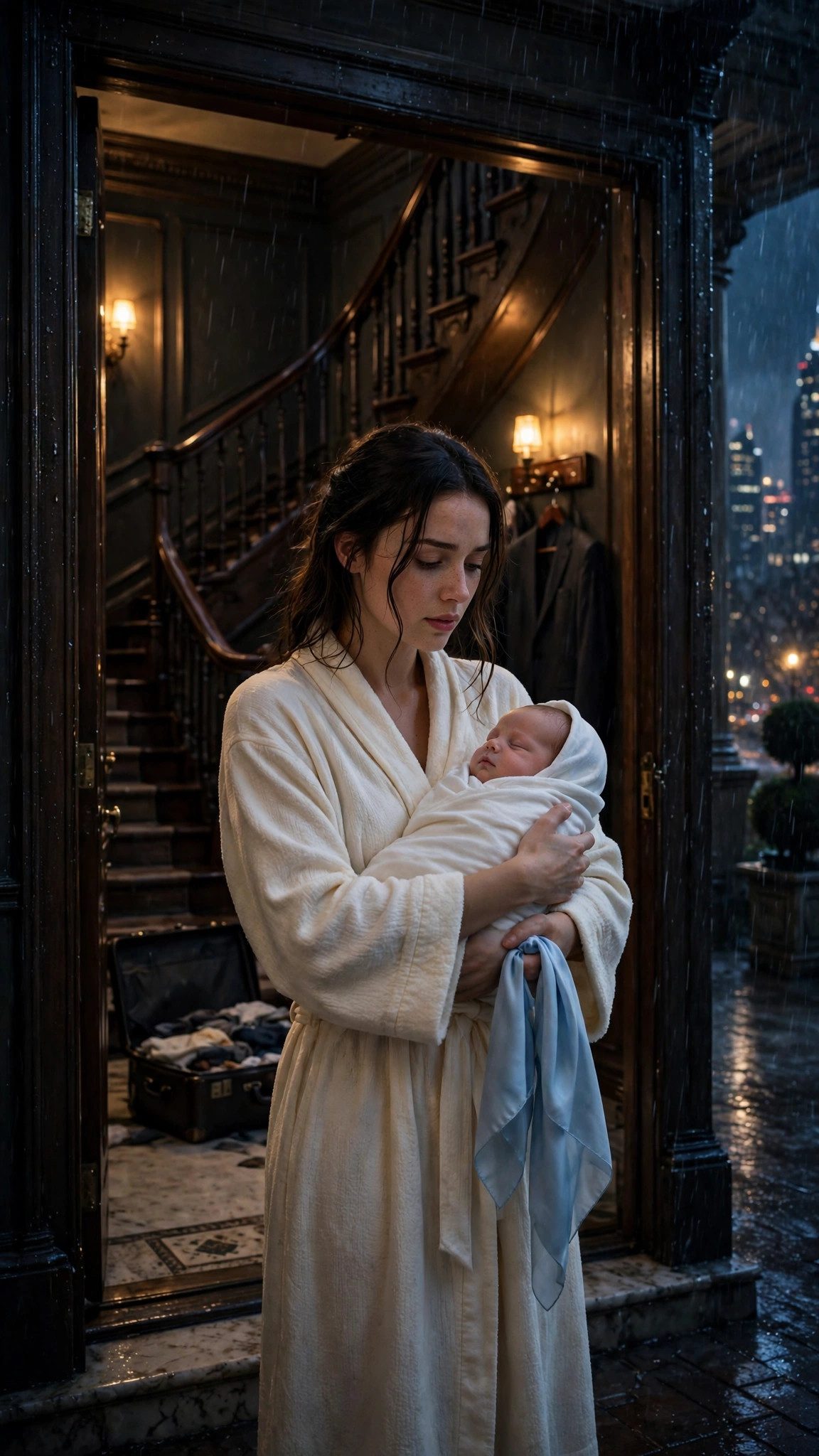
Rosa arrived an hour later, with Ren wrapped in her favorite blanket, asleep in the car seat. I met her in the family room, and I took my daughter in my arms, and I carried her into Room 412, and I laid her gently in the crook of Colton's good arm, the way the nurses had shown me in the hospital, seventeen days ago.
Colton looked down at her. His face changed. All the hardness went out of it, all the calculation, all the fear. He looked at our daughter, seventeen days old, with her tiny fists curled and her breathing soft and even, and he whispered, "Hi, Ren. I'm your dad. I'm sorry I'm late."
Ren opened her eyes. She looked up at him. And for the first time since she was born, her father looked back at her, really looked at her, and did not look away.
That night, I stayed at the hospital. Rosa took Ren home, and I sat in the chair beside Colton's bed, and I watched him sleep, and I thought about everything Reyes had said, and everything Jade had said, and everything Colton had said, and I tried to put it together into a single story that made sense.
It didn't make sense. Not yet. It was too many pieces, too many lies, too many people who had been afraid. But underneath all of it, there was one thing that was simple, and true, and I held onto it the way you hold onto a railing in the dark. Ren was safe. She was with Rosa. She was asleep in a laundry basket lined with blankets. And her father, for the first time in a month, was not running anywhere.
In the morning, a nurse came in with a fresh diaper and a bottle, because Rosa had brought Ren back to the hospital, and Colton woke up, and he looked at his daughter, and he said, "Can I try?"
The nurse showed him how. She was patient, the way good nurses are, and she did not laugh when he put the diaper on backward the first time. She helped him fix it, and he held Ren up, very carefully, and he looked at her, and he said, "There. See? I can do this. I can learn this."
"You can," I said. "Everyone learns. No one is born knowing how."
Reyes came back that afternoon, with a folder full of papers, and he sat down with us, and he explained the plan in detail. The FBI would put agents on the hospital floor, around the clock. They would watch Rosa's house. They would watch the shipping office. Colton would give a formal statement, on video, the next day, so that even if something happened to him, the testimony would survive. Jade would be moved to a safe location that night. And when Colton was strong enough to leave the hospital, he would be moved too, to a house the FBI had arranged, with Ren and me, until the trial was over.
"How long?" I asked.
"Months," Reyes said. "Maybe longer. I won't lie to you, Mrs. Beckett. This is not a short road. But it's the only road that ends with Castellano in prison and your family safe. And I promise you, I will walk it with you, every step."
After he left, I called Rosa. I told her the plan. I told her Ren was safe, and that I was safe, and that Colton was going to testify, and that we were going to give it all up, the empire, the warehouses, all of it. Rosa was quiet for a moment. Then she said, "Good. That's the right thing. And Lauren, when this is over, when the trial is done, you come home. To my house, or to your house, or wherever you want. But you come home, and we plant that garden I've been talking about, and we watch Ren grow up, and we don't let any man, no matter how powerful, take that away from us again."
"I will," I said. "I promise."
That night, Colton slept, and I slept in the chair beside him, and Ren slept in a hospital bassinet at the foot of his bed, and for the first time in seventeen days, the three of us were in the same room, together, and no one was running anywhere.
The next day, Colton gave his formal statement. Reyes set up a camera in a small room down the hall from his hospital bed, and Colton sat in a wheelchair, with his shoulder bandaged and his voice still hoarse, and he told the whole story, from the beginning, on the record. The Lisbon flight. The bugged office. The photograph. The parking garage. He did not leave anything out. When it was over, Reyes turned off the camera, and he said, "That's enough to put Castellano away for life, Mr. Beckett. You did the right thing." Colton nodded, and he looked at me, and he said, "I did it for them. For Lauren. For Ren. Everything I do from now on, I do for them."