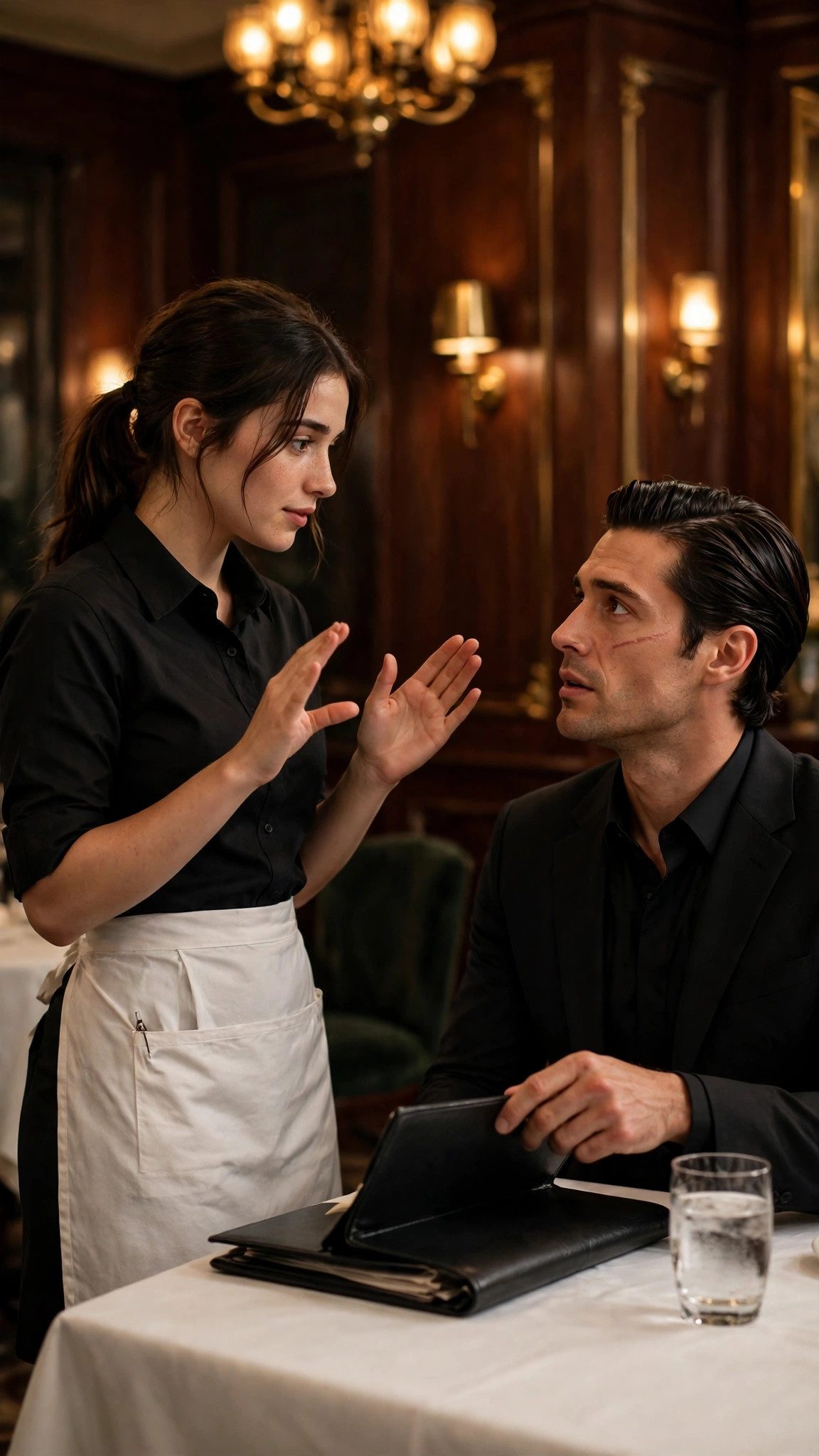
The second Thursday, I arrived at Bellini House at six o'clock and found a black car waiting at the curb. Rocco, the largest of the three men from the private dining room, was leaning against it with his arms crossed, and when he saw me he straightened up and opened the back door without a word.
"Mr. Marquetti sent me," he said, his voice low and rough. "He says you ride with me now. On Thursdays. So nobody bothers you on the way."
I stared at him. "Nobody bothers me on the way."
"They will," he said. "Now get in."
I got in. It was the first time I had ever ridden in a car that cost more than my apartment building, and I sat very still with my hands in my lap, the way I used to sit in church as a child, afraid to touch anything. Rocco drove in silence, his eyes on the road, and after a few minutes he glanced at me in the rearview mirror.
"He doesn't talk much," Rocco said. "Not since the accident. You know about the accident?"
"I know he can't hear," I said. "I figured it out."
Rocco nodded slowly. "Nobody knows. You understand? Nobody. Not his uncles. Not his cousins. If that gets out, men will come for him. Men have been trying to come for him for six years."
"I won't tell anyone," I said, and I meant it. "I know what a secret like that costs."
Rocco studied me in the mirror for another moment, and then he nodded again, and that was the end of the conversation. But I understood, in that moment, that I had just been tested, and that I had passed, and that passing mattered more than I knew.
Salvatore was already in the private dining room when I arrived. He was reading his papers, the same leather folder, the same untouched glass of water. When I stepped into his line of sight, he looked up, and his face did something I had not seen it do the night before: it relaxed. Just slightly. The way a person's face relaxes when they come home.
"Hi," I signed. "How was your week?"
"Long," he signed back. "Yours?"
"Long," I signed. "The usual."
He smiled, that small careful smile, and then he set his folder aside, and for the first time, he did not pretend to be working. He simply sat there, watching me, waiting for me to speak, and I realized that he had been waiting all week for someone to talk to him.
We talked for an hour that night. Not about business. Not about the family. About ordinary things. He asked about Noah, and I told him about the print shop, about the posters Noah designed, about the way Noah's boss had once asked him to design a menu for a wedding and he had made it so beautiful the bride had cried. He asked about the community center, and I told him about Maya, the little girl with the hearing aids, and the word for "butterfly," and the way her mother had cried. He asked about my parents, and I told him about my father, who drove a bus and still called me every Sunday, and my mother, who worked in a school cafeteria and still packed me leftovers in plastic containers like I was twelve years old.
And he told me things, too. Small things, at first. He told me he had a house on the lake that he never visited, because the silence there was too loud. He told me he missed music, which surprised me, because I had never thought about what it would be like to lose something you had once loved. He told me he could still remember the last song he had ever heard, a jazz record his mother used to play in the kitchen, and that sometimes, when he was very tired, he thought he could almost hear it again, and then he would wake up and remember.
I did not know what to say to that. So I did the only thing I could think of. I signed the chorus of the song for him, the way I remembered it from my own childhood, my hands moving through the air, and he watched me, and his eyes went very bright, and he did not look away until I had finished.
"Thank you," he signed, and his hands were unsteady. "No one has done that for me in six years."
After that, the Thursdays became something I looked forward to, which frightened me, because I had learned a long time ago not to look forward to things that belonged to other people's worlds. But I could not help it. Every Thursday, Rocco picked me up. Every Thursday, I served Salvatore his dinner, and then I sat down across from him, and we talked in the language that belonged to both of us, and the rest of the world went quiet in a way that felt like peace instead of loneliness.
He started asking me to come on other nights, too. Not to Bellini House. To other places. To a gallery opening, where he needed someone to interpret for him without anyone knowing he needed an interpreter. To a meeting with a lawyer, where he needed me to sit beside him and sign the questions he could not hear. To his house, once, on a Sunday afternoon, where he showed me his mother's piano, still sitting in the corner of the living room, covered in dust, and asked me if I thought it was too late to learn to play it again.
I told him it was never too late. I told him my brother had taught himself to draw at twenty, and that the piano had waited this long and could wait a little longer. He looked at the piano for a long time, and then he looked at me, and he said, in sign, "Will you teach me?"
I did not know how to play the piano. But I said yes anyway, because I had learned that sometimes the most important thing you can do for a person is agree to try.
We spent that Sunday afternoon with our hands on the keys, and he could not hear a single note, but he could feel the vibration through the wood, and he laughed, a real laugh, low and surprised, when he played a chord and felt it travel up through his arms. I laughed too. I had not laughed like that in a long time.
That was the night I understood that I was falling in love with him. I understood it the way you understand that you have walked too far out into the water: suddenly, and all at once, and too late to turn back.
I also understood that it was dangerous. Not because he was a dangerous man, although he was. Because his world was dangerous, and I was not part of it, and people who were not part of it did not survive in it for long. I had seen what had happened to Brett, and Brett had only laughed at the wrong person. I knew what would happen to me if anyone found out that the most feared man in Chicago was deaf, and that I was the one who knew.
But I went back the next Thursday anyway. And the Thursday after that. And the Thursday after that.
Meanwhile, outside the warm light of the private dining room, the world was moving. Brett Calloway, fired and humiliated, had not gone quietly. He had gone to a bar on the South Side, and he had drunk too much, and he had told anyone who would listen that Salvatore Marquetti was not what he seemed, that there was something wrong with him, that he had seen it with his own eyes. Most people laughed at him. One person did not.
Vincent Castellano had been waiting six years for a weakness in Salvatore Marquetti. He had planted the bomb that killed Enrico. He had watched Salvatore survive it and rebuild, stronger and colder than before. He had tried everything: bribes, spies, ambushes. Nothing had worked.
Now a bitter, drunken waiter was telling him that the great Salvatore Marquetti could not hear. Vincent did not laugh. Vincent listened. And Vincent began to make plans.
He did not know that Rocco's men were already watching Brett. He did not know that Salvatore had expected exactly this. He did not know that the trap he was building was a trap Salvatore had already seen coming.
But I did not know any of that either. Not yet. All I knew was that every Thursday, a black car waited for me at the curb, and every Thursday, I walked into a room full of golden light and sat across from a man who could not hear the world, and for one hour, the world went quiet for both of us, and it felt like the most honest thing I had ever known.
One Thursday, about a month into our dinners, Salvatore asked me to come with him to a gallery opening. It was not a date. He was very clear about that, in the way men are clear about things they are not sure of. It was business. A gallery owner named Elena Vasquez was showing a collection of photographs, and Salvatore needed to be there, and he needed someone who could interpret for him without anyone knowing he needed an interpreter.
I wore the only dress I owned that was nice enough, a dark blue thing I had bought on sale two years earlier, and I stood beside him in a room full of people drinking champagne and talking about art, and I signed everything anyone said to him, my hands moving low and close to my body so no one would notice, and he nodded and smiled and asked questions through me, and no one in that room had any idea.
At one point, a woman came up to him and said something I could not quite catch, and I signed, "She says your father would have loved the photographs," and Salvatore's face changed, just slightly, and he said, aloud, "My father loved everything that was beautiful and useless," and the woman laughed, and I thought about how much it must cost him, every single day, to live like this, to pretend, to perform, to be a man who heard the world when he did not.
After the gallery, we went back to Bellini House, and he ordered dinner, and he sat across from me, and he signed, "Thank you. I have never been to a gallery before. Not since the accident. I was afraid."
"You were wonderful," I signed back. "No one knew."
"That's the problem," he signed. "No one ever knows. That's the whole point of my life now. No one ever knows."
I reached across the table and took his hand, before I could stop myself, and his fingers closed around mine, and we sat like that for a long time, not signing, not speaking, just holding hands in the golden light, and I understood that some conversations do not need words at all, signed or spoken. Some conversations are just two people sitting together, refusing to be alone.
Another night, he took me to a meeting with his lawyer, a thin man named Mr. Kowalski who talked very fast and used words like "liability" and "indemnification," and I signed everything, and Salvatore watched my hands the way a man watches a lifeline, and afterward, in the car, he said, in sign, "Do you ever get tired of being my ears?"
"Do you ever get tired of being my voice?" I asked him, because it was true: there were rooms I could not enter without him either, rooms full of powerful men who would never have looked at a waitress twice, and he had opened every door for me simply by standing beside me.
He thought about that for a long time. Then he signed, "No. I never get tired of it. It's the best job I've ever had."
We laughed about that, the two of us, in the back of a black car driving through the dark streets of Chicago, and I thought about how strange it was that the most feared man in the city and a waitress from Bellini House had found each other, and how neither of us had been looking, and how the universe had a sense of humor after all, even if it was a dark one.
The piano lessons continued, too. Every Sunday afternoon, I went to his house, and we sat at the piano, and he played chords, and I told him which ones were major and which ones were minor, and he learned to feel the difference in his chest, the way a major chord felt like sunlight and a minor chord felt like rain. He was terrible at it, honestly. He hit wrong notes constantly. But he laughed every time, and I had never seen him laugh like that, free and unguarded, and I thought about how much of his life had been spent not laughing, and how much time we had to make up for.
One Sunday, Noah came with me. He sat on the couch and watched us, and then he walked over to the piano, and he played a simple melody, something he had learned as a child, before the fever, and Salvatore watched his hands on the keys, and then he looked at Noah, and he signed, "You play beautifully."
Noah signed back, "I can't hear it. But I can feel it. That's enough."
Salvatore stared at him for a long moment, and then he nodded, slowly, and I saw something pass between them, something I could not name, something that belonged only to men who had lived in silence and learned to make peace with it.
That was the night I understood that Salvatore was not just falling in love with me. He was falling in love with my family. With Noah. With the life I had built out of small things: Wednesday evenings, Sunday dinners, paper butterflies, a piano covered in dust. He was falling in love with the idea that a life could be small and still be enough. And I was falling in love with the idea that a man could be powerful and still be gentle. That a man could be feared and still be kind. That a man could be silent and still have everything to say.