The first thing I heard through the hidden microphone was my son crying.
It was eleven forty-seven at night, and I was sitting in my study with the lights off, a glass of whiskey sweating untouched on the desk beside me, and a pair of cheap earbuds in my ears. The microphone was no bigger than a button. Gabe had sewn it into the seam of the curtain in Matteo's room three days earlier, while the boy was at physical therapy and the house was empty. I had told myself it was a precaution. I had told myself I was being paranoid. I had told myself a dozen things that night, and every one of them was a lie I had needed to believe so I could sleep.
My son had not spoken in fourteen months. Not one word. Not since the explosion that killed his mother and left him with a spinal cord injury at T8 and a silence so complete that the doctors had started using words like permanent and acceptance, as if a father could accept that his eight-year-old boy had simply folded himself up inside his own head and locked the door.
He was crying now. Through the earbuds, the sound was small and thin, like something leaking through a crack in a wall. It was not the loud crying of a child who has skinned his knee. It was the crying of a child who has learned that crying loudly only makes things worse, so he cries quietly, into his pillow, where no one can hear him and no one can punish him for it.
And then I heard her voice.
"Get your hands off me," Clara Hayes said. "I didn't do anything."
Her voice was low and cold, nothing like the warm, honeyed voice she used when I was in the room. I had hired her three months ago to take care of my son, and in all that time I had never once heard her speak to him in that tone. But I had seen the way Matteo flinched when she reached for him. I had seen the way his small hands tightened on the wheels of his chair whenever she came into the room. I had seen it, and I had told myself I was imagining it, because Clara looked so much like Elena — the same dark hair, the same soft way of moving through a room — that some stupid, grieving part of me had wanted to believe she was a gift. A second chance. A woman who could bring warmth back into a house that had gone cold the day my wife died.
I was already on my feet before I knew I had stood up. The earbuds tore out of my ears and hit the desk. The whiskey glass went over and rolled off the edge and shattered on the floor, and I did not stop to look at it. I took the stairs two at a time, and by the time I reached the second floor my heart was hammering so hard I could feel it in my throat.
Matteo's door was closed. I put my hand on the knob and stopped. Through the wood, I could hear her voice again, sharper now, and underneath it the thin, leaking sound of my son crying into his pillow.
"Stop it," she was saying. "Stop it right now, or I swear to God—"
I opened the door.
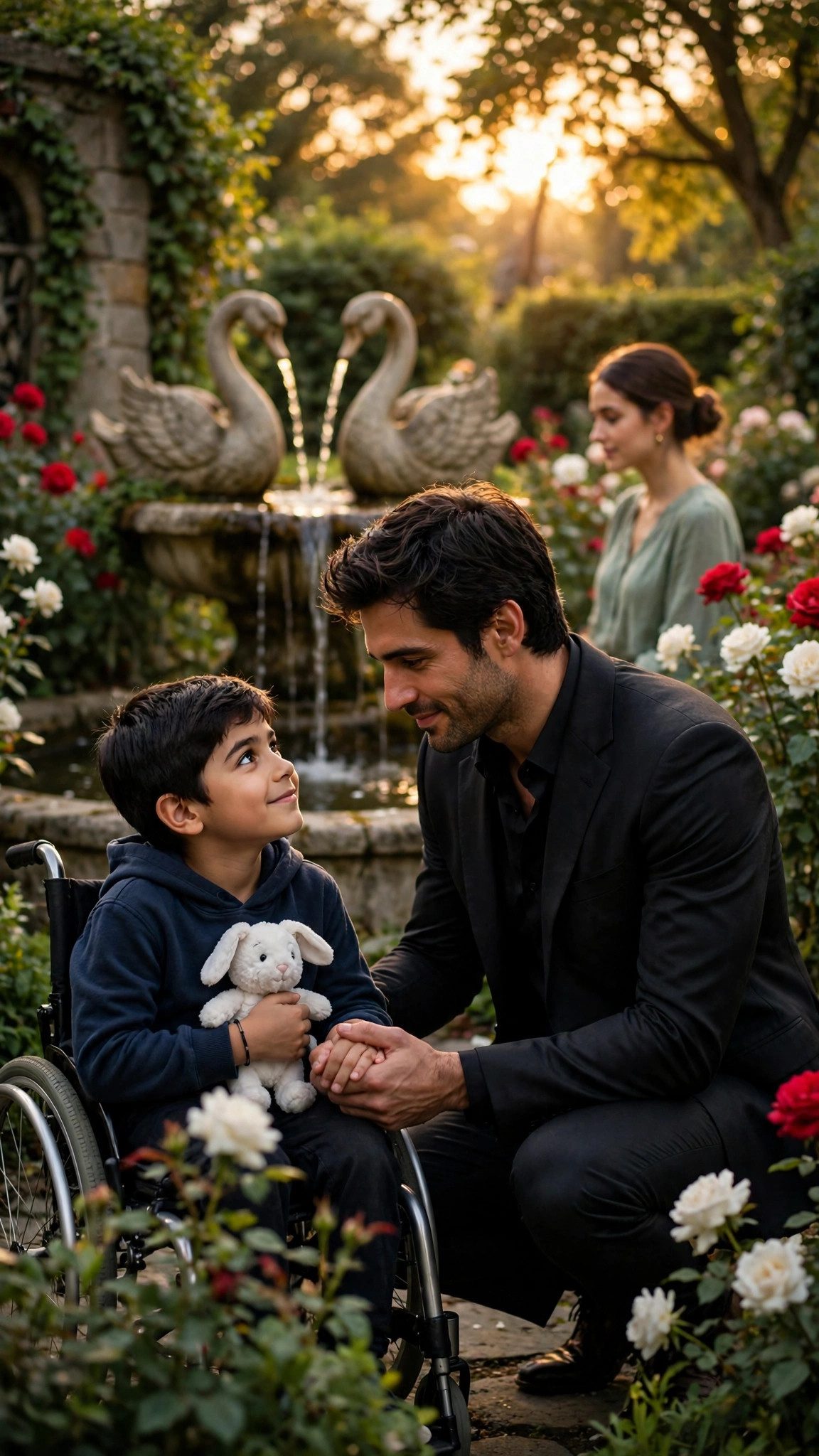
The room was dark except for the small lamp on the nightstand, the one shaped like a rocket ship that Elena had bought him for his sixth birthday. Matteo was curled on his side in his bed, his face buried in the pillow, his thin shoulders shaking. His wheelchair stood folded against the wall. On the bedside table, his white plush rabbit — the one his mother had given him when he was three, the one he had not let go of since the hospital — lay face-down on the floor, as if it had been knocked there.
Clara was standing over the bed with one hand raised. Her other hand was tangled in my son's hair.
I have killed men for less than what I saw in that room. I have ordered things done that I do not talk about, not even to myself, in the dark. But in that moment, standing in the doorway of my eight-year-old son's bedroom, I did not think about any of that. I thought about the fact that for three months I had let this woman into my house. I had let her into the room where my son slept. I had smiled at her in the mornings and thanked her for her patience, while behind my back she was pulling my silent boy's hair and telling him to stop crying.
"Get your hand off my son," I said.
My voice did not sound like my own. It sounded like something coming up out of the ground.
Clara spun around. Her face went white. Her hand came out of Matteo's hair so fast it was as if the hair had burned her.
"Vincent," she said. "I was just—he was having a nightmare, and I was trying to—"
"Don't." I crossed the room in three strides and put myself between her and the bed. "Don't say another word."
"You're misunderstanding," she said, and her voice had already changed, already gone soft and reasonable, the voice she used for me. "He woke up crying, and I was calming him down. He grabbed my wrist. Look." She held up her wrist, as if there would be a mark. There was no mark. "I didn't do anything."
Behind me, Matteo made a sound. It was not a word. It was a small, broken gasp, the sound a child makes when he has been holding his breath for a very long time and finally lets it out. I turned around and looked at him, and his eyes were open, wide and dark and wet, fixed on my face. He was not looking at Clara. He was looking at me, and in his eyes I saw something I had not seen in fourteen months.
Hope.
I turned back to Clara. "You are finished here," I said. "You will go downstairs, you will pack whatever you brought into this house, and you will leave. If you ever come near my son again, I will not be this calm."
"I need this job," she said. Her voice cracked, and for a second she almost sounded like a real person, like someone who was afraid. "Vincent, please. I have nowhere else to go."
"Then go nowhere," I said. "But go."
She looked at me for a long moment, and something moved behind her eyes — not fear, exactly. Something colder. Calculation. Then she nodded once, picked up her cardigan from the chair, and walked out of the room without looking at my son again.
I waited until I heard her footsteps on the stairs. Then I sat down on the edge of Matteo's bed, and I picked up the white rabbit from the floor, and I put it in his arms. He curled around it the way he always did, the way he had done in the hospital when the doctors told me he would never walk again and I had stood in the hallway with my forehead against the wall, trying to remember how to breathe.
"It's all right," I said. "She's gone. She can't hurt you anymore."
He looked at me, and his lips moved. For one wild, impossible second I thought he was going to speak. But no sound came out. His mouth closed again, and he turned his face into the pillow, and the crying started again, quieter now, the leaking kind.
I sat with him until he fell asleep. I sat with him long after that, too, with my hand resting lightly on his back, feeling the rise and fall of his breathing, listening to the silence of the house. Downstairs, the front door opened and closed. Clara Hayes was gone.
I should have felt relief. Instead, I felt something else, something I had not felt in a long time: a cold, clear fury, and underneath it, a question that would not let go.
Why was my son afraid of her?
It was not a normal fear. Children are afraid of strangers, of the dark, of loud noises. Matteo had been afraid of Clara in a way that was specific and personal, the way a small animal is afraid of the one creature in the house that has hurt it before. He flinched when she touched him. He went rigid when she came near his chair. And three months ago, when she first walked into this house, he had looked at her with something that was almost recognition — not the recognition of a friend, but the recognition of a danger he had seen before and could not name.
I had hired her because she reminded me of Elena. I had told myself that was a good reason. A grieving widower, a silent boy, a kind woman with dark hair and a soft voice — it had felt like the universe offering me a small mercy. But now, sitting in the dark in my son's room, I wondered if the resemblance had been the point. I wondered if someone had chosen her for me, the way you choose a key for a lock.
I thought about the explosion.
Fourteen months ago, on a Tuesday in October, my wife Elena got into the back of my armored SUV with our son, and I got into the front seat with Gabe driving, and we drove out of the gates of this house toward a charity gala downtown. It was supposed to be an ordinary evening. Elena was wearing a dark green dress, and Matteo was wearing a small suit with a bow tie that he hated, and he kept tugging at it, and Elena kept laughing and fixing it for him, and I remember thinking that this was what my life was: a beautiful wife, a funny little boy, a house full of light.
We never made it to the gala.
The bomb was under the SUV. It went off at a red light on the edge of the Loop, and the world turned into noise and fire and glass. I remember the sound most of all, because it did not sound like an explosion in a movie. It sounded like the whole world tearing in half. I remember Gabe dragging me out of the front seat. I remember the smoke, and the screaming, and the way the street looked afterwards, black and wet, like the city itself was bleeding.
Elena never woke up. She died in the ambulance, before we reached the hospital, and the paramedic who told me had tears in his eyes, and I remember thinking how strange it was that a stranger would cry for my wife when I could not cry at all. My body had simply refused. It was as if all the grief had been locked behind a door inside me, and the door would not open.
Matteo survived. That was the word the doctors used — survived — as if it were a victory, as if surviving were the same thing as living. The blast had broken his back at the eighth thoracic vertebra. T8. He would never walk again. And something else had broken, too, something the doctors could not see on any scan. He stopped speaking. Not that day, not all at once, but gradually, over the weeks in the hospital, the words simply stopped coming. First he stopped answering questions. Then he stopped asking for things. Then one morning I asked him if he wanted his rabbit, and he looked at me, and his mouth moved, and nothing came out, and after that, nothing ever did.
The doctors called it psychogenic mutism. Trauma. The mind protecting itself by shutting down the one thing that might let the pain out. Dr. Marcus Hale, the child trauma specialist, told me that some children come back from it and some do not, and that there was no way to know which kind Matteo was. He said the best thing I could do was give him safety, and routine, and time.
"What if he never talks again?" I asked him, in his office, on a day when the rain was coming down so hard it sounded like static against the windows.
"Then you love him in silence," Dr. Hale said. "And you wait."
I waited. For fourteen months, I waited. I rebuilt our lives piece by piece, the way you rebuild a house after a fire — you do not ask whether it will ever be the same, because you already know it will not. You just lay one brick at a time and hope the walls hold.
I hired nurses. I hired therapists. I hired a physical therapist named Anna who came three times a week and worked Matteo's legs through their exercises, and who talked to him the whole time as if he could answer, telling him about her garden and her grandchildren, and once, when she thought I was not listening, she told him that his mother would be proud of how brave he was. Matteo had cried that day, silently, the tears running down his face while his mouth stayed closed, and Anna had held his hand and said, "That's all right, sweetheart. Tears count, too."
I kept the fountain running. That was Elena's fountain, in the garden behind the house — a stone fountain with two carved swans that she had found at an estate sale in Lake Forest and insisted on having, even though it leaked and the pump was always breaking. After she died, I told Gabe to keep it running, no matter what. I did not know why it mattered so much to me. It just did. As long as the water was moving, some part of her was still here.
And three months ago, on the recommendation of a doctor I trusted, I hired Clara Hayes.
She had excellent references. She had worked for two families in Winnetka, both of whom spoke highly of her patience and her warmth. She was thirty-two, dark-haired, soft-voiced, with a smile that reached her eyes. In her interview, she told me she had always wanted to work with children who needed extra care, and that she believed every child had a voice, even the ones who could not speak. I hired her on the spot. I told myself it was because she was qualified. The truth was simpler and uglier: she reminded me of Elena, and I was lonely, and my son was silent, and I wanted to believe that a kind woman could fix what was broken.
For the first few weeks, everything seemed fine. Clara was gentle. She read to Matteo. She pushed his wheelchair through the garden. She learned the names of his medicines and the schedule of his therapy. Rosa, my housekeeper of twenty years, said she seemed like a good girl. Gabe said nothing, which for Gabe meant he was watching.
But then the small things started. Matteo stopped eating his breakfast when Clara served it. He started refusing to go to the garden when she was the one pushing his chair. Once, when she reached out to adjust his blanket, he jerked away from her so hard that his chair nearly tipped. I asked him what was wrong, and he looked at me with those big dark eyes, and his mouth moved, and nothing came out.
I asked Clara about it. She smiled her soft smile and said that Matteo was shy, that he was still adjusting, that children with trauma sometimes fixated on a caregiver and blamed them for things that were not their fault. She said it so reasonably, so kindly, that I believed her. Or I wanted to believe her. I am a man who has built an empire on knowing when people are lying to me, and I let this woman lie to my face in my own house, because she reminded me of my dead wife.
That was my failure. Not the explosion. Not the silence. That. I had brought a stranger into my son's room and told myself it was love, when it was only grief wearing a kinder face.
Now, sitting on the edge of his bed in the dark, I made myself a promise. I would find out who Clara Hayes really was. I would find out why my son was afraid of her. And I would find out who had put a bomb under my wife's car fourteen months ago, because I was beginning to understand that those two questions might have the same answer.
Matteo's breathing had gone slow and even. He was asleep. The white rabbit was tucked under his chin. In the lamplight, his face looked younger than eight — small and pale, with Elena's dark eyelashes and the faint scar on his left temple where a piece of glass had cut him in the blast. I leaned down and kissed the top of his head, the way I used to do when he was small and I came home late from work, and I whispered the words I had whispered to him every night since the hospital, the words I would keep whispering until the day he could answer me.
"I'm here, Matteo. I'm not going anywhere. And I swear to you, on your mother's name, I will find out who did this to us."
He did not answer. He never answered. But as I stood up to leave, his small hand came out from under the blanket and closed around one of my fingers, and he held on, tight, the way he used to hold on when he was three years old and afraid of the dark.
I stayed where I was, holding his hand, until the first gray light of morning came through the curtains. And when the sun finally rose over the garden, over the fountain that never stopped running, I went downstairs to my study, and I called Gabe, and I told him to find out everything there was to know about Clara Hayes.
"Everything," I said. "Where she was born. Who her family is. Who she worked for before us. Who recommended her. I want it all by tonight."
"Yes, boss," Gabe said. He did not ask why. Gabe never asked why.
I hung up the phone and stood at the window of my study, looking out at the garden where my wife used to read in the afternoons, where my son used to chase butterflies before he knew what a wheelchair was, and I thought about the words Dr. Hale had said to me in his office on that rainy day.
"Then you love him in silence. And you wait."
I had waited for fourteen months. I was done waiting.
It was time to start listening instead.