For the first three weeks, Clara Hayes was everything I had hoped for.
She arrived every morning at eight o'clock, always on time, always smiling, always wearing that red scarf. It was a bright, dark red, the color of wine, and she wore it knotted at her throat no matter the weather. She told me once that it had belonged to her grandmother, and that she wore it for luck. I thought it was charming. I thought it was the kind of small, human detail that made a person real.
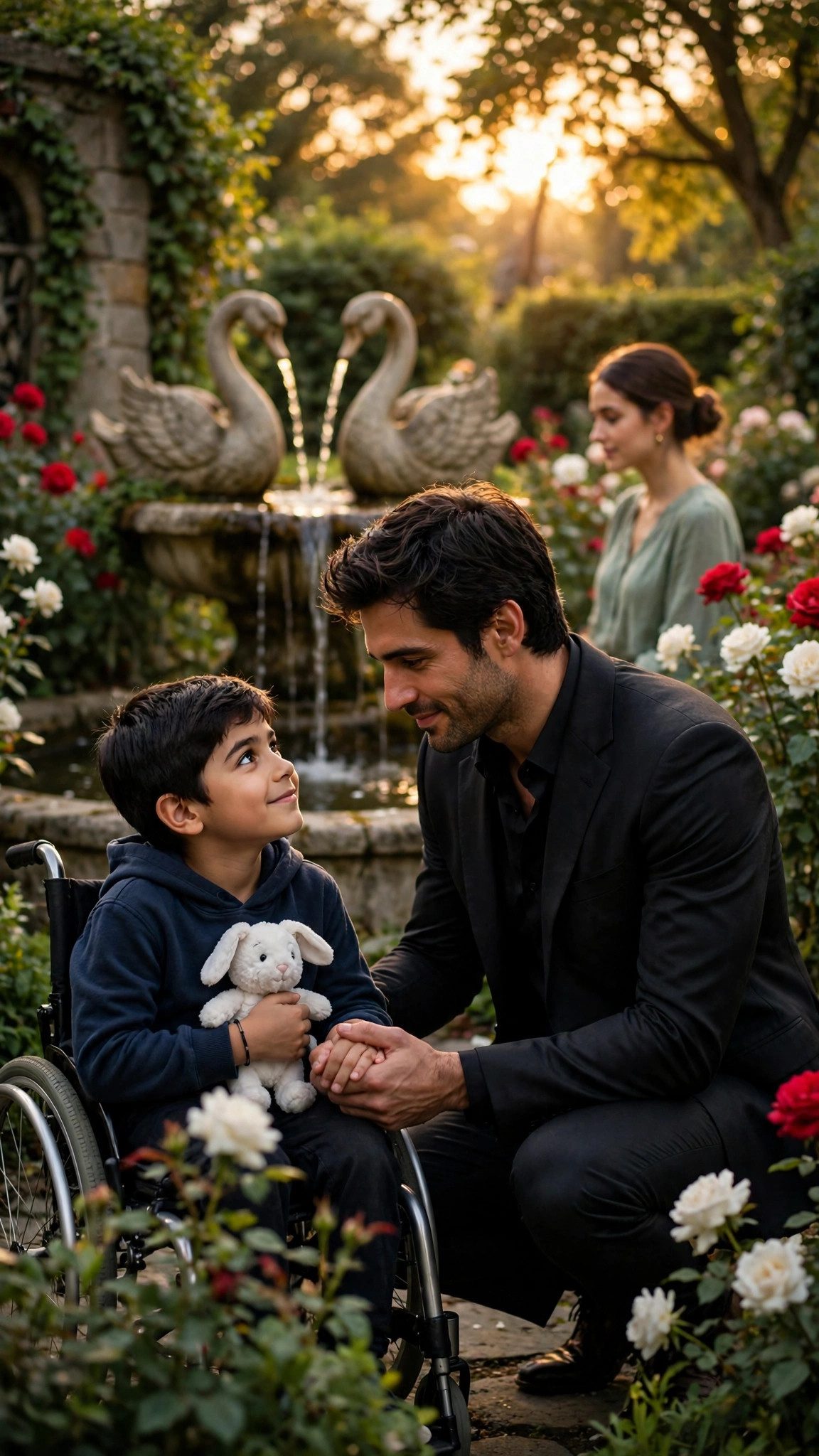
She read to Matteo. She pushed his wheelchair through the garden, along the paths between the rose bushes, and she talked to him the whole time — about the flowers, about the birds, about a book she was reading — in a voice that was warm and easy, the voice of a woman who was not in a hurry. She learned the names of his medicines. She learned the schedule of his therapy. She learned that he liked his toast cut into triangles and his milk in the blue glass, not the green one, and that he hated the smell of lavender, which reminded him of the hospital.
Rosa liked her. "She's a good girl," Rosa told me one evening, while she was peeling potatoes at the kitchen table. "She has patience. That boy needs patience."
Gabe said nothing. Gabe watched.
And Matteo — Matteo was the problem. Or so I thought, at first.
He did not warm to Clara the way I had expected him to. He did not smile at her. He did not reach for her hand. When she came into the room, his shoulders would go up, tight and high, the way a small animal's shoulders go up when a shadow passes over it. When she pushed his wheelchair, his hands would grip the armrests so hard his knuckles went white. When she served him his breakfast, he would stare at the plate for a long time before he ate, as if he were checking it for something.
I told myself it was the trauma. I told myself it was the adjustment. I told myself what Clara told me, which was that children who had been through what Matteo had been through sometimes fixated on a caregiver, blaming them for things that were not their fault, because it was easier to be afraid of a person than to be afraid of the whole world.
She said it so reasonably. She said it with such kindness. And I believed her, because I wanted to believe her, because the alternative — that I had brought a dangerous woman into my son's room — was something I could not afford to believe. I had already lost my wife. I had already lost my son's voice. I could not lose the idea that someone kind had come to help us.
But the small things kept coming.
One morning, I came downstairs early and found Clara in the kitchen, making Matteo's breakfast. She was humming, a low, tuneless hum, and Matteo was sitting at the table in his wheelchair, watching her. When she turned around with the plate in her hands and reached out to put it down in front of him, he jerked backward so hard that his chair rolled back from the table and hit the wall. The plate clattered. The toast slid off onto the tablecloth.
"Matteo!" Clara said, and her voice was sharp, just for a second, before it went soft again. "It's all right, sweetheart. It's just breakfast. I'm not going to hurt you."
She said it the way a person says something they have said many times before. And Matteo sat there, breathing hard, his eyes fixed on her hands, and I stood in the doorway, and I felt something cold settle in the bottom of my stomach.
"Is everything all right?" I asked.
Clara turned around and smiled at me, her warm smile, her Elena smile. "He startled," she said. "He's still getting used to me. It takes time."
"It does," I said. And I believed her. Or I told myself I believed her.
Another day, I came home from the office in the early afternoon, earlier than usual, and I found them in the garden. Clara was pushing Matteo's wheelchair along the path beside the fountain, and she was talking to him about the roses, and Matteo was sitting very still, his hands folded in his lap, staring straight ahead. As I watched, Clara reached down and put her hand on his shoulder, the way a caregiver does, a casual, affectionate gesture, and Matteo flinched. Not a small flinch. A full-body flinch, as if her hand had been hot. His shoulders came up. His head went down. His hands clenched on the armrests.
Clara saw me standing there, and she took her hand away, smoothly, as if nothing had happened.
"He doesn't like to be touched," she said, when she reached me. "Some children don't. It's a sensory thing, after trauma. I'm working on it, slowly."
"Does he flinch with Anna?" I asked. Anna was the physical therapist, who touched Matteo every day, moving his legs through their exercises.
Clara's smile did not move. "Anna is different," she said. "He's known Anna longer."
I nodded. It sounded reasonable. Everything she said sounded reasonable.
That evening, Rosa came to my study with a tray of coffee, and she did not leave right away, the way she usually did. She stood by the door, wiping her hands on her apron, and she looked at me with the expression she wore when she had something to say and was deciding whether it was her place to say it.
"Mr. Vincent," she said, finally. "The boy is sleeping with the light on now. He never did that before. Not even in the hospital."
"Since when?" I asked.
"Since about two weeks after Miss Clara came," Rosa said. "And he hides his rabbit. He puts it under his pillow when she comes into the room, as if he is afraid she will take it. And yesterday, I found her red scarf on his chair. Just draped there, over the back. And when Matteo saw it, he pushed it onto the floor with his foot, and he would not look at it. I picked it up, and I put it in the hallway, and he watched me do it, and his shoulders came down, just a little."
"Did you say anything to her?" I asked.
"No," Rosa said. "I did not want to make trouble. She is very polite to me. She always says thank you. But Mr. Vincent — I have been in this house for twenty years, and I have seen many people come and go, and I know what a child looks like when he is afraid of someone. That boy is afraid of her. I don't know why. But he is."
I thanked her, and she left, and I sat in my study for a long time, staring at the wall, thinking about the light left on in my son's room, and the rabbit hidden under a pillow, and a red scarf on a chair. Small things. Any one of them meant nothing. All of them together meant something, and I was a man who had built his life on reading patterns, and the pattern in front of me was one I did not want to see.
But that night, I could not sleep. I lay in my bed, staring at the ceiling, thinking about the way Matteo had flinched. I thought about Dr. Hale's words: "Watch your son. He will tell you the truth, even if he cannot speak it."
The next morning, I called Dr. Hale.
"He flinches when she touches him," I said. "Every time. Not just sometimes. Every time."
There was a long pause on the other end of the line. Then Dr. Hale said, "Has he ever flinched like that with anyone else?"
"No," I said. "Not with Anna. Not with Rosa. Not with me."
"Then believe him," Dr. Hale said. "Children who cannot speak still communicate, Mr. Rossi. They communicate with their bodies. If your son's body is telling you that this woman is not safe, you should listen."
"But she has references," I said. "Dr. Pierce recommended her. Two families in Winnetka—"
"References can be bought," Dr. Hale said. "And recommendations can be wrong. I'm not telling you she has done anything. I'm telling you that your son is afraid of her, and that fear is real, whether or not you understand the reason for it. A child does not flinch at a kind hand."
I thanked him and hung up, and I sat in my study for a long time, looking out at the garden, at the fountain, at the roses Elena had planted, and I thought about what I was going to do.
What I did, in the end, was nothing. Or rather, what I did was watch. I started coming home early. I started watching Clara with Matteo when she did not know I was watching. I stood in doorways. I listened from hallways. And what I saw was a woman who was always warm, always patient, always kind — whenever she knew I was there.
But there were moments. Small moments, at the edges of things, that I almost missed.
Once, I saw her take Matteo's white rabbit off his lap and set it on the table, out of his reach, and when he reached for it, she said, "You can have it back when you've finished your exercises," in a voice that was not unkind, exactly, but was not kind, either. It was the voice of someone who enjoys having something another person wants.
Once, I saw her brush Matteo's hair back from his forehead, and her fingers caught in his hair, and she pulled — not hard, not enough to leave a mark, but enough that his head jerked back, and his eyes went wide, and she said, "Oh, I'm sorry, sweetheart, your hair is so tangled," and she smiled, and Matteo said nothing, because Matteo never said anything.
And once, late in the afternoon, I came into his room without knocking, and I found her standing over his bed, and Matteo was curled on his side, and his face was wet, and Clara was holding his wrist in one hand, and her mouth was close to his ear, and she was saying something in a low voice, so low I could not hear the words. When she saw me in the doorway, she let go of his wrist at once, and she straightened up, and she smiled her warm smile, and she said, "He was having a bad dream. I was calming him down."
"Was he?" I said.
"Yes," she said. "He cries in his sleep sometimes. Did you know that?"
I did not know that. I did not know whether it was true. Matteo cried silently, in his sleep and out of it, and I had never been sure what woke him. But something about the way she said it — the easy way she offered it, as if it explained everything — made the cold settle deeper in my stomach.
That night, I went to Gabe.
"I want a microphone in Matteo's room," I said. "A hidden one. Small. Sewn into the curtain, or behind the headboard. I want to hear what happens in that room when I'm not there."
Gabe looked at me for a long moment. He did not ask why. He did not tell me it was wrong. He simply nodded and said, "I'll have it done tomorrow, while he's at therapy."
"And I want you to watch her," I said. "When she comes and goes. Who she talks to. Where she goes when she leaves here."
"Yes, boss," Gabe said.
The microphone went in the next day, sewn into the seam of the curtain beside Matteo's bed. I told myself I would only listen if I had to. I told myself it was a precaution. I told myself I was being paranoid, and that in a week or two I would take it out again, embarrassed, and apologize to Clara for ever having doubted her.
But before the microphone ever told me anything, Matteo told me something himself. Not with words. With a drawing.
Matteo had always liked to draw. Before the explosion, he drew constantly — dinosaurs, race cars, superheroes, his mother. After the explosion, he stopped, the way he stopped everything else. For fourteen months, his crayons sat untouched in a box on his desk.
One afternoon, about a week before the night of the microphone, I came home and found him at his desk, a crayon in his hand. Rosa was standing behind him, her hand over her mouth, tears in her eyes. On the paper in front of him was a drawing, crude and childish, the way an eight-year-old draws: a road, a car, and a woman standing beside the road. The woman was wearing a long coat, and she had dark hair, and around her neck, drawn in thick, urgent strokes of red crayon, was a scarf.
A red scarf.
Matteo looked up at me, and his eyes were wide, and his hand was shaking, and he pointed at the drawing, and then he pointed at the door, and then he pointed at the drawing again, as if he were trying to tell me something that was too big for his silence to hold.
I knelt down beside his chair and looked at the drawing more closely. The car in the drawing was black. The road was gray. And the woman in the red scarf was standing at the edge of the road, watching the car, her hand raised, as if she were waving it down — or stopping it.
"Did you see this, Matteo?" I asked, quietly. "Did you see a woman in a red scarf?"
He nodded. Once. Hard. His eyes filled with tears.
"When?" I asked. "When did you see her?"
He pointed at the drawing again, and then he pointed out the window, toward the road that ran past our house, and I understood.
The roadside. The kidnap attempt.
Three weeks earlier, Gabe had taken Matteo to a physical therapy appointment, and on the way home, a van had tried to force their car off the road. Gabe had called it a traffic incident — a drunk driver, a near miss. He had not wanted to worry me. But now, looking at my son's drawing, I understood that it had not been a traffic incident at all. Someone had tried to take my son off the road. And the woman in the red scarf had been there, watching.
I took the drawing and I put it in the drawer of my desk, and I told no one about it, not even Gabe. Not yet. I needed to hear what the microphone would tell me first.
Three days later, at eleven forty-seven at night, the microphone told me everything I needed to know.
And Clara Hayes, with her dark hair and her soft voice and her red scarf, walked out of my house for the last time.