Friday came, and Salvatore Castellano did not give me Danny Brennan.
Instead, he sent me a message of his own. It arrived at noon, in the form of a black car parked across the street from my house, its engine running, its windows dark. It sat there for an hour, not moving, just watching. Gabe called me from the gate, and I looked out the window of my study, and I understood.
It was a reminder. A man like Castellano does not need to say "I am watching you." He simply watches you, and lets you do the worrying yourself.
I called Gabe into the study. "Double the men on the gate," I said. "And I want someone with Matteo at all times. Not just Lucia. One of our men, in the house, at all times, until this is over."
"Yes, boss," Gabe said.
"And find Danny Brennan," I said. "I don't care where he is. Milwaukee, Gary, Mexico — find him."
Gabe found him in Cleveland.
It took four days. Four days of phone calls, and favors, and men asking questions in bars and garages and all the places where men like Danny Brennan go when they are trying not to be found. On Tuesday morning, Gabe came into my study with a photograph on his phone: Danny Brennan, sitting at a bar in Cleveland, drinking a beer, wearing a jacket with the collar turned up, looking over his shoulder the way a man looks when he knows someone is coming for him.
"He's working at a body shop," Gabe said. "Under a different name. The owner doesn't know who he is. He thinks he's just a mechanic."
"Get him," I said.
Gabe took three men and drove to Cleveland that night. They waited until the body shop closed, and they took Danny Brennan off the street two blocks from his apartment, and they put him in a car, and they drove him back to Chicago, and by Thursday morning, he was sitting in a chair in the warehouse on the South Side, in the room where conversations happen that cannot happen anywhere else.
I went to see him alone. Gabe wanted to come with me. I told him no. This was something I needed to do by myself.
Danny Brennan was thirty-four years old, thin, with dark hair and a scar that ran from his left eyebrow down to his cheek. He looked smaller than his photograph. He looked tired. His hands were shaking, and there was a cut on his lip, and when I walked into the room, he looked up at me, and I saw something in his eyes that I recognized.
Fear. Not the fear of a man who is afraid of being hurt. The fear of a man who has been afraid for a very long time, and who is tired of it.
"Mr. Rossi," he said. His voice was hoarse. "I know why I'm here."
"Do you?" I said.
"Yes," he said. "The bomb. The SUV. Your wife. I know."
I sat down in the chair across from him, and I looked at him for a long moment, and I thought about Elena, and about Matteo, and about the fourteen months of silence, and about the white rabbit on the floor of my son's bedroom, and I felt the cold fury rise in me, the way it always rose, and then I pushed it down, because fury was not what I needed right now. What I needed was the truth.
"Tell me," I said.
He told me.
He told me that Eddie Marcone had come to him eighteen months ago, in the garage on the South Side, and had offered him fifty thousand dollars to plant a device under a car. He told me he had not asked whose car it was, at first, because fifty thousand dollars was more money than he had ever seen in his life, and because he owed money to men who were not patient. He told me that Marcone had given him the device, and a photograph of the car, and a schedule — Tuesdays and Thursdays, the armored SUV, the same route, the same red light on the edge of the Loop — and that he had waited at that red light for three weeks, in a borrowed car, watching, until one Tuesday in October, the SUV stopped beside him, and he had gotten out, and he had crouched beside it, and he had done what he was paid to do.
"I didn't know there was a child in the car," he said, and his voice broke. "I swear to God, I didn't know. Marcone told me it was a business thing. He told me the car would be empty, that it was parked, that no one would be in it. He lied to me. He told me it was just a car. I didn't know your wife was in it. I didn't know your boy was in it. I didn't know until I saw it on the news, and by then it was too late, and Marcone told me that if I ever said a word, he would kill me, and my sister, too."
"Your sister," I said. "Clara."
"Yes," Danny said. "Clara. She's my little sister. After our mother died, I raised her. I was all she had. And when Marcone told me what he wanted, I said no, at first. But then Castellano's men came to see me, and they told me that Clara would be taken care of, that she would be given a job, a good job, and that all she had to do was watch the boy, and keep him quiet, and report back if he ever said anything about what he saw."
"What did he see?" I asked. "What did Matteo see?"
Danny looked down at his hands. "Me," he said. "He saw me. He was in the back seat, and he looked out the window, and he saw me crouching beside the car. He saw my face. He saw the scar. I saw him see me, and for a second, we just looked at each other, a grown man and a little boy, and then the light changed, and the car drove away, and I stood there on the sidewalk, and I knew. I knew that boy could point at me in a lineup and end my life. And I knew that Castellano knew it, too. That's why they sent Clara. Not to hurt him. Just to keep him quiet. To make him too afraid to speak."
I sat there in the silence of that room, looking at the man who had killed my wife, and I felt something I had not expected to feel. Not just fury. Not just hatred. Something else, underneath it, something colder and heavier.
Pity. Not for him. For all of us. For the way a single decision, made by a desperate man in a garage for fifty thousand dollars, had rippled outward and destroyed so many lives — Elena's, Matteo's, Lucia's parents', Clara's, Danny's own. A stone thrown into a pond, and the ripples had not stopped yet.
"Why did Castellano want my wife dead?" I asked. "Why Elena? Why not me?"
"Because you were the target," Danny said. "You were supposed to be in the car. Marcone told me you always rode in the back with your family on Tuesdays. But that day, you rode in the front, with the driver. I didn't know. I planted the device under the rear of the car, where you were supposed to be sitting. Your wife was sitting where you were supposed to be sitting."
I closed my eyes. I had ridden in the front that day because Gabe had asked me to look at a map, because there was roadwork on our usual route, because of a hundred small, ordinary reasons that had nothing to do with anything. And Elena had sat in the back, where I was supposed to be, and she had died in my place.
"I want you to do something for me," I said, and I opened my eyes. "I want you to tell the police. All of it. Marcone, Castellano, the device, the money, Clara. All of it. And in return, I will make sure the police know that you cooperated. I will make sure your sister is treated fairly. And I will not kill you."
Danny stared at me. "Why?" he asked. "Why would you do that? After what I did?"
"Because my son is alive," I said. "And because if I kill you, I become the man who killed a man in a warehouse, and my son will grow up in a house where that is what his father does. I have done enough of that in my life. I will not do it for you. You will go to prison, Danny. You will go to prison for a very long time. And you will live with what you did, every day, the way I live with what happened to my wife. That is your punishment. Not my hands. Your own conscience."
He started to cry then, quietly, the way men cry when they have been holding it in for a very long time, and he looked up at me, and he said, "Will you tell him I'm sorry? Your boy. Will you tell him I didn't know he was in the car?"
"I will tell him the truth," I said. "All of it. And one day, when he is older, he will decide for himself what to do with it. That is his right, not mine to give away."
"Do you think he'll ever talk again?" Danny asked, and his voice was small, almost a whisper.
"I don't know," I said. "But he is alive, and he is brave, and he drew a picture of a woman in a red scarf with a shaking hand, and that picture brought all of this down. So whatever happens next, he has already done more than most men ever do."
I stood up, and I walked out of the room, and I told Gabe to call the police.
Clara Brennan was arrested the next morning, in Milwaukee. She did not resist. The police found fifty thousand dollars in cash in a drawer in her apartment, and a prepaid phone with Castellano's number in it, and a notebook with dates and times in it — every time Matteo had cried, every time he had flinched, every time he had drawn a picture, every time he had almost spoken. She had been reporting it all, for three months, the way a scientist reports on an experiment.
Eddie Marcone was arrested that afternoon, at his garage. Salvatore Castellano was arrested three days later, at his home in Lake Forest, in front of his wife and his children, and the photograph of it was on the front page of every newspaper in Chicago the next morning.
I did not go to the trials. I did not need to. Gabe went, and he told me what happened, and the lawyers told me what would happen next, and it was enough to know that the men who had done this to my family were going to spend the rest of their lives in prison, and that the law, for once, was going to do what I had spent fourteen months wanting to do myself.
But there was one thing the law could not do. One thing no court, no prison, no punishment could give back to me.
My son's voice.
That was something only Matteo could give back to himself, in his own time, in his own way. And all I could do was what Dr. Hale had told me to do, fourteen months ago, in his office, on a rainy day.
Sit with him. Keep him company. And wait.
So I went home, and I went upstairs to his room, and I sat down on the edge of his bed, and I told him the truth. Not all of it — he was eight years old, and some truths are too heavy for a child to carry — but enough of it. I told him that the bad men had been caught. I told him that Clara was gone, and that she would never come back. I told him that the man who had hurt his mama was going to prison, and that he would never hurt anyone again.
And then I told him the thing I had been afraid to tell him for fourteen months, the thing I had carried inside me like a stone.
"I was supposed to be in the back of the car that day," I said. "Not your mama. Me. I was supposed to be sitting where she was sitting. And I have spent fourteen months thinking that if I had been in the back, she would still be alive. And I want you to know that I am sorry. I am sorry I was not there. I am sorry I could not protect her. I am sorry I could not protect you."
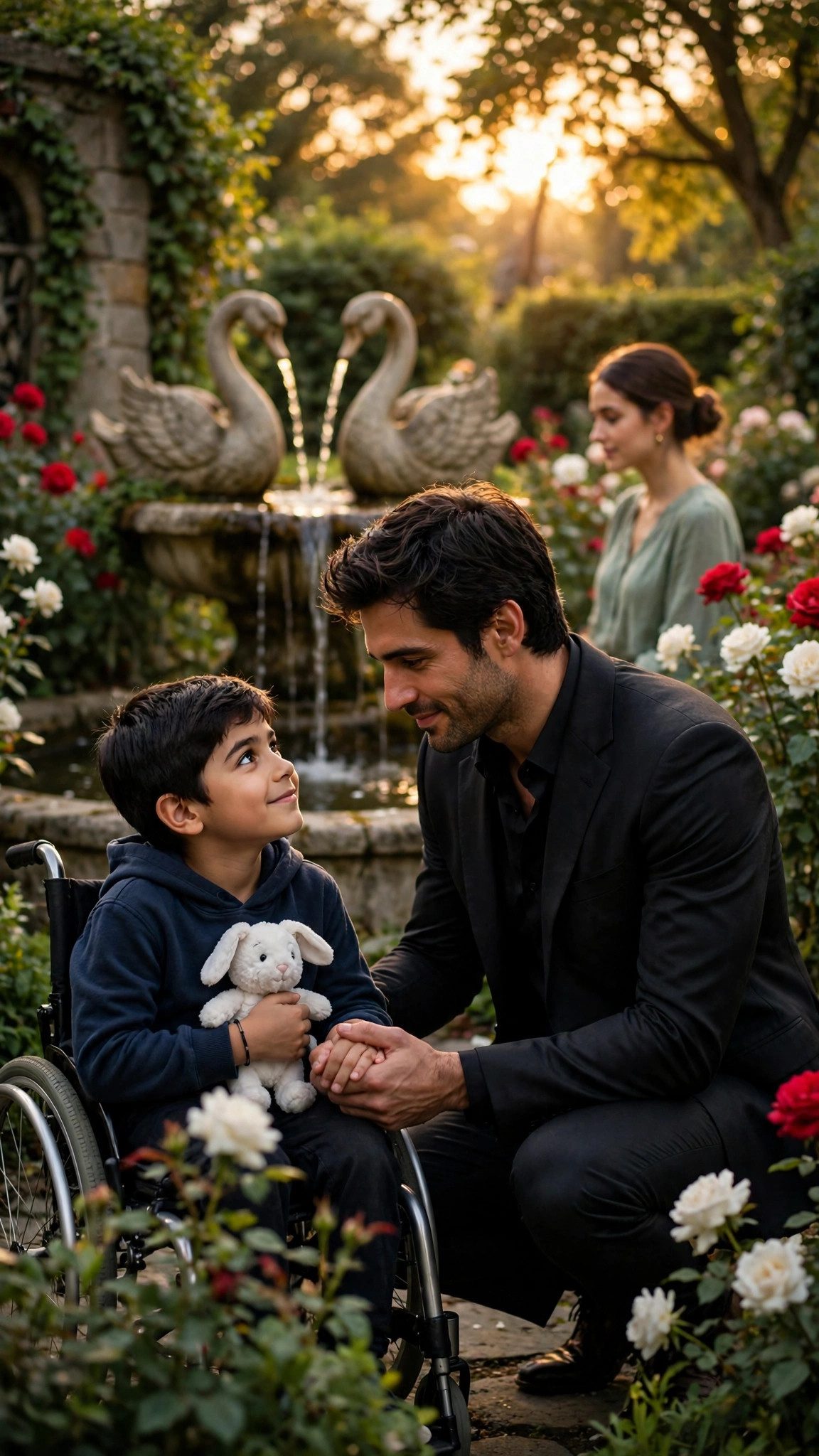
Matteo looked at me, and his eyes were wide, and his mouth moved, and for one wild second I thought he was going to speak. But no sound came out. Instead, he reached out, and he took my hand, and he put it over his heart, the way he had done in the drawing, the way he had done a hundred times since the hospital.
I am here. You are here. We are still here.
Then he did something he had never done before. He reached for the notepad on his bedside table — the notepad Lucia had left there for him, so he could draw whenever he wanted — and he picked up a pen, and he wrote something, slowly, in large, shaky letters, the way a child writes when he is concentrating very hard.
He turned the notepad around so I could read it.
I SAW THE MAN.
Four words. The first words my son had communicated to anyone, in any form, in fourteen months. Not spoken. Written. But words. His words. The truth, in his own hand.
I looked at those four words, and I felt the tears come, and I did not try to stop them, and Matteo reached out, and he wiped one of them away with his small thumb, the way Elena used to do, and he looked at me, and his eyes said what his mouth could not yet say.
It's all right, Dad. I saw him. And now you see him, too. And it's over.
"No," I said, quietly, and I took his hand, and I held it tight. "It's not over yet, Matteo. But it's beginning. It's finally beginning."