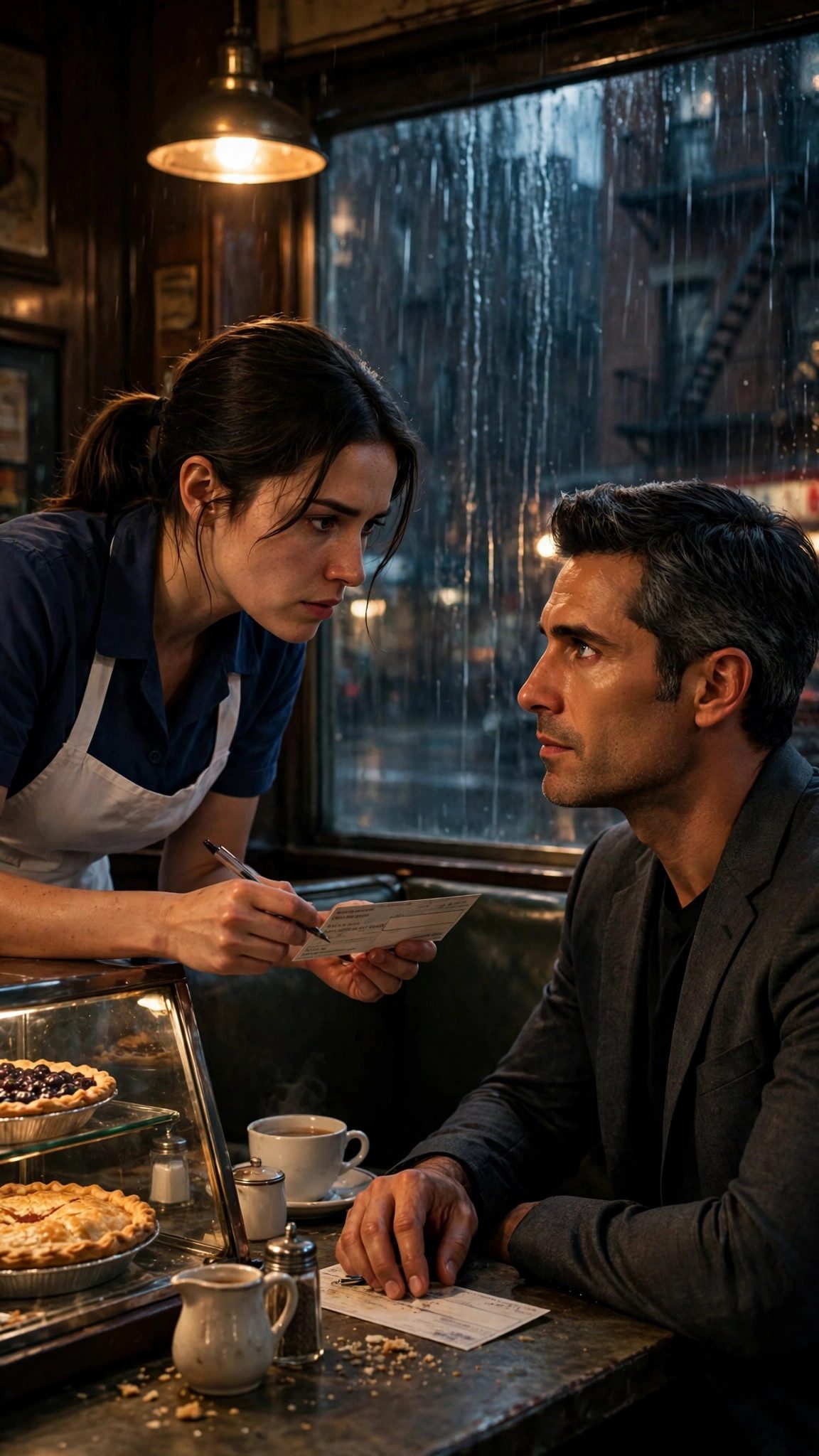
"I met your brother six years ago," Adrian said. "He was twenty-four, driving a delivery truck for a warehouse company in Philadelphia, and he stopped to help one of my men change a tire in the rain. My man was carrying a bag of cash for a pickup, and any other driver on that road would have seen the bag and seen an opportunity. Danny saw a man with a flat tire, and he changed it, and he refused the money my man offered him, and he drove away."
He paused, and for the first time since I had met him, he looked uncertain — like a man choosing his words carefully because the wrong ones would cost him something.
"I had him followed for a week," he went on. "Not because I suspected him. Because I wanted to know if he was real. Men who refuse money are either saints or traps, and I have never met a saint. Danny was the closest thing I ever found. He lived in a two-room apartment with his little sister. He sent money to his mother every month. He went to church on Sundays, not because he was holy, but because his mother had asked him to, and he had promised her he would. So I offered him a job."
"What kind of job?" I asked.
"Driving," Adrian said. "That was all, at first. Driving me. Driving my men. Sitting in cars outside buildings, watching doors. The work was boring, and the pay was very good, and the only rule was the one I gave him on his first day. I taught him the code myself, Emily. 317. Don't speak. You're being watched. Write it where only the right person will see it. I taught it to every man I trusted, because a man who can warn you without opening his mouth is worth ten men with guns."
My throat was so tight I could barely breathe. "He never told me who you were."
"He wasn't supposed to. That was part of the rule. The code only works if nobody knows who taught it." Adrian looked down at his hands. "Danny worked for me for three years. He was the best driver I ever had. He never asked questions. He never took more than he was owed. And when Vincent Castellano started moving against my Philadelphia operation, Danny was the one who drove me to every meeting, and the one who sat outside every warehouse, and the one who noticed things other men missed."
"Vincent Castellano," I said. "The V.C. in the notebook."
Adrian nodded. "Castellano has wanted my docks and my shipping routes for a decade. He is patient, and he is rich, and he does not forgive. Three years ago, he arranged a meeting at a warehouse in Philadelphia — a meeting to discuss a truce, or so he said. It was a trap. I was supposed to walk into that warehouse at ten o'clock at night. Danny was supposed to drive me there and wait outside."
He stopped. The silence in the diner was so complete I could hear the rain on the roof.
"Danny didn't wait outside," Adrian said quietly. "He went in first. He said he wanted to check the room. He said it with a smile, like it was nothing, like he was just being careful. I told him to stay in the car. He went in anyway. And when the shooting started, I was still in the car, and he was inside, and by the time my men got to him, it was over."
I closed my eyes. I had imagined a hundred versions of that night over three years, and none of them had been this one — none of them had included a man who loved my brother like a brother, sitting across from me in a closed diner, telling me the truth in a voice that sounded like it hurt him to say it.
"He died for you," I whispered.
"He died instead of me," Adrian corrected. "There is a difference, and it is the difference that has kept me awake for three years. Danny took a meeting that was meant for me, and I let him, because I was in the car and he was already through the door, and I have spent three years telling myself there was nothing I could have done. There was something I could have done. I could have gone in first. It was my meeting. It was my trap. And I have carried that every day since."
I looked at him — really looked at him, the way I had not allowed myself to look at him in the diner that first night — and I saw what the city never saw. Not the Boss. Not the feared man. A man who had lost someone and had never forgiven himself for it, the same way I had never forgiven myself for the phone call Danny ignored.
"You knew who I was the moment you read the bill," I said.
"I knew the moment I saw the number," he said. "317. Danny's code. My code. I taught it to six men in my life, and five of them are dead, and the sixth is sitting in this room lying to me about a notebook." He reached into his jacket and took out a photograph, worn soft at the edges, and slid it across the counter. "This is Danny. In Philadelphia. Two weeks before he died."
I picked it up with shaking hands. It was my brother — my Danny, in a clean shirt, leaning against a black car, laughing at something off camera. Beside him stood a younger Adrian Moretti, his arm around Danny's shoulders, both of them grinning like boys who had just gotten away with something. On the back, in Danny's handwriting: "Me and the boss. He keeps his word."
I pressed the photograph to my chest and cried, right there in the closed diner, in front of the most feared man in Brooklyn, and he did not look away, and he did not tell me to stop, and he did not offer me a handkerchief. He just sat there, and waited, the way a man waits when he knows there is nothing to say that will make it better.
When I could speak again, I said, "The men at the diner that night. The ones who were going to kill you. Were they Castellano's?"
"Yes," Adrian said. "And someone told them where I would be, and when, and how many men would be with me. Four total. Corner booth. Twelve minutes. That information came from inside my organization, Emily. Someone I trust is feeding Castellano my movements, and I don't know who it is yet."
"Enzo," I said before I could stop myself. "The man with the silver hair. He kept looking at the door. And at you."
Adrian's eyes narrowed. "Enzo Falcone has been my lieutenant for twelve years. He was at my father's funeral. He held my mother's hand at the cemetery."
"I'm not accusing him," I said quickly. "I'm just telling you what I saw. He looked nervous. The big one, Marco, he just ate. The young one, Luca, he kept checking his phone. Enzo was the only one who kept looking at you like he was waiting for you to do something."
Adrian was quiet for a long time. Then he said, "The phone call you heard in the hallway. The man whispering. Did you see his face?"
"No. I only heard his voice. He was standing near the restrooms, facing away from me."
"Would you recognize the voice again?"
I thought about it. "Maybe. It was low. Rough. Like a man who smokes too much."
Adrian nodded slowly, as if he were filing the detail away in a place where he kept all the other details. "Then listen carefully from now on. To everyone. And Emily — from tonight, you are not alone in this. I put a man outside your building because I won't lose another person I owe a debt to. Marco will be across the street every night. If you see anything unusual, you call me. Not the police. Me."
"I don't want a guard," I said.
"You don't get a choice," he said, and for the first time his voice had the edge in it that the city was afraid of. "Castellano's men saw you serve my table. They saw me leave a card with you. They will assume you warned me, and they will be right. You are in this now, whether you want to be or not. The only question is whether you face it with my protection or without it."
He stood up, and the meeting was over, the way meetings with men like Adrian Moretti are over — not with a goodbye, but with a decision already made.
"One more thing," he said at the back door. "Danny's notebook. The names in it. Don't show it to anyone else. There are things in there that could get people killed, including you. Bring it to me tomorrow night. Same time. I'll keep it safe, and I'll tell you everything it means."
Then he was gone, into the rain, and I was alone in the closed diner with a photograph of my brother and a bakery bag full of bread I would never eat.
I locked up and walked home the way I always did, eyes on the street, umbrella up. Marco's Lincoln was across from my building, just like Adrian had said it would be. I nodded at it without thinking, the way you nod at a neighbor, and went upstairs.
There was a note under my door.
It was a single sheet of white paper, folded in half, with five words written on it in block letters: STOP TALKING, OR YOU'RE NEXT.
I stood in the hallway with the note in my hand, and I understood, with a clarity that was almost peaceful, that the rule I had lived by for three years — do not get involved, do not notice things, do not warn anyone — was dead. I had broken it the night I wrote 317 on a bill, and there was no unbreaking it. Someone had followed me home. Someone knew where I lived. Someone wanted me silent.
I took the note downstairs and showed it to Marco. He read it once, folded it into his pocket, and said, "I'll call the boss."
Then I went back upstairs, pushed the chair under the door handle, and sat on my bed with Danny's photograph in my hands until the sun came up.
My brother had died for a man who kept his word. Now that man was keeping his word to me. And the people who had killed my brother were coming for me next.
I was done running. I just didn't know it yet.
Adrian refilled my coffee from the pot on the counter, and for a while neither of us said anything. The diner was quiet except for the refrigerator and the rain, and I found myself noticing small things about him that I had missed that first night — the way his left hand rested flat on the counter, the way he listened with his whole body, the way his eyes went to the door every time the wind rattled it, a habit so deep he probably didn't know he had it.
"Tell me about your father," I said finally. "Salvatore."
Adrian's face changed, the way a man's face changes when you ask him about someone he loved and lost. "My father built the family from nothing," he said. "He came to this country with a suitcase and a name nobody could pronounce, and he built construction companies, and shipping routes, and restaurants, and he did it with his hands and his word. His word was everything. If Salvatore Moretti said he would do something, it was done. If he said he would protect you, you were protected. And if he said he would kill you —" He stopped. "He didn't say that often. But when he did, men listened."
"What did he teach you?" I asked.
"Two things," Adrian said. "First, that the family is everything. That you protect your own, no matter what it costs. And second —" He paused. "Second, that a man who keeps his word is worth more than a man with a hundred guns. My father said that to me the night before he died. He was in a hospital bed, and he could barely breathe, and he grabbed my wrist and said, 'Adrian. Your word is the only thing they can't take from you. Don't ever give it away cheap.'"
He looked down at the photograph on the counter — Danny, laughing, his arm around a younger Adrian — and he said, "I gave my word to your brother. I told him that if he ever needed me, I would come. That if anything ever happened to him, I would take care of his sister. I didn't know his sister's name. I didn't know where she lived. I didn't know if she even existed, or if Danny had made her up to make himself feel better on long nights in the car. But I gave him my word, Emily. And then he died, and I couldn't keep it, because I couldn't find you, and I have spent three years looking for a girl I didn't know, in a city of eight million people, with nothing but a first name — Em — and a code I taught her brother."
My eyes filled with tears. "He called me Em," I whispered. "Nobody else ever called me that. Just Danny."
"I know," Adrian said. "He talked about you in the car, on long drives. He said his little sister was the smartest person he knew. He said she could spot a liar from across a room. He said she made the best coffee in Philadelphia, which was a lie, because your coffee is terrible, but he said it with such pride that I believed him anyway."
I laughed, and then I cried, and then I laughed again, and Adrian just sat there, the way he had sat there through all of it, patient and still, a man who understood that grief doesn't come in a straight line.
After a while, Rosa came into the kitchen doorway in her robe, and she looked at the two of us — me with tears on my face, Adrian with his hands flat on the counter — and she said, "It's late. You should both get some sleep. Whatever you're talking about, it will still be there in the morning."
"It will," Adrian said. "But she deserves to hear it tonight."
Rosa nodded, and she put a hand on my shoulder as she passed, and she said, "My son doesn't talk about his father often. If he's talking to you about Salvatore, it means he trusts you. Don't forget that, child. Trust, in this family, is worth more than money."
She went back upstairs, and Adrian and I sat in the quiet diner for a while longer, and he told me about the warehouse — not the shooting, not the part that hurt, but the building itself. The layout. The loading dock. The office on the second floor where the meeting was supposed to happen. He drew it on a napkin, in clean lines, the way a man draws a place he has studied a hundred times in his memory, looking for the moment where it all went wrong.
"He went in through the side door," Adrian said, tapping the napkin. "I was supposed to go through the front. He said he'd check the room first. He was inside for forty seconds. Then the shooting started. I got out of the car. My men got out. But the men inside had already —" He stopped, and he folded the napkin very carefully, and he put it in his pocket, and he said, "Forty seconds. That's all it took. Forty seconds, and I lost the best man I ever had, and I have spent three years trying to find a way to make forty seconds unhappen."
"You can't," I said softly.
"I know," he said. "But I keep trying. And tonight, sitting here with you, is the first time in three years that trying has felt like it might be enough."