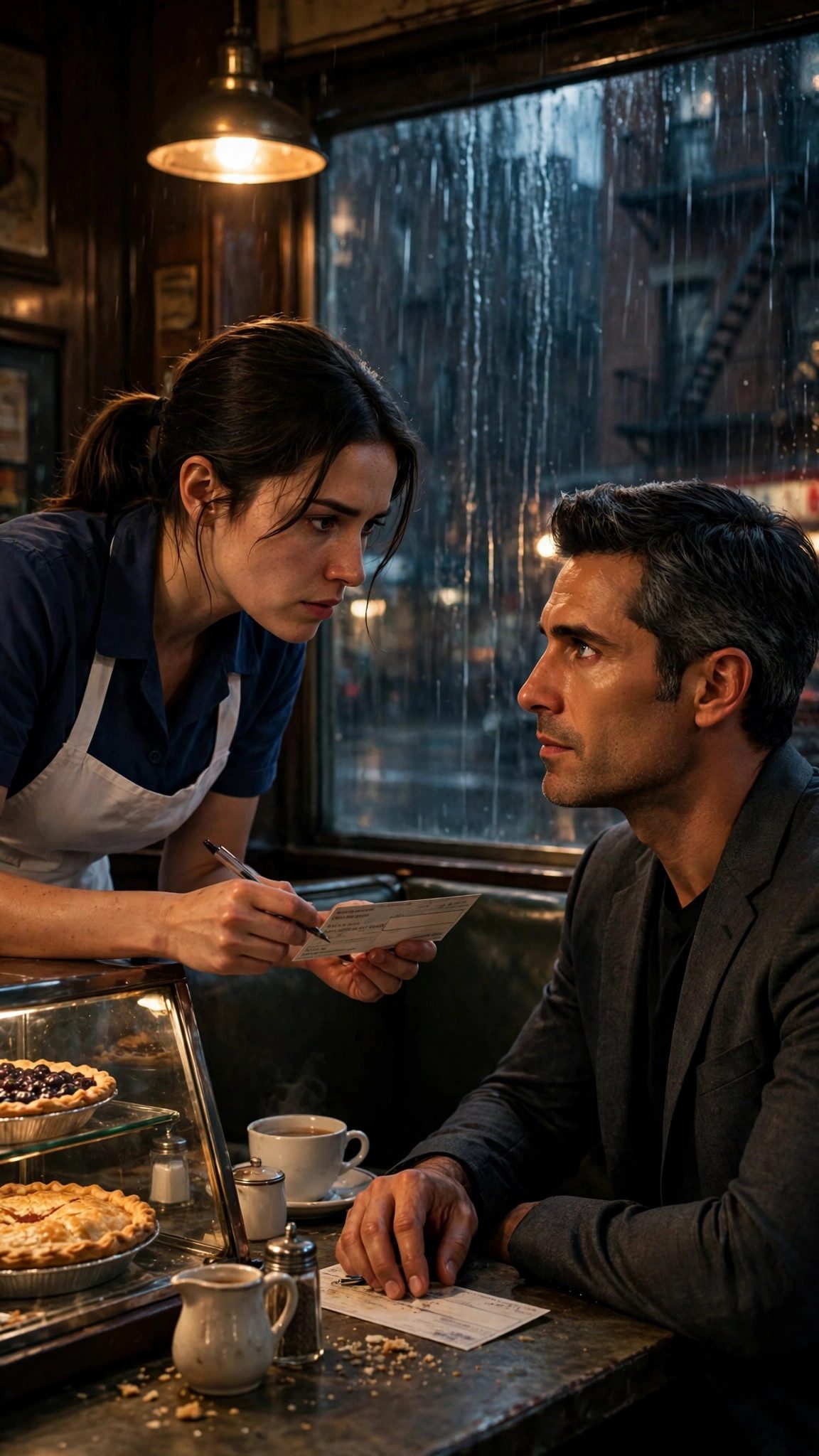
The week after the arrests was the longest week of my life. Agent Reyes called me every day. Sometimes twice. He took my statement in a small office in lower Manhattan with a tape recorder on the desk and a window that looked out at a brick wall, and he asked me to tell the story from the beginning, and then from the middle, and then from the end, and then from the beginning again, until I was sure I had told it so many times that the words had lost their meaning and become just sounds.
But Reyes was patient, and he was kind in a way I had not expected from a federal agent, and when I stumbled over a detail — the time on the clock, the color of the sedan, the exact words Enzo had said into his phone — he never pushed me. He just waited, and wrote it down, and said, "Take your time, Miss Rivers. The truth doesn't get worse for waiting."
On the fourth day, he called me with news. "The phone records came back," he said. "Enzo Falcone's burner phone called a number belonging to Vincent Castellano's organization forty-seven times in the last two years. Forty-seven. And the calls always happened within an hour of Adrian Moretti's movements being discussed. The night of the diner, Enzo called that number from inside your restaurant, six minutes before Cole Brandt and his partner walked through your door."
"So it's proven," I said.
"It's proven," Reyes agreed. "And there's more. We searched Enzo's apartment. We found a second notebook — his own records, in his own handwriting. Payments from Castellano. Two thousand dollars a month, every month, for three years. And a letter, unsent, to his son. In it, Enzo wrote that Castellano was holding his son's gambling debts, and that he had no choice, and that he was sorry. He wasn't sorry enough to stop, but he was sorry enough to write it down."
I thought about Enzo's son, a young man I had never met, who had gambled his way into a debt that had cost my brother his life. I tried to hate him, and I couldn't. Hate takes energy, and I had spent all of mine surviving.
"What happens to Enzo now?" I asked.
"He has a choice," Reyes said. "He testifies against Castellano — full cooperation, everything he knows, every meeting, every payment, every order — and he gets eight years. Or he refuses, and he gets life. He has forty-eight hours to decide."
Enzo decided in twelve. Reyes called me the next morning and said, "He's cooperating. He gave us everything. The warehouse in Philadelphia. The diner. Three other hits we didn't even know about. And he confirmed what your brother's notebook said — Castellano ordered the warehouse hit because he wanted Adrian Moretti dead, and Danny Rivers died in his place."
Hearing it said out loud by a federal agent, in plain words, with no room for doubt, did something to me that three years of grief had not done. It made it real. Not a story I told myself. Not a suspicion. A fact, written in a file, confirmed by the man who had helped arrange it. My brother had not died in a robbery. He had died because a man named Vincent Castellano wanted another man dead, and my brother had walked through a door first.
Reyes asked if I wanted to be there when they arrested Castellano. I said yes before I could think about it, and then I spent the whole night wondering if I had made a mistake.
The arrest happened at dawn, on a Tuesday, at Castellano's house in Staten Island. Reyes picked me up at 5 a.m., and we sat in an unmarked car two blocks away, and I watched through the windshield as twenty agents moved in with the quiet efficiency of men who have done this a hundred times. There was no shouting. No gunfire. No drama. Just a door opening, and a man in a silk robe being led out in handcuffs, blinking in the early light like a man who has just woken from a dream he thought would never end.
Vincent Castellano was sixty-four, with white hair and a face like a banker's, and he looked at the agents the way a man looks at waiters who have brought him the wrong order — annoyed, inconvenienced, certain that the mistake would be corrected soon. He did not look afraid. Men like Castellano never look afraid. That is their whole performance.
"He'll say he doesn't know Enzo," Reyes said quietly, watching the arrest through the windshield. "He'll say he doesn't know Cole Brandt. He'll say he never heard of Danny Rivers. And then we'll show him the phone records, and the notebook, and Enzo's testimony, and his face will change. It always does."
"Will it be enough?" I asked. "Will he go to prison?"
"For the rest of his life," Reyes said. "Racketeering. Murder. Conspiracy. We have him on the warehouse, Miss Rivers. We have him on your brother. And we have him on the diner, because he sent two men to take you, and that is attempted kidnapping on top of everything else. The man who ordered your brother's death is going to die in a cell. I promise you that."
I believed him. I sat in that car and watched the sun come up over Staten Island, and for the first time in three years, I felt something I had forgotten how to feel. Not happiness. Not peace. Just the absence of fear — a quiet space in my chest where the fear used to live, and the strange, unfamiliar feeling of air moving through it.
That afternoon, Adrian took me to Philadelphia.
We drove in silence for two hours, past the turnpike and the warehouses and the gray river, and we didn't talk, because there was nothing to say that hadn't already been said. When we got to the cemetery, Adrian parked the car and walked with me through the rows of headstones to the small one at the edge, the one I had paid for with three months of diner tips and a loan from Joe Barone that I was still paying back.
DANNY RIVERS. BELOVED BROTHER. 1994–2023.
I knelt down and put my hand on the stone, and I told him everything. I told him about the diner, and the bill, and the three numbers. I told him about Adrian, and the notebook, and Enzo, and the arrests. I told him that the man who killed him was in a cell, and that the man who taught him the code had kept his word, and that I was done running.
Adrian stood a few feet behind me, with his hands in his pockets, and when I finished, he stepped forward and put a hand on my shoulder, and he said, "Danny. I owe you my life. I owe your sister more than I can ever repay. I'm going to take care of her now. That's my promise. And I keep my promises."
We stood there for a long time, in the cold Philadelphia wind, with the traffic humming in the distance and the bare trees moving overhead. And then Adrian did something I did not expect. He knelt down beside me, and he put his hand on the headstone too, and he said, very quietly, "I'm sorry I wasn't the one who walked through that door."
I looked at him, and I saw the guilt in his face, the same guilt I had carried for three years — the guilt of the person who survived, the guilt of the phone call ignored, the guilt of the minute that wasn't enough. And I understood, finally, that guilt is not a debt you pay. It is a weight you carry, and the only way to make it lighter is to share it with someone who understands it.
"You didn't kill him, Adrian," I said. "Castellano did. And Castellano is going to prison. And Danny — Danny would have done the same thing again, because that's who he was. He walked through doors first. He always did. Even when we were kids, he was the one who went down the dark hallway with the flashlight while I waited at the top of the stairs. That was Danny. You didn't make him that way. He just was."
Adrian nodded, and for a moment his eyes were wet, and he didn't hide it, and I didn't look away.
On the drive back to Brooklyn, he told me about his plans. He was going to legitimize the family businesses — all of them. The construction companies, the shipping, the restaurants. He was going to cut ties with the old ways, the way his father never could, and he was going to do it with the FBI's help, because Reyes had offered him a deal: full cooperation, full testimony, and in return, the Moretti family would become what it had always pretended to be — a legitimate business, run by legitimate people.
"It's going to take years," Adrian said. "And it's going to cost me men, and money, and probably a few friends I thought I had. But I'm tired, Emily. I'm tired of looking over my shoulder. I'm tired of carrying Danny. I'm tired of being the man the city is afraid of. I want to be the man my mother thinks I am. And I think — I think you might be the person who helps me become him."
I didn't answer right away. I watched the highway lights go by, and I thought about the diner, and the card, and the three numbers, and the strange, impossible road that had led from a bill on a table to a cemetery in Philadelphia to a car on a highway with the most feared man in Brooklyn telling me he wanted to change.
"Okay," I said finally. "But I'm not quitting the diner."
Adrian laughed — a real laugh, the first one I had ever heard from him, low and surprised and genuine. "I wouldn't dream of asking you to," he said. "Somebody has to make sure I eat."
And for the first time in three years, I laughed too.
The trial was the hardest part, and also the strangest, because it made everything real in a way that nothing else had. For three years, Danny's death had been a private grief — something I carried alone, in a small apartment above a laundromat, with a notebook under my bed and a photograph on my wall. In the courtroom, it became a public fact. A case number. An exhibit. A name read aloud by a prosecutor in a dark suit, in front of a jury of twelve strangers, who wrote it down in their notebooks the way Danny used to write things down in his.
I testified on a Tuesday. I wore the nicest dress I owned — a navy blue one I had bought on sale two years ago and never worn — and I sat in the witness box with my hands folded in my lap, and I told the truth. I told them about the diner, and the bill, and the three numbers. I told them about the voice in the hallway, and the sedan, and the card, and the five hundred dollars. I told them about the note under my door, and the night at the diner, and the FBI agents, and the handcuffs. And when the defense lawyer stood up and asked me, in a voice full of doubt, whether I was sure — sure about the voice, sure about the numbers, sure about any of it — I looked at him, and I said, "I'm sure about my brother. And I'm sure about what I saw. And I'm sure that the man sitting over there ordered him killed."
The courtroom was silent. The jury wrote it down. And I stepped down from the witness box, and Adrian was waiting for me in the hallway, and he didn't say anything, he just put his hand on my shoulder, and we walked out of the courthouse together, into the sunlight, and for the first time in months, I felt like I could breathe.
On Sundays, while the trial was going on, I went to Rosa's house for dinner. She cooked enough food for twenty people, even though there were only four of us — Rosa, Adrian, Marco, and me — and she insisted that I eat seconds, and thirds, and she told me stories about the old neighborhood, and about Adrian's father, and about the way things used to be, before the family became what it became. She never talked about the trial. She never asked me how I was holding up. She just fed me, and that was her way of asking, and her way of telling me that I was family now, whether I had asked to be or not.
One Sunday, after dinner, Adrian and I sat in the garden, and he told me about the changes he was making. The construction companies were already clean — they had always been clean, mostly. The shipping routes were harder. The restaurants were easy. The rest — the money that came from places he didn't want to name — was going away, slowly, piece by piece, the way you dismantle a house you no longer want to live in. It would take years, he said. Maybe five. Maybe ten. But he was doing it, and Reyes was helping him, and the FBI had agreed that a man who cooperates is worth more than a man in a cell.
"My father would have hated this," Adrian said, looking at the garden. "He built the family on his word and his strength, and he would have said that going to the FBI was weakness. But my father is dead, Emily. And I'm alive. And I have to decide what kind of man I'm going to be for the rest of my life. I think — I think I want to be the kind of man Danny thought I was."
I didn't say anything. I just sat beside him in the garden, and I listened to the birds, and I thought about Danny, and about how he had believed in Adrian Moretti — a man he had met by changing a tire in the rain — and how that belief had cost him his life, and how it had also, somehow, saved mine.
The day Castellano was sentenced, Reyes called me himself. "Life without parole," he said. "It's over, Miss Rivers. It's really over." I thanked him, and I hung up, and I sat at my kitchen table for a long time, with the notebook closed in front of me, and I cried — not the shaking, body-wracking crying from that first night, but quiet tears, the kind that come when something you have carried for a very long time finally sets down.
That night, I went to the diner, and I worked my shift, and Marcus made me a pie on the house, and Joe Barone came out of his office and hugged me, which he had never done before, and the truck driver raised his coffee cup to me, and the nurse smiled at me, and I understood, finally, that the Blue Anchor Diner was not just a place where I hid. It was a place where I belonged. It had always been a place where I belonged. I had just been too afraid to see it.