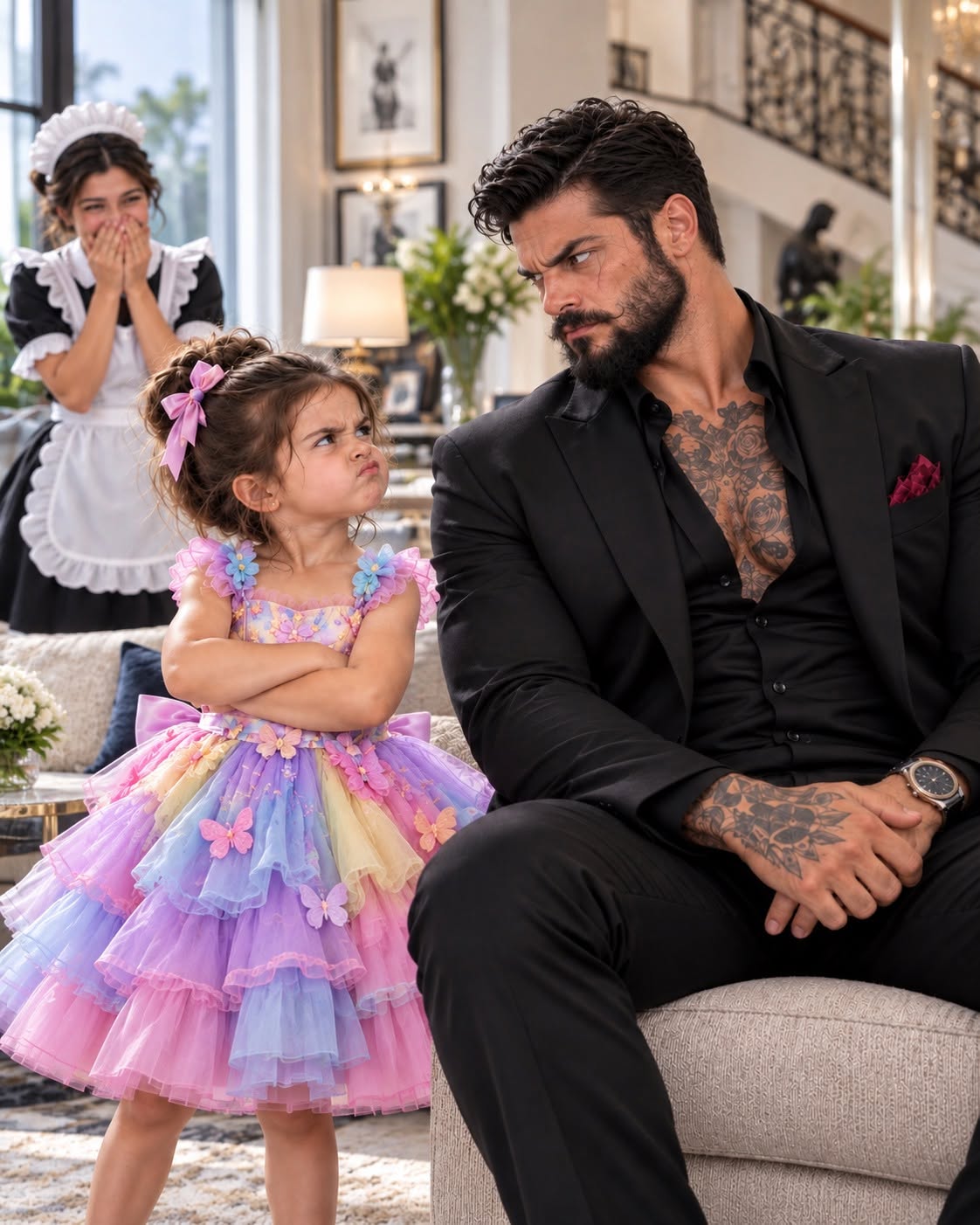
The morning Grace Ellis walked into the police station, she wore the only navy-blue dress she owned.
It had belonged to her sister.
The hem was slightly too long.
The sleeves were a little loose.
And the shoes she paired with it were the same black pumps she had worn to Daniel's funeral.
She had considered buying something new.
Then she remembered the eighty-three dollars she had in her account just days earlier.
Some things mattered more than looking impressive.
Mia stayed with Mrs. Whitcomb at the mansion.
Grace kissed her daughter goodbye before leaving.
"Where are you going, Mommy?"
"To talk to some people."
"Are they nice?"
"I hope so."
Mia studied her.
Then reached up and gently pulled the corners of Grace's mouth into a smile.
"Don't be scared."
Grace hugged her.
"I'll try."
Mia pointed toward the living room.
"Mr. Vincent said you're brave."
Grace looked up.
Vincent was standing near the doorway.
Their eyes met.
He didn't smile.
But his expression told her he meant it.
Denise Carter accompanied Grace to the interview.
Vincent waited outside.
Grace had insisted on speaking for herself.
She knew the rumors about their relationship had become a weapon.
Every public appearance together generated more speculation.
Every photograph gave Victor's lawyers another opportunity to suggest she had been manipulated.
So Grace entered the interview room with Denise and sat across from two detectives.
They asked about Daniel.
About her employment.
About the hidden notebook.
About the circumstances under which she discovered the altered documents.
Grace answered every question.
When they asked whether Vincent had instructed her to make accusations against Victor Bellini, she shook her head.
"No."
"Did he promise you money?"
"No."
"Did he offer you a promotion?"
"No."
"Why did you go to work for his family?"
Grace hesitated.
Then told the truth.
"Because I needed a job. And because I knew his company had been involved in my husband's death."
One detective glanced at the other.
"Did you intend to investigate Mr. Castalano?"
"I hoped I might find out what happened."
"Without telling him?"
"Yes."
"Why?"
Grace looked directly at the detective.
"Because every official explanation I'd received was wrong, and I didn't know who I could trust."
The room became silent.
Then the older detective asked, "And do you trust him now?"
Grace thought about Vincent reading Mia's storybook.
About his apology.
About his willingness to open the company's accounts to investigators.
About the night he ran through a dark garden to find them.
Finally, she said, "I trust that he's trying to do the right thing."
"That's not the same thing."
Grace nodded.
"No. It isn't."
The interview lasted three hours.
No charges were brought against Grace.
The documents she presented were copied, cataloged, and examined by forensic specialists.
The original inspection reports contained details that matched engineering records obtained independently from a supplier.
The dates in Daniel's notebook corresponded to actual bank transfers.
And the letter hidden inside Mia's nursery book was consistent with Daniel's handwriting and predated his death.
Victor's accusations began collapsing under the weight of evidence.
But public opinion was harder to change.
Reporters appeared outside the bakery beneath Grace's apartment.
Strangers posted cruel comments beneath photographs of her.
Some called her a liar.
Others accused her of trying to become Vincent Castalano's wealthy new wife.
A few questioned Daniel's integrity despite having never met him.
Grace stopped looking at the news.
She could endure attacks against herself.
But seeing Daniel's name dragged through headlines hurt in a way she couldn't explain.
And the photograph of Mia circulating online frightened her more than anything.
Vincent arranged for a lawyer to pursue the removal of the child's images wherever possible.
Grace insisted that no photograph of Mia be used to defend her publicly.
"She's three," she told Denise. "She doesn't belong in any of this."
Denise agreed.
The child would remain outside the publicity and legal arguments as much as possible.
The investigation continued for months.
Autumn arrived in New York.
The trees around the mansion turned orange and gold.
Mia celebrated her fourth birthday in the garden with a small chocolate cake, pink balloons, and exactly seven guests.
Vincent had offered to hire entertainers.
Mia rejected the idea.
She wanted cookies, bubbles, and a butterfly-shaped cake.
Most importantly, she wanted everyone to make happy faces.
Renzo wore a paper crown.
Mrs. Whitcomb supervised the candles.
And Vincent, after considerable negotiation, agreed to wear a pair of ridiculous purple party glasses.
Mia laughed so hard she nearly fell off her chair.
Grace took a photograph.
It became one of her favorites.
Not because Vincent looked important.
But because he didn't.
For the first time, he looked like a man enjoying an ordinary birthday party.
Someone who belonged in the moment rather than commanding it.
Behind those small moments of happiness, the investigation deepened.
Auditors discovered additional diverted funds.
Former employees came forward with records of ignored safety complaints.
A retired accountant testified that Victor's office had demanded changes to project ledgers.
Samuel Ortiz, the worker Daniel saved, agreed to describe the final minutes before the fatal accident.
And Peter Walsh, confronted with financial records and surveillance evidence, eventually cooperated with prosecutors.
His statements identified Victor as the person who ordered the threatening messages sent to Grace.
Walsh also described his role in concealing construction records and arranging the attempted break-in at the guest cottage.
The evidence grew stronger.
But it revealed something else that Vincent could no longer ignore.
Victor's wrongdoing had flourished inside an organization built to discourage questions.
Employees feared losing their jobs.
Managers worried about contradicting executives.
Accountants approved suspicious transfers because the orders carried powerful names.
And people who might have spoken up believed silence was safer.
Vincent had not personally ordered Daniel's death.
He had not approved the forged safety documents.
But the culture of fear he helped maintain had allowed others to commit terrible wrongs.
One evening, he admitted that to Renzo.
"I thought they respected me."
Renzo stood beside him in the study.
"Some did."
"And the others?"
"They were afraid."
Vincent looked at the photographs arranged on his desk.
A picture of his father.
A photograph of the original family restaurant.
And Mia's childish drawing.
For years, he had believed his father's methods were essential to maintaining control.
Now he saw their hidden cost.
"Fear makes people keep secrets," Vincent said.
Renzo nodded.
"And secrets can destroy people."
Vincent looked toward the door.
"Then we're going to build something different."
In January, the criminal case against Victor Bellini moved forward.
A grand jury returned indictments involving financial fraud, falsified records, obstruction, witness intimidation, and offenses connected to the fatal construction incident.
The precise responsibility for Daniel's death remained a question the criminal proceedings would have to resolve.
Victor denied wrongdoing.
His attorneys promised to expose what they described as a conspiracy against him.
But as the trial approached, the evidence was no longer something he could dismiss with a polished smile.
For Grace, the months leading up to the courtroom were exhausting.
She attended meetings with prosecutors.
Reviewed statements.
Prepared to testify.
And tried to keep life normal for Mia.
Vincent became a quiet presence during those weeks.
He never demanded gratitude.
He never told Grace how she should feel.
Sometimes he brought her coffee when she had been awake too long.
Sometimes he sat beside her without speaking.
And sometimes Mia insisted that all three of them watch cartoons in the family room.
Those were Vincent's favorite evenings.
He had never admitted it aloud.
But Grace suspected.
One rainy evening, Grace found him standing beside the fireplace.
He was holding Daniel's photograph.
She stopped.
"Where did you get that?"
"Mrs. Whitcomb brought over the framed copy you left in the cottage."
Grace looked at him.
"Why are you holding it?"
Vincent studied the photograph.
"Trying to understand something."
"What?"
"How a man who never met me managed to change my life."
Grace moved closer.
Vincent continued.
"Your husband tried to warn me. He trusted that if I understood what was happening, I'd stop it."
"He didn't know you."
"No."
"But he believed somebody with power ought to be responsible for how that power was used."
Vincent nodded slowly.
"I let him down."
Grace took the photograph.
She traced Daniel's face with her thumb.
"You did."
Vincent accepted the words.
"But you're not letting him down now," she added.
He looked at her.
Grace smiled sadly.
"I don't know what happens after this. I don't know whether I'll ever completely trust the world that took him away."
"You don't have to."
"But I can see what you're doing."
Vincent stood very still.
"And it matters."
He looked down.
For a moment, he seemed unable to speak.
Finally, he said, "Grace, there's something I need to tell you."
She waited.
"I've spent years thinking I had to become my father to protect what he built."
He glanced toward the windows.
"But when Mia laughs, I remember a time before all of that. Before I started believing that being feared was the same as being strong."
Grace felt her heart tighten.
Vincent continued.
"I'm not asking you to forgive what my name has done to your family."
"I know."
"And I'm not asking you to feel anything for me because I've helped you."
Grace looked into his eyes.
"Then what are you asking?"
He hesitated.
"Nothing."
She blinked.
Vincent gave a faint, sad smile.
"For once in my life, I want to do something right without expecting anything in return."
Grace reached for his hand.
Only briefly.
Only for a moment.
But the gesture meant more than either could say.
The trial began in the spring.
Grace entered the Manhattan courthouse carrying a small photograph of Daniel in her purse.
Vincent arrived separately with Renzo and his attorneys.
Reporters crowded the steps.
Cameras flashed.
Questions flew through the air.
"Mrs. Ellis, are you accusing Mr. Bellini of murder?"
"Mr. Castalano, did you know about the missing money?"
"Are you and the housekeeper romantically involved?"
Neither stopped to answer.
Inside, the courtroom was cool and quiet.
Victor Bellini sat beside his defense attorneys.
He looked older.
His expensive suit couldn't conceal the strain in his face.
When Grace entered, he watched her with an expression she could not read.
She looked away.
She had spent too much of her life being afraid of him.
Today, she would tell the truth.
Grace testified about Daniel's final phone call.
The hidden letters.
The fraudulent settlement papers.
The threatening messages.
And the documents she discovered inside Mia's nursery book.
Victor's defense attorney attempted to portray her as a woman who had manipulated Vincent Castalano for money.
"Mrs. Ellis," he asked, "isn't it true that you deliberately sought employment in Mr. Castalano's home?"
"Yes."
"And isn't it true that you hoped to obtain information damaging to his company?"
"Yes."
The attorney looked pleased.
"So you admit entering his household under false pretenses."
Grace took a breath.
"I applied for an advertised housekeeping job. I cleaned his house. I followed the household rules. And I hoped somebody might know why my husband died."
The attorney adjusted his glasses.
"You were angry at the company."
"Yes."
"Angry enough to lie?"
Grace looked directly at him.
"No."
"How can this court be certain?"
Grace paused.
Then answered softly.
"Because my husband wrote those warnings before I ever knew Vincent Castalano. The equipment records existed before my husband died. And the money disappeared long before I stepped inside that mansion."
The courtroom fell silent.
She continued.
"You can call me angry. You can call me desperate. You can question every decision I made after becoming a widow."
Her voice strengthened.
"But none of that changes what happened to Daniel."
The defense attorney had no immediate response.
Grace looked toward the jury.
"My husband was a good man who tried to keep other people alive. I want the truth about him to matter more than the money somebody made by ignoring him."
For the first time that morning, she felt the fear inside her begin to loosen.
Samuel Ortiz testified next.
He described Daniel shouting a warning.
The equipment moving despite the safety concerns.
And the moment Daniel pushed him away from the collapsing structure.
"I would not be here without him," Samuel said.
His voice shook.
"He saved my life."
Caleb Dunn then admitted accepting money in exchange for a false statement.
He described the pressure exerted by Victor's associates.
He acknowledged his own shame.
And he explained why he had finally decided to tell the truth.
"I watched a good man die," Caleb said. "Then I helped the people who covered it up. I can't change what I did, but I can stop lying."
Additional testimony and financial records established how the safety budget had been diverted.
The prosecution presented authenticated communications, contractor records, and evidence of the deliberate decision to continue dangerous operations.
Finally, Vincent Castalano took the witness stand.
The courtroom became intensely quiet.
The prosecutor asked about the electronic approval bearing Vincent's credentials.
"Did you authorize this payment?"
"No."
"How can you be certain?"
"I was traveling when it was issued. My flight records and secure-system logs establish that I did not access the company network."
"Who had access to your credentials?"
"A limited group of senior personnel."
"Did that include Victor Bellini?"
"Yes."
"Did you know Mr. Ellis had submitted safety warnings?"
"No."
"Do you believe you should have known?"
Vincent paused.
"Yes."
The prosecutor watched him.
"Why?"
"Because I owned the company. Because warning systems are meaningless if employees are too frightened to use them. And because I allowed people I trusted to operate without enough oversight."
The courtroom was silent.
Vincent continued.
"I didn't know Daniel Ellis personally. But I knew the company employing him. I knew the culture. I knew people were afraid to challenge senior management."
He looked toward Grace.
"And I did not ask enough questions."
The prosecutor nodded.
"Are you accepting responsibility for the defendant's actions?"
"I'm accepting responsibility for my own failures."
Victor's attorney attempted to exploit Vincent's criminal reputation during cross-examination.
He asked about his father's organization.
His business dealings.
His use of intimidation.
Vincent did not pretend that his past was spotless.
He admitted that some operations had been conducted through methods he was no longer willing to defend.
And when the attorney suggested that Vincent was blaming Victor to protect himself, Vincent answered calmly.
"I'm here under oath. My past doesn't change the financial records, the forged documents, or the warnings Daniel Ellis made."
Grace watched him.
For years, Vincent had built his life around appearing untouchable.
Now he was allowing the world to see his failures.
He looked less powerful than she had ever seen him.
And more courageous.
After weeks of testimony, the jury returned its verdict.
Victor Bellini was found guilty on multiple charges involving fraud, falsified records, obstruction, and witness intimidation.
He was also convicted of criminal conduct arising from the willful disregard of safety requirements that contributed to Daniel's fatal accident.
The precise sentence would be determined at a later hearing.
Grace sat motionless as the verdicts were read.
She had imagined this moment countless times.
She expected triumph.
Relief.
Perhaps even joy.
Instead, she felt a great hollow sadness.
Daniel was still gone.
Mia would still grow up without knowing his voice.
Nothing that happened in the courtroom could restore the life they had lost.
Then Samuel Ortiz approached her outside.
He was a tall man with kind eyes and a nervous smile.
"Mrs. Ellis?"
Grace turned.
"I wanted to thank you."
She shook her head.
"You don't have to."
"Yes," he said. "I do."
His eyes filled with tears.
"Your husband gave me another chance to go home to my family. I've got a little boy now. His name is Daniel."
Grace covered her mouth.
Samuel smiled through his tears.
"I wanted you to know."
Grace stepped forward and embraced him.
For the first time, she understood that Daniel's story had not ended only in tragedy.
Some part of him lived on in the people he had saved.
Outside the courthouse, Vincent waited near the steps.
Grace approached him.
For a while, they stood in silence.
Then she said, "We did it."
Vincent nodded.
"Daniel did most of it."
Grace smiled through tears.
"He would've liked that answer."
Vincent looked at her.
"What happens now?"
Grace glanced toward the city.
She had been thinking about that question for weeks.
"I want to go home."
"To Brooklyn?"
"Yes."
Vincent's expression changed.
She continued before he could speak.
"I need Mia to have an ordinary life again. School. Friends. A neighborhood where nobody watches us through security cameras."
Vincent lowered his gaze.
"I understand."
"I also want to find work that doesn't depend on your family."
He nodded.
"Of course."
Grace took a breath.
"And there's something else."
He looked at her.
"I don't want to spend the rest of my life being the widow who works for Vincent Castalano."
A flicker of pain crossed his face.
Then he said quietly, "You shouldn't have to."
Grace smiled sadly.
"You've done more for us than I ever expected. But I need to know I can stand on my own."
Vincent looked toward the courthouse.
Then back at her.
"Grace, you've been standing on your own since the day Daniel died. All I did was finally stop standing in the way."
Her eyes filled with tears.
She reached for his hand.
This time, she held it.
Neither spoke.
The traffic moved around them.
Reporters called from the far side of the courthouse plaza.
Somewhere in the city, people were beginning to hear the true story of Daniel Ellis.
And Vincent Castalano realized that loving someone might mean allowing them to choose a life that didn't include him.
He squeezed Grace's hand gently.
"Whatever you decide," he said, "Mia deserves to be happy."
Grace looked into his eyes.
"So do you, Vincent."
He smiled faintly.
Then stepped back.
But as Grace turned toward the waiting car, his attorney approached.
"Vincent, we need to talk."
Vincent looked at him.
"About what?"
"The separate investigation into your family's older business operations."
His attorney hesitated.
"The authorities are asking questions. Serious ones."
Vincent looked toward Grace, who was climbing into the car that would take her back to Mia.
He thought about everything she had told him.
That changing required more than regret.
That doing the right thing sometimes cost more than anyone wanted to pay.
Then he looked at his attorney.
"I'm ready to answer them."
For the first time, the most feared man in New York was prepared to face a future where his money and reputation might not protect him.
Because he had finally found something more important than being untouchable.
He wanted to become someone a little girl could be proud to know.