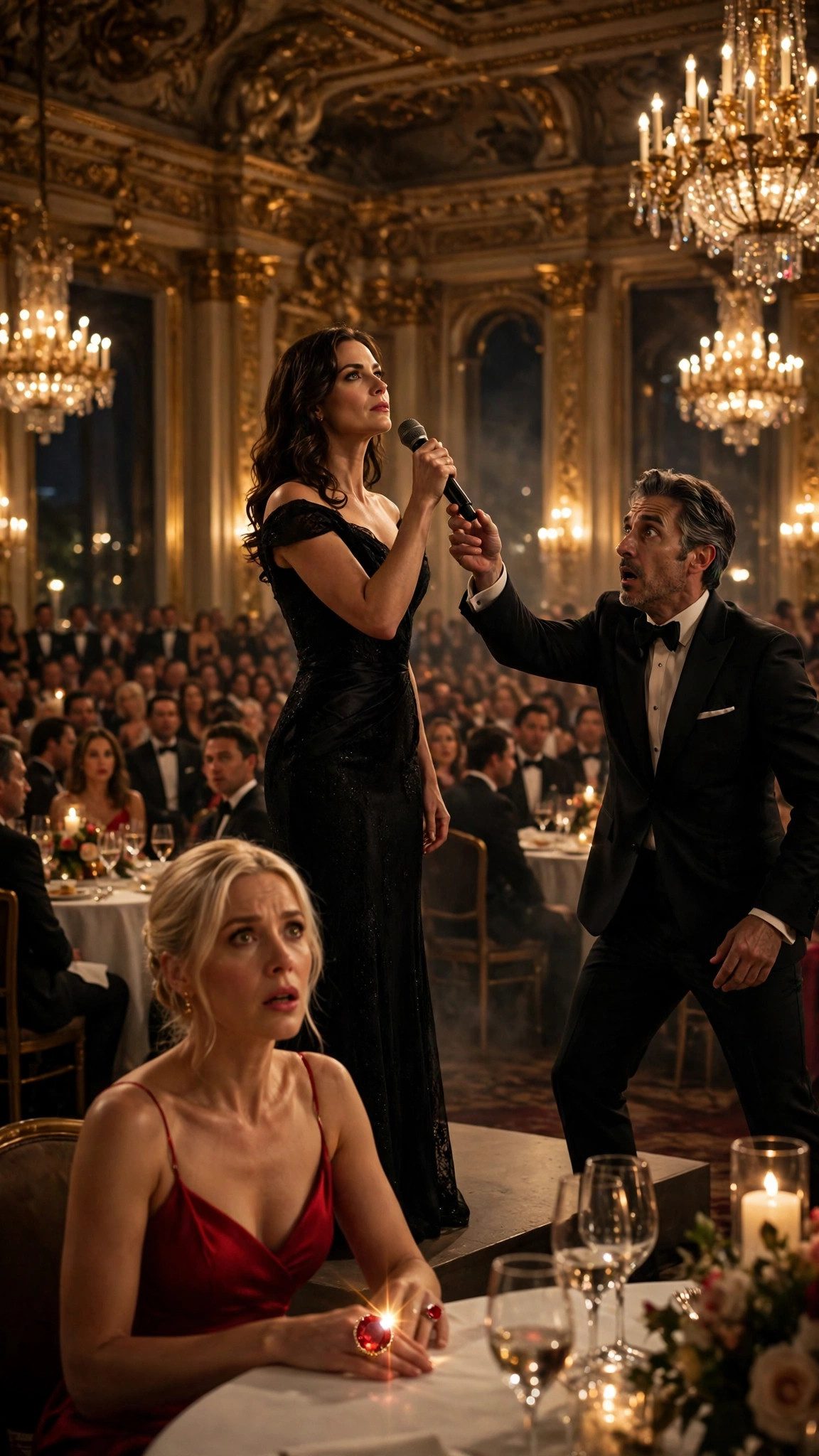
The ballroom was full of light and noise and money.
Chandeliers hung from the ceiling like frozen fireworks. White tablecloths covered a hundred tables. Waiters moved between them with trays of champagne. Three hundred people — executives, associates, politicians, their wives in dresses that cost more than cars — talked and laughed and raised their glasses to Alexander Moretti, the man who owned the room, the man who owned the city, the man who owned me.
I sat at the head table, beside an empty chair, because Alexander was on the stage, giving his speech. He stood in his black tuxedo, handsome and untouchable, and he talked about the company's year, about growth, about loyalty, about family. He used the word "family" the way he always did — as if it were a weapon, as if it were a wall.
Vivian Cross sat in the front row, in a red dress, her blonde hair perfect, her hand resting on the table beside her wine glass. The ruby ring caught the light every time she moved. I watched it flash, red as blood, red as a warning, and I thought about my father's letter, folded in my purse, and the twenty-five dollars in the envelope beside it.
Alexander finished his speech about loyalty, and the room applauded, and then he did something I had not expected. He stayed on the stage. He looked out across the room, and his eyes found me, and he smiled — the small, controlled smile of a man who is about to make an example of someone.
"Before we continue," he said, into the microphone, "I want to address a small matter. My wife seems to have forgotten who pays for her father's care. The hospital bills are considerable, and I have been generous. But generosity has its limits. Perhaps a reminder is in order."
The room went quiet. Three hundred people turned to look at me. Cameras turned toward me — the press, the photographers, the phones held up in the air.
"The money stops tonight," Alexander said, "unless my wife remembers her place."
He was threatening to cut off my father's hospital money. In front of hundreds of people. At a gala. With cameras rolling.
He did not know there was no father left to save.
My father had been dead for four days. He had been buried for three. And Alexander Moretti, who had not visited him once in twelve years, who had not come to his funeral, who had sent white lilies and a card in his assistant's handwriting, was standing on a stage threatening to cut off money for a man who was already in the ground.
I stood up slowly. My chair scraped against the marble floor, and the sound carried through the whole hall. The entire room fell silent as the cameras turned toward me. I walked to the stage — I do not remember deciding to walk, I only remember the carpet under my heels and the chandeliers blurring above me — and I took the microphone from his hand.
Alexander stared at me. For the first time in twelve years, he looked surprised. He looked, for one moment, like a man who has just realized that the receipt on his wall has learned to speak.
I turned to the room. I turned to Vivian Cross, sitting in the front row in her red dress, her hand resting on the table, the ruby ring flashing in the light. I turned to Frank DeLuca, sitting at the next table, old and watchful, the consigliere, the keeper of oaths. I turned to the cameras.
And I lifted the microphone to my lips, and I said four words that made every executive, every guest, every associate, and Alexander himself go pale.
"Look at her hand!"
The silence that followed was total. Three hundred people, and not one of them made a sound. Every eye in the room turned to Vivian Cross. Every camera turned to Vivian Cross. And Vivian Cross, who had smiled at cameras a thousand times, went white — because she knew, in that moment, what every person in that room knew.
The ruby ring. The Moretti matriarch's ring. The ring that belonged to the wife of the head of the family. The ring that had been passed from mother to wife for four generations. The ring that Alexander's mother had worn, and that his wife — me — had never been given.
It was on the hand of his assistant.
Frank DeLuca stood up slowly from his table. He was seventy-two years old, and he moved like a man who had seen everything and forgotten nothing. He looked at Vivian's hand. He looked at Alexander. He looked at me. And he said, in a voice that carried to every corner of the room, "That ring belongs to the wife of the head of this family. Whose hand is it on?"
No one answered. No one needed to.
I turned back to Alexander, and I held the microphone steady, and I said, very clearly, so that every person in the room could hear me, "My father is dead, Alexander. He died four days ago. He was buried three days ago. You did not come to his funeral. You sent lilies. And tonight, you stood on this stage and threatened to cut off money for a man who is already in the ground."
A murmur ran through the room like a wave. I saw wives put their hands to their mouths. I saw executives look at each other. I saw Frank DeLuca's face go hard as stone.
"My father saved your life," I said. "He took a bullet that was meant for you, eighteen years ago, and it damaged his heart, and he lived eighteen years with that damage, and it killed him. And while he was dying in intensive care, you sent me twenty-five dollars, and you wrote, 'For nourishment.'"
I reached into my purse, and I took out the envelope, and I took out the twenty-five-dollar bill, and I held it up so the cameras could see it.
"Twenty-five dollars," I said. "That is what twelve years of marriage is worth to Alexander Moretti. Twenty-five dollars, and a ring that belongs to his wife, given to his assistant."
The room erupted. Not all at once — first a gasp, then a murmur, then a roar of voices, of chairs scraping, of cameras flashing. Vivian stood up, her face white, her hand — the hand with the ring — pressed to her chest as if she could hide it. Alexander reached for the microphone, but I stepped back, out of his reach, and I looked at him, and I said the last thing I would ever say to him as his wife.
"You swore an oath, Alexander. On your mother's grave, and before God, and before Frank DeLuca. You swore my father's daughter would live a life of honor and protection. You broke that oath. And tonight, in front of everyone who matters to you, I am calling it due."
I put the microphone down on the stage. I put the twenty-five dollars on top of it. And I walked out of the ballroom, through three hundred staring people, through the doors, into the night, with my head high and my father's letter in my purse and my mother's tears finally, finally avenged.
Behind me, I heard Frank DeLuca say, "The family will want to discuss this, Alexander."
I did not look back. But later — much later, when Rosa told me what had happened after I left — I learned that the ballroom had stayed silent for a full minute after the doors closed behind me. A whole minute, three hundred people, not one of them speaking. And then the room had erupted, all at once, in a roar of voices, and Vivian Cross had stood up, her face white, her hand pressed to her chest, and she had tried to leave, and Frank DeLuca had stood in her path, and he had said, very quietly, "Sit down, Miss Cross. The family will want to hear from you, too."
And Alexander — Alexander had stood on the stage, staring at the microphone, staring at the twenty-five dollars lying on top of it, and he had not moved. Rosa told me he stood there for a long time, while the room shouted around him, while the cameras flashed, while his whole world came apart in front of him. He stood there, and he looked at the twenty-five dollars, and for the first time in his life, Alexander Moretti understood what something was worth — not what it cost, but what it was worth.
He understood, in that moment, that he had sent his wife twenty-five dollars, and that twenty-five dollars had just cost him everything.
And I heard nothing else, because the doors closed behind me, and the night was cold and clean, and for the first time in twelve years, I was free.
But I have never forgotten the hours before that moment — the hours inside the ballroom, when I sat at the head table and smiled, and waited, and watched the room the way a woman watches a storm gather on the horizon.
I had arrived early, before most of the guests, because Alexander liked his wife to be seated when the room filled, like a piece of furniture that belonged to the house. I sat at the head table, beside the empty chair where my husband would sit, and I watched the ballroom fill — the executives in their black tuxedos, the wives in their gowns, the politicians shaking hands, the photographers setting up their lights. The chandeliers blazed. The waiters moved between the tables with trays of champagne. A string quartet played in the corner, soft and elegant, as if nothing in the world could ever go wrong in a room like this.
A woman I barely knew — the wife of one of Alexander's executives, a woman named Caroline, with pearls at her throat and a practiced smile — leaned across the table and said, "Emma, darling, you look wonderful. Black is so brave for a gala. Is everything all right? You look a little pale."
"I am fine," I said. "Thank you for asking."
"And your father?" she asked. "How is he? Alexander mentioned he has been unwell."
I looked at her — at her kind, curious face, at her pearls, at her practiced smile — and I said, very quietly, "My father is dead, Caroline. He died four days ago."
Her face went white. Her hand flew to her mouth. "Oh, Emma. Oh, my God. I had no idea. I am so sorry. Why — why are you here?"
"Because my husband expects me to be here," I said. "Because my husband has not yet noticed that my father is dead."
She stared at me, and I could see her trying to decide whether I was joking, or mad, or telling the truth. And then she looked across the room, at Alexander, laughing with a group of men near the bar, and at Vivian Cross, in her red dress, at his elbow, and I saw understanding dawn on her face — slow, and terrible.
"Emma," she whispered, "what are you going to do?"
"I am going to tell the truth," I said.
She nodded, very slowly, and she did not say anything else. But when Alexander came to the table, a few minutes later, and sat down beside me, and leaned close to ask me why I was not smiling, I saw Caroline watching us, and I saw her put down her champagne glass, and I knew that whatever happened next, at least one person in that room would believe me.
The dinner was served — course after course, salmon and beef and chocolate, wine poured and poured again — and Alexander gave his speech, and the room applauded, and then he stayed on the stage, and he looked at me, and he said the words that would end our marriage.
I have told you what he said. I have told you what I said. But what I have not told you is what happened in the minutes after I put the microphone down and walked out — because those minutes matter, too, and I remember them the way I remember everything from that night, in perfect, terrible detail.
I walked through the ballroom, through three hundred staring people, and no one stopped me. No one spoke to me. The string quartet had stopped playing. The waiters had stopped moving. The only sound was the click of my heels on the marble floor, and my own breathing, loud in my own ears.
At the doors, a young waiter — a boy, really, no more than twenty, with dark hair and frightened eyes — held the door open for me. As I passed him, he whispered, "Good luck, ma'am."
I stopped. I looked at him. "Thank you," I said. And I meant it, because in that moment, his kindness — a stranger's kindness, freely given — meant more to me than twelve years of Alexander Moretti's money.
Outside, in the lobby, the night air was cold through the glass doors. My phone was buzzing in my purse — message after message, calls I did not answer, from numbers I did not recognize, from reporters, from associates, from people who had been in that room and wanted to know more. I turned the phone off. I walked out of the hotel, into the night, and I stood on the steps for a moment, looking up at the sky, at the stars above the city, and I breathed — really breathed, for the first time in twelve years, as if my lungs had been closed and someone had finally opened them.
A taxi pulled up. The driver — an older man, with a kind face — leaned out and said, "Where to, miss?"
"Home," I said. And then I corrected myself, because the palace on the lake was not my home, and it had never been my home. "Take me to the lake," I said. "To a small apartment near the water. I will give you the address."
He drove, and I sat in the back seat, and I watched the city go by through the window, and I thought about my father, and my mother, and the bullet, and the debt, and the ring, and the twenty-five dollars, and the four words that had changed everything.
"Look at her hand!"
I had said it. I had done it. And whatever came next — whatever Alexander did, whatever the family did, whatever the world did — I had finally, finally spoken.
And no one could ever make me silent again.