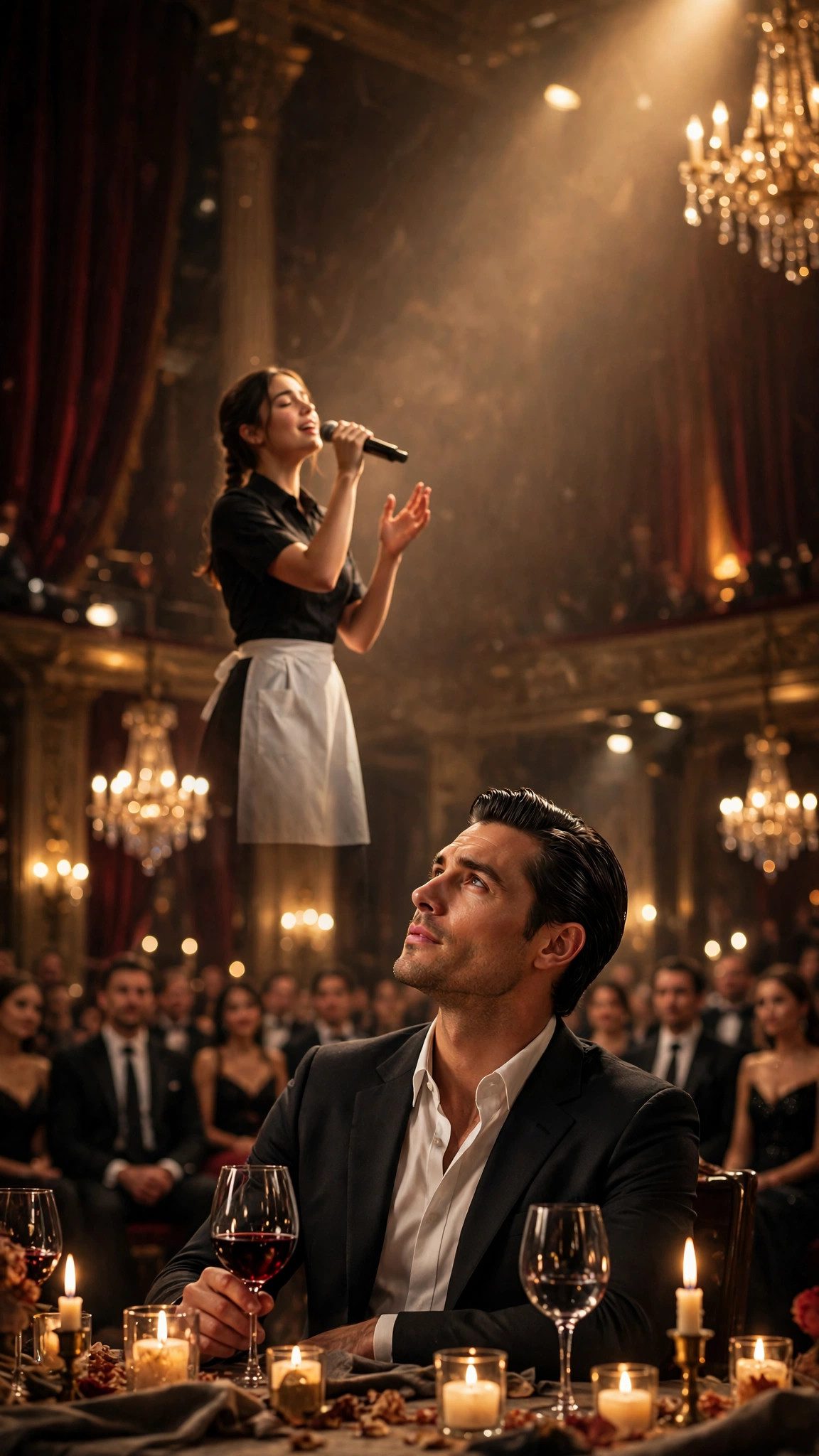
The first thing I learned about running is that you never really stop. You just get better at pretending you have.
I pretended for five years. I pretended in Rome, where I worked three weeks in a cafe near the train station before the money ran out. I pretended on the plane to New York, holding a six-month-old baby who cried the whole way across the Atlantic while the woman next to me pretended not to notice. I pretended in Queens, in a two-room apartment above a laundromat where the radiators clanged all night and the cockroaches came out after dark like they owned the place. And I pretended at Lumière, where I smiled and carried trays and became invisible, because invisible women do not get found.
But I was found anyway. Or rather, I was not found. I was recognized. There is a difference, and it took me five years to understand it.
Before New York, there was Naples. Before Naples, there was a little girl with a violin for a father and an opera singer for a mother, growing up in an apartment full of music.
My father, Antonio Marchetti, played second violin with the Naples orchestra, and he was the kindest man I ever knew. He had big hands and a soft voice, and he used to lift me onto his knee after dinner and play the opening of The Magic Flute for me on his violin, just the first few notes, and tell me that Mozart had written the Queen of the Night for a woman with a voice like a knife and a heart like a fire, and that one day I would understand her. He died of a heart attack in the middle of a rehearsal when I was twelve years old. He was forty-seven. The orchestra played at his funeral, and my mother stood beside his coffin in a black dress and did not cry, not once, and I thought that was what strength looked like.
My mother, Sofia Marchetti, was a soprano. Not a famous one. She sang in the chorus of the Naples opera and sometimes, on the good nights, she sang small solo roles, and once, when I was eight, she sang the Queen of the Night for a private audience at a wedding, for a woman named Isabella Moretti, and she came home that night with her face shining and said, "Elena, tonight I sang for a queen, and the queen wept." I did not understand then. I was eight. I thought she meant a real queen.
My mother taught me to sing the way other mothers teach their daughters to cook or sew. She taught me to breathe from the belly, to open the throat, to let the sound come from the floor of the body and not from the mouth. She taught me the Queen of the Night when I was fourteen, note by note, phrase by phrase, and she made me sing it until the high F's came clean, until the runs were like water over stones. "This aria is not a song," she used to say. "It is a woman who has been pushed too far. You do not perform her. You become her."
My mother died when I was seventeen. It was her lungs, the doctors said, years of singing in cold theaters and damp dressing rooms. She died in the spring, in our little apartment full of sheet music, and I held her hand while she went, and the last thing she said to me was, "Sing, Elena. Whatever happens, sing."
I was seventeen and alone in the world, with a dead father and a dead mother and a voice nobody wanted to pay for. I worked in a bakery. I worked in a flower shop. I sang in the church choir on Sundays because it was free and because it was the only place I could still hear music. And then, when I was eighteen, I met Matteo Bellini on the steps of the opera house, and he smiled at me like the sun coming out, and I thought God had finally remembered me.
Matteo was twenty-one, tall and dark and laughing, with his grandfather's money and his mother's charm and not a single worry in the world. He courted me the way men in old songs court women: with flowers every day, with poetry copied out by hand, with long walks along the bay at sunset and promises whispered against my hair. He told me his family was in shipping. He told me his grandfather, Don Salvatore Bellini, was a respected businessman, a pillar of Naples. He told me he would take care of me forever, and that I would never be alone again.
I believed him. I was eighteen years old, and I had been alone for a year, and a kind word felt like shelter.
We married when I was nineteen, in a small church with white flowers and a hundred guests I did not know, and Matteo's grandfather sat in the front pew like a king holding court, an old man with white hair and cold eyes who looked at me the way a man looks at a horse he is thinking of buying. I told myself I was imagining it. I told myself that old men in important families always looked like that.
For six months, I was happy. Or I thought I was happy. Matteo was tender and funny and attentive, and he bought me a little piano for our apartment, and on Sunday mornings he would sit and listen while I sang, and he would say, "Elena, your voice is the most beautiful thing in Naples," and I believed him.
Then, on a Tuesday night in November, three men with guns took me from the street outside our apartment.
I remember everything about that night. I remember the cold of the pavement through my shoes. I remember the smell of the car, leather and cigarettes. I remember the black hood going over my head and the way my own breathing sounded inside it, fast and shallow, like a trapped animal. I remember the warehouse by the docks, the concrete floor, the single bare bulb hanging from the ceiling, and the three men standing around me, polite and almost gentle, like doctors about to deliver bad news.
"We are not going to hurt you, signora," the oldest one said. He had gray hair and a scar through his eyebrow. "We are here to teach you something. You are a weakness. Do you understand? A man like Matteo Bellini cannot have a weakness. His enemies will find you. They will use you to get to him. A wife who can be taken off the street is a liability, and the family has decided that you need to understand your place."
They kept me for four hours. They gave me water. They let me sit in a chair. They talked to me about the family the way teachers talk to a slow student, patiently, as if I should be grateful for the lesson. And then they drove me home and let me out on the corner, and Matteo was waiting at the door, white-faced and shaking, and he held me and cried and swore he had not known, swore he would protect me, swore it would never happen again.
But I saw the truth in his eyes. He had known. Maybe not the details, maybe not the night or the place, but he had known what his family was. He had known what they did to women who became inconvenient. And he had married me anyway, and brought me into a house where I was nothing but a soft spot in his armor, a door his enemies could walk through.
He gave me a name. An heir. But he could not give me love, or even a single minute to call him his own, because every minute belonged to the family, to his grandfather, to the business, to the men with guns who decided who lived and who died in Naples.
I stayed for another year. I stayed because I was pregnant, and then because I had a baby, a beautiful dark-haired boy I named Gabriel, after the angel, because I wanted him to have a guardian even if his father could not be one. I stayed because I had nowhere else to go, and no money, and no family, and because part of me still loved the laughing boy on the steps of the opera house, even though I knew he was gone.
And then, one night, when Gabriel was six months old, I heard Matteo on the telephone in the next room, talking to his grandfather in a low voice. "She is still a problem," he said. "The boy too. The family thinks we should send them away. Somewhere they cannot be used."
Send them away. Not protect them. Send them away, like luggage, like a problem to be stored somewhere safe and forgotten.
That night, I packed a bag. Baby clothes. Three hundred euros I had saved from the household money, a little at a time, hidden in a shoebox. My mother's old score of The Magic Flute, pressed flat in the bottom of the suitcase. I waited until Matteo fell asleep, and then I picked up my son and I walked out of the apartment, and I did not look back.
I took a train to Rome. I worked three weeks in a cafe near the train station, washing dishes and sleeping in a room above the kitchen with Gabriel in a drawer lined with blankets, because there was no crib. Then a woman in the cafe, an old American tourist with kind eyes, told me about a cheap flight to New York, and about a cousin who ran a boarding house in Queens, and I spent my last money on two tickets, one for me and one for a baby who did not yet know how to be afraid.
New York swallowed us whole. It was cold and loud and enormous, and nobody knew my name, and that was the most beautiful thing in the world. I found work cleaning offices at night, and then waitressing at a diner in Queens, and then, after three years, at Lumière, the most elegant restaurant in Manhattan, where the pay was good and the customers never looked at the waitresses long enough to remember their faces.
Gabriel grew up in that little apartment above the laundromat, and he grew up brave and stubborn and smart, the way children do when they have only one parent and that parent would die for them. He learned to walk holding onto the radiators. He learned to talk in two languages, Italian from me and English from the television. He learned to read from the backs of cereal boxes. And when he was old enough to ask questions, he asked the one I had been dreading for five years.
"Mamma," he said one night, when he was four, sitting in the bathtub with his toy boat, "where is my papa?"
I sat on the edge of the tub with a towel in my hands, and I looked at my beautiful boy with his father's dark hair and my mother's green eyes, and I told him the truth as I had chosen to tell it.
"You simply have no father, Gabriel," I said. "No long explanations. No false stories. Some men are fathers, and some men are only names. Your papa is only a name."
He thought about that for a long moment, the way he does, with his little forehead wrinkled. "Okay," he said finally. "Then you are my mamma and my papa too."
"Yes," I said, and I kissed the top of his wet head. "I am both."
That was the story we lived by for five years. I was both. I was the mother who cooked and cleaned and sang lullabies, and I was the father who fixed the broken toys and carried him on my shoulders and taught him to be brave. I was everything, and it was enough, until the night I spilled red wine on the white shirt of the King of New York, and he grabbed my wrist, and he said my mother's name out loud, and suddenly the past I had buried came back to life.
I went home that night after my shift, to Gabriel asleep with his stuffed rabbit under one arm, and I sat by his bed for a long time, holding Alessandro Moretti's plain white card in my hand. A name. A number. An invitation to sing for a dying woman I had never met, whose last wish was to hear my mother's aria sung live.
I thought about my mother, dying in our little apartment in Naples, holding my hand and saying, "Sing, Elena. Whatever happens, sing."
I thought about Gabriel, and about Matteo, and about the three men with guns, and about five years of running.
And I knew, even then, that I was going to sing. I just did not know that singing would bring the whole world crashing down around me.
Our first winter in New York nearly broke me. The cold came down like a hammer in November, and our little apartment above the laundromat had radiators that clanged and hissed but never really warmed the rooms, and Gabriel caught a cold that turned into a cough that would not go away, and I sat up with him for three nights in a row, holding him against my chest while he wheezed, and I sang to him, very softly, the lullabies my mother used to sing to me, and on the third night his fever broke, and I cried with relief into his hair.
Mrs. Deluca lived downstairs, an old Italian woman with a face like a walnut and a heart as big as the whole building. She had come to New York fifty years ago, a bride like me, and she knew what it was to be alone in a strange city with a child. She watched Gabriel when I worked nights, and she taught him to make fresh pasta on Sundays, flour all over the kitchen and sauce on his chin, and she never once asked me about my past. "Every woman has a past, cara," she used to say. "The only question is whether the past is finished with you."
That first Christmas, I had thirty dollars to spend on Gabriel's present, and I bought him a stuffed rabbit from a discount store, gray and soft, with one ear slightly longer than the other. He named it Barnaby, and he carried it everywhere, and to this day, five years later, Barnaby still sleeps in his bed, worn and gray and missing one ear, the most precious thing my son owns.
I sang in the church choir on Sundays, because it was free, and because it was the only place I could still hear music. The choir director was a kind old man named Mr. Okafor, and he heard me sing once, just once, a solo in the Christmas service, and after the service he took me aside and said, "Child, where did you learn to sing like that?" And I told him, "From my mother," and he said, "Then your mother was a great teacher, and you must never stop singing." I did not tell him the rest. I did not tell him about Naples, or Matteo, or the men with guns. I just nodded, and I kept coming to choir, and I kept singing, quietly, in the back row, where no one would notice me.