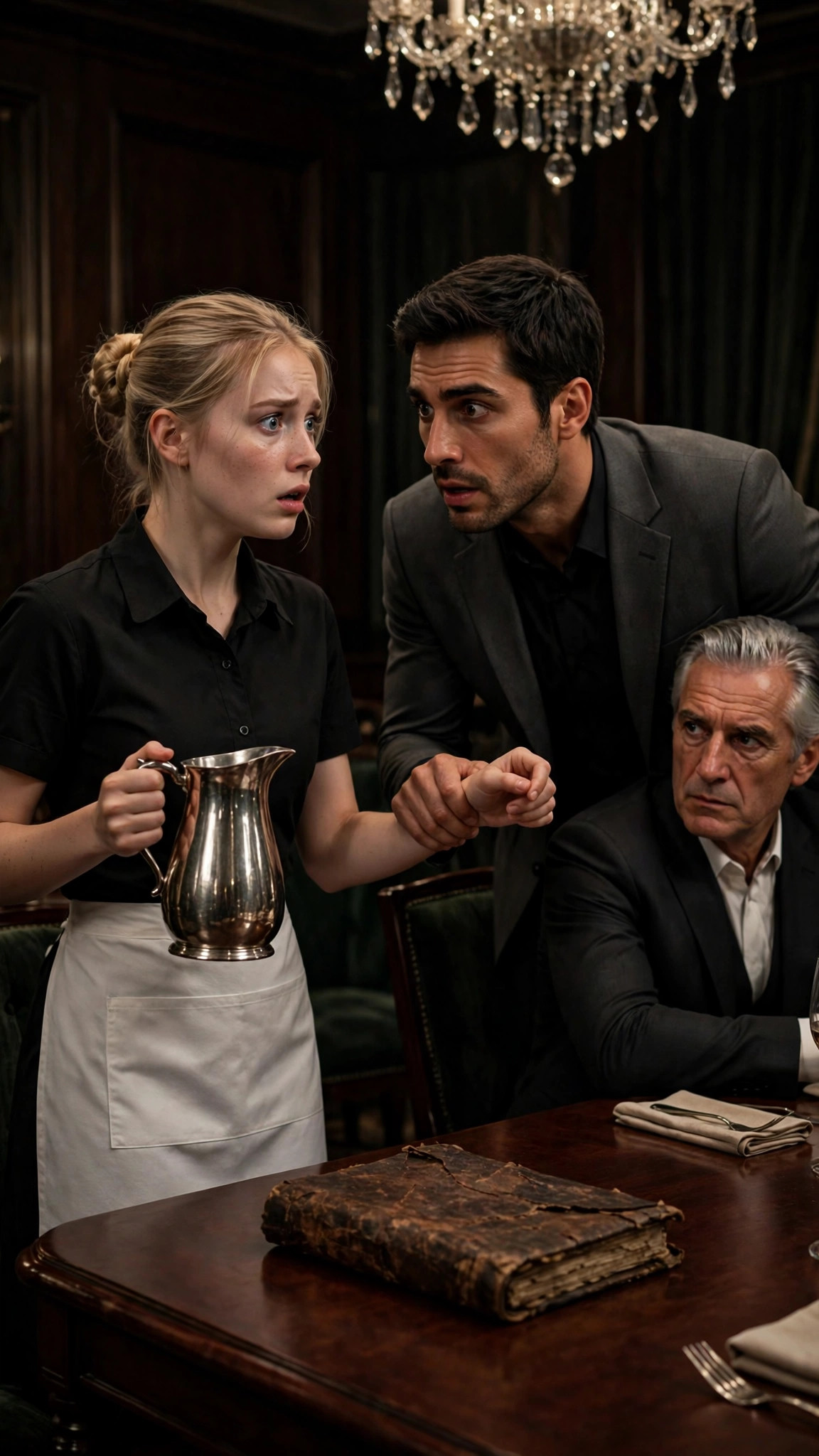
Thursday night, the Plaza Hotel ballroom glittered like a jewel box. Chandeliers hung from the ceiling like frozen fireworks. Waiters in white jackets moved between tables with trays of champagne. Men in tuxedos and women in gowns the color of midnight laughed and talked and pretended that the charity gala was about the children it was raising money for, and not about who was seen talking to whom.
I stood beside Dominic at the entrance, and I did not look like a waitress.
I wore a gown the color of deep sapphire, the same blue as the carpet in the Sapphire Dining Room, and my blonde hair was down for the first time in three years, falling past my shoulders in soft waves. I wore no jewelry except a small silver locket, the one thing of my mother's I had kept, and I wore shoes that made a sound on the marble floor, because tonight, I was not trying to be invisible.
Tonight, I was trying to be seen.
Dominic wore a black tuxedo, and he looked like a king walking into his own coronation. His dark hair was neatly styled. His hands were still. He held a glass of champagne he did not drink, and he smiled at the photographers, and he shook hands with men who had no idea that the most dangerous thing in the room was standing right beside him, wearing a sapphire gown and a silver locket.
"Are you ready?" he asked, very quietly, so that only I could hear him.
"No," I said. "Are you?"
"No," he said, and he smiled, the real smile, the one that changed his whole face. "But we are here anyway."
The speeches began at nine o'clock. The mayor spoke first, then a senator, then a woman from the charity, who talked about the children and the money and the future, and the room applauded politely, and the waiters refilled the champagne, and the chandeliers glittered, and everything was exactly as it was supposed to be.
And then, at nine twenty, Constantine walked into the ballroom.
He wore a dark tuxedo, and he smiled the way he had smiled in the Sapphire Room, the way a man smiles when he believes he has already won. Behind him were four men I did not recognize, men in dark suits, men with the flat, watchful eyes of men who have done this before. They spread out along the edges of the room, the way wolves spread out around a flock, and Constantine walked toward us, slowly, through the crowd, and the crowd parted for him, because crowds always part for men like Constantine, men who carry danger the way other men carry cologne.
"Dominic," he said, when he reached us. "What a pleasure. I did not expect to see you here tonight. I thought you would be at the docks, watching your shipment sail."
"My shipment is fine, Constantine," Dominic said calmly. "My men are at the docks. My best men are here."
Constantine's smile did not move. "Your best men are waiters? How charming. You always did have a sense of humor, Dominic."
"Not waiters," Dominic said. "Witnesses."
He raised his hand, very slightly, and the room changed.
The waiter nearest the door was Silas, in a white jacket, holding a tray. The waiter by the window was Gabriel, in a white jacket, holding a tray. The bartender was a man I did not know, but his eyes were the eyes of a federal agent, and the woman by the piano was a federal agent, and the man in the kitchen doorway was a federal agent, and the ballroom, which had seemed so full of rich people and champagne, was suddenly full of something else entirely.
Constantine understood in a single moment. I saw it happen in his face, the way I had seen it happen in the Sapphire Room, when I read the first sentence aloud and his smile disappeared. His eyes moved from Dominic to Silas to Gabriel to the bartender to the woman by the piano, and then his eyes moved to me, and in them I saw the calculation, the cold, furious calculation of a man who has just realized that his best weapon has been taken away from him, and is already trying to find his next one.
"The waitress," he said softly. "You brought the waitress."
"I brought the woman who read your ledger," Dominic said. "Every page. Every name. Every shipment. She translated it all, Constantine. In English. And this morning, a copy of her translation was delivered to the Federal Bureau of Investigation, along with Arthur's confession, and the harbor master's bank records, and the names of every buyer you have ever sold a gun to."
The federal agent by the piano walked toward us. He was a tall man in a dark suit, with a badge on his belt and a calm, professional face, and he held a pair of handcuffs in his hand, the way a man holds a tool he has used a thousand times.
"Constantine Varga," he said. "You are under arrest for weapons trafficking, conspiracy, bribery, and attempted murder. You have the right to remain silent."
Constantine did not resist. He did not run. He simply stood there, very still, in his dark tuxedo, in the glittering ballroom, in front of a hundred of the richest people in New York, and he looked at me, and his eyes were cold and calculating, and he said, in a voice so quiet that only I could hear it, "You read the dead, little girl. The dead have a way of coming back."
"Not this time," I said, and my voice was steady, and I was surprised by how steady it was, because nothing else about me was steady. My hands were shaking. My knees were shaking. The whole glittering ballroom seemed to be shaking, or maybe that was just me. "This time, the dead told the truth."
The federal agents led Constantine away. His four men were led away behind him, their hands cuffed, their faces blank. The crowd watched in silence, and then the murmur began, the way crowds murmur when they have just witnessed something they do not understand, and the photographers' cameras flashed, and the mayor stood at the podium looking pale and confused, and the woman from the charity stood beside him looking pale and confused, and the chandeliers glittered, and the champagne sat untouched on the trays.
Dominic turned to me. He took my hand, gently, the way he had taken my hand in his office, and he looked at me, and his eyes were dark, and his face was open, and I understood that the man in front of me was not just a crime boss, and not just the man who had offered to pay my father's debt.
He was the man who had stood beside me while I told the truth, and who had not flinched.
"It's over," he said. "Constantine is finished. Arthur is testifying. The Castellanos will not sail at midnight, because Pier Nine is full of federal agents. Your father's debt is paid. Every dollar. You are free, Elena."
I looked at him. I thought about my small apartment, and my black uniform, and my white apron, and my pitcher, and the girl nobody sees. I thought about my father, and his letter, and his last words to me: go and be louder than I ever was.
"I'm not going back to The Sterling," I said.
"I know," Dominic said.
"I'm not going to be invisible anymore."
"I know."
"And I'm not going to let you pay my father's debt and then walk away from me, Dominic Russo, because that is not how this works. That is not how any of this works."
He smiled. The real smile. The one that changed his whole face.
"Then how does it work, Elena Marsh?"
I took a breath. The ballroom was still murmuring around us. The chandeliers were still glittering. The photographers were still taking pictures. And I stood in the middle of it all, in a sapphire gown, with my blonde hair down, wearing my mother's silver locket, and I said the truest thing I had ever said in my life.
"It works like this," I said. "You taught me to be brave, Dominic. My father taught me to read the dead. And now I am going to do both, for the rest of my life, and I am going to do it beside you, if you will have me. Not as your translator. Not as your employee. As your partner. As the woman who loves you, and who is not afraid to say it in a room full of people."
Dominic was very still for a long moment. Then he reached into his pocket, and he took out a small velvet box, and he opened it, and inside was a ring, a simple gold band with a single sapphire, the same deep blue as the carpet in the Sapphire Dining Room, the same deep blue as my gown.
"I have been carrying this for three days," he said, "and I have been trying to find the right words, in the right language, and I could not find them, because there are no words in any language for what I want to say to you. So I will say it in the only language that matters."
He knelt, right there, in the middle of the ballroom, in front of a hundred of the richest people in New York, and he looked up at me, and he said, in ancient Corsican, in the dead language my father had taught me, in the language no one alive was supposed to speak, "Elena Marsh, will you marry me?"
The room went silent. The photographers stopped taking pictures. The mayor stopped talking. The woman from the charity stopped talking. A hundred people held their breath, waiting for the waitress in the sapphire gown to answer the most feared crime boss in New York.
I answered him in the same language. In Corsican. In the dead language. In my father's language.
"Yes," I said. "Yes, Dominic Russo. In every language I know, yes."
He stood up. He slipped the ring onto my finger. He took my face in his hands, gently, the way a man holds something precious, and he kissed me, right there, in the middle of the ballroom, in front of everyone, and the room erupted, and the photographers' cameras flashed, and the chandeliers glittered, and I understood, with a clarity that frightened me and thrilled me in equal measure, that my life of being invisible was over, forever.
At the reception, Rosa Delgado stood up, holding a glass of champagne, laughing the way she always laughed, like a church bell, and she said, "I told Elena on her first day: you see nothing, you hear nothing, you remember nothing. And she listened to me for three years. And then one night, she walked into the Sapphire Room, and she saw everything, and she heard everything, and she remembered everything, and she told the truth. And that is why we are all here today. To the waitress who read the dead — and to the man who was smart enough to listen to her."
Everyone laughed. Everyone applauded. Rosa sat down, wiping her eyes, and Dominic leaned over to me, and he whispered, "She's right, you know. You did see everything. And you did tell the truth. And that is why I love you."
Six months later, I stood in a different room, a bright room with tall windows and white walls, and I cut a ribbon with a pair of silver scissors, and a brass plaque on the wall said, in clean, simple letters: THE THOMAS MARSH INSTITUTE FOR ENDANGERED LANGUAGES.
My father's notebook sat in a glass case in the lobby, open to a page of alphabets, and schoolchildren came to look at it, and I taught them the letters, one by one, the way my father had taught me, until the strange shapes stopped being strange and started being sentences.
Dominic stood beside me, in a gray suit, holding my hand, and he smiled the real smile, the one that changed his whole face, and I smiled back, and I thought about the kitchen table in Queens, and the summer in Croatia, and the flat in Budapest, and the Sapphire Dining Room, and the ten million dollars, and the dead language wearing a dead code like a coat.
I thought about my father, and his letter, and his last words to me. Go and be louder than I ever was.
I was louder. I was so much louder. And I would be louder for the rest of my life, in every language I knew, and in every language I had yet to learn.
On our wedding day, in a small garden in the Hudson Valley, with Rosa Delgado crying in the front row and Silas standing stiffly in a suit that did not quite fit him and Gabriel smiling for the first time I had ever seen him smile, Dominic took my hand, and I took his, and I read him the last line of my father's letter, the line I had carried with me since the night I found it in the back of a weapons broker's ledger.
"The dead don't lie, Ellie," I said. "They only wait for someone who can read them."
And Dominic, who had learned three words of Corsican just for this moment, looked at me, and he said them back to me, slowly, carefully, in the dead language, in my father's language, in our language now: "I love you, Elena Marsh."
And I said it back to him, in Corsican, in English, in Italian, in French, in Spanish, in German, in Greek, and in Russian, because I spoke eight languages fluently and could decipher several more, and I wanted him to know, in every language I knew, that the waitress who read the dead had finally found the one sentence that mattered most.
I love you. I love you. I love you. I love you. I love you. I love you. I love you. I love you.
The End.
THE END