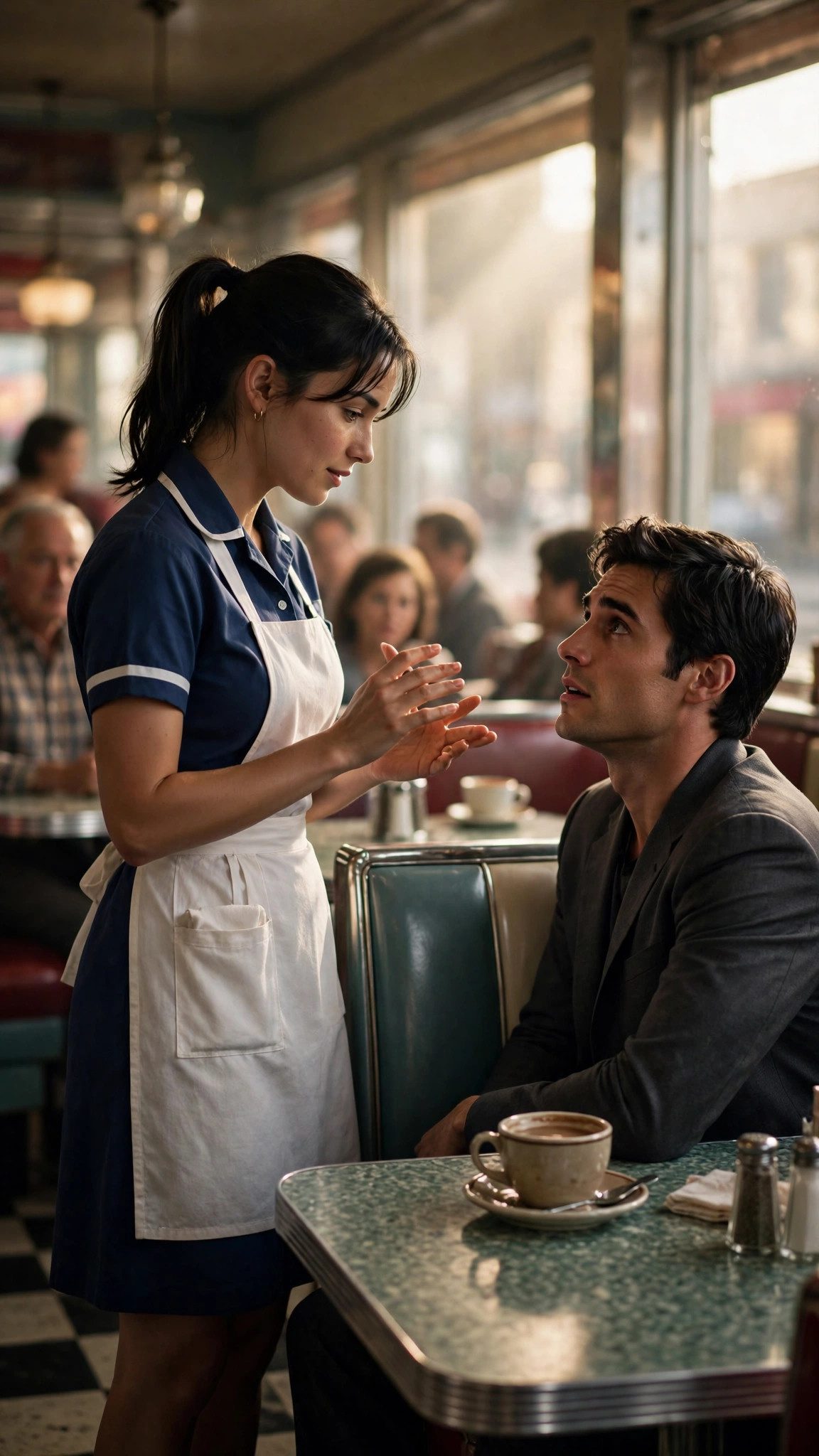
The next day, Salvatore Marquetti came at eleven forty, like always. He sat at table twelve, like always. He ordered black coffee, toast, and two eggs, scrambled, like always. And I served him, like always, except that nothing was like always anymore, because now I knew.
I knew that his company was buying the block. I knew that the diner was the last holdout. I knew that in sixty days, if Mr. Whitfield signed the papers, the Whitfield Diner would be gone, and I would be gone with it, and ten years of my life would be reduced to a demolition notice and a check from a lawyer.
I set his coffee down harder than I meant to. It sloshed over the rim of the cup and pooled on the saucer. He looked up at me, and his dark eyes were calm, and I hated how calm they were, because I was not calm at all.
"Is something wrong?" he signed.
I should have said no. I should have smiled and said, "Enjoy your eggs," and walked away, the way a good waitress walks away. But I had spent three weeks watching this man eat his eggs in my booth, and I had spent one night lying awake thinking about what his money was going to do to my life, and I was twenty-seven years old and tired of smiling at men who were about to hurt me.
"Yes," I signed back, my hands sharp and fast. "Something is wrong. You are buying my diner."
His hands stopped moving. His face went very still. For a moment, he just looked at me, and I saw something cross his face that I had never seen there before. Not anger. Not surprise. Something that looked almost like shame.
"Who told you?" he signed.
"It doesn't matter who told me," I signed. "Is it true? Is the Central Illinois Collection buying this block? Is the Whitfield the last piece you don't own?"
He was quiet for a long moment. Then he signed, slowly, "Yes. It is true."
"And in sixty days, this place closes," I signed. "And I lose my job. And Mr. Whitfield loses his life's work. And my brother and my mother lose the money that keeps our family alive. Is that true too?"
"Valentina," he signed, and his hands were careful now, like he was handling something fragile. "Let me explain."
"Explain what?" I signed. "That you came here every day and you smiled at me and you asked about my brother, and all along you were just looking at the building? That I was nothing to you but a waitress in a place you were going to tear down?"
"No," he signed, and his hands moved faster now, urgent. "No. That is not true. I came here because of you. I came here the first day because my driver took a wrong turn and I saw this diner and I thought it looked like the kind of place my mother used to take me, when I was a boy. And then you signed to me. And nobody had ever signed to me in a restaurant before. Nobody. In thirty-three years, in all the restaurants in all the cities I have been to, nobody ever once spoke to me in my language. You did. On the first day. Without being asked. And I came back because of that. Because of you."
I wanted to believe him. God help me, I wanted to believe him. But I had bills on my kitchen counter and a brother who couldn't get a job and a mother who worked nights cleaning offices, and I had learned a long time ago that beautiful words don't pay the rent.
"Then why are you buying the block?" I signed.
"Because the Collection needs the space," he signed. "Because the gallery is growing, and the neighborhood is changing, and my lawyers tell me this is good business. Because my father built this family on land and buildings, and I am supposed to do the same. Because everyone around me tells me that this is what a boss does."
"And what about the people in the buildings?" I signed. "What about Mr. Whitfield? What about me? What about Gabby, and the cooks, and the regulars who have been coming here for forty years? Are we just part of the land?"
He didn't answer right away. He looked down at his coffee, and his hands rested flat on the table, and I saw his jaw tighten, the way a man's jaw tightens when he is hearing something he doesn't want to hear but knows is true.
"My mother used to bring me here," he signed finally, his hands slow and heavy. "When I was a boy. Before she died. She would order me pancakes, and she would sign to me across the table, and she would tell me stories with her hands, and for one hour a week, I was not the deaf boy. I was just a boy eating pancakes with his mother. This diner is the only place in this city where I ever felt normal. And now my own company is going to tear it down, and I am the one who has to sign the papers."
I stared at him. "Then don't sign them," I signed.
"It is not that simple," he signed.
"Why not?" I signed. "You are the boss. You said so yourself. You took over at twenty-two. You run half the city. If you don't want to tear down this diner, then don't tear it down."
He shook his head. "My board wants it. My underboss wants it. My lawyers want it. If I stop it, they will say I am weak. They will say the deaf boss cannot make hard decisions. They already say that, Valentina. Every day. Behind my back. In rooms where they think I cannot hear them. They say I am soft. They say I am not my father. And if I protect a little diner because a waitress asked me to, they will say I am ruled by a woman."
"Then let them say it," I signed, and my hands were shaking now, but I didn't stop. "Let them say whatever they want. You are not your father. Your father was killed in a drive-by when you were twenty-two, and you took over, and you built something that lasted, and you did it without ever hearing a single word anyone said to you. You did that. Not them. You. And if you tear down the one place in this city where your mother made you feel normal, just because a room full of men who mock you behind your back told you to, then they are right. Then you are weak. But not because you are deaf. Because you let them decide for you."
The silence after that was the loudest silence I had ever heard. The whole diner seemed to be holding its breath. Gabby was frozen behind the counter, holding a coffee pot. The cooks had stopped clanging pans in the kitchen. Even the rain outside seemed to stop.
Salvatore Marquetti looked at me for a long time. Then he stood up, slowly, and he put a twenty-dollar bill under his coffee cup, and he signed, "Thank you for the coffee, Valentina," and he walked out of the diner without eating a single bite of his eggs.
I stood at table twelve, holding an empty tray, watching him walk out into the rain, and I felt like I had just made the biggest mistake of my life. Or the bravest decision. I couldn't tell which one. They felt exactly the same.
Gabby came over, her face white. "Val," she whispered. "What did you just do?"
"I told the truth," I said, and my voice sounded strange to my own ears, too loud in the quiet diner. "I told him the truth, and now I have to live with it."
That afternoon, the man in the gray suit came back. He didn't sit down. He stood by the door, and he looked at me, and he smiled in a way that made my skin crawl, and he said, out loud, to no one in particular, "Sixty days. Tick tock."
And then he left, and I went back to work, and I served coffee and cleared plates and smiled at the regulars, and all the while I kept thinking about the way Salvatore had looked at me before he walked out, like I had said something no one had ever said to him before, like I had handed him a key to a door he didn't know was locked.
That night, I couldn't sleep. I lay in bed, listening to the rain on our apartment windows, listening to Chris breathing in the next room, listening to my mother come home from her cleaning shift at two in the morning, her keys jingling softly in the door, and I thought about what I had done. I had confronted the most feared man in Chicago. I had told him he was weak. I had told him his own men mocked him. I had done it in sign language, in the middle of my diner, in front of everyone.
And the worst part was, I didn't regret it. Not one word of it. Because every word of it was true.
The next morning, I went to work early, before my shift, and I found Mr. Whitfield in his office, going through a stack of papers. He looked up when I came in, and he smiled, a tired, kind smile.
"Val," he said. "I have some news. The Collection called this morning. They want to move the closing up. They want the papers signed by the end of the month. Thirty days instead of sixty."
"Thirty days," I repeated, and the number felt like a punch to the stomach.
"I'm sorry, Val," he said. "I tried to hold them off. I told them I needed time. But their lawyers are very persuasive, and their money is very good, and my daughter keeps calling from Florida, telling me to take it and come live with her, and I'm so tired, Val. I'm so tired."
I nodded. I understood. Mr. Whitfield was seventy-four years old, and he had given forty-one years to this diner, and he deserved to rest. I couldn't ask him to fight for me. I couldn't ask him to turn down a fortune because a twenty-seven-year-old waitress was afraid of losing her job.
"It's all right," I said, and I meant it, mostly. "You've done enough for us. All of us. We'll be all right."
But as I walked out of his office and started my shift, I didn't believe it. I didn't believe we would be all right. I believed we would survive, because we always survived, but surviving and being all right are not the same thing, and I was tired of just surviving.
At eleven forty, I found myself looking at the door. I told myself I wasn't waiting for him. I told myself I didn't care if he came back. I told myself that the man in the charcoal suit was just a customer, and customers come and go, and the diner would close, and life would go on.
But at eleven forty, the bell over the door rang, and Salvatore Marquetti walked in, rain on his shoulders, and he sat at table twelve, and he looked at me, and he signed, "Good morning, Valentina."
And despite everything, despite the thirty days and the papers and the gray-suited man and the fear sitting in my stomach like a stone, I felt my heart lift, just a little, like a bird testing its wings.
"Good morning," I signed back.
And he smiled, and I smiled, and for a moment, the diner was just a diner again, and I was just a waitress, and he was just a man who had come to see me, and none of the rest of it mattered at all.
That evening, after my shift, my mother was sitting at our kitchen table with a cup of tea, her cleaning uniform still on, her feet up on a chair. Rosa Cruz was fifty-two years old, with gray threading through her dark hair and hands rough from years of scrubbing other people's offices, and she was the strongest person I had ever known.
"You look tired, mija," she said, and she patted the chair next to her.
I sat down, and I told her everything. I told her about the Collection, and the thirty days, and Mr. Whitfield, and the man in the charcoal suit who came every day and spoke my brother's language. I told her about the confrontation, and the things I had signed to him, and the way he had walked out without eating his eggs, and the way he had come back the next day anyway.
My mother listened without interrupting, the way she always listened, her eyes on my face, her hands wrapped around her tea. When I finished, she was quiet for a long moment.
"Your father," she said finally, "used to say that a man shows you who he is not by what he says, but by what he does when he thinks nobody is watching. This man, this Salvatore, he comes to your diner every day. He sits in your booth. He speaks to you with his hands. He cries in an old man's office because of you. That is a man doing something when he thinks nobody is watching. The men who are going to hurt you, mija, they do not cry. They do not come back the next day. They do not ask you to stay and talk to them."
"But he is buying the diner, Mama," I said. "He is going to close it."
"Then ask him not to," my mother said simply. "You already told him the truth once, and he came back. Maybe you need to tell him the truth again, and this time, ask him for what you want. You have spent your whole life taking care of everyone else, Valentina. Your brother. Me. That diner. Maybe it is time someone took care of you."
I looked at her, and I felt tears sting my eyes, because she was right, and because I had never once asked anyone for anything in my whole life, and I didn't know how to start.
"Okay, Mama," I whispered. "Okay. I will ask him."