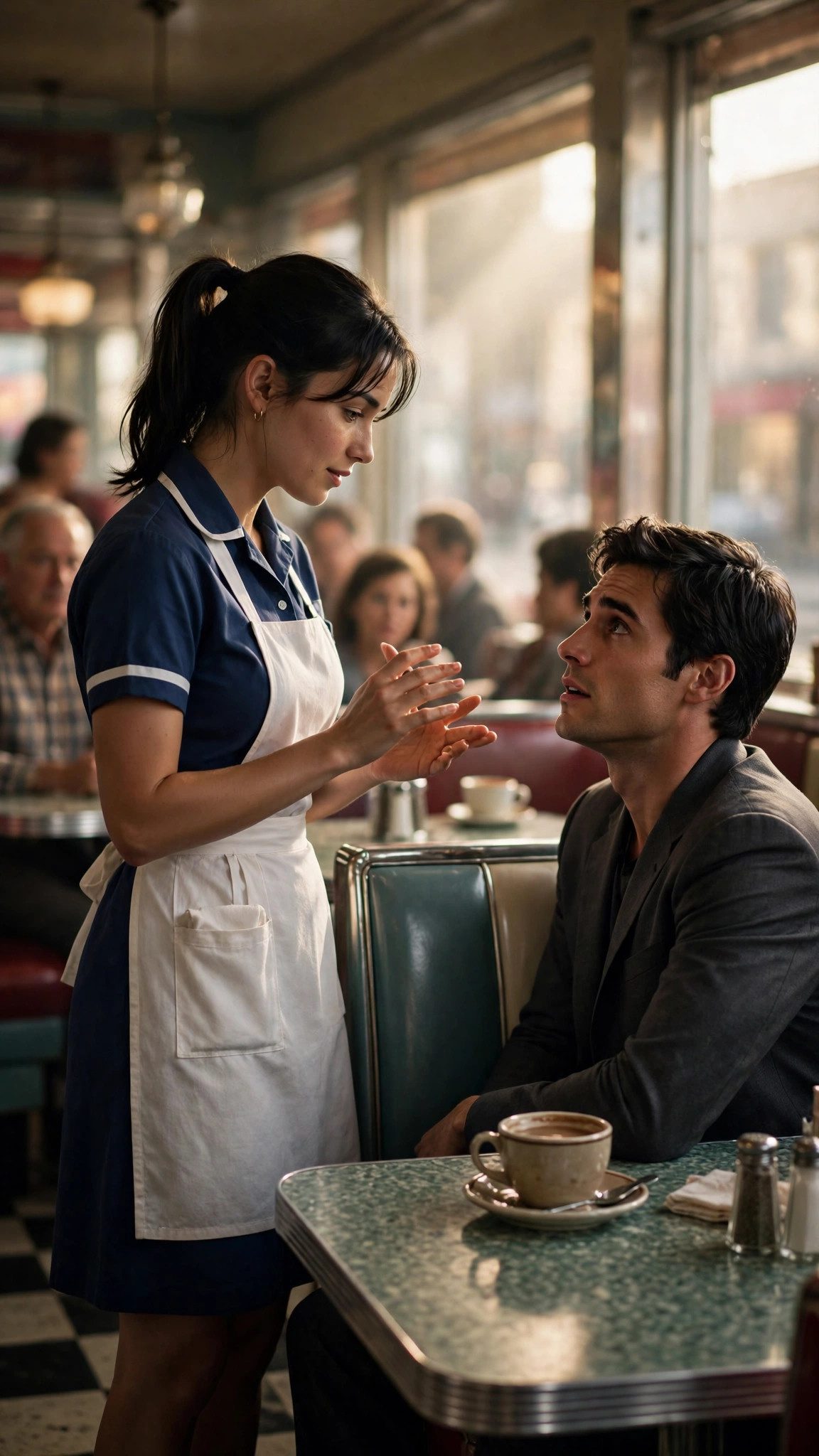
It happened on a Thursday, during the lunch rush, on a day that started out so ordinary I didn't even notice it was ordinary until it stopped being ordinary.
The diner was full. Every table had people. The bell over the door was ringing. The coffee machine was hissing. Gabby was running orders to the back tables, the cooks were shouting in the kitchen, and Mr. Whitfield was sitting in his office, doing paperwork, like he did every day.
At eleven forty, Salvatore came in. He sat at table twelve. He ordered black coffee, toast, and two eggs, scrambled. He signed, "Good morning, Valentina," and I signed, "Good morning," and for a moment, everything was exactly the way it was supposed to be.
And then I noticed the man at table four.
He was sitting alone, near the door, wearing a dark jacket that was too heavy for the weather. He hadn't ordered anything. His coffee sat untouched in front of him. His hands were in his lap, and he kept looking at the door, and then at Salvatore's booth, and then at the door again. His eyes moved the way a hunter's eyes move, checking and checking and checking, never resting, never relaxed.
I felt a cold prickle run down the back of my neck. Tommy's warning came back to me, word for word: if you see anyone you don't recognize, anyone who doesn't order, anyone who keeps watching the door, you tell me. Or you tell Salvatore. In sign language. So no one else understands.
I looked at the man again. His jacket was too heavy. His hands were too still. And when he shifted in his seat, I saw it: the dark shape under his jacket, the hard line of it against his ribs, the way his right hand kept drifting toward it, like a man checking that his keys are still in his pocket.
A gun. He had a gun. And he was sitting four tables away from the man I loved, and he was waiting, and I knew, with a certainty that went all the way down to my bones, that he was waiting for the right moment, and that the right moment was coming, and that if I didn't do something, right now, Salvatore Marquetti was going to die in my diner.
I didn't think. I didn't plan. I didn't hesitate. I did the only thing I could do, the only thing I knew how to do, the thing I had been doing since I was eight years old.
I lifted my hands, and I signed, across the whole diner, straight at Salvatore, my movements big and sharp and impossible to miss.
"GUN," I signed. "MAN AT TABLE FOUR. GUN UNDER HIS JACKET. DON'T TURN. DON'T STAND UP. GET DOWN."
Salvatore's eyes snapped to mine. He saw my hands. He saw my face. And he didn't hesitate either. He didn't look around. He didn't ask questions. He just dropped, sliding sideways out of the booth and down onto the floor behind the table, in one smooth motion, like a man who has practiced being shot at.
At the exact same moment, the man at table four stood up, and his hand came out of his jacket, and there was a gun in it, a black gun, and he pointed it at the booth where Salvatore had been sitting, and he pulled the trigger.
The sound was enormous. It filled the whole diner, louder than anything I had ever heard, louder than the coffee machine and the bell and the lunch rush all put together. The window behind table twelve shattered. Glass rained down onto the booth. People screamed. Chairs went over. A tray hit the floor and plates exploded.
And then, before the man could fire again, two of Salvatore's bodyguards, who had been sitting at the counter pretending to be truck drivers, were on him. One of them hit his arm, and the gun went flying across the floor, skidding under a table. The other one took him down, hard, onto the tile, and held him there with a knee in his back while he shouted and struggled and swore.
It was over in less than ten seconds. Ten seconds, and the diner was silent again, except for the sound of people crying, and the hiss of the coffee machine, and the rain on the windows, and my own heart beating so loud I thought everyone could hear it.
Salvatore stood up slowly from behind the booth. There was glass in his hair. There was a cut on his cheek, a thin line of blood. But he was alive. He was alive, and he was looking at me, and his hands were already moving.
"Are you hurt?" he signed.
I shook my head. I couldn't speak. I couldn't sign. My hands were shaking too hard. I just stood there, holding my tray, staring at him, staring at the shattered window, staring at the man on the floor with a knee in his back, and I felt like I was going to fall down.
Salvatore crossed the room to me in three strides, and he took my hands in his, gently, the way you hold something precious, and he signed, with his hands wrapped around mine, "You saved my life. You saved my life, Valentina. Do you understand? If you had not signed to me, if you had hesitated for one second, I would be dead right now."
I looked at him, and I looked at the man on the floor, and I looked at Gabby, who was standing behind the counter with her hands over her mouth, crying, and I looked at Mr. Whitfield, who had come out of his office with his face white as paper, and I thought about how close we had all come to something terrible, and how one pair of hands, my hands, had stopped it.
The police came. The ambulance came. The man on the floor was taken away in handcuffs, and his name, the police told us later, was Danny Cole, and he was twenty-six years old, and he had a record, and he had been paid fifty thousand dollars to kill Salvatore Marquetti at eleven forty on a Thursday, at table twelve, in the Whitfield Diner.
Fifty thousand dollars. That was the price of the man I loved. Fifty thousand dollars, and a gun, and a Thursday lunch rush.
That night, Salvatore came to our apartment. He didn't call first. He just knocked on the door, and my mother opened it, and she took one look at his face, at the cut on his cheek and the glass still in his hair, and she pulled him inside and sat him down at our kitchen table and made him tea, like he was family, like he had always been family.
Chris was there, and Salvatore signed to him, "Your sister saved my life today. She saw a gunman, and she signed to me, and I am alive because of her. Your sister is the bravest person I have ever known. I want you to know that."
Chris looked at me, and he signed, "I already knew that."
And then Salvatore turned to me, and he took my hands, and he signed, slowly, carefully, like every word mattered more than anything he had ever said before.
"Valentina," he signed. "Today, a man tried to kill me because of who I am. Because of what I am. Because I am the boss, and because I am deaf, and because there are men in this world who think that makes me weak, and who think they can take what is mine. And today, you stood in the middle of a diner, in front of everyone, and you spoke my language, and you saved my life. And I need you to know something. I need you to know that I am not going to let anyone hurt you. Not Enzo. Not Castellano. Not anyone. Not ever. I am going to find out who paid that man. I am going to find out who is behind this. And I am going to end it. For you. For Chris. For your mother. For this diner. For all of us."
I looked at him, and I believed him. I believed him completely. Because he was not just a mafia boss, sitting in my booth, eating scrambled eggs. He was a man who had almost died, and who had come to my apartment, and who was holding my hands, and who was promising me, in sign language, that he would protect us.
"Okay," I signed back, and my hands were still shaking, but they were steadier than they had been all day. "Okay. We will do it together."
He nodded. "Together," he signed. "Always together."
And in that moment, sitting at our kitchen table with my mother and my brother and the man I loved, with the rain on the windows and the tea going cold between us, I understood something I had never understood before. Silence is not empty. Silence is where the truth lives. And the truth was this: I loved Salvatore Marquetti, and he loved me, and no amount of money, and no gun, and no man in a gray suit, was ever going to change that.
The next morning, I went to work, because that is what I do. I show up. Even when I am afraid. Even when my hands are still shaking. Even when the window behind table twelve is boarded up with plywood and there is glass in the cracks of the floor that the broom missed.
Mr. Whitfield was already there, standing in the middle of the dining room with his hands on his hips, looking at the boarded-up window like it had personally insulted him.
"We are not closing," he announced, to no one in particular, and then to me, and then to Gabby, and then to the cooks, who had come out of the kitchen to listen. "A man came into my diner with a gun, and he shot my window, and he scared my customers, and he scared my girls, and I am not closing. Not today. Not tomorrow. Not ever. This diner has been here for forty-one years, and it will be here for forty-one more, and no gunman is going to change that. Now, somebody get me a broom, and somebody put on a fresh pot of coffee, and let's open the doors."
And so we did. We swept the glass. We mopped the floor. We put on a fresh pot of coffee. And at seven o'clock, we opened the doors, and the regulars came in, one by one, and they sat at their usual tables, and they ordered their usual breakfasts, and they pretended not to look at the boarded-up window, and they pretended not to notice the two men in dark suits sitting at the counter, who were definitely not truck drivers, and who definitely had guns under their jackets, and who were definitely there to make sure nothing like yesterday ever happened again.
One of the regulars, old Mr. Kowalski, who had been coming to the Whitfield every morning for thirty years, waved me over to his table and said, "Val, I heard what happened yesterday. I heard you saved that man's life. I heard you saw the gun before anyone else did. Is that true?"
"I just did my job," I said, which was true, and also not true, because my job was serving coffee, not saving mafia bosses from assassins.
"You did more than your job," Mr. Kowalski said, and he patted my hand with his old, shaking hand. "You are a brave girl, Val. Your father would be proud of you. I knew your father, you know. He used to come in here after his shift at the warehouse. He would sit right there, at the counter, and he would tell me about his little girl who was learning to talk with her hands. He said you were the smartest person he ever met. He was right."
I felt tears sting my eyes, and I thanked him, and I went back to work, and all morning, the regulars found small ways to tell me they were proud of me. A bigger tip than usual. A kind word. A hand on my shoulder. The diner, which had always been my workplace, felt like something more that morning. It felt like a family. And I realized, standing behind the counter with a coffee pot in my hand, that this was what Salvatore's mother had loved about this place. Not the pancakes. Not the coffee. The people. The showing up. The being together, every day, even when it was hard.
That afternoon, Tommy came to see me, and he told me what the police had learned. Danny Cole, the gunman, had confessed within an hour of his arrest. He had been paid fifty thousand dollars by a man named Enzo Falcone, Salvatore's own underboss, who had promised him another fifty thousand after the job was done. Enzo had given him the schedule: eleven forty, table twelve, every day, like clockwork. Enzo had told him the diner would be crowded, and that no one would notice a man who didn't order, and that the deaf boss would never hear the gunshot coming.
"But he didn't count on you," Tommy said. "He didn't count on a waitress who watches people's hands. He didn't count on sign language. He didn't count on you, Miss Cruz. And that is why his plan failed."
"What happens to Enzo now?" I asked.
"Salvatore is going to handle it," Tommy said. "At the family sit-down, tomorrow night. He is going to bring the evidence. The phone records. The bank transfer. Danny Cole's confession. And he is going to expose Enzo in front of the whole family. And then he is going to decide what happens next. And whatever he decides, I can promise you this: Enzo Falcone will never come near this diner again."
"And Castellano?" I asked. "The man Enzo was working with?"
"Castellano is next," Tommy said. "One thing at a time. First Enzo. Then Castellano. And then, God willing, this will all be over."
That night, I couldn't sleep. Every time I closed my eyes, I saw the man at table four standing up, and I saw the gun, and I heard the sound of the window shattering. I got up and I went to the window of our apartment, and I looked down at the street, and I saw a black car parked across the street, with two men inside, and I knew, without anyone telling me, that they were Salvatore's men, and that they were there to watch over us, and that I was safe, and my mother was safe, and Chris was safe.
And I stood at that window for a long time, looking at the street, looking at the rain, looking at the city lights, and I thought about how strange life was. A month ago, I was just a waitress. A month ago, my biggest problem was a wobbly table and a short tip jar. And now I had saved a mafia boss's life, and a gunman was in jail, and an underboss was about to be exposed, and the most feared man in Chicago was sleeping, or not sleeping, somewhere across the city, thinking about me.
And I wasn't afraid. Not anymore. I was tired, and I was sad, and my hands still shook sometimes, but I wasn't afraid. Because I had learned something in that diner, on that Thursday, at eleven forty. I had learned that the bravest thing a person can do is show up. And I had shown up. And I would keep showing up, every day, for as long as it took.