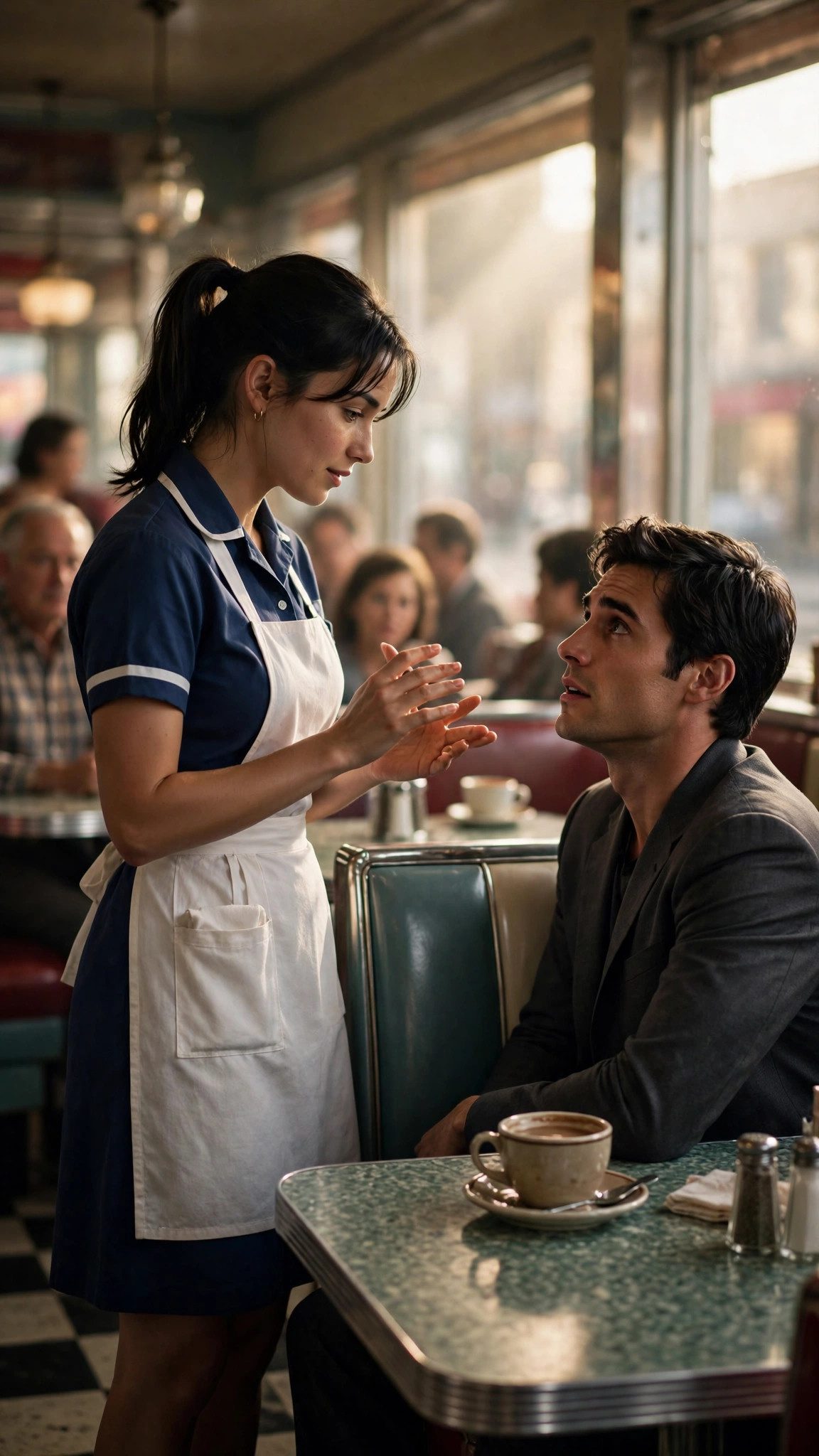
He took me back to the Whitfield Diner. Of course he did. Where else would he take me? The diner was where it had all started, and the diner was where it was going to end, or rather, where it was going to begin.
It was a Sunday morning, early, before the diner opened. The chairs were still up on the tables. The coffee machine was still cold. The sun was just coming up over the rooftops, and the light was coming through the big front windows in long, golden bars, and the whole place smelled like cleaning solution and old wood and possibility.
Salvatore was standing at table twelve, in his charcoal suit, with his hands behind his back, and he looked nervous. I had never seen him nervous before. Not when a gunman pointed a gun at him. Not when he exposed Enzo in front of the whole family. Not when he walked into a room full of men who wanted him dead. But standing in an empty diner at seven o'clock on a Sunday morning, waiting for a waitress, he was nervous, and it was the most endearing thing I had ever seen.
"Valentina," he signed, and his hands were shaking, just a little. "I have been thinking about what to say to you for a week, and I have practiced it a hundred times, and I still don't know if I am going to say it right. So I am just going to say it the way I know how. With my hands. In the language that brought us together."
He took his hands out from behind his back, and in one of them was a small velvet box. He opened it, and inside was a ring, a simple gold band with a single diamond, and it caught the morning light and threw it all over the room in tiny, sparkling pieces.
"Valentina Cruz," he signed, "the first day I met you, you signed to me, 'Welcome to the Whitfield.' And I have been welcome, every day since then, in a way I have never been welcome anywhere else in my life. You spoke my language when nobody else would. You told me the truth when nobody else would. You saved my life when nobody else could. And you taught me that silence is not empty. You taught me that silence is where the truth lives. And the truth is, I love you. I have loved you since the first day, since the first word, since the first sign. And I want to spend the rest of my life with you, if you will have me."
He knelt down then, right there on the floor of the Whitfield Diner, in his charcoal suit, in front of table twelve, and he held the ring up to me, and he signed, "Stay. Marry me. Be my wife. Be my partner. Be the woman who speaks my silence, every day, for the rest of our lives."
I couldn't speak. I couldn't sign. My hands were shaking too hard, and my eyes were full of tears, and my heart was beating so loud I thought the whole diner could hear it. And then, somehow, my hands found their way, and they moved, and they signed the only word that mattered.
"Yes," I signed. "Yes. Yes. Yes."
He stood up, and he took my hand, and he slid the ring onto my finger, and it fit perfectly, like it had been made for me, like it had always been mine, and he leaned forward, and he kissed me, right there in the middle of the Whitfield Diner, with the chairs up on the tables and the sun coming through the windows, and it was the best kiss of my life, because it was the first kiss of the rest of my life.
We got married three months later, in the diner. Of course we did. Where else would we get married? Mr. Whitfield gave me away, because my father was gone, and Mr. Whitfield had been more of a father to me than anyone since my father died. My mother cried through the whole ceremony. Chris was the best man, and he signed the vows along with us, so that everyone in the room could understand them, hearing and deaf alike. Gabby was my maid of honor, and she cried too, and she told everyone afterward that she had known it all along, from the very first day, which was a lie, but a kind lie, and I let her tell it.
The whole diner was decorated with white roses and candles, and the regulars filled every table, and the cooks made the best food they had ever made, and Tommy cried, which he denied afterward, and Salvatore's capos, all twelve of them, stood in the back and watched their boss get married to a waitress, and not one of them said a word against it. Not one.
And when it was time for the vows, Salvatore took my hands, and he looked into my eyes, and he signed, slowly and clearly, so that everyone in the room could see, "Valentina, you spoke my silence. You saved my life. You gave me a family. You gave me a home. And I promise you, every day, for the rest of my life, I will show up. I will be here. I will listen to you, with my eyes, and with my hands, and with my heart. Every day."
And I signed back, "Salvatore, you came to my diner every day. You asked me to stay. You asked me to talk to you. And I promise you, every day, for the rest of my life, I will stay. I will talk to you. I will speak your silence, and you will speak mine, and together, we will never be silent again."
Our first dance was to a song I had never heard before, a slow, beautiful song that the band played softly, and Salvatore held me close, and he didn't need to hear the music to dance to it. He felt it, in the floor, in my heartbeat, in the way the whole room was moving around us, and he swayed with me, gently, perfectly, like he had been dancing all his life. And when the song ended, he leaned down, and he signed against my cheek, where only I could see it, "You are the most beautiful woman in this room. You are the most beautiful woman in this city. You are the most beautiful woman I have ever seen."
And I laughed, and I cried, and I signed back, "You are biased."
"Yes," he signed. "I am. And I always will be."
In my first year as manager, I changed things at the Whitfield. Not big things. The diner was perfect the way it was, and I didn't want to change its soul. But I added a small card to every table, a card that said, in English and in sign language diagrams, "Welcome to the Whitfield. We speak your language." And I taught every waitress and every cook twenty basic signs: hello, thank you, please, coffee, water, check, more, less, good, beautiful. And I put a sign in the window that said, in big, clear letters, "DEAF FRIENDLY. ALL ARE WELCOME HERE."
And do you know what happened? Deaf people started coming. From all over Chicago. Families with deaf children. Old deaf couples who had never once been served in their own language. Young deaf men and women who had never once ordered a meal without writing it down on a piece of paper. They came, and they sat at our tables, and they signed to us, and we signed back, and they cried, sometimes, right there in the middle of lunch, because someone had finally bothered to learn their language.
One afternoon, a little deaf girl, maybe eight years old, came in with her mother, and she sat at table twelve, and she watched me sign to Salvatore, and her eyes went wide, and she signed to her mother, "Mama, the waitress is talking with her hands, like me. And the man is talking back. Mama, they are talking like us."
And her mother cried, and I cried, and Salvatore reached across the table and took my hand, and he signed, "This. This is why the diner stays. This is why we did all of it. For her. For that little girl. For every little girl like her."
On our first wedding anniversary, Salvatore took me back to the diner after closing time, just the two of us, and he had set table twelve with candles and white roses, and there was a bottle of champagne on ice, and two glasses, and a small chocolate cake from the bakery down the street. And we sat there, in the dark, quiet diner, with the candles flickering and the city lights outside the window, and he signed to me, "One year ago, I asked you to marry me, right here, at this table. And you said yes. And it was the best day of my life. And I want you to know that if I could go back and do it all again, the drive-by, and my father's death, and the meningitis, and the silence, and all of it, I would do it all again, exactly the same way, because all of it brought me here. To this table. To you."
And I signed back, "One year ago, you asked me to stay, and I stayed. And I will stay, every day, for the rest of my life. And if I could go back and do it all again, the ten years at this diner, and the early mornings, and the tired feet, and the tip jar in the coffee can, I would do it all again, exactly the same way, because all of it brought me here. To this table. To you."
And we sat there for a long time, in the candlelight, holding hands across table twelve, not saying anything, not signing anything, just being together in the silence, and the silence was not empty. The silence was full. Full of love. Full of history. Full of everything we had been through, and everything we still had ahead of us.
A year later, the Whitfield Diner is still open. The window behind table twelve has new glass in it, and if you look closely, you can see a tiny crack in one corner, where the bullet hit, and we never fixed it, because Mr. Whitfield said a scar is a reminder, not a flaw, and he was right. The diner is busier than it has ever been. People come from all over the city to eat here, because they have heard the story, the story of the waitress and the mafia boss, the story of the hands that spoke, and they want to sit at table twelve, and they want to see the place where it happened.
Mr. Whitfield retired to Florida, to live with his daughter, and he calls me every Sunday, and he asks about the diner, and he asks about the coffee machine, and he asks about the regulars, and I tell him everything is fine, because everything is fine. Gabby is the head waitress now, and she runs the floor like she owns the place, and she is wonderful at it, and she never once bets on anyone emptying a tray anymore.
Chris is a docent at the Central Illinois Collection, and he leads tours for deaf schoolchildren three times a week, and he has his own desk, and his own business cards, and a girlfriend named Ana, who is also deaf, and who is also wonderful, and who signs even faster than he does. My mother retired from cleaning offices, and she spends her days in our garden, and she tells everyone she meets that her daughter married a mafia boss, and she says it with pride, because she knows what I know: that the man I married is not a mafia boss first. He is a man first. A man who is deaf. A man who is kind. A man who shows up.
And Salvatore? Salvatore still comes to the diner every day at eleven forty. He still sits at table twelve. He still orders black coffee, toast, and two eggs, scrambled. He still tips twenty dollars, folded neatly under the coffee cup. And he still signs to me, across the table, with his beautiful, careful hands.
"Good morning, Valentina," he signs.
"Good morning," I sign back.
And then he signs, "I love you."
And I sign, "I love you too."
And the diner goes on, and the coffee flows, and the bell over the door rings, and the world talks and talks and talks, with its mouths and its noise and its shouting, and in the middle of it all, at table twelve, in the corner booth by the window, a waitress and a mafia boss sit together in silence, speaking with their hands, saying everything that needs to be said, without making a single sound.
My name is Valentina Marquetti now. I am twenty-eight years old. I am the manager and part-owner of the Whitfield Diner in Chicago. I am the wife of Salvatore Marquetti, and the sister of Chris Cruz, and the daughter of Rosa Cruz, and I am the woman who spoke his silence.
And if you ever come to Chicago, and you ever walk into the Whitfield Diner on a rainy morning, and you see a man in a charcoal suit sitting at table twelve, and a waitress with dark hair in a ponytail signing to him, you will know who we are. You will know our story. And you will know that silence is not empty. Silence is where the truth lives, if you know how to read it.
Stay. Talk to me. I work here every day. Then I'll come every day.
Every day. For the rest of our lives. And that is our story, and it is only the beginning.
The End.
THE END