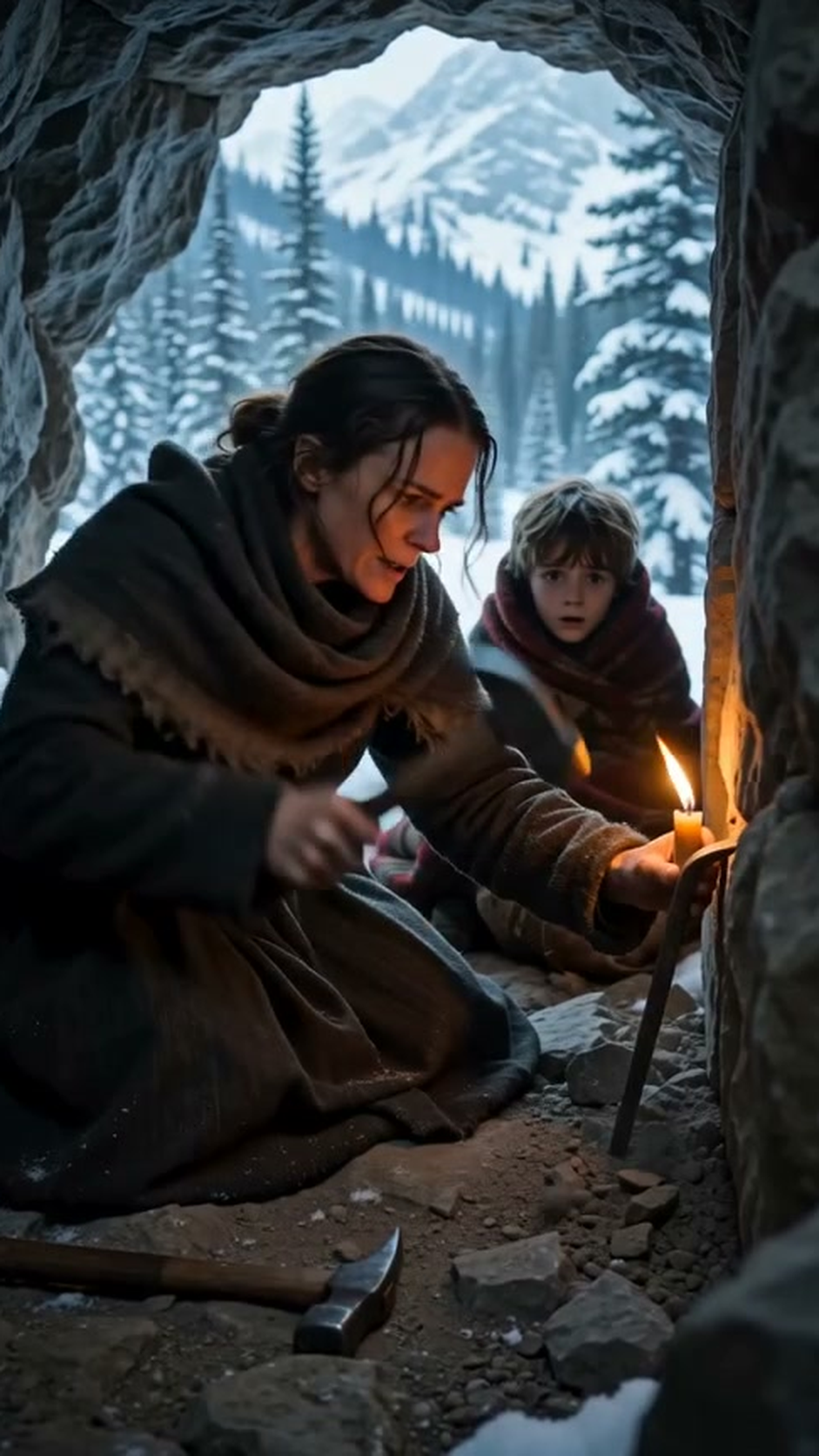
There was no time to do it properly, and so Martha did it the way her whole life had trained her to do everything: completely, with whatever was at hand.
She fed the fire up until the cave glowed like a forge, because she would need light and because smoke no longer mattered — Pike already knew the way. She set Samuel on the pine-bough bed with his blanket, his cup of water, and strict instructions that were also a promise: "Whatever you hear, whatever you see — you watch, and you remember. That's the job your papa left, and it's yours now. Surveyors' sons are witnesses." Then she took up Caleb Foss's hammer, and she went to the wall.
TAP.
The hammer struck the smooth stone, and the mountain answered wrong — hollow, deep, a sound that traveled and came back. Samuel, behind her, breathed, "Mama… what was that?" and Martha, who had asked herself the same question with a whole night to be afraid in, answered it now with her sleeves pushed up and her jaw set.
"That's the sound of a lie with empty space behind it, Samuel. Hold the candle where I can see."
She worked the way Isaac's book had taught her to think: seam first, then the fracture, then the wedge. The candle showed her the straight unnatural line between the stones and the cold breath sliding out of it, and she whispered to the dark, "This isn't natural stone," and set the iron wedge against the ancient mortar at the edge of the one rectangular stone that did not match its neighbors, and struck. CRACK. The mortar crumbled. She struck again, and a fracture came creeping between the stones, and Samuel leaned forward in his blanket and said, in wonder and fear together, "Someone built that wall?"
"Yes," said Martha. "Your great-grandfather's friend built it, to keep a promise." She turned the hammer in the light so he could see the carved name, deep and black. "Caleb Foss. Read it, Samuel. Witnesses read names out loud."
"Caleb Foss," the boy said, obediently, and somehow saying it made the cave feel less empty, as if the name were a third person standing with them in the firelight.
She drove the pry bar into the crack and leaned her weight on it — all of it, every starved ounce of a winter of grief — and her boots scraped on the rock and the wall ground out its low protest, and behind the stone, faint and patient, something answered: TAP… TAP… Samuel's hand locked around her sleeve. "Mama… there's something back there."
"Then it can wait one minute more to be found," Martha said, though her heart was trying to climb out of her body. "It has waited thirty years. Push with me, witness."
Together they pushed. The stone moved — GRRRRIND — dust sifting from its upper edge, freezing air rushing out, the candle bending nearly flat — and Martha braced and shoved one final time and the great stone shifted inward and stood open, a narrow black doorway in the heart of Blackstone Mountain, with cold air spilling over her face like water over a dam.
Something heavy shifted faintly in the darkness beyond. A deep, hollow knock echoed out.
Martha raised the candle high, and her voice, when it came, was not fear. It was fury, thirty years deep and one winter wide: "What did they hide in here?"
The chamber was not large — a natural pocket in the rock, ten feet by eight, that Caleb Foss had enlarged with a mason's patience and sealed with a mason's skill. The candlelight found it piece by piece, the way truth usually arrives. A stack of supply crates along the left wall, one of which had slumped in the earthquakes of the years, its corner split — that was the heavy shift she had heard, a dead weight settling at last. A surveyor's tripod, folded. A roll of chain. And at the center, on a shelf of flat stone, set like an altar: an iron strongbox, green-black with age, and beneath its hasp, hung on a nail driven into the rock, a tin cup.
As Martha watched, a bead of water gathered on the chamber's ceiling, swelled, and fell — TAP — into the tin cup, musical and patient. Another gathered. TAP. Thirty years of mountain water, dripping through a fissure in the stone onto overturned tin, counting out the decades in the dark like a clock in an empty house. Samuel, peering past her shoulder, let out a breath that was half laugh and half sob. "It's just water, Mama."
"It's just water," she agreed, and her knees nearly went, because the mountain was not haunted, and never had been. It had only been keeping something. "Just water, and time, and a man who trusted stone more than people. He was right to."
The strongbox hasp had rusted to lace, and the pry bar persuaded it in a moment. Inside, in oilcloth, in a surveyor's hand as exact as print: the journal of Caleb Foss, 1858–59. Beneath it, folded in a sheet of oiled canvas, a deed of territorial grant, sealed with a seal Martha had only ever seen in the land office window — the original grant of Blackstone Mountain, six hundred and forty acres and the mineral rights entire, made out to the Sullivan family, in perpetuity. And beneath that, a plat map in Caleb's hand, the true lines drawn clean and hard, and a letter, sealed with wax, addressed in that same exact hand:
For the Sullivan who comes. Read the journal last. Trust the figures first.
Her hands were shaking too hard to be careful, so she made herself be careful anyway, and read the journal first — no: the figures first, as instructed, and the figures were exactly what Isaac had died knowing they would be. The territorial survey of 1859, true. The Pike filing of '59, with its smooth profitable bow, laid over it like a hand over a mouth. And then the journal, and Caleb Foss stepped out of thirty years of silence and spoke in a voice so dry and tired and funny in places that Martha laughed once, aloud, in that sealed room, with tears starting:
…Amos Pike came to my camp on the 9th with two men and an offer, and when the offer failed he made the other kind. I am not a brave man. I am a surveyor. But a line is a line, and if I move it for money I am nothing that ever lived. I have put the proof where the mountain will keep it, in the old cave above the cairn, behind nine courses of stone. If I reach the land office, I will come back for it with soldiers. If I do not reach the land office, then whoever finds this — the mountain is the Sullivans', it was always the Sullivans', and Amos Pike is a thief in a good coat, and God and the figures are my witnesses…
There was more — pages of it, the whole last month of a man's life kept in a hand that never hurried and never wasted a word. There was the survey itself, day by day, in cold and hunger and rising certainty. There was the assay Caleb had run in secret on ore from the north face, and Martha read that page three times, because it changed the size of everything: the silver showing was no showing. It was a lode, a true lode, rich beyond the rumors — the kind of strike that builds a railroad town or a dynasty, the kind men did not merely cheat for but killed for, in an orderly, ledger-keeping way, with lanterns held by other men's sons.
And there was the entry for the 9th of October, 1859, written in a hand that was still exact but had gone, somehow, older:
Amos Pike came up the mountain today in a good coat with two men behind him who did not offer their names, and he stood in this cave and offered me a partnership, and then a price, and then — smiling the whole while, a reasonable man — he told me what surveyors cost in this territory when they will not be reasonable, and what widows cost, and orphans. I have a sister in Ohio who will get a letter from me this winter that says nothing true, because a true letter can be read by the wrong hands at a dozen desks between here and Ohio. The proof goes behind the wall tonight. Nine courses. I built it to be found by a man who knows the sound of a hollow stone, and I pray the mountain raises such a man, in such a family, in time. — C.F.
He had raised him. It had only taken thirty years, and the man had been her husband, and he had died eleven days after reading the first page of this book with his hands shaking in their lamplit kitchen — no. Martha corrected herself, standing in the sealed room with the candle burning down. Isaac had not died of the book. Isaac had died of the lantern-holder, and the schedule, and the forty dollars. The book was not the curse of the family. The book was the family's sword, and it had been waiting in the mountain, in oilcloth, in the dark, for a hand angry enough to pick it up.
The last entry was dated three days later, and it was short.
They are watching the north trail. I will go out by the south ravine at first light and draw them after me, away from the cave. The wall keeps its own counsel. So do I. — C.F.
Martha closed the journal and sat for a while in the candlelight with her head bowed, in the company of a brave, tired, funny man who had walked out of this cave into the snow to die with his secret intact so that a family not yet born could stand exactly where she was standing.
"Mama?" Samuel's voice, small, from the doorway stone. "Is it ours? Is it really ours?"
She looked up at her son — Isaac's son, Caleb's heir in everything that mattered — framed in the black opening with the candle gilding his thin, recovering face, and Martha Sullivan smiled the first whole smile of the winter.
"Every stone of it," she said. "Now help me wrap these in oilcloth, witness. We have visitors coming up the mountain, and I intend to be a very difficult woman to rob."
She did the work the way she did all work: completely, and in order. The assay pages and the plat she copied in her mind as she wrapped — no, better: she checked them once against Isaac's field book, figure against figure, in the candlelight, her lips moving, two surveyors and a schoolteacher agreeing across thirty years that a line was a line. The copies in Isaac's book were true copies. Which meant the mountain's truth now existed in two places — behind this stone, and in a leather satchel in the entrance chamber — and Pike, arriving with his lantern and his arithmetic, would have to find both, and silence both, and silence the woman and the boy besides. She could see the shape of his problem as clearly as she had seen the shape of her own in the pantry with the pencil, and it steadied her wonderfully. His arithmetic, for the first time in thirty years, was going to come out wrong.
"This part stays in your shirt," she told Samuel, binding the oilcloth packet flat against his thin chest with a strip torn from her own petticoat, under his nightshirt, under the blanket. "Against your heart, the way your papa carried his book. If any man lays a hand on you or asks you what's under there, you scream for me like the house is afire. Is that a surveyor's order you can follow?"
"Yes, Mama." His face was pale and solemn and, for the first time in a week, entirely clear of fever — the clearest thing in the cave. "I'm the witness."
"You are the witness," she agreed, and kissed his forehead, and tasted only cool skin, and allowed herself, for exactly the length of one breath, to believe that God and Caleb Foss between them had timed the boy's recovery to the hour it would be needed. "And a witness's whole job, Samuel Sullivan, is to live long enough to say what he saw."
She had the grant and the journal wrapped and bound against Samuel's chest under his shirt, beneath the blanket — the mountain's truth riding against a child's heartbeat, where no search of the cave would think to look and no man's hand would dare linger — when the first sound reached them from outside: not wind, not water. A horse, blowing hard, on the ledges below. And then a man's voice, courteous as a coffin lid, floating up through the falling snow.
"Mrs. Sullivan. I know you're up there. Let's not make the boy climb down in the dark."