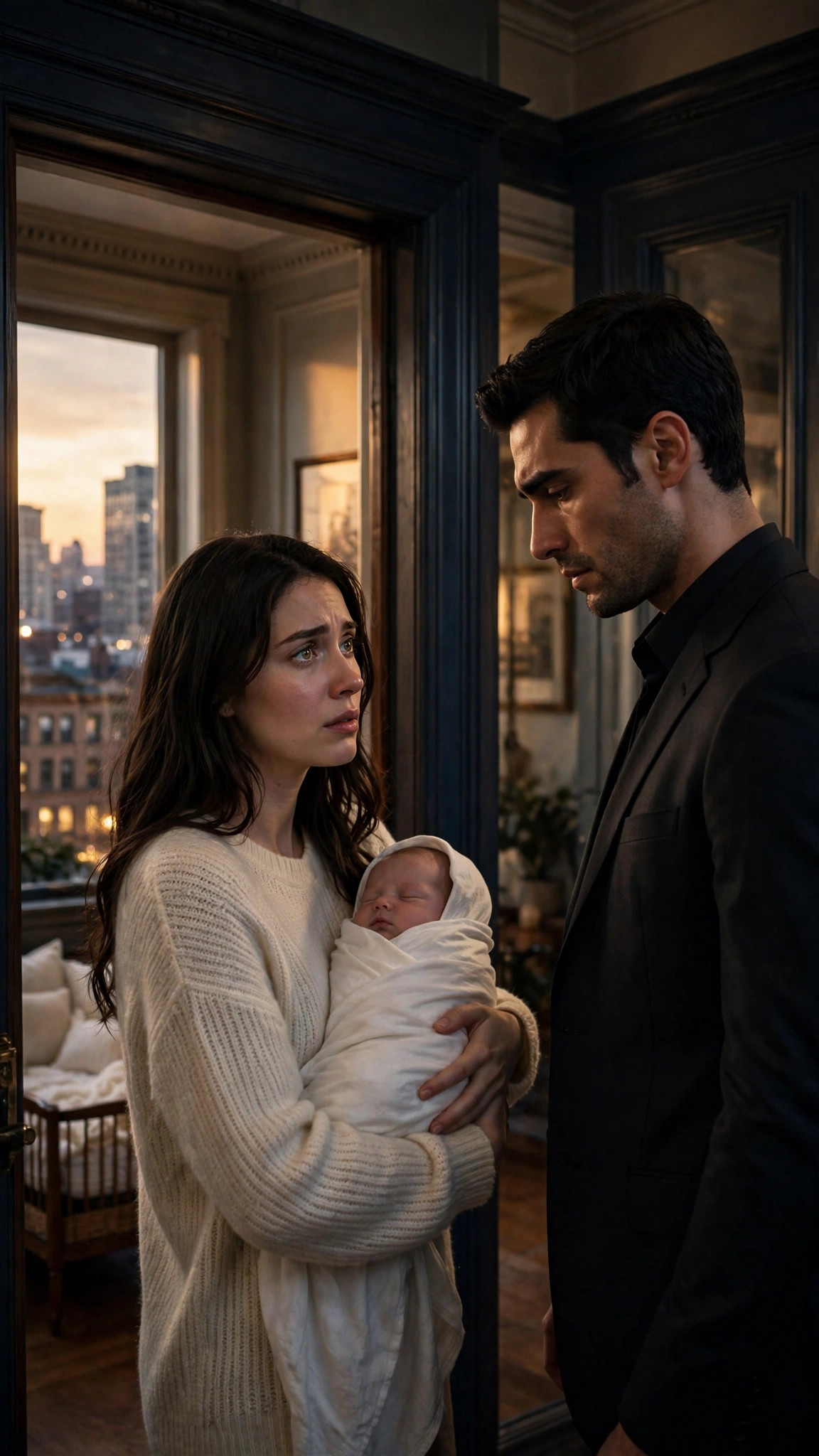
Vincent did not leave that night. I did not ask him to stay, and I did not ask him to go. He slept on the couch in the living room, with his suit jacket folded over the armrest and his shoes lined up neatly by the door, the way he had always done, as if nothing had changed, as if he had simply come home late from work. In the morning, I found him in the kitchen, making coffee with the careful, quiet movements of a man who knows he is not welcome but is trying anyway.
"Madison," he said. "Please. Let me explain."
"Explain what?" I asked. I was holding Elias against my shoulder, patting his back in slow circles. "Explain the fifteen days? Explain the photograph? Explain the midnight calls? Which one would you like to start with?"
He went very still. "Midnight calls?"
"Every night at midnight," I said. "An unknown number. Silence. And then, on the fourteenth night, a recording of your voice. Someone has been listening to you, Vincent. Someone has been listening to both of us. Did you know that?"
His face changed. The color drained out of it, and for the first time since he had walked through my door, he looked afraid — not the controlled fear of a man in danger, but the raw, unguarded fear of a man who has just realized that the danger is worse than he thought.
"Tell me exactly what the voice said," he said quietly.
So I told him. I told him about the woman's voice, and the questions about the wife in the hospital and the grandfather who had passed away, and his own voice answering calmly on the recording. And as I told him, I watched his hands tighten around the coffee mug until his knuckles went white, and I watched him set the mug down very carefully, as if he were afraid of what he might do with it.
"That was Vanessa," he said. "That was Vanessa Reed, playing you a recording of a conversation I had with her. She recorded me without my knowledge, and she has been calling you to break us apart."
"Why would she do that?" I asked.
"Because she works for the Falcone family now," he said. "Because when my grandfather died, the Falcones saw their chance to take the South Side, and Vanessa is their way in. She was my college sweetheart, Madison. She knows me. She knows what will hurt me. And she knows that the fastest way to destroy a man is to destroy his marriage first."
I wanted to believe him. God help me, I wanted to believe him. But I had spent fifteen days learning how to live without believing him, and I was not going to unlearn it in one morning.
"Then explain the photograph," I said. "Explain why you were in a hotel with her, laughing, while I was in the hospital."
He sat down at the kitchen table, and he put his head in his hands, and for a long moment he did not speak. When he finally looked up, his eyes were red.
"My grandfather died at 1:40 in the morning, Madison. Thirty-four minutes before they cut you open. I was holding his hand. He looked at me, and he said, 'Vincent. The family is yours now. Don't let them take it.' And then he was gone. And before his body was cold, Marco Bellini — my grandfather's lieutenant, a man who has wanted the top seat for twenty years — called a meeting of the capos and told them I was too young, too soft, too distracted by my pregnant wife to lead. He told them the family needed a real boss. He told them he was the real boss."
"And Vanessa?" I asked.
"Vanessa came to me on the third day," he said. "She said the Falcones wanted a truce. She said they would recognize me as the head of the family if I agreed to give them the docks at Calumet. She named the hotel. She named the time. She said no phones, no guards, no witnesses — just the two of us, the way it used to be, when we were in college and the world was simple. I went because I had to go. If I refused, the Falcones would have backed Bellini, and there would have been a war, and people would have died — people in our family, people on our streets. I went to that hotel to stop a war, Madison. I laughed because she told a joke about our old professor, and for one second I forgot where I was. One second. And someone took a photograph in that one second, and they sent it to you, and they have been using it to destroy us ever since."
"Who took the photograph?" I asked.
"Vanessa," he said. "Or one of her people. She sent it to your friend Rosa, knowing Rosa would send it to you. She has been calling you at midnight to play you recordings of my voice. She wants you to leave me, Madison. She wants you to take the baby and go, because a man with nothing to lose is a man who cannot be controlled, and a man who has lost his wife is a man who will burn the whole city down to get her back. The Falcones don't want me strong. They want me broken."
I held Elias a little tighter. "And your phone? Eleven calls, Vincent. Twenty-three calls. Why didn't you answer a single one?"
"Because the meeting was a blackout," he said. "No phones. No contact with the outside world. That was Bellini's rule — he said that if anyone in the family knew where I was during the succession, they would come for me. And he was right. On the fifth day, someone tried. They came to the hotel where I was staying, and they shot at my car, and Tony — " He stopped. His voice broke. "Tony took a bullet in the shoulder protecting me. He's been in the hospital for ten days. Did you know that? Did anyone tell you that Tony was shot?"
No one had told me. No one had told me anything.
"I didn't know," I whispered.
"I know you didn't," he said. "Because no one was allowed to tell you. Bellini's men were watching our house. They were watching the hospital. If anyone had come to see you, they would have known where I was, and they would have come for me, and then they would have come for you and the baby. My mother was the only one who could move freely, because Bellini's men thought she was just an old woman bringing fruit to her daughter-in-law. She was the only one. And even she could only come once."
I thought about Eleanor, sitting beside my hospital bed with the fruit basket, telling me the truth in pieces, because the whole truth would have put us in danger. I thought about Tony, shot in the shoulder, lying in a hospital somewhere while I cursed Vincent for not answering his phone. I thought about the midnight calls, and the photograph, and Vanessa's red dress, and I felt the ground shift under my feet.
But I did not forgive him. Not yet. Because there was one thing he had not explained, and it was the most important thing of all.
"Vincent," I said. "You knew I was in the hospital. You knew I was having our baby. You knew I was in danger. And you chose the family over us. You chose them. You chose the empire. And I need you to understand something: I will never be second to your empire again. Not me. Not Elias. Never."
He looked at me for a long time. "I know," he said. "And I don't blame you."
That afternoon, I went to see Amelia Hill.
Her office was on the forty-second floor of a glass tower downtown, and the view from her window showed the whole city spread out below us like a map — the river, the bridges, the neighborhoods, the South Side where Vincent's world lived and breathed. Amelia was a small woman with silver hair and eyes like a hawk, and she listened to my whole story without interrupting once, and when I finished, she folded her hands on her desk and said, "Mrs. Carter. Do you know what your husband is worth?"
"I know he has money," I said.
"You don't understand," she said. "Your husband is worth approximately four hundred million dollars. Half of that is in legitimate holdings — Carter Holdings, the hotels, the restaurants, the real estate, the import company. The other half is in assets that the IRS would very much like to know about, and that we will not be discussing in this office. But the legitimate half — the clean half — is worth roughly two hundred million dollars. And because you never signed a prenuptial agreement — " She paused, and her eyes sharpened. "Did you sign a prenuptial agreement, Mrs. Carter?"
"No," I said. "Vincent never asked me to. He said he married me for love, and that love doesn't need a contract."
Amelia smiled. It was not a warm smile. It was the smile of a woman who had just been handed the case of her career.
"Then under Illinois law," she said, "you are entitled to half of the marital estate. That is approximately one hundred million dollars in clean, legitimate assets. Hotels. Restaurants. Buildings. A shipping company. And because you are the mother of his only child, and because he abandoned you during a life-threatening medical emergency, a judge will look very favorably on your claim. Mrs. Carter, if you divorce Vincent Carter, you will not walk away with nothing. You will walk away with an empire."
I sat there, looking out at the city, and I thought about my mother counting her tips at the kitchen table, telling me I was the backbone of my family. I thought about my grandmother, shelling peas, telling me that a person's true character is revealed by how they respond when you're weak. And I thought about Elias, asleep in his car seat in Amelia's waiting room, and about what kind of world I wanted him to grow up in.
"Then let's do it," I said. "I want the divorce. And I want what's mine."
Amelia nodded. "There's one more thing you should know," she said. "If you file, Vincent will fight you. Not because he doesn't love you — I believe he does — but because the moment you take half of Carter Holdings, the family will see him as weak, and Bellini will move against him, and the Falcones will move against both of you. Filing for divorce is not just the end of a marriage, Mrs. Carter. In your husband's world, it is an act of war."
"Then it's a war I'm willing to fight," I said.
That night, I sat in the nursery with Elias, and I told him the truth about his father. Not the whole truth — he was two weeks old, and the whole truth would have taken years — but the beginning of it.
"Your father is a complicated man," I whispered to him. "He loves us. I believe that. But love is not enough when it doesn't show up. Love has to show up, Elias. Love has to be there in the hospital room. Love has to answer the phone. Love has to hold your hand when you're scared. And if it doesn't show up, then it doesn't matter how real it is. It doesn't count."
Elias slept on, his tiny fist curled around my finger, and I made him a promise in the dark.
"I will build you a world where you are never second to anyone's empire," I whispered. "Not even your father's. Especially not your father's."
The next morning, Amelia filed the papers.
And Vincent Carter, the most feared mafia boss in Chicago, came home to find an envelope on the kitchen table, and his wife gone, and his son gone, and half of his empire suddenly, legally, and very publicly, in the hands of the woman he had abandoned.
The next morning, before I went to Amelia's office, I did something I had not planned to do. I drove to St. Anthony's Hospital, on the other side of the city, and I asked the nurse at the front desk for Tony Marino.
Tony had been Vincent's driver for six years. He was a big man with a soft voice and a daughter in college, and he had once told me that the best part of his job was driving me to the farmer's market on Saturdays, because I always bought him an apple cider donut and ate one myself, and we would sit in the car eating donuts like two kids who had skipped school.
The nurse took me to a room on the fourth floor, and there he was, propped up in bed with a bandage across his shoulder and a television murmuring in the corner. His face lit up when he saw me, and then it fell, because he saw Elias in my arms, and he understood what my being there meant.
"Mrs. Carter," he said. "You shouldn't be here. If Bellini's people see you — "
"I don't care about Bellini's people," I said. "Tony, I need you to tell me the truth. Was Vincent with his grandfather when he died? Was there really a shooting? Were you really shot protecting him?"
Tony looked at me for a long moment, and then he nodded, slowly, like a man who had been waiting to be asked.
"On the fifth day," he said. "We were leaving the hotel on Wabash, and a car pulled up alongside us, and a man leaned out the window with a gun. I threw myself across the seat. The bullet went through my shoulder. Mr. Carter dragged me out of the car and held pressure on the wound with his own jacket until the ambulance came, and he stayed with me until they took me into surgery, and then he disappeared again, because he had to. Mrs. Carter, your husband has not slept more than three hours a night in two weeks. He has been living in safe houses and back rooms, eating out of paper bags, holding this family together with his bare hands. And the whole time, the only thing he talked about was you. He talked about you and the baby. He said, 'When this is over, I have to go home and beg her to forgive me, because I chose the family over her, and I know what that cost her.'"
I stood there, holding my son, listening to a man with a bullet wound in his shoulder tell me that my husband had been thinking of me the whole time, and I felt something crack open inside my chest — not forgiveness, not yet, but the beginning of understanding. Understanding that the truth was bigger and uglier than a photograph, and that Vincent's choices had been terrible, and that he had still made them, and that I still had the right to be angry, and that anger and understanding could live in the same heart at the same time.
"Thank you, Tony," I said. "Get better. Elias will want to meet you properly one day."
On the drive home, I saw the car. A gray sedan, parked across the street from my house, with a man in the driver's seat reading a newspaper he was not actually reading. Bellini's men were still watching. Even now, even after Vincent had come home, they were watching.
I parked in the driveway, and I carried Elias inside, and I locked the door behind me, and I understood, finally, what Eleanor had meant all those years ago. Don't believe his story until you see it with your own eyes. I had seen it now. I had seen Tony's bandage. I had seen the fear in Vincent's eyes. I had seen the gray sedan across the street. The story was true. Every terrible, complicated part of it was true.
And it still was not enough. Because the truth did not change what had happened to me in that hospital. The truth did not change the fifteen days. The truth did not change the fact that when I needed him most, he was not there. Understanding a man's reasons is not the same as forgiving him. I could understand Vincent completely, and still decide that understanding was not enough.
That was the day I stopped asking whether Vincent had a good reason. Good reasons do not heal a wound. Only time heals a wound, and only actions prove a promise. Vincent had promised me, on the night I told him I was pregnant, that he would be there. He had not been there. And now he would have to prove, with more than words, that he could be the man he had promised to be.
I just did not know yet that the proving would cost him half his empire.