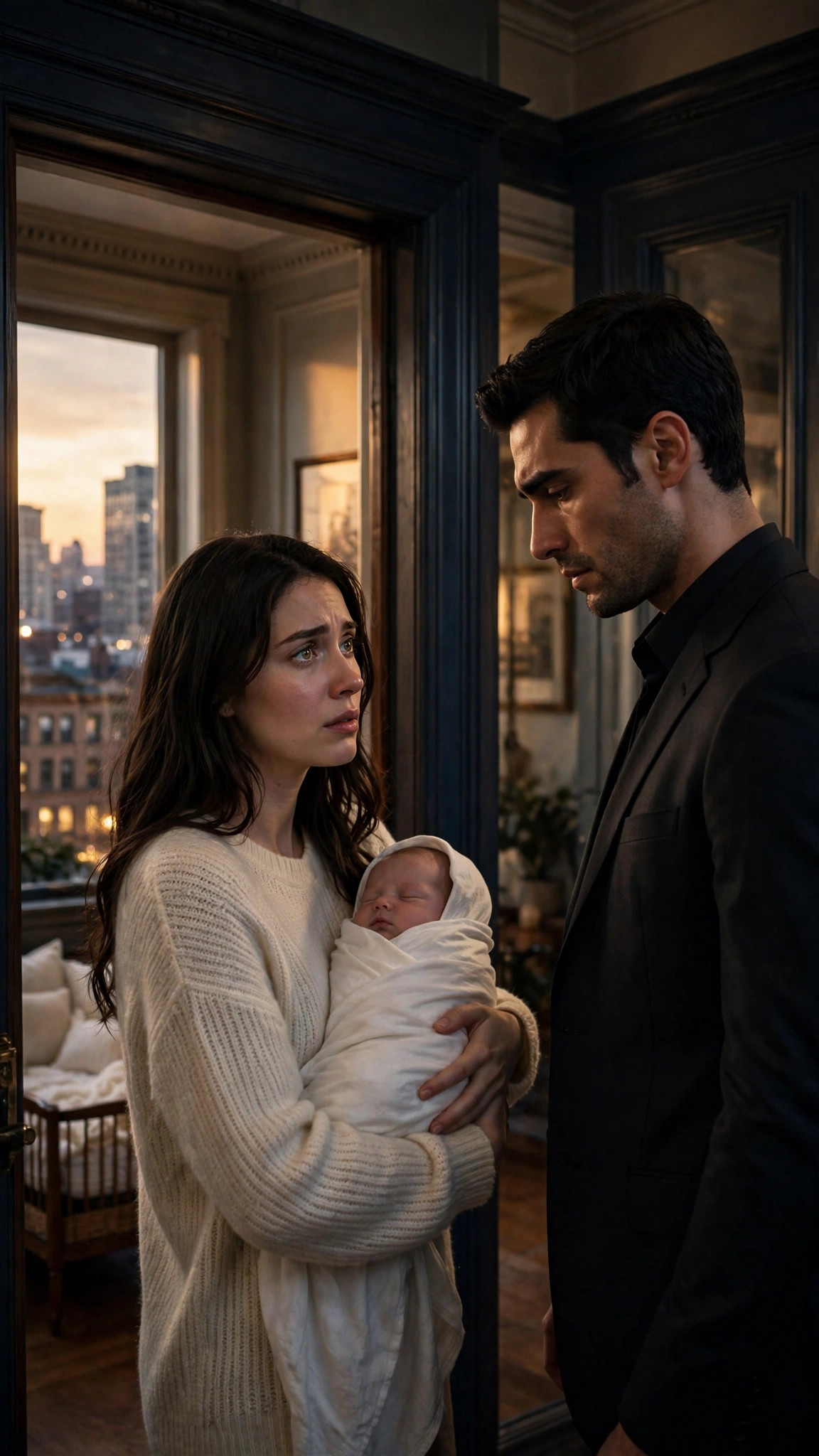
Vincent came to see me on a Sunday in November, on the first cold day of the season, when the wind off the lake cut through Bridgeport like a knife. He stood on my mother's porch with his hands in his coat pockets, and he looked smaller than I remembered him — not physically smaller, but somehow diminished, the way a man looks when he has been carrying something too heavy for too long and has finally set it down.
"Can I come in?" he asked. "I need to tell you something. And I need you to hear it from me, before you hear it from anyone else."
My mother took Elias upstairs. I made coffee. Vincent sat at the kitchen table — the same table where my mother had counted her tips, where my grandmother had shelled her peas, where I had signed the divorce papers in my head a hundred times before I ever signed them for real — and he told me the truth about the last two months.
"I made a deal," he said. "With the FBI."
I set the coffee pot down very carefully. "What kind of deal?"
"The kind where I give them Falcone," he said. "Everything. The docks. The shipments. The money laundering through the import company. The names, the dates, the account numbers. All of it. In exchange, they give me immunity, and they give the family a way out — a way to go legitimate, all the way legitimate, not just the hotels and the restaurants, but all of it. No more underground. No more South Side empire. Just Carter Holdings. Just the clean half. Just — " He stopped. He looked at me. "Just the half that you own."
"Why?" I asked. "Why would you do that? You would be giving up everything your grandfather built. Everything your father built. Everything you built."
"Because I finally understood something," he said. "On the night Elias was born, my grandfather died, and I spent fifteen days trying to hold his empire together, and I lost my wife and my son in the process. And I realized — sitting in a safe house at three in the morning, eating cold food out of a paper bag, wondering if you were ever going to speak to me again — I realized that my grandfather's empire was never worth anything. It was built on fear. It was built on men like Bellini and Falcone, who smile at you and then put a knife in your back. It was built on midnight calls and photographs and women in red dresses. And I don't want my son to grow up in that world. I don't want Elias to grow up the way I grew up — learning that the people you love can disappear, and that the only thing that matters is power. I want him to grow up the way you grew up. In a house where the radiators knock and the kitchen smells like garlic and coffee. In a world where people show up."
He reached into his coat and took out a folder, and he set it on the table between us.
"This is everything," he said. "The FBI file. The recordings. The evidence against Falcone, against Bellini, against Vanessa. I recorded every meeting. I wore a wire for six weeks. I gave them the midnight calls — Vanessa's calls to you, the recordings of my voice, all of it. She was working for Falcone the whole time, Madison. She leaked the photograph. She made the midnight calls. She wanted to destroy our marriage so the Falcones could take the family while I was weak. And it almost worked. It almost worked, because I let it work, because I chose the family over you, and I will regret that choice for the rest of my life."
I opened the folder. Inside were photographs, transcripts, bank statements — page after page of evidence, all of it in Vincent's handwriting in the margins, all of it annotated in his careful, precise script. And on the last page, there was a letter, in his handwriting, addressed to me.
I read it out loud, because I needed to hear it in my own voice, to believe it was real.
"Madison," I read. "I know that I abandoned you. I know that no reason makes it right. I know that you took half my empire because I gave you no choice. And I know that you may never forgive me. But I want you to know that I have spent the last two months dismantling everything that kept me away from you. I have given the FBI everything they need to destroy the Falcones. I have cut Bellini out of the family. I have closed the import company, the part that was never clean. I have fired every man who ever told me that my wife was less important than my business. And I have done it all for one reason: because I want to be the man you married. The boy in the waiting room. The man who held your hand and told you the dark couldn't hurt you. I want to be that man again. And if you will let me, I will spend the rest of my life proving it."
I set the letter down. My hands were shaking. Vincent was watching me, and his eyes were wet, and he looked like a man who had just put his whole heart on the table and was waiting to see whether I would pick it up or push it away.
"Vincent," I said. "Do you know what my grandmother used to say? She said a person's true character is revealed by how they respond when you're weak. You failed that test, Vincent. You failed it completely. But you know what she never said? She never said a person only gets one test."
He leaned forward. "What are you saying, Madison?"
"I'm saying that what you've done — the FBI, the recordings, dismantling the empire — that's a second test. And you passed it. You passed it because you did it without being asked, and without knowing whether I would ever forgive you. You did it because it was right. And that matters to me. That matters more than I can tell you."
"Then — " He stopped. He swallowed. "Then is there a chance? Is there any chance at all that we could — "
"I don't know," I said honestly. "I don't know yet. I need time. Elias needs time. And you need to understand something: if we do this — if we try again — it will not be the way it was before. I am not the same woman you married. I own half of your empire now. I run a company. I have a lawyer, and an accountant, and a boardroom full of men who answer to me. I will never again be the wife who waits at home while her husband disappears for fifteen days. I will never again be second to anything. Not your family. Not your business. Not your empire. Do you understand that?"
"I understand," he said. "And I wouldn't want it any other way."
That night, after Vincent left, I sat in the nursery with Elias, and I told him about his father. Not the whole story — he was three months old, and the whole story would take years — but the beginning of it.
"Your father is trying, Elias," I whispered. "He made a terrible mistake, and he is trying to fix it. And trying matters. Trying is the difference between a man who abandons you and a man who comes back. Your father came back. He came back, and he is still coming back, every single day, and that has to count for something."
Elias slept on, his tiny fist curled around my finger, and I thought about the lion who was afraid of the dark, and about the boy who had told me that story, and about the man that boy had become, and about the woman I had become in the fifteen days when no one came for me.
I had survived the fifteen days. I had taken half an empire. I had built a company, and faced down Bellini, and faced down Falcone, and faced down Vanessa Reed. And now I had a choice to make — not about whether Vincent deserved forgiveness, but about whether I deserved a family that was whole.
I did not decide that night. But for the first time in months, I let myself imagine what it would be like to decide yes.
The arrests came on a cold morning in December, three weeks after Vincent's confession in my mother's kitchen. I watched it on the news, holding Elias in my arms, while the television showed federal agents leading Anthony Falcone out of his office building in handcuffs, and Marco Bellini out of a restaurant on Taylor Street, and Vanessa Reed — in a gray suit, not a red dress — out of a hotel downtown, her face blank, her hands cuffed in front of her.
The news anchor said the words "organized crime" and "racketeering" and "money laundering," and I thought about the photograph of Vincent laughing with Vanessa in that hotel, and about the midnight calls, and about the fifteen days, and I felt something loosen in my chest — not forgiveness, not yet, but the beginning of justice. The people who had tried to destroy my marriage were going to prison. The people who had shot Tony were going to prison. The people who had firebombed my restaurant were going to prison.
Tony called me that afternoon from the hospital, where he was finally being discharged. "Mrs. Carter," he said, his voice thick with emotion, "I just want you to know — Mr. Carter did the right thing. He did what his grandfather never could. He chose his family over the family. You should be proud of him."
"I am," I said, and I was surprised to find that it was true. "I am proud of him, Tony. I just haven't told him yet."
Eleanor came to the house that evening with a bottle of champagne and tears in her eyes. "Salvatore would have hated this," she said, pouring two glasses in my mother's kitchen. "He built that empire with his own hands, and Vincent just gave half of it to the FBI. But you know what? Salvatore also abandoned me for three weeks when Vincent was born, and I forgave him, and I spent thirty years wondering what my life would have been if I hadn't. Vincent is not his grandfather, Madison. Vincent is better. He proved it. And you — " She raised her glass. "You proved that a wife is not a possession. You proved that a woman can take half an empire and run it better than the man who built it. To you, Madison. To the bravest woman I know."
We drank the champagne, and Eleanor held Elias, and she told him stories about Vincent as a little boy — how he had once brought home a stray dog and hidden it in his closet for a week, how he had cried when his goldfish died, how he had held her hand in the hospital when his own father had surgery, the way he had once held mine.
"He was always a good boy," Eleanor said. "The world made him hard. But underneath it all, he was always a good boy. And you, Madison — you were the one person who ever saw that. Don't forget that you saw it first."
The next day, Vincent asked if he could take Elias to the park.
It was the first time he had asked to be alone with his son. I watched from the kitchen window as he carried the car seat out to his car, buckling it in with the careful, nervous movements of a man who had read the instruction manual three times and was still afraid of getting it wrong. He drove slowly — so slowly that my mother laughed and said he was going slower than her old bicycle — and when they came back two hours later, Elias was asleep, and Vincent was carrying him against his chest, and his face was transformed.
"He smiled at me," Vincent said, his voice full of wonder. "He looked up at me, and he smiled, and I — " He stopped. His eyes were wet. "Madison, I have done a great many things in my life. I have built an empire. I have commanded men. I have stood in rooms where everyone was afraid of me. And none of it — none of it — felt like that. None of it felt like my son smiling at me."
He sat down on the porch steps, still holding Elias, and he looked out at the street, and he said, very quietly, "I missed his first smile. I missed his first two months. I will never get those back. But I am here now. And I am not going anywhere. Not ever again. I promise you that, Madison. I promise you on my grandfather's grave, on my mother's life, on everything I have left. I am not going anywhere."
I sat down beside him on the porch steps, and Elias slept between us, and the cold December wind moved through the bare trees, and for the first time in months, I felt something I had not felt since the night Vincent walked back into my house and said "I'm back."
I felt hope.
Not certainty. Not forgiveness. Not yet. But hope — the quiet, stubborn kind of hope that my grandmother had talked about, the kind that lives in the dark and waits for morning. Hope that the boy from the waiting room was still there. Hope that the man he had become could be better. Hope that my son would grow up in a world where his father showed up.
"I believe you," I said. And I meant it. "I believe you, Vincent. But believing you and trusting you are two different things. Trust takes time. And I need you to give me time."
"Take all the time you need," he said. "I'll be here. I'll be right here, for as long as it takes."