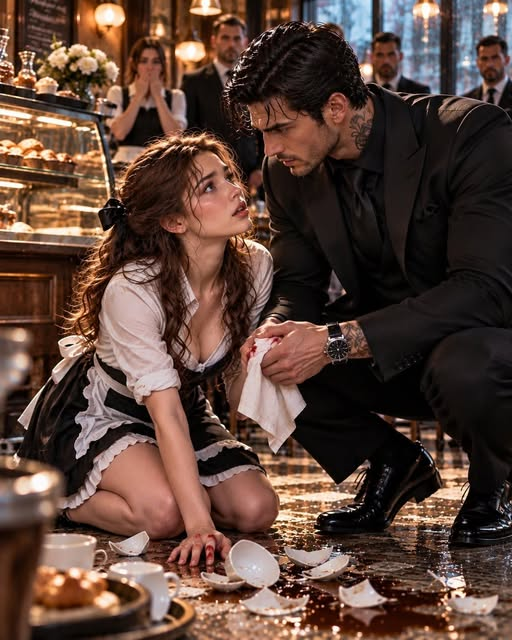
On a bright morning in late spring, Alessandro asked me to marry him.
Not again — he was careful about that, standing in the garden with his hands conspicuously at his sides, like a man defusing something. Not again, because the first time had been arranged over my head by desperate men, and he wanted it understood, by me most of all, that everything about this was different.
"The lawyers say the marriage was never dissolved," he said. "There were never any papers. Legally, you're my wife. You've been my wife every day for six years." A muscle worked in his jaw. "But I didn't come out here to read you the law, Sophia. The law is what was done to you. I'm asking — asking, with no family, no council, no dead father's instructions standing behind me — whether you would choose it. Choose me. And if you won't, then the lawyers will draw up whatever freedom looks like, and you will have this house or another, and money that is yours outright, and my protection for the rest of your life whether you want it or not, and no one — no one — will ever make you pay for the answer. I have spent four years learning exactly what my name cost you. I won't spend another day letting it be a debt."
Six years earlier, a man I barely knew had stood beside me in a cathedral and looked like he'd rather face a firing squad. Now the same man stood in his garden in the spring light and offered me every exit, at ruinous cost to himself, and waited with his hands empty.
That was when I understood what my father had seen in him. Not the power. Not the protection. The faith-keeping. A man who closes his fingers over an envelope and doesn't open it for four years, because he promised a dying man he'd wait until she asked.
"Alessandro," I said, "I have a condition."
He braced, visibly. "Name it."
"The tin box in my dresser at the apartment. I need you to send someone for it. There's eleven dollars in it that's mine — the first money I ever earned that no collector ever touched, and I've been saving it for something that mattered." I took a breath. "And the ring is in it."
He was very still.
"You kept the ring," he said.
"I kept the ring," I agreed. "I told myself it was evidence. Then I told myself it was an asset — silver's worth something, I could sell it if things got bad enough, and there were months, Alessandro, there were months I stood in a pawnshop doorway with it in my fist. I never went in. I told myself it was pride." I looked at him, and kept the envelope rule, one more time, the hardest time. "It wasn't pride. It was the only thing in that box that was ever really mine, and I think some part of me knew the story I'd been told about it was a lie. I just wasn't ready to be right."
He crossed the garden in three strides and stopped — stopped, still obeying the law of his own restraint — an arm's length from me, close enough that I could see the gray of his eyes go bright at the edges.
"Say it plainly," he said, roughly. "I've waited six years, Sophia. Say it plainly."
"I choose you," I said. "Not the arrangement. Not the protection. Not my father's plan, God rest him, though he chose well. You. The man who held an umbrella of himself over me in the rain. The man with the drawer of dead ends. I choose you, Alessandro Caruso, with my eyes open, and I would like my ring back on my finger, and this time I want flowers I picked myself, and I want to be asked the question in the church like a person and not a policy. And I want — " my voice did something unsteady " — I want to stop being a story that was told about me. I want to be the woman it happened to, living the rest of it out loud."
On the morning of the wedding — the real one, the chosen one — Marie came to my room with a garment bag over her arm and a face doing complicated things. She'd finished three months of treatment in the hills by then: real treatment, with doctors who treated her compulsion the way you'd treat a fire in the walls, patiently and structurally, without pretending it was a flaw that shame could solder shut. She looked older and younger at once. Her hands, I noticed, were still.
"Your mother wore this to her wedding," she said, and unzipped the bag. "Not a gown — we weren't gown people. But your father kept it, and then I kept it, and I kept it through years when I was selling everything that wasn't nailed down, Sophia. I want you to know that. Whatever else I sold. Not this."
It was a simple dress, ivory, older than I was, with hand-sewn lace at the sleeves gone the color of weak tea. It would never photograph like the first wedding dress — the cathedral one, with its banked roses and its politics. It fit me like it had been waiting.
"I can't forgive all of it yet," I told her, standing in my mother's dress while her hands did up the back buttons the way they had when I was small. "I need you to hear that out loud, because we're done with scripts in this family. I love you. You're my family — the only one the fire left me, besides him. And I can't forgive all of it yet. Both of those are going to have to be true at the same table for a while."
Her hands paused at the last button. In the mirror I watched her decide, the way I'd watched Alessandro decide things — the whole cost of a sentence, weighed in a silence.
"I can carry both," she said at last. "I carried worse, for worse reasons, and called it love because I had nothing else to call it. This — this I can carry honestly." She finished the buttons and set her palms flat and warm between my shoulder blades, just for a second, the way she used to check me for fever. "Your father would have walked through fire to see you in that dress, choosing it yourself. Since he can't, I'll sit where he can see through me. Front pew. Hands quiet."
She did exactly that. And so, three days after a man in a garden offered me every door out of his life, I walked into the cathedral where I'd once been a policy — wearing my mother's dress, toward the man who'd made the offer — and I have never in my life been so sure of a direction.
He put the ring on my finger himself, in that same cathedral — and this time the flowers were daisies and white roses I'd chosen at the market that morning with my own money, and Marie sat in the front pew in a new dress with three months of treatment behind her and her hands quiet in her lap, and Mrs. Moretti was there, and Dante stood at Alessandro's shoulder wearing the expression of a man personally taking credit for the weather. This time, when I said the words, my hands didn't shake. This time, when he said them, he was looking at me — only at me, like there was nothing else in the building, or the city, or the world that had earned the right.
Afterwards, at the estate, over a table that groaned, he gave me his wedding gift: a slim case, like the one that had held my father's ledgers. Inside were documents, stamped and sealed — the deed, transferred outright and irrevocably, to a certain property in the bakery district of Bellhaven.
"Moretti's," he said, while I stared. "Mrs. Moretti has wanted to retire to her sister in Florida for two years. She held out for a buyer she'd trust with the place. I told her the place already had a soul and the soul's name was Sophia, and she said — " his mouth did the rare thing it did, the almost-smile " — she said it was about time somebody with sense married you, and she knocked four percent off the price for sentiment."
I laughed, and then I cried, and then I laughed again, standing in my wedding dress holding the deed to the place where my life had broken open — because that's what it was, in the end. Not where I'd been small. Where I'd been found. By him, yes — but by myself first, kneeling in spilled coffee with a bleeding hand, telling the most feared man in the country that I didn't belong to him.
He was right, that morning. I never had.
I belonged to myself. And then, freely, entirely, eyes wide open — I chose to belong with him too.
I walked through the bakery alone the week before the reopening, with the deed in my bag and the keys — my keys — cold in my hand. The staff had gone home. The ovens ticked as they cooled. I stood at the pass-through counter where I had stood for four years with my feet screaming and my stomach empty, and I put my palm flat on the marble, on the scar's side, and I made the place a promise of my own.
The first thing I built was a shelf by the door. Oak, at waist height, with a small brass plate that says nothing at all. Every morning, what didn't sell the day before goes on that shelf, and it is free — not discounted, not charitable-looking, free, in paper bags with no names taken and no questions wearing a uniform. The staff thought it was a promotion. Mrs. Moretti, visiting from Florida planning with a tape measure and strong opinions about awnings, understood it instantly, because she had run the same shelf for years in everything but name and furniture: its stock had been broken pastry corners, fed quietly to a girl too proud to ask, by a woman too proud to offer outright.
"I charged you nothing and you paid me in pretending not to notice," she said, when I showed her the plans over the phone. "Now you'll charge nothing and nobody has to pretend. That's not sentiment, Sophia. That's an upgrade to the system." A pause, full of Florida sunshine. "Four percent off, I gave him. The man drives a hard bargain for a romantic."
The second thing I built was slower and had no furniture: a fund, from the bakery's profits and the forfeiture settlement both, that pays for exactly one thing — the trade-school fees and first month's rent of any girl in Bellhaven who is working a job like the one I worked, carrying debts that aren't hers. Dante's people vet the quiet part; I vet the rest myself, over coffee, at the counter, one girl at a time. My father kept books for half the families in this city, and his daughter keeps one book of her own now — a small one, in pencil, with stars beside the figures I've verified twice. There are no doors drawn in its margins. Every page of it is one.
Moretti's Bakery reopened in June under a new sign, though I kept the name — some names deserve keeping. I work the mornings still, because the mornings are mine now and I love them: the ovens breathing warmth into the dark, the first trays, the city's earliest faces at the counter. My hands know the work the way they always did, but they work for me now. The scar on my palm has faded to a thin white seam. Some mornings I catch myself looking at it the way you look at a road on a map that you traveled a long time ago, in another life.
On the first morning of the reopening, Alessandro came in at seven, in his black suit, with the rain threatening outside — because some things even a happy ending doesn't change, and Bellhaven weather is one of them. He sat at table seven. He ordered coffee, and a pastry, and he watched me over the rim of his cup with those cold gray eyes that aren't cold at all once you've learned the language of them.
I carried his coffee across the bakery myself. Past the new window, past the full cases, past the little brass plaque by the door that says what the place is and whose it is.
Halfway to his table, my fingers — trained by four years of exhaustion and one morning of fate — remembered their old trick. The cup tipped. Just a breath. Just enough.
Alessandro's hand was there before the coffee was: steady, tattooed, unhurried, closing around the cup mid-fall with the ease of a man who has caught falling things before and intends to go on doing it. Not a drop spilled. He set it down on its saucer with great ceremony, like a man completing a ritual, and looked up at me.
"Careful, Mrs. Caruso," he said.
"My husband taught me," I said, "that I'm allowed to be caught."
And he smiled — fully, helplessly, the smile nobody in Bellhaven would have believed — and pulled out the chair across from him, at table seven, in my bakery, in the morning light.
I sat down with my husband, and I drank my coffee while it was hot, and it was the best thing I had ever tasted.