It was a Tuesday in October, three years after our second anniversary, when I found the receipt. I was doing laundry, the most ordinary task in the world, emptying the pockets of Vincent's jackets before I put them in the washing machine, and in the inside pocket of a grey suit jacket he had worn to Miami the week before, I found a folded piece of paper.
It was a receipt from the Meridien Hotel. Not our hotel in Chicago. The Meridien in Miami, the one on the beach, the one with the restaurant that served dinner until midnight and the rooms with the view of the water.
A receipt for champagne, candles, and roses.
And scrawled across the bottom, in a handwriting I did not recognize, were two words: "Happy Anniversary."
But it wasn't our anniversary.
Our anniversary was in June. This receipt was dated October 14th. The champagne was a vintage bottle, the kind that cost more than most people spent on dinner in a month. The candles were the ones the hotel put in the rooms when a guest requested a romantic evening. The roses were two dozen white ones, the same flowers Vincent had given me on our wedding day.
I sat down on the floor of the laundry room with the receipt in my hand and I read it five times. I read it the way you read a letter that changes your life, slowly, word by word, because your brain refuses to understand it all at once.
Champagne. Candles. Roses. Happy Anniversary. October 14th.
I knew, in that moment, with a certainty that went through me like cold water, that my husband had been cheating on me for years. Not months. Years. The anniversary on that receipt was not ours. It was theirs. Whoever she was, she had an anniversary with my husband, and he had celebrated it with champagne and candles and two dozen white roses in a hotel room in Miami while I was at home in Chicago, coordinating a charity gala and wondering why his phone calls had gotten shorter.
I did not cry. I wanted to cry, but the tears would not come. Instead, something cold and clear settled over me, the way it settles over you when you finally stop being afraid of the answer because you already know it.
I folded the receipt and put it in my notebook. I wrote the date. I wrote down what it said. I wrote down the name of the hotel and the price of the champagne and the words "Happy Anniversary" in quotation marks, because I wanted to remember exactly how it had been written, in case I ever needed to prove it to someone who did not believe me.
Then I went upstairs, and I waited for Vincent to come home.
He came home at nine that night. He kissed my cheek. He asked me about my day. He told me the Miami trip had gone well, that the shipping contracts were almost finished, that he would be home for the next two weeks and we should do something nice together, maybe dinner at the Italian restaurant where we had our first date.
I looked at him, this man I had loved for eight years, and I said, "Vincent. Who is she?"
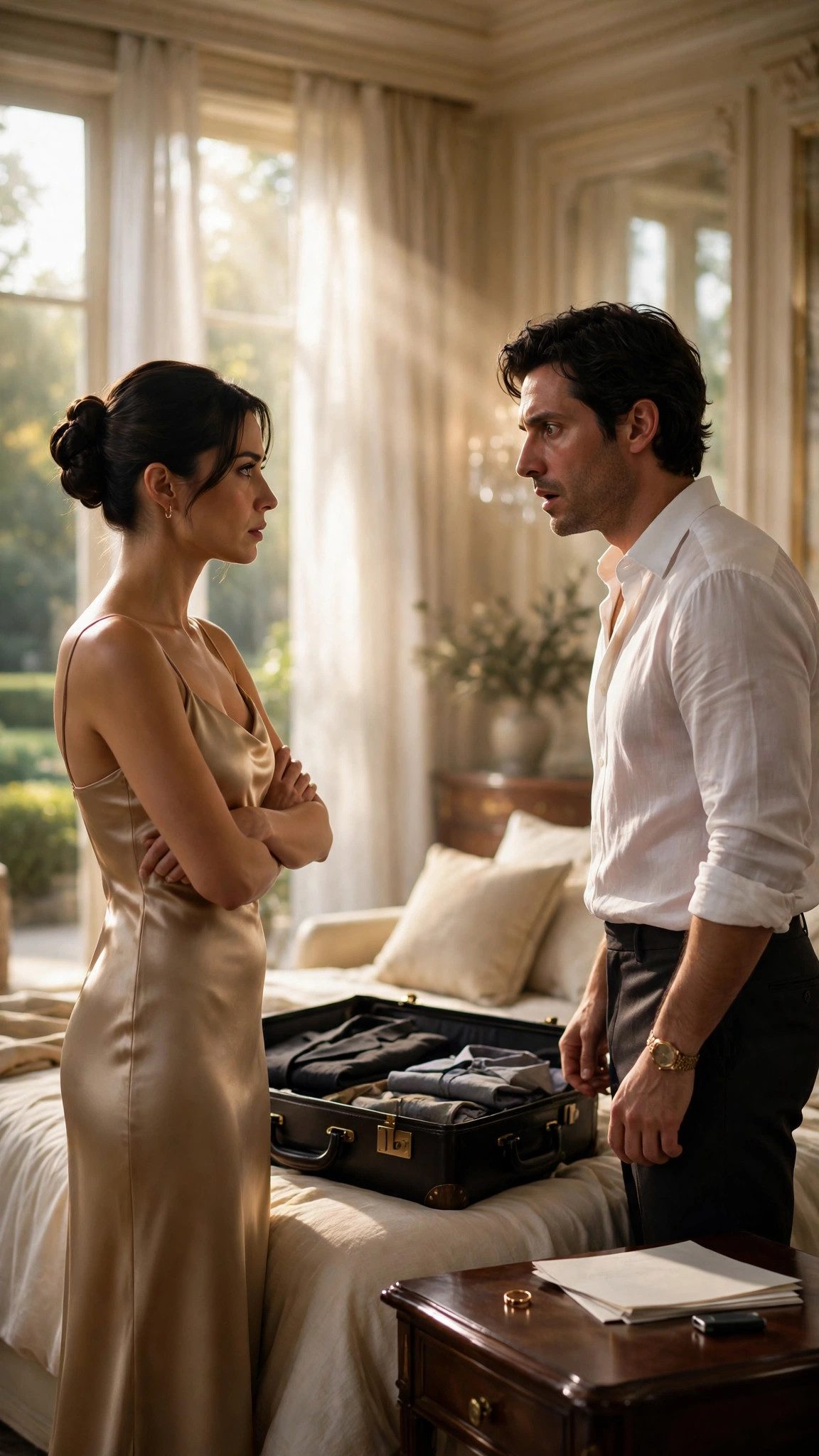
The color did not leave his face that night. Not yet. That would come later, in the bedroom, beside the suitcase. That night, he just looked at me with an expression I had never seen on his face before, an expression that was not guilt and not anger but something worse: surprise. He was surprised that I knew. He was surprised that I had found out. He had been so careful, or so he thought, and the idea that his wife had noticed anything at all seemed to genuinely shock him.
"Who is who?" he asked.
"Don't," I said. "Don't do that. I found the receipt, Vincent. The Meridien. October 14th. Champagne, candles, roses. Happy Anniversary. It wasn't our anniversary."
He was quiet for a long moment. Then he said, "It's just an annual meeting. You're imagining things."
An annual meeting. He said it so calmly, so reasonably, that for a second I almost believed him. That was the terrible thing about Vincent. He could lie the way other men breathed, easily and without thinking, and he could make the lie sound like the truth because he believed, in that moment, that he was protecting me.
But he wasn't acting like his usual self, because he wouldn't meet my eyes. Vincent Moretti, the man who could stare down a room full of dangerous men without blinking, could not look his wife in the eye while he told her that a receipt for champagne and roses was an annual meeting.
"An annual meeting," I repeated. "With candles and roses. And a card that says Happy Anniversary. What kind of annual meeting is that, Vincent?"
"The hotel makes mistakes," he said. "They write things on receipts. It doesn't mean anything."
"The hotel doesn't write 'Happy Anniversary' on a receipt for a business meeting," I said. "And it doesn't put two dozen white roses in a business meeting."
He stood up. He walked to the window and looked out over the lake, his back to me, and I watched the muscles in his shoulders tighten under his shirt.
"Claire," he said, without turning around, "you have a wonderful life. You have this penthouse. You have everything you could ever want. Don't ruin it by imagining things that aren't there."
I stared at his back. I thought about the necklace he had given me on our second anniversary, the one with *My Claire* engraved on the back. I thought about the rooftop garden and the white roses and the phone calls that had once lasted half an hour. I thought about Rosa in the kitchen, telling me that I was the one thing Vincent did not know how to guard, because he had never had anything he was afraid to lose before.
And I thought: he is not afraid to lose me. That is the whole problem. He has never been afraid to lose me, because he has always believed I would stay, no matter what he did.
I did not argue with him that night. I did not scream or cry or throw anything. I went to bed, and I lay awake in the dark listening to him breathe beside me, and I made a decision.
I would stay silent. Not because I was afraid of him. But because I wanted proof.
The following week, I found the photographs.
Vincent had left his phone on the kitchen counter while he was in the shower, and it lit up with a message. I did not mean to look at it. I had never looked at his phone before, not once in seven years of marriage, because I had believed that looking at your husband's phone was something you did when you no longer trusted him, and I had wanted to trust him until the very last second.
But the phone was there, and the screen was lit, and the message preview showed a photograph, and the photograph showed my husband kissing a young woman outside a hotel.
I picked up the phone. My hands were shaking so hard I almost dropped it. I opened the photographs, and there they were. Not one photograph. A dozen. My husband, in Miami, in New York, in Atlantic City, kissing a young woman with long blonde hair and a red dress, a woman I had never seen before in my life, a woman who was laughing in every photograph as if the world were a wonderful place and my husband belonged to her.
Her name, I would learn later, was Sofia Marchetti. She was twenty-four years old. She was a lounge singer at the Meridien Hotel in Miami, a girl with a beautiful voice and a beautiful face and no idea, or no care, that the man she was kissing was married.
Or maybe she knew. Maybe she knew exactly what she was doing. It did not matter. What mattered was that my husband had chosen her, again and again, for three years, and he had done it while I was at home believing in him.
I put the phone back on the counter, exactly where I had found it. I went into the bathroom and I was sick, quietly, into the sink, so he would not hear me. Then I washed my face, and I put on my makeup, and I went downstairs and I made breakfast, and when Vincent came into the kitchen in his suit, I kissed his cheek and asked him about his day.
He did not notice anything different about me. That was the most frightening thing of all. He looked at me and he saw the same wife he had always seen, and he had no idea that the woman standing in front of him had just seen the photographs that would end their marriage.
I stayed silent for three weeks. Not because I was afraid of him. But because I wanted proof, and because Grace had told me that a man like Vincent, confronted without proof, would tell me I was imagining things, and he would be so good at it that I would start to believe him.
I was not going to give him that chance.
During those three weeks, I collected everything.
Text messages. I waited until Vincent was asleep, and then I took his phone from the nightstand and I photographed every message between him and Sofia with my own phone, one by one, in the dark, my heart beating so hard I was sure it would wake him. The messages were not subtle. They were not the messages of a man conducting business. They were the messages of a man in love, or at least a man who wanted someone to believe he was in love. *I miss you. I can't wait to see you. The room is booked. Wear the red dress.*
Voice messages. Sofia had left him voice messages, and I listened to them with the phone pressed to my ear in the bathroom with the water running so he would not hear. Her voice was young and bright and breathless. "Vincent, darling, I counted the days. Three more days until Miami. I bought something new for you. You are going to love it." I listened to that message three times, and each time I felt a little less like a wife and a little more like a detective, which was good, because a wife would have cried, and a detective does not cry. A detective writes things down.
Flight records. Vincent's assistant, a nervous young man named Paolo who had worked for him for two years, kept the travel calendar. I did not have to ask Paolo for anything. I simply waited until Vincent was out of the office and I walked into his study and opened the calendar on his desk, and I photographed every flight for the last three years. New York, he had told me. The calendar said Miami. Late meetings, he had told me. The calendar said the Meridien Hotel, four nights, a suite with a view of the water. I wrote it all down in my notebook, in my neat handwriting, date after date after date, until the notebook was half full and the pattern was so clear that no one in the world could have looked at it and called it a coincidence.
Credit card statements. This was the easiest part, and the hardest. The statements came to the house, and I had always thrown them away without reading them, because Vincent handled the money and I had never needed to know how much a bottle of champagne cost. Now I opened every envelope. I found the charges for the Meridien, again and again. I found the charges for jewelry, a necklace that was not mine, a bracelet that was not mine, earrings that I had never seen. I found the charges for flowers, delivered to a hotel room in Miami, two dozen white roses, the same flowers he had given me on our wedding day.
The pieces fit together perfectly. Not like a puzzle, where you have to guess. Like a confession, where every piece says the same thing in a different way.
And once I had everything, I planned my exit carefully.
I had already realized that Vincent didn't care about my feelings, nor did he care about my loyalty. He only cared about his own reputation. A man who controlled an empire worth hundreds of millions of dollars could not afford a public scandal. A wife who left him would be a scandal. A wife who left him with proof would be a disaster.
So I would give him a disaster. But I would give it to him on my terms, in my own time, in a way he could not undo.
I called Grace. I told her everything. I showed her the notebook, the photographs of the messages, the flight records, the credit card statements. She read through it all in silence, and when she finished, she looked at me the way she had looked at me in that restaurant years ago, when she told me to document everything.
"You have enough," she said. "You have more than enough. What do you want to do?"
"I want a divorce," I said. "And I want him to know exactly why."
Grace nodded. She did not try to talk me out of it. She did not tell me to think about the money or the penthouse or the life I would be giving up. She simply opened her briefcase and took out a set of papers.
"Sign these when you are ready," she said. "Not before. The papers are ready. The rest is up to you."
I took the papers home. I put them in the drawer of my nightstand, underneath a stack of scarves, where Vincent would never look. And I bought a USB drive, a small black one, and I copied everything onto it. The photographs. The videos I had taken of his phone screen, showing the messages. The hotel records. The travel dates. Every woman, every lie, every so-called business trip, documented and dated and saved in a file that could not be argued with.
I labeled the drive in my own handwriting. I wrote one word on the label: *Truth.*
I kept it in my nightstand too, beside the divorce papers, waiting for the night I would need it.
That night came sooner than I expected. Vincent came home on a Friday evening and told me he was leaving on Monday for another three-day business trip. He stood beside an open suitcase in expensive trousers and a crisp white shirt, folding a jacket, and he said, "Don't wait up, Sweetheart, just try to sleep."
And I looked at him, and I saw the uncertainty in his eyes for the first time, and I knew that this was the night. This was the night I would say the words I had been waiting seven years to say.