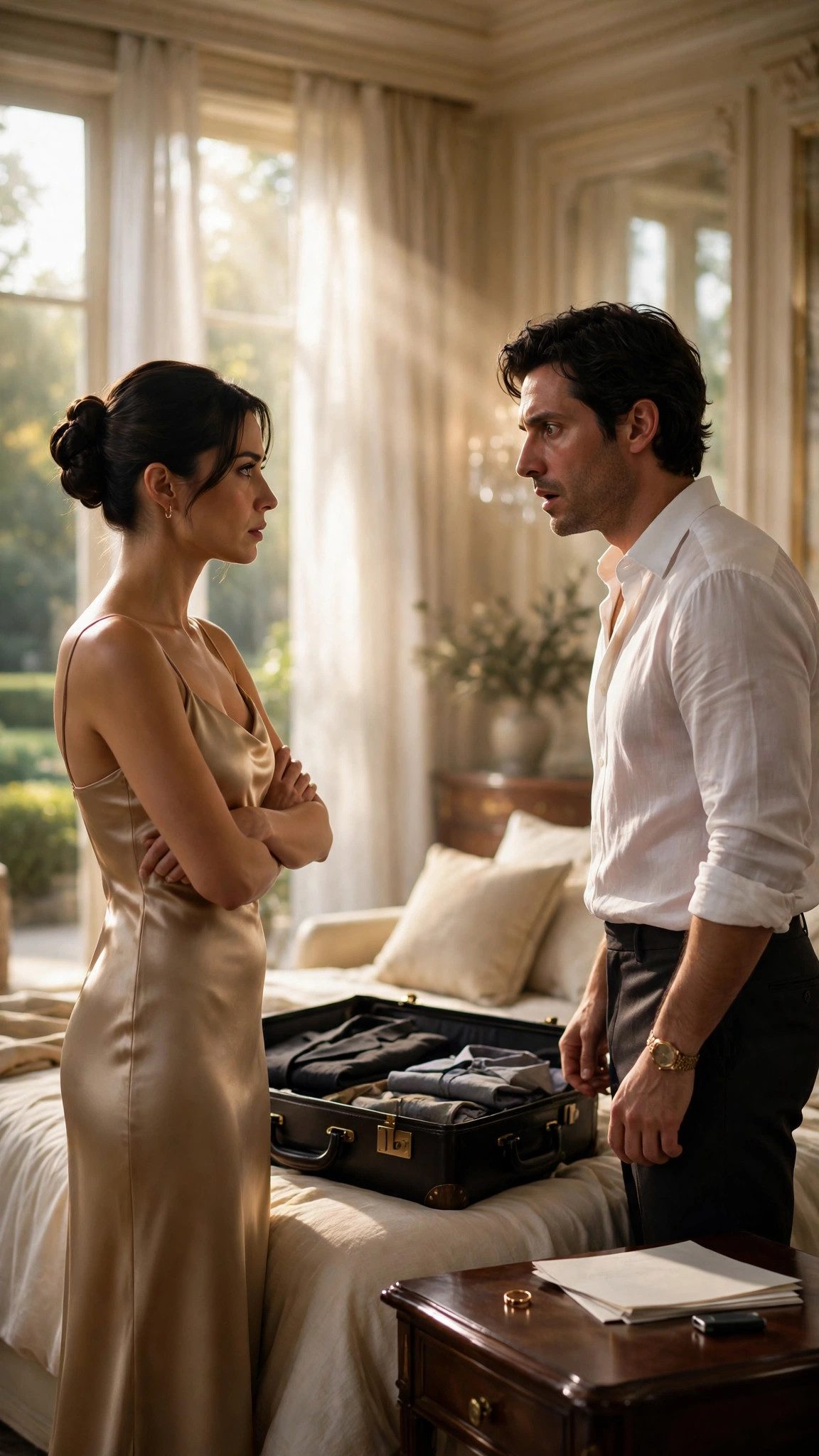
Vincent Moretti had never been afraid of anything in his life. He had been afraid exactly once, when he was nine years old and his father had taken him to a warehouse in the middle of the night to show him what happened to men who betrayed the family, and he had stood in the dark and watched and understood, in the way a child understands terrible things, that the world was a dangerous place and that the only way to survive it was to never show fear.
He had not been afraid since. Not when he took over his father's empire at twenty-four. Not when rival families had tried to kill him. Not when the police had raided his casinos and his lawyers had told him he might go to prison. He had faced all of it with the same cold, flat calm, and he had survived all of it, because Vincent Moretti did not feel fear.
He felt it now.
It started the moment Claire walked out of the bedroom, and it did not stop. It sat in his chest like a stone, and it grew heavier every hour, until by the third day he could barely breathe.
He did what he had always done when he was afraid. He gave orders.
"Find her," he told his men. "Check every airport, every hotel, everywhere she could have gone. IMMEDIATELY!"
They checked the airports. They checked the hotels. They went to her mother's house in Ohio and they asked questions, and her mother told them she did not know where Claire was, and Vincent believed her, because her mother had looked at his men with the same cold contempt Claire had looked at him with in the bedroom, and he understood that his wife's family had never liked him and had never trusted him, and that they were glad she was gone.
They checked her credit cards. She had not used them. They checked her phone. It was off. They checked the friends she had in Chicago, one by one, and every one of them said the same thing: they did not know where she was.
Only one friend did not answer the phone. Grace Hollis. The lawyer. The best friend. Vincent knew, the moment her phone went to voicemail for the third time, that Grace knew exactly where Claire was, and that Grace would rather go to prison than tell him.
He did not send men to Grace's office. He was not a fool. He knew that threatening a divorce attorney would only make things worse, and he knew, in the part of his mind that was still capable of thinking clearly, that the problem was not Grace. The problem was him.
On the fourth night, alone in the penthouse, Vincent picked up the USB drive from the nightstand. It was still there, exactly where Claire had left it, beside the signed divorce papers and the empty space where her wedding ring had been. He had not touched it since the night she left. He had been afraid to touch it, the way a man is afraid to touch a letter he knows contains bad news.
He plugged it into his laptop.
The drive opened, and there it was. Everything. Photographs of him kissing Sofia outside the Meridien. Videos of his own phone screen, showing the messages he had sent her. Hotel records, flight records, credit card statements, all of it organized by date, all of it labeled in Claire's neat handwriting, all of it proof of three years of lies.
He watched the videos. He saw his own messages to Sofia, the ones he had sent at midnight from hotel rooms while Claire was asleep in Chicago. *I miss you. I can't wait to see you. The room is booked. Wear the red dress.* He saw the photographs of himself, laughing, holding Sofia's hand, looking happy in a way he had not looked happy at home in years.
And he saw, at the bottom of the drive, a folder he had not expected. It was labeled *Us.* Inside were photographs of him and Claire. Their wedding. The rooftop garden. The anniversary dinner. Claire asleep on his shoulder on a plane. Claire laughing in the kitchen while Rosa cooked. A hundred photographs of a marriage that had once been real, and Vincent sat in the dark in his empty penthouse and looked at them one by one, and for the first time since he was nine years old, he cried.
He cried for the man he had been in those photographs, the man who had remembered his wife's coffee order and built her a garden on a roof in the middle of winter. He cried for the woman in those photographs, the woman who had believed in him with her whole heart. And he cried because he understood, finally, what Rosa had tried to tell him years ago: Claire was the one thing he had never known how to guard, because she was the one thing he had never been afraid to lose.
Until now. And now she was gone.
The next morning, Vincent flew to Miami. He did not tell anyone he was going. He went to the Meridien, and he went to the lounge where Sofia sang, and he waited until her set was over, and then he walked up to her table.
"Vincent!" she said, smiling, standing up to kiss him. "I didn't know you were coming. I thought you were in Chicago."
"I was," he said. "My wife left me."
The smile faded from Sofia's face. She sat down slowly.
"Left you?" she said. "What do you mean, left you?"
"She found out about us," Vincent said. "She found the receipt. She found the photographs. She left me a USB drive with three years of evidence on it, and she left me divorce papers, and she left."
Sofia was quiet for a moment. Then she said, "Well. That's terrible. But Vincent, darling, now we don't have to hide anymore. Now we can be together properly. I was thinking, maybe I should move to Chicago. You could get me an apartment near the penthouse. Something nice. With a view."
Vincent stared at her. He looked at her the way he had looked at Claire in the bedroom, except this time he was not the one who was confused. This time, he was the one who finally understood.
Sofia did not love him. She had never loved him. She loved his money, and his hotels, and the life he could give her. She loved the red dress and the room with the view of the water. She did not love him. She had never once asked him about his day. She had never once remembered anything about him except what he could buy for her.
Claire had remembered everything. Claire had loved him when he had nothing to give her but his time and his attention. And he had thrown that away for a woman who was already asking him for an apartment.
"It's over, Sofia," he said. "It was over the moment my wife walked out of our bedroom. I just didn't know it yet."
"You can't be serious," Sofia said. "Vincent, I gave up three years of my life for you—"
"You gave up nothing," Vincent said. "You took everything I offered you, and you asked for more. That is not love. I know what love looks like now, because I lost it, and it does not look like you."
He walked out of the lounge without looking back. Behind him, Sofia called his name, but he did not stop. He went to the airport, and he flew back to Chicago, and he went to the penthouse, and he sat in the kitchen in Claire's chair, and he looked at the unsigned divorce papers on his desk, and he made a decision.
He would not sign them. Not because he wanted to trap her. Not because he wanted to punish her. Because he was not going to end their marriage with a signature on a piece of paper while she was two hundred miles away. If their marriage was going to end, it was going to end with him looking her in the eye and telling her the truth. And if it was not going to end, then it was going to begin again with him looking her in the eye and asking her to choose.
He called Grace Hollis. This time, she answered.
"Tell her," Vincent said, "that I am not looking for her to drag her home. Tell her I am looking for her because I need to ask her something, and I need to ask it in person. Tell her I will come alone. No men. No car. No phone. Just me. And tell her that if she says no, I will sign the papers the same day, and I will never bother her again."
There was a long silence on the other end of the line.
"I will tell her," Grace said finally. "But Vincent, you should know something. She is not the same woman who left your house. She is stronger now. She is not afraid of you anymore. If you go to her, you had better be ready for that."
"I am ready," Vincent said. "I have never been more ready for anything in my life."
Before he left for Harbor Springs, Vincent did three things.
The first thing he did was go down to the kitchen and find Rosa. She was rolling pasta at the counter, the way she had been rolling pasta for thirty years, and she did not look up when he came in.
"Rosa," he said.
"Mr. Vincent," she said, without stopping.
"Tell me something," he said. "Tell me what Claire loved. Not what I bought her. What she loved."
Rosa stopped rolling the pasta. She wiped her hands on her apron and she looked at him, and her eyes were not kind. They were the eyes of a woman who had watched a family destroy itself for thirty years and had finally run out of patience.
"She loved the garden," Rosa said. "She loved the white roses. She loved the mornings when you used to sit with her on the roof and drink coffee and tell her about your day. She loved the man who stacked chairs at a charity gala and helped a girl he did not know. That man is gone, Mr. Vincent. I do not know where he went. But if you find him, tell him his wife is waiting for him to come back."
Vincent nodded. He did not say anything. There was nothing to say.
The second thing he did was call his lawyer and tell him to close the suite at the Meridien in Miami. Not the hotel. Just the suite, the one with the view of the water, the one where he had celebrated an anniversary that was not his. He told his lawyer to cancel the standing reservation, to remove his name from the room, to make sure that no one in his organization would ever book that room for him again.
"Are you sure?" his lawyer asked. "That suite has been yours for three years."
"I am sure," Vincent said. "It was never mine. It belonged to a man I do not want to be anymore."
The third thing he did was go to his father's grave. He had not been there in five years. He stood in the cemetery in the rain and he looked at the stone with his father's name on it, and he thought about what his father had taught him: that the world takes what you do not guard, that love is a weakness, that a man who shows fear is a man who loses.
His father had been wrong. Vincent understood that now, standing in the rain with his suit getting wet and his shoes sinking into the grass. His father had guarded everything — his money, his territory, his men — and he had died alone in a hospital room with no one holding his hand, because he had never learned to guard the one thing that mattered. He had never learned to be afraid of losing a person.
Vincent was afraid now. He was terrified. And for the first time in his life, he understood that fear was not weakness. Fear was what told you that something was worth protecting. Fear was what Claire had felt for three years, every time his phone rang, every time he packed a suitcase. Fear was what she had lived with, while he had lived without it, and that was why she had left him.
He drove to Harbor Springs himself. No driver. No bodyguards. No men in cars behind him. Just Vincent Moretti, alone in a car, driving north along the lake, practicing what he was going to say to his wife.
He practiced it a hundred times, and every time it sounded wrong. Every version was too long, or too proud, or too much like a man giving orders. He wanted to tell her that he was sorry. He wanted to tell her that he had ended it with Sofia. He wanted to tell her that he had looked at the USB drive and seen three years of his own lies laid out in her handwriting, and that it had broken something in him that he had not known could break.
But most of all, he wanted to tell her the truth, the one truth he had never told her, because he had been too proud and too afraid to say it out loud.
He wanted to tell her that she was the only thing in his life he had ever been afraid to lose, and that he had not understood that until she was gone.
When he reached Harbor Springs, it was late afternoon, and the lake was grey and still, and the cottage was small and white with blue shutters, and there was smoke coming from the chimney. He parked the car at the end of the drive and he sat there for a long time, looking at the cottage, trying to find the courage to get out of the car.
He had faced rival families. He had faced the police. He had faced men with guns. He had never been as afraid as he was sitting in that car, looking at a small white cottage with blue shutters, knowing that the woman inside it held his entire life in her hands.
Finally, he got out of the car. He walked up the path. He knocked on the door.
And he waited.