I was twenty-five years old the night I met Alexander Moretti, and I was standing on a ladder in the ballroom of the Drake Hotel in Chicago, trying to hang a garland of white roses above a doorway without falling off and dying in front of two hundred of the richest people in the city.
I was a florist. Not a fancy one. I worked for a little shop on Milwaukee Avenue called Petals & Pine, and my boss, Mrs. Deluca, had taken the contract for the Moretti Foundation charity gala because the money was very good and because she was not afraid of anyone, including the Moretti family. I was the one she sent to do the work, because I was the one with steady hands and no fear of heights, and because I could arrange white roses the way other people played the piano — without thinking, and better than anyone else in the room.
"Careful on that ladder, sweetheart," a voice said from below me, deep and amused. "If you fall, I will have to catch you, and I am wearing a very expensive suit."
I looked down. Alexander Moretti was standing at the bottom of my ladder, looking up at me, holding a glass of whiskey he had not drunk from. He was thirty-seven years old, tall, dark-haired, with a face that newspapers described as handsome and police files described as dangerous, and he was smiling at me like I was the most interesting thing he had seen all evening.
"Then move," I said. "Or hold the ladder. One or the other."
He held the ladder. For forty minutes, while I finished the garland, the most feared man in Chicago stood at the bottom of a florist's ladder in a tuxedo and held it steady, and asked me questions about roses. He asked me why white roses and not red. He asked me how long they would last. He asked me if I had arranged the flowers for my own wedding, and I told him I had never been married, and he said, "Good," in a way that made my hands stop moving for a second.
"Good?" I said.
"Good," he said, "because you arrange flowers like a woman who has never had to settle for less than beautiful. I would hate to think someone had already taught you to settle."
I should have known then. I should have known that a man like Alexander Moretti does not hold a ladder for forty minutes by accident. But I was twenty-five, and I was covered in rose thorns, and no one had ever looked at me the way he was looking at me, like I was a locked door and he had all the time in the world to find the key.
He came to the flower shop the next week. He bought twelve white roses and asked me to teach him their names. He came the week after that, and bought twenty-four, and asked me where I had learned to arrange flowers. I told him my mother had taught me, in the kitchen of our little apartment above a bakery on Taylor Street, back when my father was still alive and the world was still simple. He listened the way nobody had ever listened to me — like my words were something he intended to keep.
By the third week, Mrs. Deluca was hiding in the back room every time his black car pulled up outside, because she said she did not want to be in the same room as a man who made the air feel heavy. "Gianna," she said to me one afternoon, "that man is the head of the Moretti family. Do you know what that means?"
"I know what it means," I said. "It means he buys a lot of roses."
"It means," Mrs. Deluca said, "that his grandfather built an empire on shipping and silence, and his father died in a car that exploded on the Kennedy Expressway, and the police have been trying to prove what the Moretti family does for thirty years and have never proved a thing. It means you should be careful."
"I am careful," I said. "I am always careful."
I was not careful. I was twenty-five and in love for the first time in my life, and Alexander courted me the way I later learned he did everything — completely, and without asking permission from anyone, including me. He sent flowers to the shop every morning, always white roses, always with a card that said only one line. You arrange flowers like a woman who has never settled. He took me to dinner at a restaurant so quiet I could hear the ice in my water glass. He took me to the lake at midnight and told me about his grandfather, Enzo Moretti, who had come to Chicago from Sicily with nothing but a suitcase and a name, and built an empire out of shipping containers and loyalty.
"He is dying," Alexander told me that night, sitting on the hood of his car with his tie undone, looking out at the black water. "The old man. The doctors say six months. He has one condition for me, Gianna. He wrote it into his will years ago, and he will not change it. I must be married to take control of the empire. A married don is a stable don, he says. A man with a wife has something to lose, and a man with something to lose can be trusted."
I should have heard the warning in that sentence. I heard only the rest of it: that he was telling me his secrets, that he trusted me, that I was the person he talked to at midnight on the hood of a car.
"What happens if you are not married?" I asked.
"Then control passes to the board," he said. "And the board is run by men who would sell the docks to Vincent Castellano before the old man's body is cold. Castellano has wanted the Moretti empire for twenty years. My grandfather's will is the only thing standing between him and it."
"And you need a wife," I said.
"I need a wife," he said, and he looked at me, and for a moment I thought he was going to say something else, something that would have changed everything. But he only said, "I need a wife, Gianna. And I would like it to be you."
He proposed to me three weeks later, in the flower shop, on one knee, in front of Mrs. Deluca and a delivery man and a bucket of sunflowers. He did not have a speech. He had a ring — a simple gold band with a single diamond, not too big, not too small — and he had a question.
"Gianna Ferraro," he said, "will you marry me?"
I said yes before he finished the sentence.
The wedding was the largest Chicago had seen in years. A priest. A judge. Fourteen witnesses — family, captains, lawyers, the alderman, two priests' worth of God and law standing in a cathedral while I walked down the aisle in a dress that cost more than my mother's apartment. Alexander waited for me at the altar in a black suit, and when I reached him he took my hand, and he leaned close, and he said, so carefully, like the ring on my finger was a business transaction, "This is what you want. A wife."
I smiled. I thought he was nervous. I thought he was a man who did not know how to say the things he felt, and that the stiffness in his voice was shyness, and that the marriage would teach him how to be soft. I did not understand, not then, that he was saying the words his grandfather had taught him to say, the words of a contract, because he was afraid that if he said what he actually felt — that he had fallen in love with a florist on a ladder and could not imagine his life without her — I would see the fear in him and leave.
We were married in front of God and fourteen witnesses, and I believed it was real. For fourteen months, I believed it was real.
Three weeks after the wedding, Enzo Moretti sent for me. Not Alexander — me. A car came to the house at nine in the morning, and the driver said only, "The old man wants to see you," and I rode in silence to the hospital on the lakefront, where Enzo lay in a private room full of flowers I had arranged myself, white roses wilting in the dry hospital air.
He was ninety-one years old, small in the big bed, his hands like paper over the blanket, but his eyes were still sharp, still the eyes of a man who had built an empire out of shipping containers and loyalty and had never once apologized for it.
"Sit," he said.
I sat.
"You are the florist," he said. It was not a question.
"I am," I said.
"My grandson married a florist," he said, and he smiled, a thin, tired smile. "Do you know why I wrote the will the way I did, girl?"
"Because you wanted him married," I said.
"Because I wanted him human," Enzo said. "A man with no one to lose will burn the world to keep warm. A man with a wife has something to lose, and a man with something to lose thinks twice. I did not write that will to buy my grandson a wife. I wrote it to buy him a reason to come home at night." He looked at me for a long moment. "He comes home to you, doesn't he? Every night?"
"Yes," I said. "Every night."
"Good," Enzo said. "Then the will did its job." He closed his eyes then, and for a moment I thought he had fallen asleep, but then he said, without opening them, "Take care of him, florist. He is harder than he looks, and softer than he lets anyone see. And if Castellano ever comes to you with a smile and a story about my grandson, you come to me first. Or you come to Alexander. You do not believe a stranger about your husband. That is the whole of marriage, girl. The rest is flowers."
He died six weeks later. I arranged the white roses for his funeral, and I stood beside Alexander in the cathedral while the priest spoke, and I held his hand, and I thought about what the old man had said to me in that hospital room, and I promised myself I would remember it.
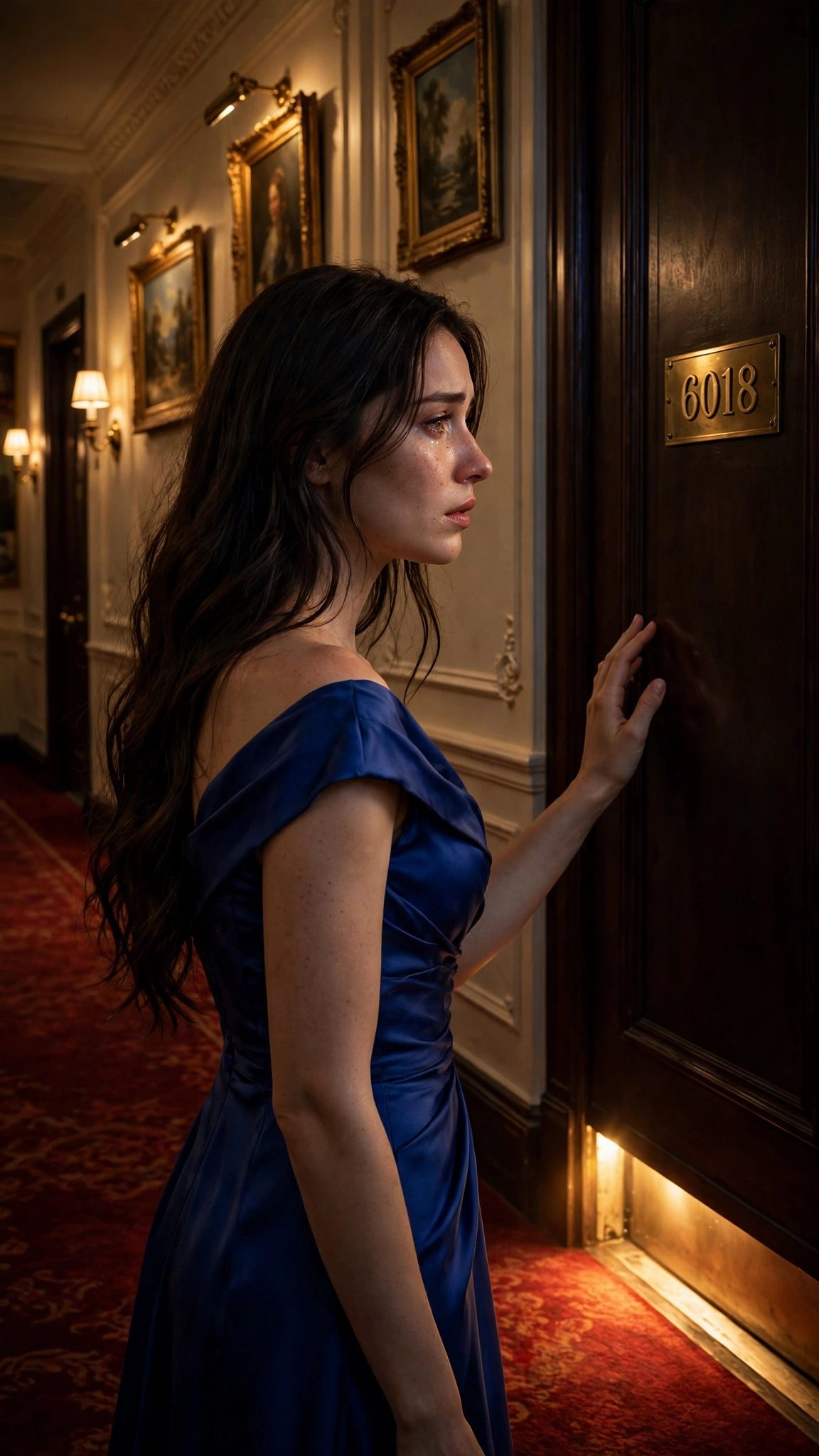
I forgot it in the hallway outside Room 6018. That is the part I have never forgiven myself for — not the leaving, but the forgetting. Enzo had warned me, in his own way, and I had promised, and when the moment came, I believed a laugh behind a door over the word of a dying old man and the husband who had come home to me every single night.
The house on Lake Shore Drive was beautiful and cold, all marble and tall windows and portraits of dead Moretti men staring down at me while I learned to be a wife. I learned the names of his captains. I learned which fork to use at family dinners. I learned that the men who came to our house at midnight were not friends, and that the phone calls Alexander took in his study were not about shipping. I learned to dust the portrait of his grandfather every Tuesday, and I learned that Enzo Moretti had the same stubborn chin as his grandson, and that the old man watched me from his frame like he was still deciding whether I was good enough for his empire.
And in between the learning, there were moments that felt like a marriage. Alexander brought me coffee in the morning, the way I liked it, with too much sugar, because he had watched me make it once and remembered. He came home early on Fridays and sat in the kitchen while I cooked, and he told me about his day in the careful, edited way a man tells his wife about a life she is not supposed to fully understand. He remembered that I loved white roses, and there were always fresh ones in the house. Once, when I was sick with the flu, he sat beside my bed for two days and read to me from a book of poetry he had found in the library, stumbling over the words, refusing to let anyone else do it.
I held those moments like small warm stones in my pocket, and I told myself they were the proof. I told myself that a man who marries you for a will does not bring you coffee. A man who marries you for a signature does not sit beside your bed for two days.
But there were other moments, too. The nights he came home late and would not say where he had been. The way his head of security, Marcus Hale, looked at me — like I was a problem he had already solved. The way Alexander never once called himself my husband. Not once, in all the time I knew him. Not when he introduced me at parties. Not when he signed the marriage certificate. Not even in bed, in the dark, when there was no one to perform for. He called me Gianna. Always Gianna. Never wife. Never love. Never anything that would have told me the marriage was more than a transaction.
I told myself it was his nature. I told myself that men like Alexander Moretti do not say such things, that their love is in their actions, that the coffee and the roses and the two days beside my bed were his way of saying what his mouth could not.
I was wrong. I know that now. Or maybe I was right, and I was wrong about which one of us was afraid. That is the question I have spent two years trying to answer, and the question Alexander drove through the rain to Galena to ask me himself.
But on the night of Room 6018, I did not know any of that. On the night of Room 6018, I knew only one thing: I had stood outside my husband's hotel room and heard another woman laughing, and the marriage I had believed would last forever had lasted fourteen months.
And so I walked away.