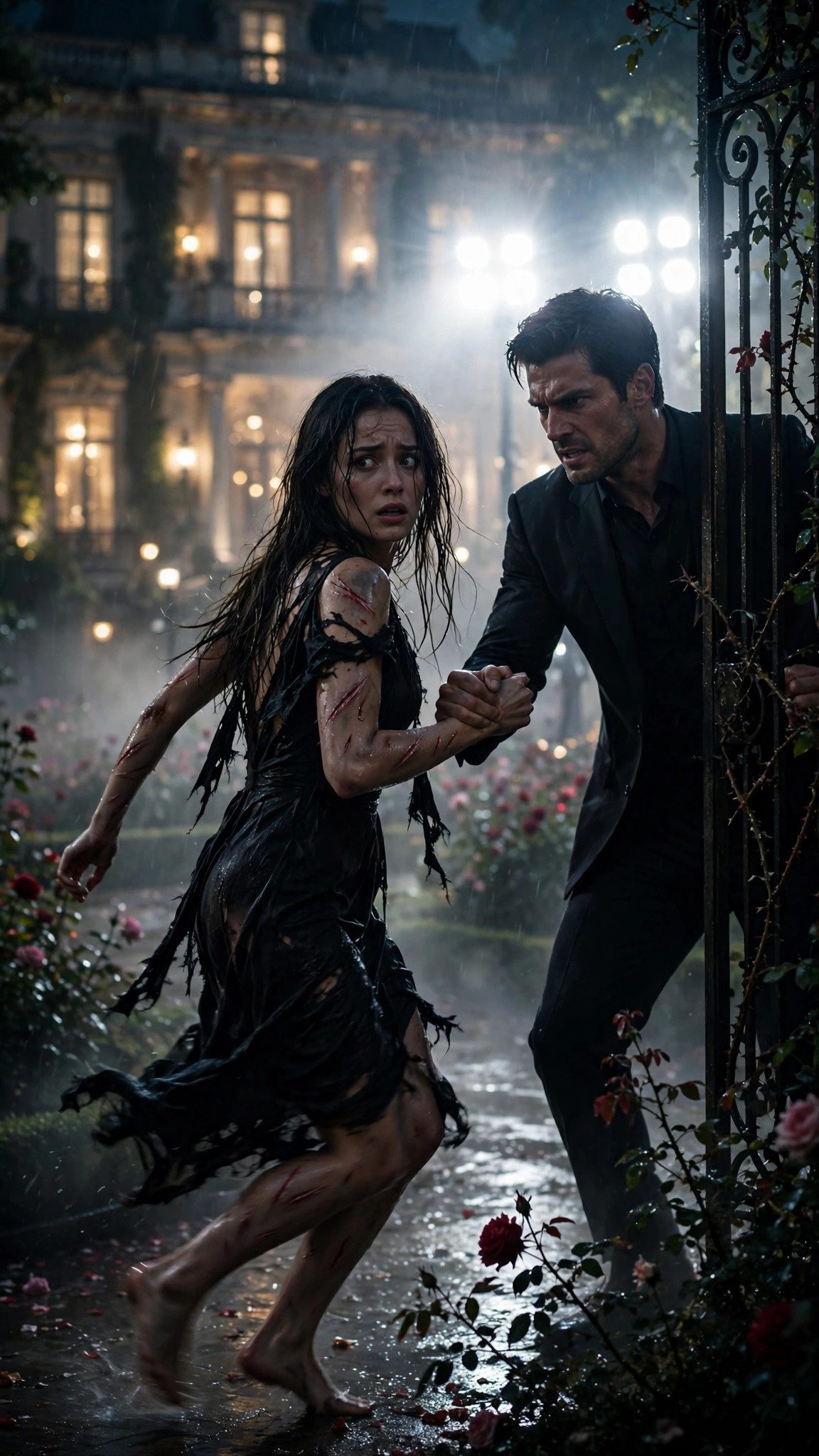
The morning after the night I ran, I woke up in my own bed, in my own room, in Nico's house, with the door locked from the outside.
That was new. In three years, my door had never been locked. Not from the inside, not from the outside. Nico's house had always been open to me. My room was at the end of the hall from his, and the door between our lives had always been a matter of choice. I walked in. I walked out. No one stopped me. No one ever had to.
Now there was a lock. And on the other side of it, silence.
I sat up slowly. My arms were scratched from the roses. My shoulder was bruised where it had clipped the gate. My feet were cut from the stones and the concrete. Someone had bandaged them while I slept, neat white strips, careful knots. I did not remember anyone touching me. I did not remember falling asleep at all. The last thing I remembered was Nico's hand on my arm, and the garden, and the light, and then nothing.
There was a tray on the dresser. Coffee. Toast. A glass of orange juice. A small white envelope with my name on it in Nico's handwriting. I opened it with hands that would not stop shaking.
"Stay in your room today. Do not answer the door. Do not use the phone. I will come for you at six."
No apology. No explanation. No "I am sorry." Just orders, the way Nico gave orders, as if the world would rearrange itself to suit them.
I should have been angry. I was angry. But underneath the anger there was something worse, something colder. Fear. Not of Nico, exactly. Of what I had heard. Of what it meant. Of the fact that the man I loved had discussed my disappearance the way other men discussed the weather, and then had the nerve to lock me in my room and send me toast.
I ate the toast because my body demanded it. I drank the coffee because my hands needed something to hold. And then I sat on the edge of my bed and did what I had done for three years whenever I did not understand something about Nico Moretti.
I thought about it. Carefully. The way he had taught me to think about everything. Slowly. Without panic. Looking for the pattern.
The pattern was this. For the last month, Nico had been pulling away from me. Not all at once. Slowly. The way the tide goes out. Dinners cancelled. Meetings I was suddenly not invited to. Conversations that stopped when I walked into the room. A new lock on his study door. A new guard at the gate. A new tension in his shoulders that had not been there before.
I had told myself it was business. Nico's business was always complicated, and there were always rivals, always deals, always something. I had told myself that a man like Nico did not owe me an explanation for every bad month. I had told myself that love was not a report you filed at the end of every day.
But now, with the words from the keyhole still ringing in my ears, the pattern looked different. It looked like a man preparing to let go of something. It looked like a man clearing the table before a guest arrived.
And then there was the other sentence. The one that had frightened me more than the first.
"She has already been replaced."
Replaced. Not "will be." Already. As if it had happened while I was still sitting at his table, still pouring his coffee, still believing I was the only woman in his life who mattered. As if I had been replaced and no one had bothered to tell me.
Who? That was the question I could not stop asking. Who had replaced me? And when? And why had Nico not told me himself, instead of letting me hear it through a keyhole like a servant?
I got up and went to the window. The garden was below me, green and perfect in the morning light, as if nothing had happened there. The roses were still blooming. The gap in the hedges was invisible from up here, just a dark seam in the green. Two guards stood at the gate. Not the usual two. These were men I did not recognize. Bigger. Harder. The kind of men Nico hired when he expected trouble.
Trouble. That was the word that kept coming back to me. Nico was expecting trouble. He had been expecting it for a month. And whatever it was, I was somehow at the center of it, and he had decided the safest thing was to cut me out of it entirely.
I turned away from the window and looked at my room. My clothes were in the closet. My books were on the shelf. My laptop was on the desk. Everything was exactly where I had left it. Nothing had been packed. Nothing had been moved. If Nico had wanted me gone, he would have had my things boxed by morning. That was how his world worked. Efficient. Final.
But my things were still here. I was still here. So whatever he had told Arthur, it was not the whole truth. It could not be. Men who throw women away do not bandage their feet and send them toast.
Unless, of course, they do. Unless the bandages and the toast were just the last kindness before the door closed for good. Unless I was reading hope into a breakfast tray the way a drowning woman reads hope into a piece of driftwood.
I did not know. And not knowing was worse than knowing. Not knowing meant I had to sit in this room until six o'clock and wonder whether the man I loved was going to explain himself or erase me.
I sat down at my desk and opened my laptop. No internet. The wifi was off. I checked my phone. It was not in the room. My bag was not in the room. My keys were not in the room. Everything I owned in the world that could get me out of this house was gone.
I laughed then. A short, ugly sound. Three years at his table, and I had nothing. No money of my own that he did not control. No car that he had not bought. No phone that he had not given me. I had built my whole life inside his world, and now his world had locked the door on me.
I thought about the first time I had understood how deep I was in. It was a business dinner, six months after I started working for him, at a restaurant Nico owned on the river. A developer named Charles Whitfield, a man with too much money and too little shame, had put his hand on my knee under the table, and I had frozen, because I was twenty-three and I did not know what to do, and Nico had gone very still, the way he went still when his phone rang after midnight, and he had looked at Whitfield and said, in a voice so quiet the whole table leaned in to hear it, "Take your hand off her, or I will take it off for you."
Whitfield had laughed. He had said, "She is just your assistant, Moretti."
And Nico had said, "She is mine. Do not touch what is mine."
Whitfield never touched me again. He never came to another dinner, either. I never asked what Nico had done to him. I never wanted to know. But I remembered the words. "She is mine." I had heard them as protection. I had heard them as love. I had not heard what they really were. A claim. A brand. A fence built around something a man had decided belonged to him.
I thought about the scar on his left shoulder, too. The one I had seen for the first time on a summer morning, when he came out of his bedroom in a towel and I was standing in the hallway with his coffee, and we both froze, and he did not cover it, and I did not look away. Later that night, over dinner, he told me about it. A knife, when he was twenty-two, in a parking garage, a man who had wanted his father's territory and had decided Nico was the price. Nico had survived. The other man had not. He told me the story the way other men tell stories about a car accident. Flat. Distant. Like it had happened to someone else.
"Does it hurt?" I had asked.
"Only when it rains," he had said. And then, after a pause, "And sometimes when I am afraid."
I had not known what to say to that. I had reached across the table and taken his hand, and he had let me, and we had sat there like that until the food went cold.
That was the night I had first understood that Nico Moretti was not made of stone. He was made of the same things everyone else was made of. Fear. Pain. A past he could not outrun. He had just learned, earlier than most men, how to hide it.
That was when I understood, really understood, what I had done. I had mistaken protection for love. Nico had protected me for three years. He had given me a job, a home, a life. He had kept me safe. And I had called that love. But protection is not love. Protection is what you do for something you own. Love is what you do for someone who is free to leave.
I had never been free to leave. I had just never tried.
I spent the day doing the only thing I could do. I waited. I watched the garden. I watched the guards change shifts at noon. I watched a black car pull up to the gate at two o'clock and a woman get out. A woman I had never seen before. Tall. Dark hair. A red coat. She walked into the house like she owned it, and Arthur met her at the door, and he smiled at her, the smile that never reached his eyes, and he kissed her hand.
So that was her. The replacement.
I watched her through the window until she disappeared inside, and I felt something in my chest go very quiet and very still. Not anger. Not yet. Just a kind of cold clarity, like the moment after you fall through ice and the water closes over your head and you realize you are going to have to save yourself.
At six o'clock, exactly, the lock turned. The door opened. Nico stood in the doorway, and he looked at me the way he had looked at me in the hotel ballroom three years ago, like I was the only real thing in a room full of performances.
"We need to talk," he said.
"Yes," I said. "We do."
He stepped into the room and closed the door behind him. He did not lock it. I noticed that. I noticed everything about him now, the way a prisoner notices the guard's keys.
"Sit down, Norah," he said.
"I will stand," I said.
For a moment, something almost human flickered across his face. Then it vanished, like it had never been there.
"As you wish," he said. "What you heard last night was not what you think it was."
"I heard you tell Arthur that if I disappeared, you would forget my name by Friday," I said. "What should I think it was?"
"A performance," he said. "For Arthur's benefit. And for the benefit of the man Arthur reports to."
I stared at him. "You knew I was listening."
"I saw your shadow under the door," he said. "I have known your shadow for three years, Norah. I know the way you stand. I know the way you breathe when you are trying not to be heard."
"Then why?" I asked. "Why say those things if you knew I was there?"
"Because Arthur needed to believe them," Nico said. "And because the man he reports to needed to believe them. And because if either of them had doubted for one second that you meant nothing to me, you would already be dead."
The words landed like stones in still water. I did not believe him. I wanted to believe him, and that was worse. Wanting to believe a man who has just told you that you mean nothing is the most dangerous thing a woman can do.
"Who wants me dead?" I asked.
"A man named Vincent Castellano," Nico said. "He has wanted me dead for ten years. He has finally understood that killing me is difficult, so he has decided to kill the thing I love most instead. He believes that will break me. He is not wrong. It would."
"So you decided to protect me by telling the world I am replaceable," I said.
"Yes," Nico said. "And by replacing you. Publicly. Visibly. The woman you saw this afternoon is Sofia Romano. She is not my lover. She is a former soldier, and she is very good at her job, and her job is to be the woman Vincent Castellano's men shoot at when they come for the woman at my table. She knows the risk. She volunteered. She is being paid a fortune, and she has a team behind her, and she is the best chance we have of drawing Castellano's people out into the open."
I sat down then. My legs had decided for me.
"And me?" I asked. "What is my job in this plan?"
"Your job is to stay alive," Nico said. "Your job is to stay in this house, behind these walls, until Castellano is finished. Your job is to let the world believe you are nothing to me, so that the world leaves you alone."
"And if I refuse?" I asked.
"Then you will die," Nico said, simply. "Not by my hand. By his. And I will not be able to stop it, because I will not know where you are."
I looked at him for a long time. At the man I had loved for three years. At the face I knew better than my own. And I tried to see the lie in it. I tried to find the coldness, the casual cruelty, the man who had spoken through the keyhole. But all I saw was a man who looked tired in a way I had never seen before. Tired, and afraid, and furious about being afraid.
"Prove it," I said.
"How?" he asked.
"Tell me everything," I said. "No more performances. No more locked doors. Everything. From the beginning. Or I walk out of this house tonight, and I do not care who is waiting for me."
Nico was quiet for a long time. Then he nodded, once, the way a man nods when he has lost a negotiation he knew he was going to lose.
"Everything," he said. "From the beginning."