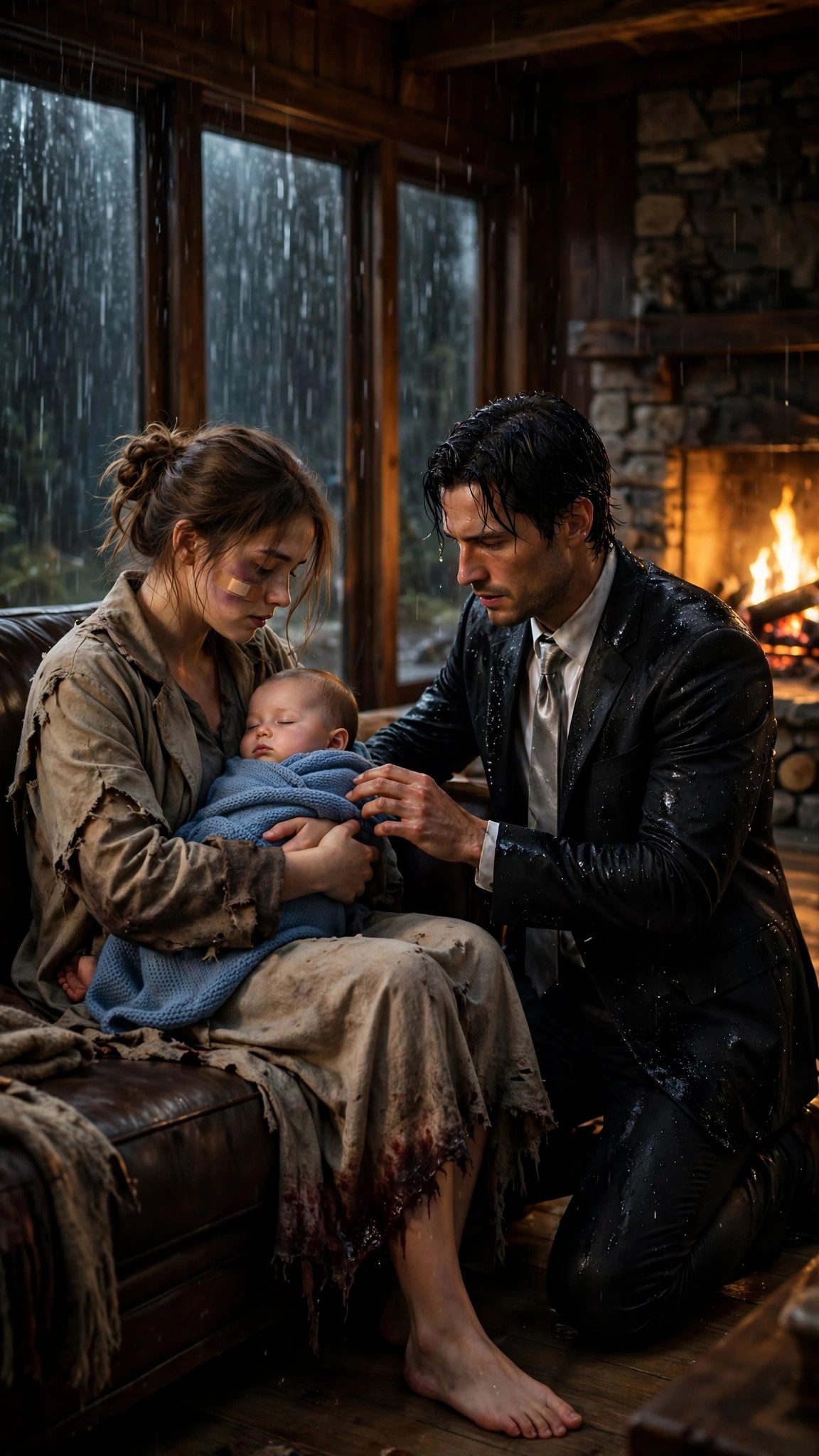
The promotion changed everything and nothing. My salary doubled. My office moved to the east wing, fourteenth floor, behind a door that needed a key card I had not asked for. My new desk was bigger, my window faced the lake, and Harold Finch started calling me "Miss Bennett" in a tone that suggested he had always known I was going somewhere.
What did not change was the work. Numbers still didn't lie. People still did.
I learned the shape of Gabriel Kane's world slowly, the way you learn a house by living in it — one room at a time, bumping into the furniture in the dark. Kane Meridian Group was the clean face of it: construction, freight, property, logistics. Behind it, in files I was never meant to see but eventually did, were the other companies, the ones with names that sounded like they had been chosen by a lawyer who charged by the syllable. I didn't ask what they did. I didn't need to. I had read enough newspapers to know that Gabriel Kane's name, when it appeared at all, appeared next to words like "feared" and "untouchable" and "alleged." I had also read the numbers, and the numbers told me something the newspapers never did: the man ran his empire the way my father ran his garage. Every bolt accounted for. Every debt paid. No shortcuts.
The first time I saw him after the promotion, it was in the elevator. I was carrying a stack of binders and trying not to drop them, and the doors opened and there he was, alone, in a black suit with a silver tie, looking at his phone. He looked up. He held the door. He said, "Miss Bennett," the way a man says a name he has already memorized.
"Mr. Kane," I said. I tried to sound professional. I sounded like a girl who had just been caught reading someone else's diary.
"Your reports are the only ones I read all the way through," he said. "Do you know why?"
"Because they're accurate?" I said.
"Because they're honest," he said. "Everyone else in this building writes me what they think I want to hear. You write me what the numbers say. That's rarer than you think."
The elevator stopped at my floor. He held the door again. I got out. I did not look back, because I was afraid that if I did, he would see my face, and my face would tell him something I wasn't ready to know — that nobody had ever looked at my work that way before. Not a teacher. Not a supervisor. Not anyone. And that it felt like someone had turned a light on in a room I hadn't known was dark.
Over the next year, I learned his habits the way you learn the habits of weather. He arrived at seven in the morning, before anyone else, and left after dark. He drank his coffee black, one sugar, from the same chipped mug he had apparently owned for a decade — a detail Rosa, the housekeeper who cleaned the executive floor, told me with the air of a woman sharing state secrets. He never raised his voice. He never had to. When Gabriel Kane went quiet, the whole building went quiet with him, the way a forest goes quiet before a storm.
And I learned, in pieces, about the family he had lost.
His older brother, Daniel Kane, had been the heir. The golden one, people said. Daniel was the one who smiled at parties and remembered names and made the family look human. He married Anna, a nurse from a small town in Wisconsin, and for a while — people said — the Kane family almost looked like a normal family. Then, eleven months before I met Gabriel, Daniel and Anna died in a car crash on the Kennedy Expressway, on a rainy night, on their way home from a charity dinner. The official report said the brakes failed. The newspapers called it a tragedy. Gabriel never called it anything at all.
Eli was born three weeks after the crash, in a hospital room with Gabriel standing outside the door, because Anna's doctors had managed to save the baby even though they couldn't save her. Daniel never got to see his nephew. He never even knew Anna was pregnant — she had been waiting to tell him at the dinner, a surprise, a gift. Gabriel told me none of this. I heard it from Rosa, in the kitchen on the executive floor, while she was wiping down a counter and talking to me like I was the only person in the building who would listen.
"He never talks about it," Rosa said. "Not one word. But he goes to the cemetery every Sunday, and he comes back, and he works until midnight, and that's how he talks about it. The baby is all he has left of his brother. He would burn this whole city down for that child. Don't ever forget that, Miss Bennett. Whatever else he is, he is that."
I didn't forget it. I filed it away with all the other things I knew about Gabriel Kane — the chipped mug, the one sugar, the seven o'clock arrival — and I went back to my numbers.
But the numbers, it turned out, had more to say.
It started with the freight invoices. Kane Meridian's logistics division moved freight all over the Midwest, and the invoices were supposed to be boring. Most of them were. But in the spring of my second year, I noticed a pattern I had seen before: small payments, just under the review threshold, routed through vendor names that changed every few months. Not theft this time — the money was going out to companies that existed on paper and nowhere else, for services nobody could describe. It was the opposite of the Aldous problem. Someone wasn't stealing from Gabriel. Someone was paying people Gabriel didn't know about, with Gabriel's money, in amounts small enough to hide.
I wrote it up the way I always did: plain, polite, impossible to argue with. I put the memo in an envelope and left it on Harold's desk. Harold read it, went pale, and took it straight upstairs.
That afternoon, Gabriel called me to his office. It was the second time I had ever been in that room. Peter Aldous's ghost still seemed to be sitting in the corner, apologizing.
"How long has this been going on?" Gabriel asked. He wasn't angry. That was the frightening part. He was calm, the way a surgeon is calm, and I understood for the first time that his calm was not the absence of feeling. It was the shape his feeling took when it had somewhere to go.
"Fourteen months," I said. "Roughly. The payments started six weeks after —" I stopped. I had almost said "after your brother died." I didn't know if I was allowed to say that in his office.
"After my brother died," Gabriel finished for me. His voice didn't change. "Yes. I know. Someone decided the family was weak, and started buying people. Go on."
"The payments go to three shell companies," I said. "They rotate. The amounts stay under one hundred twenty thousand. The approvals all come from the logistics division. The signature is —" I hesitated again. The signature belonged to Marcus Webb, the convoy dispatcher, a man I had met once in the parking garage, who had held the door for me and asked about my mother.
"Marcus Webb," Gabriel said. "I know."
"You know?" I said. It came out sharper than I meant it to. "Then why —"
"Because knowing and proving are different things," he said. "And because I wanted to see how far it would go. Who he was paying. What they were planning." He stood up and walked to the window, and for a moment he looked out at the city the way a general looks at a map. "You found in a week what my own people couldn't find in a year. Do you understand what that means, Miss Bennett?"
"It means I read invoices," I said.
"It means you see things other people don't," he said. "And it means someone out there has already noticed that about you."
I didn't understand what he meant. Not then. I went back to my office. I went back to my numbers. I told myself the conversation was about Marcus Webb and shell companies and nothing else. I told myself the way he had looked at me — like I was a door he hadn't known was unlocked — was about the work.
But that night, for the first time, I locked my apartment door twice. And the next morning, when I came to work, there was a new security guard posted outside my office door, and Eddie the driver was waiting by the elevator with an umbrella, even though it wasn't raining.
The convoy started a month later. I didn't know it was called that at first. I just knew that on the days Gabriel's drivers moved between buildings — moving documents, moving family, moving the baby between the house and the doctor — they moved in a group, three or four black SUVs, close together, the way a herd moves when it knows there are wolves. Eli travelled in the middle car, with a nurse and a guard. I travelled in the last car, when I travelled at all, because Gabriel had started sending me to meetings downtown, and because Eddie had started offering me rides, and because I had started saying yes without thinking about it.
I should have thought about it. I should have asked why an accountant needed to ride in a convoy at all. But I was twenty-nine, and good at numbers, and terrible at understanding that I mattered to anyone — and by the time I understood, I was already in the tunnel, and the GPS had already gone dark, and men with guns were already coming from both sides.
But that comes later. First, you need to know about Asher.
Asher Voss. I heard the name for the first time in Gabriel's office, on the day I brought him the memo about Marcus Webb. I didn't hear it from Gabriel. I heard it from Mason Cole, the security captain, who was standing by the door with his arms crossed, listening to my report like a man listening to a weather forecast he already believed.
"Asher," Mason said, when Gabriel had dismissed me and I was halfway out the door. "That's who Webb's paying. Asher Voss. He used to run with Daniel, back when they were young. Then Daniel became the heir, and Asher became the man who stood outside the door, waiting. He's been waiting eleven months to finish what he started."
I didn't ask what he started. I didn't need to. I had seen the crash report in the files, the one that said the brakes failed on the Kennedy Expressway on a rainy night. I had seen the way Gabriel went quiet whenever anyone said Daniel's name. And I had seen the payments — fourteen months of small, careful payments, buying people one at a time, building something in the dark.
Asher Voss had killed Gabriel's brother. He had tried to make it look like an accident. And now he was coming for the only thing Gabriel had left.
Eli. Six months old. The baby who had never met his father.
I didn't know any of that yet, not for certain. But I knew enough to be afraid, and I knew enough to understand why Gabriel had moved my office into the secure wing, and why Eddie waited by the elevator, and why the guards knew my name.
He wasn't protecting his accountant. He was protecting the only person in his world who had ever told him the truth.
I met Eli for the first time on a Tuesday, in the nursery on the top floor of the Lincoln Park house, because Gabriel had asked me to bring a file to his home office and the nurse was late. I had never held a baby before. I stood in the doorway holding a folder full of freight invoices, and the nurse — a kind woman named Grace who had worked for the family for twenty years — looked at me and said, "Come here, Miss Bennett. He's been asking for someone new to look at."
I laughed, because babies don't ask for things. Then I stepped closer, and Eli turned his head, and his eyes — dark grey, exactly like his uncle's — found mine, and he reached out one tiny hand and closed his fist around my finger.
I had spent my whole life being careful with numbers. I had never been careful with anything alive. But in that moment, standing in a nursery full of soft light and the smell of baby soap, holding a folder I had already forgotten, I understood something about Gabriel Kane that no memo could have told me. This man, who could make a room go silent by walking into it, came home every night to a baby who didn't know what fear was. He sat in that nursery after midnight, in his suit, with his tie loosened, and he held his brother's son and whispered to him in a voice nobody else in the world ever heard. Grace told me that, too. She told me he read to Eli from a book of poems Daniel had loved, and that sometimes he fell asleep in the chair beside the crib, still in his shoes, because he was afraid that if he left the room, the morning would take something else from him.
"He doesn't sleep," Grace said, straightening the blanket. "Not really. Not since the crash. He works until he can't stand up, and then he comes here, and he sits, and he watches the baby breathe. That's his sleep now. Watching."
I thought about that for a long time afterward. I thought about it on the bus home, and I thought about it while I was making dinner, and I thought about it while I was supposed to be reading freight invoices. I thought about a man who had lost his brother and his sister-in-law and his whole idea of what his family was supposed to be, and who had rebuilt his entire life around a six-month-old baby who couldn't even say his name yet.
And I thought about my own family — my mother and her piano students, my father and his garage, the small house in Evanston where the loudest sound was the radiator at three in the morning — and I realized that Gabriel Kane and I had something in common after all. We both knew what it was to love a family that the world had already decided was too small to matter.
That was the day I stopped being afraid of him. Not because he wasn't dangerous — he was, and I knew it — but because I finally understood what his danger was for. It wasn't for power. It wasn't for money. It was for the people he had left. And I had just become one of them, without anyone telling me, without anyone asking me, simply because I had held a baby's hand and he had held mine back.
And he was about to find out just how far I would go to protect his family in return.